
FIVE PHILHISTORY NUGGETS
I have received another missive regarding the legacy of Philadelphia modernist architect Vincent Kling! For those following along, I opened my Nuggets last week with an email I received from former Inquirer architecture critic Thomas Hine about the “mixed bag” of Kling’s buildings. Wall Street Journal architecture critic Michael J. Lewis responded to Hine’s characterization, detailing the very mixed Klingian (Klingon) bag at his alma mater, Haverford College: “The science building, Stokes Hall, was functional and even elegant in its classical modernism. The dormitory, Gummere Hall, is another story. I know it as intimately as one can, having lived there as a sophomore and having spent the year cleaning its 18 bathrooms in my capacity as assistant janitor. The fact that the janitor even needed an assistant is testimony to its appalling ventilation, which meant I spent 1976-1977 scrubbing mildew off the wall of showers that were just six inches away from fresh air and sunlight. The very monosyllable Kling instantly brings to my nostrils, unbidden and unwanted, the aroma of mold, disinfectant and human dankness.” I must get out to Haverford to explore the site of this wild olfactory memory!
The remainder of the Nuggets this week concern Media, Pennsylvania, Delaware County’s seat and a beautiful historic borough 13 miles West of Center City. Zara and I spent last Friday exploring this fascinating place:
During our Media Day, Zara and I hiked in Glen Providence park, a little valley with a pond and a head-spinningly diverse sprinkling of 58 tree species just outside of Media’s commercial core. The land for the park once belonged to George T. Butler, a prosperous local attorney, and his wife Eleanor. The Butlers donated the land to Media in 1936 for a bird sanctuary and arboretum. The park is exquisite, with a little edge, in its magically winding trails, sudden biome shifts, and all-consuming quietness, of what I can only call the ~supernatural~. Given these vibes, I was excited to find that a “witches’ story,” researched by the Friends of Glen Providence Park bloggers, is set (took place?) on the site—a tale of transformations into horses and wild midnight rides. You can read the story, as reprinted in a 1931 newspaper article and uploaded by the Friends of Glen, here!
We also stumbled by the former Media FBI Headquarters, a very low-key beige brick building near the center of town. A historical marker out front commemorates the March 1971 break-in to the HQ by eight antiwar activists, a group called the Citizens’ Commission to Investigate the FBI. The burglars stole over 1,000 documents concerning secret FBI surveillance and sabotage of American citizens, including actions targeting Dr. Martin Luther King Jr. and Malcolm X. They sent these documents to the media (lower case m), the first time that most Americans had heard of COINTELPRO (Counterintelligence Program). WHYY’s Kenny Cooper wrote a great article about the marker’s 2021 installation, and I will be reading the 2014 book The Burglary: The Discovery of J. Edgar Hoover’s Secret FBI by former Washington Post reporter Betty Medsger, who broke the story when many outlets were sitting on the documents. Just months later you had the Pentagon Papers, Watergate, the Church Committee—a snowball whose roll got an important push in Media!
And we saw the monumental Delaware County Courthouse, where another historical marker detailed President Ronald Reagan’s October 29th, 1984 stump speech at the site, just a week and change before Reagan won 49 states over his Democratic challenger Walter Mondale. Reagan spoke before 5,000 Medians, defending the previous year’s invasion of the Communist-controlled Carribean island of Grenada and castigating Mondale’s supposed softness toward the Nicaraguan Sandinistas and Cuba’s Fidel Castro. The Reagan Library uploaded the full video of the speech to YouTube!
To get from Media back to Philly, we took the D1 light rail back to 69th Street Transit Center. This trolley, dating from 1913, is a rare example of a surviving interurban electric train system, a brand of transit between cities that almost revolutionized the nation at the turn of the century; in the 1910s, a traveler could get from Eastern Wisconsin to central New York entirely on interurban rail. In any case, cars and politricks killed almost all of these systems, but the D1, once part of a much larger Philadelphia electric rail system, survives, and is an exhilarating ride, speeding through beautiful green spaces back to the city. To learn more about the peak of Philly’s interurban rail, read Kenneth Springirth’s Philadelphia’s Suburban Red Arrow Trolley Heritage, available from train book specialist Ron’s Books here. And if you’re interested in the promise of light rail these days—or about the future of cities writ large, pick up a copy of my best friend Benjamin Schneider’s incredible book The Unfinished Metropolis: Igniting the City-Building Revolution.
PHUILDING OF THE WEEK: FIRST NATIONAL BANK OF MEDIA
On June 20th, 2013, the hip-hop artist Drake approached the Miami Heat locker room moments after the Heat’s electrifying Game 7 NBA Finals victory over the San Antonio Spurs. Drake, a frequent and enthusiastic attendee of many major basketball contests, professional and collegiate, was accustomed to gaining easy entry to team celebrations. This time, however, a security guard denied Drake access, saying that the only non-team entrants he could admit were the media. “I am media,” an incredulous Drake responded.
I felt a similar sense of misplaced bravado as Zara and I stepped off SEPTA’s Media/Wawa Regional Rail in Media on Good Friday, a trip inspired both by a need for some nature and by the need to find a compelling structure for this week’s Archiveadelphia. Was I really attempting to be Media? Could I possibly select a Phuilding—well, a Meduilding—having never set foot in the suburban enclave before? Or would the architectural history of the borough, much like the guard at the Heat’s locker door, recognize my misplacement and refuse to reveal its stories?
As we strolled through town on the misty Media morning, hearing church bells and feeling the spirituality (our Judaism notwithstanding), my fears abated somewhat. There were gorgeous buildings everywhere we looked—a 1908 stone armory that surreally houses a Trader Joe’s, the neoclassical, aforementioned Delaware County courthouse where Reagan spoke, the stately 1927 Media Theatre, complete with an English Renaissance interior...
The Mediulding that caught my eye the most, however, was a bank structure on the corner of State Street, the main pedestrian and restaurant thoroughfare. I first noticed the round turrets placed at each corner, capped off with tiled hats that almost made them look like big sentries keeping watch over the booty once housed within. Then I saw the striking stone facade, interrupted by dramatically arched windows. This was a real French Renaissance castle!
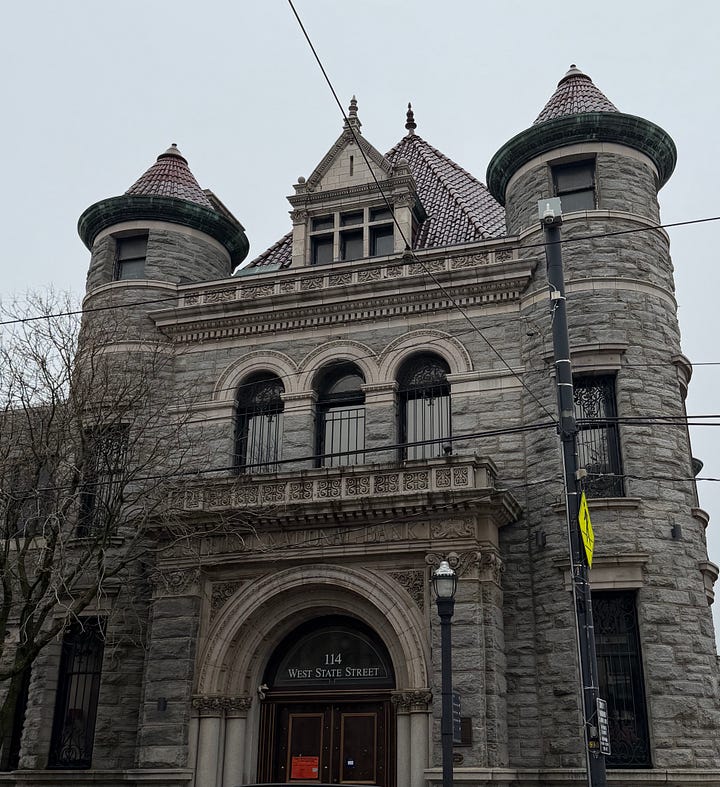
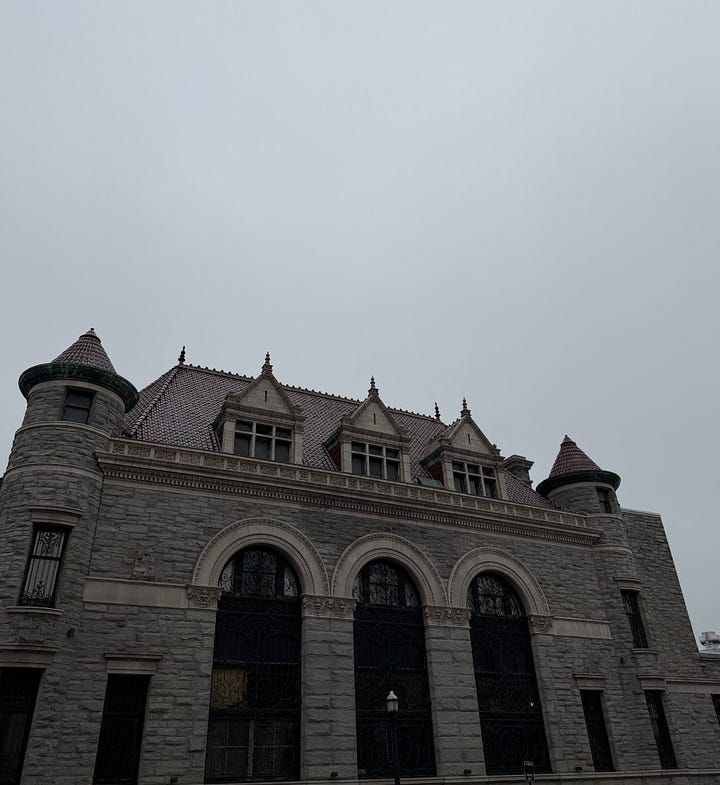
An aging placard in the stone let me know this was once the First National Bank of Media, constructed in 1899. I took to the Media Historic Archives Commission’s digital archives, where I found a portrait of J.W. Hawley, president of First National at the time the HQ emerged.
Further iPhoning revealed that Colonel Hawley was a decorated Civil War veteran who had commanded, at age 25, the 124th Regiment of Pennsylvania Volunteers. He was shot in the neck during the Battle of Antietam and the musket ball remained lodged in his neck for the rest of his life. Hawley’s regiment-mate’s father founded First National during the war, and a mostly-recovered Hawley went to work as a cashier at the new institution after the War, eventually rising to the bank presidency. Quite a tale of war and remembrance.
The Media Archives also has photos of the very understated brick bank building that preceded the Castle, a worker putting in the turrets during construction, bank employees at work in 1901, the facade covered in patriotic bunting for a post-World War I parade in 1919 and for the Media centennial in 1950, and vivid Kodachromes of the 1958 Christmas party at the bank, by then rechristened the Provident Tradesmens Bank & Trust Co. These shots have a bucolic sheen to them, and I would normally embed them into the piece, but I’m going to opt for hyperlinks given the reproduction policies of the Media Archives—as a believer in the sanctity of the archive, I try to honor these stipulations…
A shot of organist Larry Ferrari playing in the bank in 1964 evokes a certain David Lynchian quality—the intersection of quotidien commerce and high art in a cavernous castle of cash. I promptly went down a Ferrari rabbit hole, learning that he hosted a Philly-area, organ-centric Sunday morning TV show for over 40 years beginning in the mid-1950s. Do any of my older Philly-area readers have any Ferrari memories? Please, please share if so…
But what of the man who gave the bank its distinctive features? The same facade placard on the bank said that First National was designed by John Dilks. A Google search landed me nothing for Dilks, before I relievedly realized that the architect’s name was actually Albert Dilks. Despite the momentary confusion, I carry no resentment toward the placard-makers at the 1979-era Media Borough Council.
Even with the name riddle solved, Dilks remained elusive. For those who read my piece on the slippery Philly architect Stephen Decatur Button, I began fearing a similar battle to deduce basic provenance and make any sense of what this man’s architectural philosophy or inner life looked like. Dilks’s projects, however, are decently-documented on the Athenaeum’s Philadelphia Buildings and Architects database, even though the late historian Sandra L. Tatman, who wrote the architect’s biographical blurb on the portal, acknowledged that “little is known of the life of Albert W. Dilks.”
Back in Philly and walking through Center City over the course of this week, I tried to piece together Dilks’s aesthetic propensities. If he was building bank castles in Media, what was he up to in Philly?
I first stopped at 1031-33 Chestnut, an 8-story store building that Dilks designed for H.H Watkins, a local women’s clothing manufacturer, in 1895. This may be my favorite of the Dilks Center City facades I saw—the four stone corbels that support the jutting facade on Floor 3 are a real trip:


The building where Dilks had his office, 1001 Chestnut, or the Victory Building, is on the corner of this block. Dilks didn’t design this one, a beautiful 1873 Second Empire treacle, but one can imagine the architect leaving his desk, strolling half a block over, and looking at the Watkins Building go up.
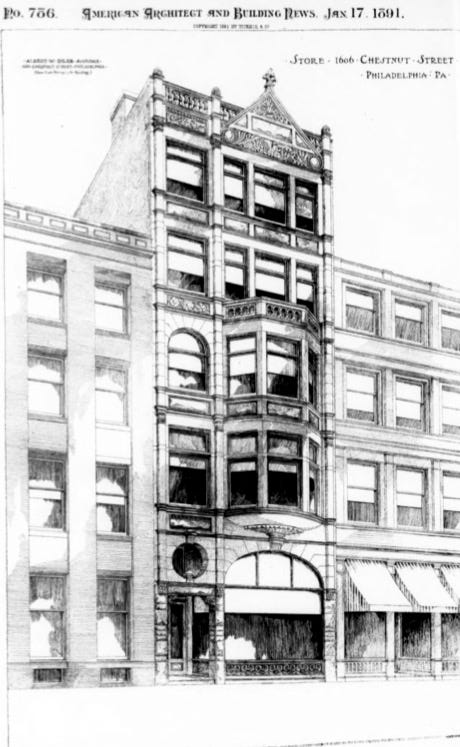
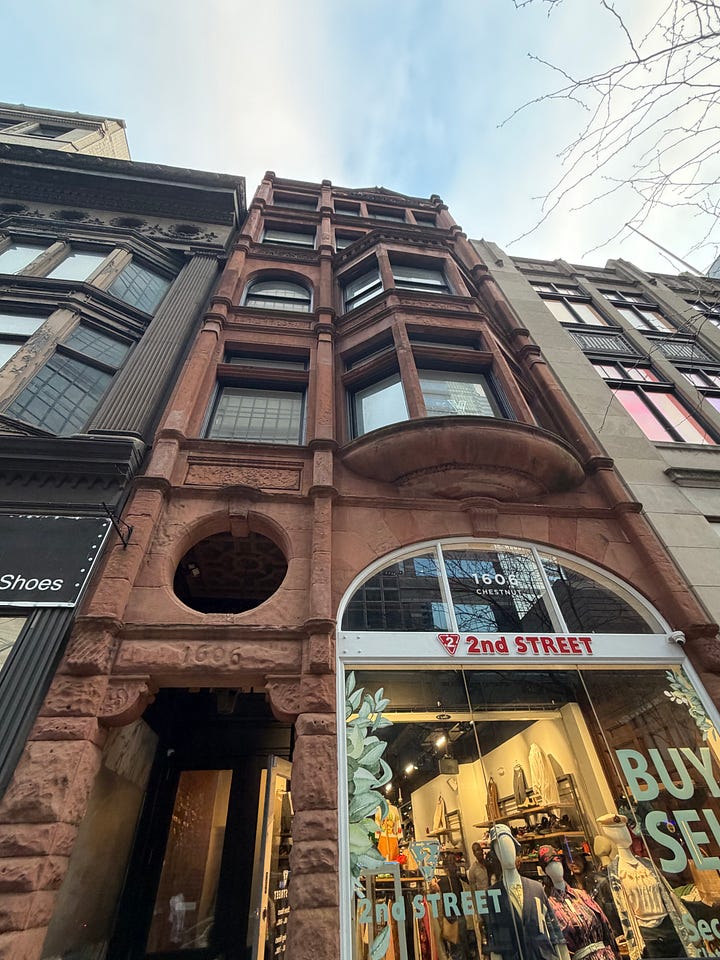
I then ventured over to 1606 Chestnut, an 1890 red sandstone Dilks design originally inhabited by a woodworker named Francis D. Kramer. In search of more information online, I found that Dennis Carlisle, the real estate agent and fantastic historian, was also a Dilks pursuer and had written a 2017 piece on 1606 for the invaluable Philly architectural history publication Hidden City, tracing the building’s subsequent tenants, from a furnace maker, to a shoe merchant, to—in 1980—the Supercade Amusement Center:
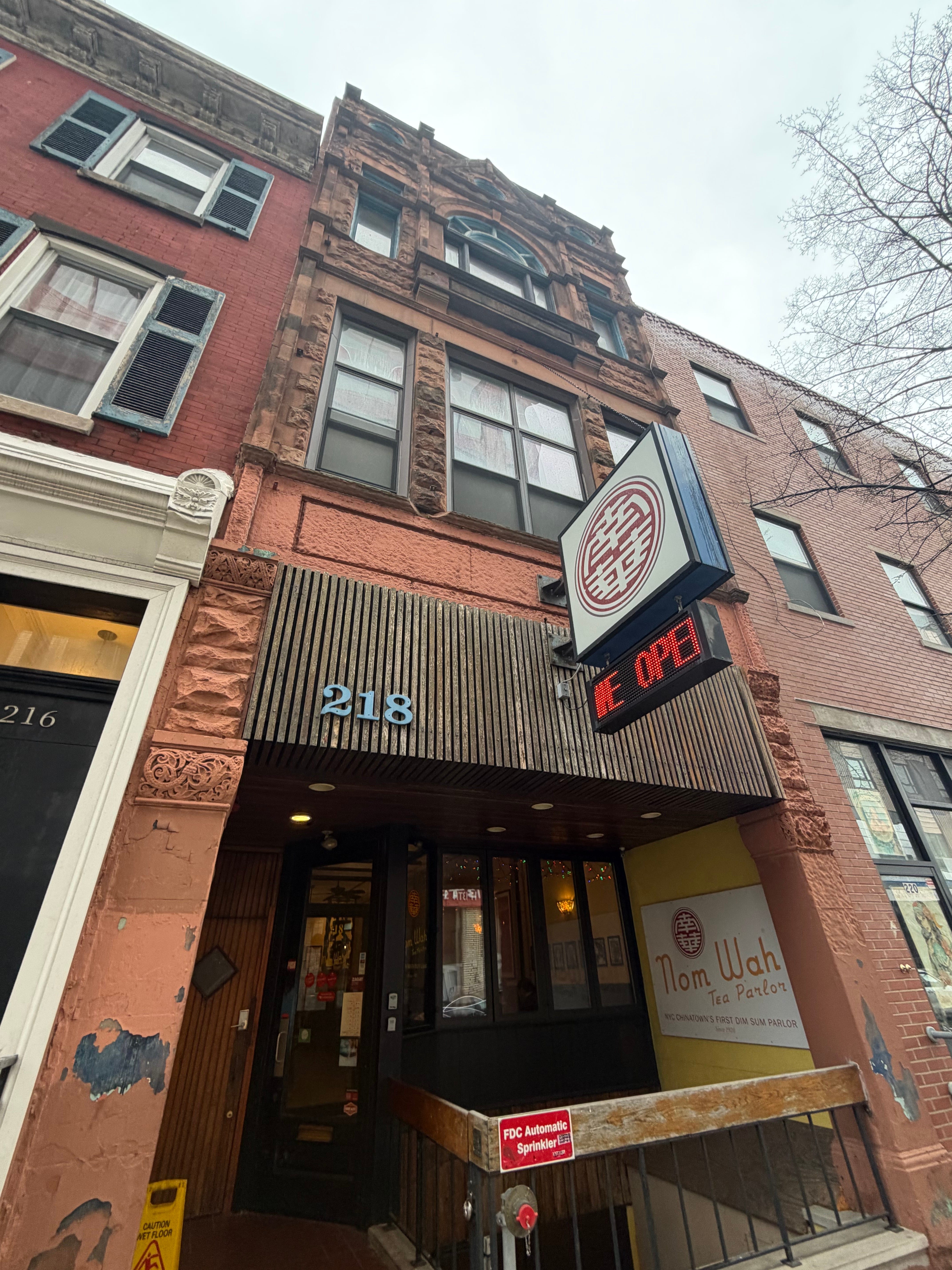
Carlisle also wrote a piece about Dilks’s 218 North 13th Street, also from 1890, and the home of Dilks’s frequent contractor, R.C. Ballinger & Company. Ballinger worked on the First National Bank of Media, so one could also envision Dilks going to call on his contractor in the Ballinger Building to look over plans for the Castle. The Ballinger facade, built of the same sandstone as 1606, is much wackier, with confluences of ovals and triangles pushed together. Probably kind of cool to be Dilks, meeting with your builder in a groovy building you designed. I’ve also added the Nom Wah dim sum restaurant, now a tenant, to my list of want-to-try restaurants:
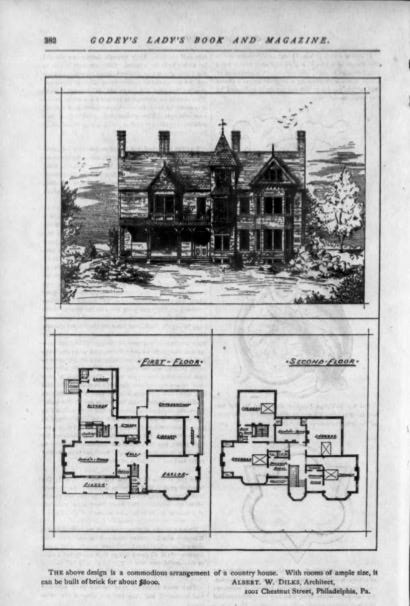
I now had a smattering of how Dilks designed and a hypothetical of some of his movements during his First National Bank construction period. But I still wanted to know more of his trajectory. Dilks’s Athenaeum blurb noted that he worked for Godey’s Lady’s Book, the super-popular, Philly-based women’s magazine edited by famed feminist, “Mary Had a Little Lamb” author, and Thanksgiving celebration booster Sarah Josepha Hale. Godey’s often included simple-ish designs for homes that thousands of Americans actually used as the basis for constructing their own dwellings (I learned about this phenomenon in George L. Hersey’s article “Godey’s Choice,” in a 1959 issue of the Journal of the Society of Architectural Historians).
Dilks seemingly worked at Godey’s early in his career—the issues I’ve been able to track down with his house plans are all from 1879, more than a decade before his big Philadelphia buildings began popping up and two decades before First National. Dilks included sketches and blueprints, and even told readers to contact him for more detailed instructions on building the houses. His mock-up of a “commodious arrangement of a country house,” he assured readers, could be constructed for around $5,000. And Dilks occasionally included plans for furnishings, including a $60 mantel and mirror frame:

Beyond Godey’s, I also discovered that Dilks had designed many far more opulent country estates for Philadelphia-area nabobs. Many of these drawings, dating from the late 1880s and early 1890s, appeared in the American Architect and Building News. I compulsively downloaded way too many of these to include in this piece, but I’m embedding a couple—a planned, unbuilt Camden estate for publishing magnate Cyrus H.K. Curtis (see: Saturday Evening Post, the Curtis Building), and the Wynnewood estate of apparel king Charles Dissel, now the site of Temple Beth Hillel:
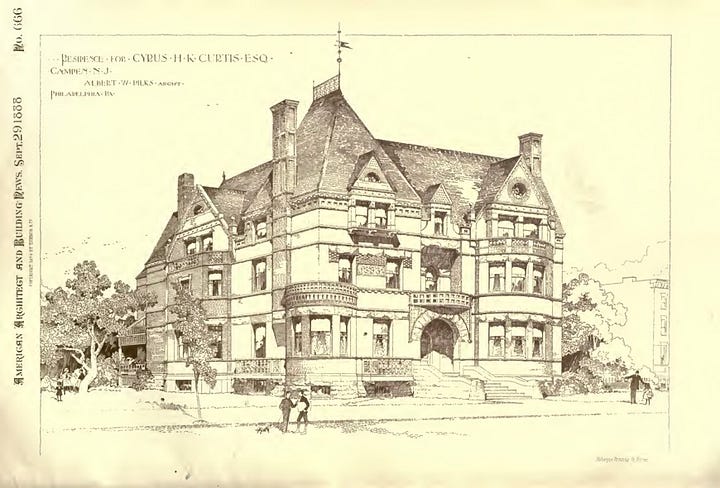
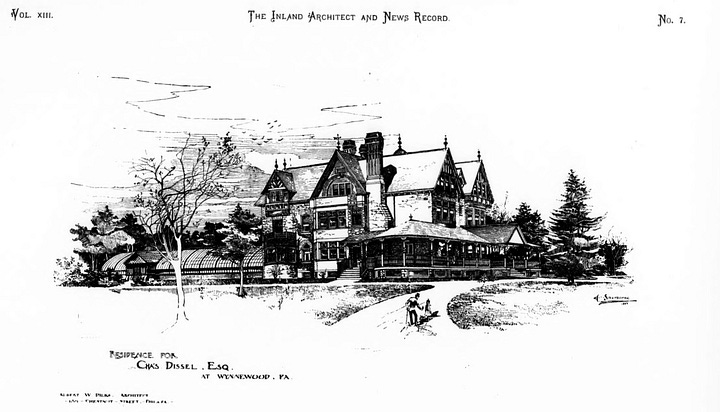
These sprawling manses most clearly illustrate the type of whimsy and wonder that define the First National Bank castle in Media—perhaps evidence that Dilks let loose outside the bounds of Philadelphia proper.
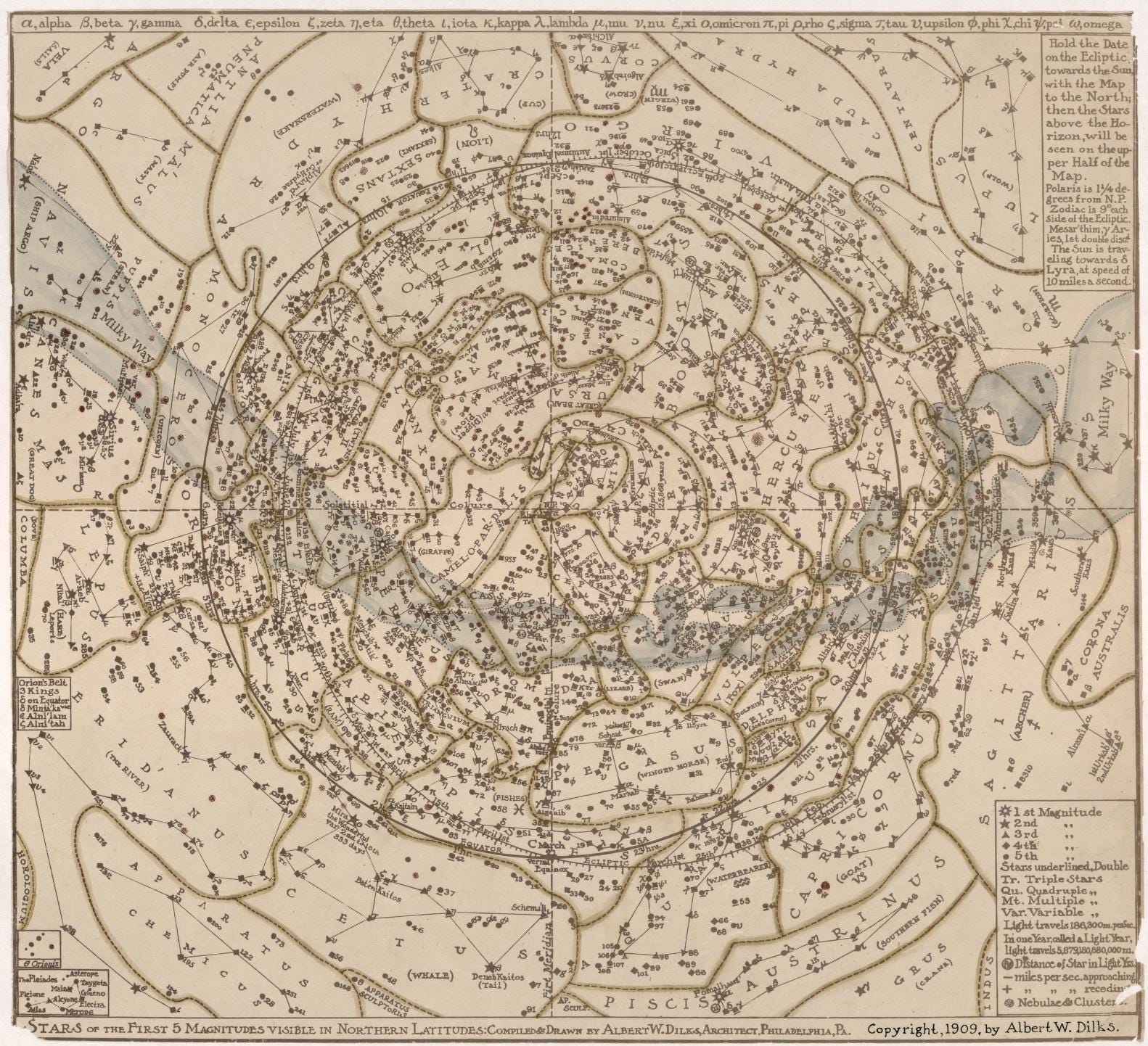
Speaking of whimsy: A final Dilks discovery came in the form of an exceedingly detailed astronomical map of stars visible in Northern latitudes. This map, from 1909, late in Dilks’s career, suggests that the architect was a real space buff. I’m imagining him, with this as really my only evidence, as having an avuncular, star-like twinkle in his eye:
There’s much more to dig into RE: Dilks—I haven’t even touched on his extensive West Philadelphia mansion output or his long-gone Commonwealth Hotel in Harrisburg. I’m happy to have a new architect to investigate, and I’m thankful that Media, despite my obnoxious “I am Media”-style historical swagger, gave me a Meduilding with such regional resonance.
I’m also excited to keep finding buildings from the suburbs and further afield that shed light on Philly’s architectural past—a trend that I will continue next week, when I head to Austin, Texas…
No posts
Comments
Nothing yet. Say the first thing.
Sign in to join the conversation.