
FIVE PHILHISTORY NUGGETS
My first nugget also serves as a correction. Former Inquirer architecture critic Thomas Hine, with whom I spoke for last week’s Archiveadelphia, “The Fascinatingly Boring Duane Morris Building,” alerted me that I had erred by blaming architect Vincent Kling for the monotony of the Penn Center complex. While Kling worked on the big-picture planning, the New York firm of Emory Roth & Sons actually did most of the designing. Hine’s appraisal of Emory: “While that firm did some memorable Central Park West apartment buildings, Penn Center shows that, even more than Welton Becket, they also did dull.” And of Kling: “While Kling’s firm’s work was a mixed bag—Fox Chase Cancer Center and Lankenau Hospital may be the best—its worst was never quite as bad as Penn Center.” Curious to learn more, I took to Gregory Heller’s 2013 Ed Bacon: Planning, Politics, and the Building of Modern Philadelphia, the fourth chapter of which, “The Architect Planner,” detailers how Kling, Planning Commission head/legend Bacon, and the rest of the Philadelphia planning apparatus became increasingly frustrated with Emory’s sterile designs!
The second social media installment promoting the Historian-in-Residence program is out and viewable on Instagram here! This video was shot in the Conservatory, the remarkable atrium that stretches up from the 12th floor of the hotel. The Conservatory was spearheaded by longtime Bellevue owner Ron Rubin for the 1986-1989 mixed-use renovation and was painstakingly designed and constructed within the 1904 building by local VITETTA architects Hyman Myers and George Skarmeas, Baltimore firm RTKL Associates, and structural engineer Udom Hungspruke. The Conservatory space provides another example of a great 1970s-1980s atrium, like Bill Rouse’s nearby Philadelphia Stock Exchange building that Archiveadelphia explored in February. The Conservatory is a stop on every one of my free historical tours of the Bellevue, offered Thursdays at 10AM and 2PM. You can sign up here!
My wonderful father-in-law Harvey, knowing me to be a lover of all things weird and true-crimey in Philly history, sent me an Inquirer piece last week, a “This Day in History” by the great history writer Tommy Rowan. The article explored the 1939 murder conviction of South Philly spaghetti salesman Herman Petrillo, whose brutal scheme was truly nuts. Petrillo and two cousins found wives in difficult marriages and convinced them to go to spiritualists who pushed the women to orchestrate their husbands’ deaths, often with arsenic. Petrillo & Co., meanwhile, had taken out life insurance policies on the husbands and shared in the resultant paydays. The plot killed an estimated 50 to 100 people! I have acquired a 1999 book on the case called Poison Widows, which is incredible so far. The book is by former Columbia Law School Professor George Cooper, who is also an astronomer, small boat ocean navigator, and Key West non-profit arts maven. The book details at length the central role the trial played in the rise of pioneering Black legal legend Raymond Pace Alexander—the more you know!
I also finally stopped and read the Philadelphia ‘76 historical sign in front of Mikveh Israel’s Cemetery a block from my apartment at 8th and Spruce Streets. I learned a lot about Philadelphia’s pioneering Jews—a lot of information on that sign! The small plot was created by Nathan Levy, a merchant whose ship, the Myrtilla, brought the Liberty Bell to Philadelphia. Also buried at the site are Haym Salomon, who helped to finance the Revolutionary War, and Rebecca Gratz (1781-1869), who the sign told me was the prime inspiration for the character Rebecca in Scottish novelist Walter Scott’s 12th-century medieval tale Ivanhoe. Wow?! I had heard Gratz’s name and was aware of her philanthropic pursuits, but knew little more of her life, and was thrilled to see that a 1929 collection of her letters is available on Google Books for free. Zara and I are still making our way through Mary Cassatt’s letters, but we have a new fighter in the proverbial arena of epistolary Philly read-aloud.
I read an obituary in the Inquirer this week of Philadelphia neurosurgeon and folk music enthusiast Roger M. Cohen, who once served as the president of the Philadelphia Folksong Society and organized many folk gatherings around the city. I love folk music and realized I hadn’t explored the history or current state of Philly’s folk scene. In this digging, I learned about the storied Philadelphia Folk Festival, a city institution since 1963 that brings together folk musicians at the Old Pool Farm in suburban Harleysville. I’m hoping to attend this year (more information here), and I was also enraptured by this documentary of the 1970 Philly Folk Fest, produced by a small Hershey TV station—wonderful performances by John Denver, Fairport Convention, Kate McGarrigle, and many others!
PHUILDING OF THE WEEK: THE ATLANTIC BUILDING
“You know when you learn about something for the first time and then you see it all over the place over the following days?”
I knew there was a name for this phenomenon, but I could not recall. So I typed the above question into whatever sort of AI-Super-Google is now operating/thinking/feeling over at Google.com.
Googlai (my name for Google AI Overview) immediately reminded me that I was thinking about the Baader-Meinhof phenomenon, coined in 1994 by a Minnesota man who learned about the 1970s radical West German militant cadre and then saw references to these mostly-forgotten revolutionaries constantly. The Minnesotan, Terry Mullen, wrote a letter to the St. Paul Pioneer Press defining the phenomenon–it’s linked here and is amazing.
Aside: After Googlai’s assistance, I fretted about my information recall abilities for the next hour because I did really know this term! I then had a second-stage fret over not being able to remember the word for something, like the Baader-Meinhof phenomenon, being on the tip of one’s tongue. Googlai had to bail me out again. It was “lethologica.” Brutal.
I’ve fallen prey to the Baader-Meinhof phenomenon with many Philadelphia buildings since starting Archiveadelphia, but none with as much potency as the Atlantic Building, on the northwest corner of Broad and Spruce Streets.
This is a somewhat embarrassing admission. For one thing, the 22-story high rise is a beautiful terra cotta gem, the kind of distinctive and graceful, early 1920s skyscraper that a self-proclaimed lover of Philadelphia architecture would want to have in their structure Rolodex. Secondly, it’s plopped at a very visible corner of South Broad Street, just blocks from the Bellevue Hotel, where I’m actually giving tours, if you weren’t aware! Thirdly, the Atlantic underwent a very public office-to-apartment renovation in 2019, with rooms designed by architect Rafael Viñoly, who also designed the domed Kimmel Center, right across the street.
And it was heading to the Kimmel, two Wednesdays ago, to see the Icelandic piano virtuoso Vikingur Ólafsson, that I first really took in the beauty of the Atlantic Building. I even had the Baader-Meinhoffian prescience to mumble, “Wow, that’s a gorgeous building. I bet I’m going to hear about it a lot over the coming days.”
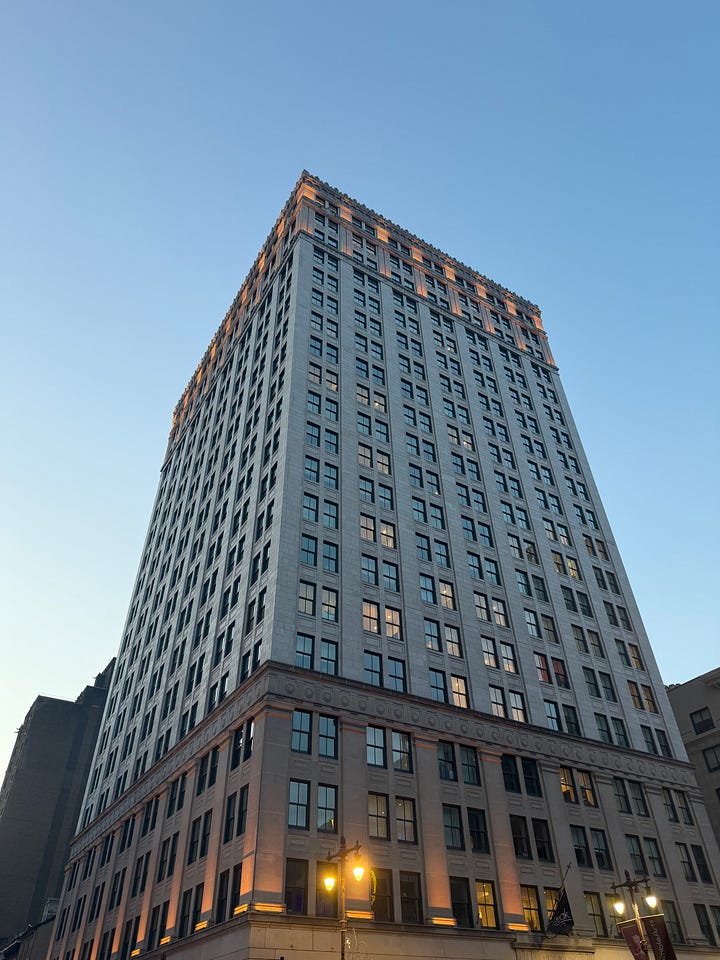
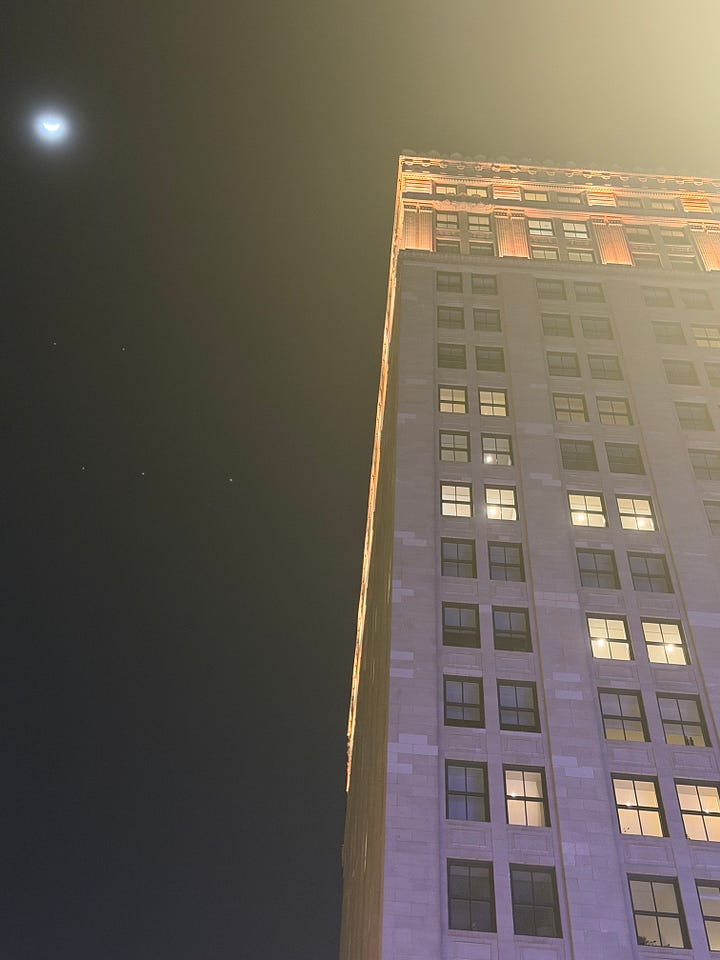
And sure enough, at drinks with a new friend at Superfolie (great happy hour) early last week, we learned that our drinkmate not only lived at the Atlantic, but that her dad, an attorney, had once worked in the building.
And then last Thursday, Sara MacDonald, the former University of the Arts librarian who publishes the fantastic UArts History Substack, provided a 1982 map of the sadly-closed school’s campus, back when UArts was called the Philadelphia College of Art. The broader, fascinating piece was a fact-check of an erroneous contention in the Inquirer that the City of Philadelphia had given the columned Hamilton Hall to UArts for $1 in the 1990s. The truth, MacDonald revealed, was that the school had owned the imposing edifice since 1893.
Baader-Meinhofingly, MacDonald’s map highlighted that the nearby Atlantic Building had also been part of the Philadelphia College of Art and had been named Anderson Hall. A little archival digging revealed that the Anderson in question was Robert O. Anderson, the art-loving CEO of Atlantic Richfield Petroleum (ARCO), and that the petroleum magnate really had donated the Atlantic Building, his company’s erstwhile Philly office, to the school.
The story of the donation captivated me—what an intriguing act of corporate largesse! And could this gift say something even grander about the Northwest corner of Broad and Spruce? Perchance, oh, I don’t know, a larger history of oil, fire, and civic pride?
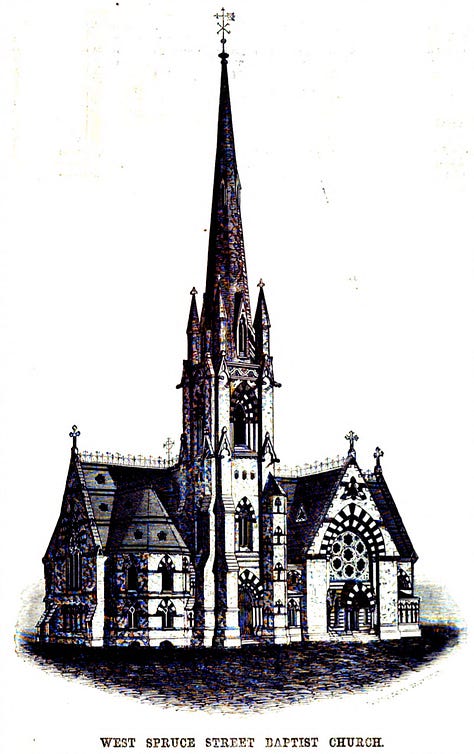
First, I had to look at the site’s architectural archaeology. Before the Atlantic Building existed to be gifted, the corner housed the Beth Eden Baptist Church, designed by architect Edward Tuckerman Potter and completed in 1869. I have long wanted to visit Schenectady, New York, in part to see Potter’s 16-sided Nott Memorial Building at Union College, a ridiculously unique domed building. I’ve had cancellable AirBnB’s booked and everything, but various duties have called. In any case, I was excited to see his name in this context…
Potter called his church “Venetian Gothic,” and his plans, tracked down in an 1869 Scientific American, are beautiful, complete with a grand spire that I am 99.9% sure never actually got built, or at least is absent in any photographs of Beth Eden.
The final product was still quite striking, full of arched stone and featuring a very high-pitched roof that gave the building a sense of grandeur, even without the big tower:
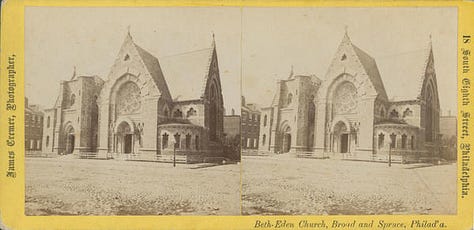
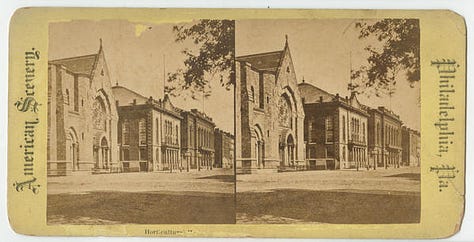
The building, however, was doomed by flame. In January 1881, a fire gutted the church entirely, a strange portent of the flammable oil that would eventually be brokered on the site. The conflagration also destroyed the grand Horticultural Hall next door at 250 Broad, and only a Herculean effort by firefighters saved the Academy of Music further up the block toward Locust. The cause was a hot air furnace that set aglow a nearby wooden beam.
Enter the civic pride: Philadelphians almost immediately rebuilt both structures, with a big fundraising choral concert at the Academy of Music just two weeks after the tragedy to fund Beth Eden’s effort.
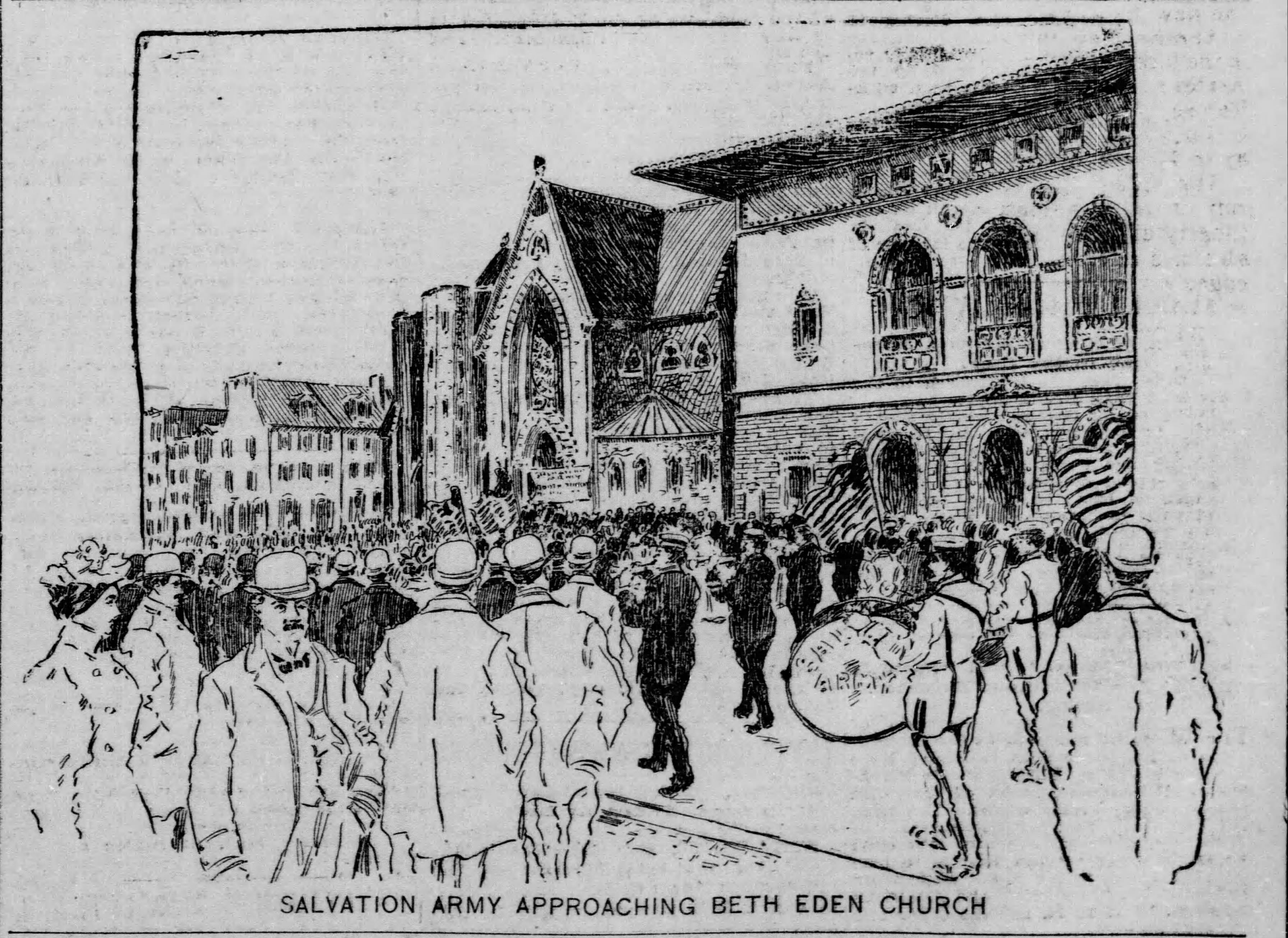
The reconstituted church remained a popular place of worship until the dawn of the 20th century. In 1897, Beth Eden played host to Emma and Frederick Booth-Tucker, the very colorful leaders of the Salvation Army who were known for taking on the dress and mannerisms of the different groups to whom they evangelized (Frederick took the name Fakir Singh and wore a turban during his missionary era in India, and dressed in “slum clothing” when working with lower classes in the U.S.). The Inquirer offered quite an etching of the parade and packed meeting the Booth-Tuckers brought to the church:
Within a few years of the Salvation Army parade, however, the congregation had merged with another group of Baptists and the property had fallen into the hands of a coal merchant named William Bryant, who began looking for buyers to build something more lucrative. Project proposals proliferated.
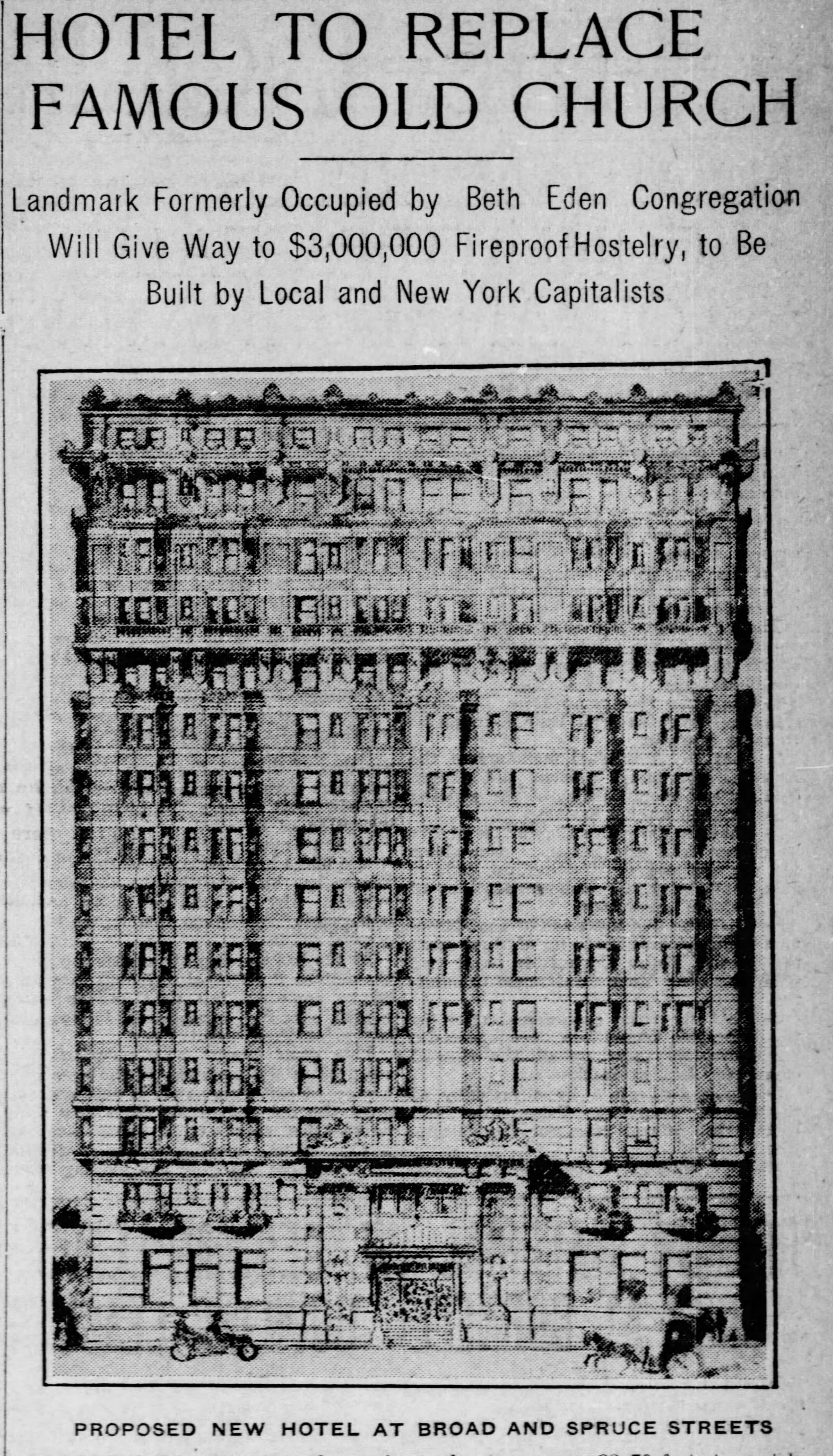
In 1905, a group led by New York architect-investor Henry Ives Cobb (check out his Yerkes Observatory in Wisconsin, which I know from its pivotal cameo in the criminally-underrated Keanu Reeves action flick Chain Reaction) planned a grand hotel on the site. The design for the hostelry, “The Franklin,” was more than a little bit similar to the Bellevue Stratford (tour link!), which had opened to much fanfare a year earlier two blocks north:
The Bellevue knock-off fell apart, and in 1913, Oscar Hammerstein I, the impresario and father of the iconic musical lyricist (OH II) called on Bryant about the possibility of building a grand opera house on the Beth Eden site. Hammerstein’s earlier Philadelphia opera experiment, his 1908 Philadelphia Opera House on North Broad Street, had ended in humiliation, when his longtime rival, New York’s Metropolitan Opera, purchased the house in 1910. His new plan also petered out.
And during World War I, Bryant lent the space to the Union League, who set up a clubhouse for visiting soldiers, complete with pool tables and a player piano.
Finally, in 1919, Bryant got his sale, for a cool $1 million, to the Atlantic Petroleum Corporation. Atlantic was Philly’s big oil company beginning back in the 1860s. Their refinery in South Philadelphia was a staggering 1,300 acres, a sort of Valley of Ashes to the West of FDR Park (now being redeveloped as HRP’s Bellwether District). Beth Eden was demolished and replaced with a gleaming new HQ for the oil giants.
Atlantic brought on a Pittsburgh-based architect named Joseph Francis Kuntz to build their hub. Kuntz, primarily remembered as a prolific designer of armories and of the warehouse that now houses the Andy Warhol Museum, had already been doing some absolutely wacky work for Atlantic: Greek “gas palace” service stations. The great Philly architectural historian Ken Finkel detailed Kuntz’s 16 local service stations, clad in terra cotta and inspired by specific works of Greek design. Finkel even dug up a 1922 article Kuntz wrote for The American City magazine, entitled “Greek Architecture and Gasoline Service Stations,” in which the architect contended that the classy pumping kiosks were far better than the more numerous utilitarian stations “erected for the purpose of supplying the wants of modern charioteers.” Read it and weep, Buc-ee’s!
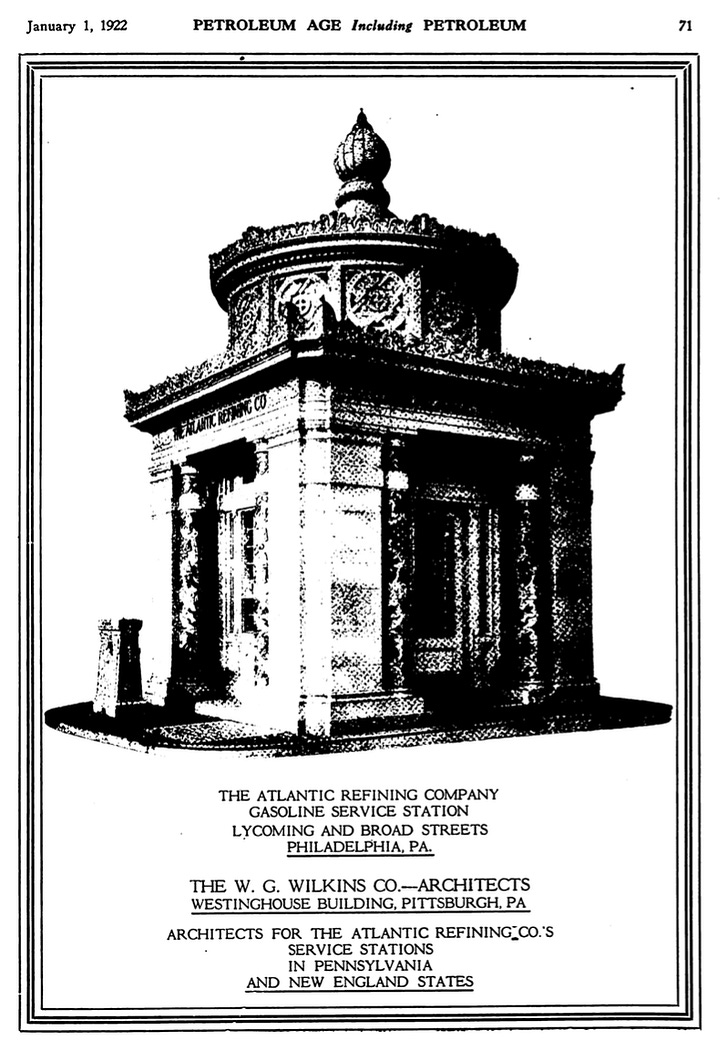
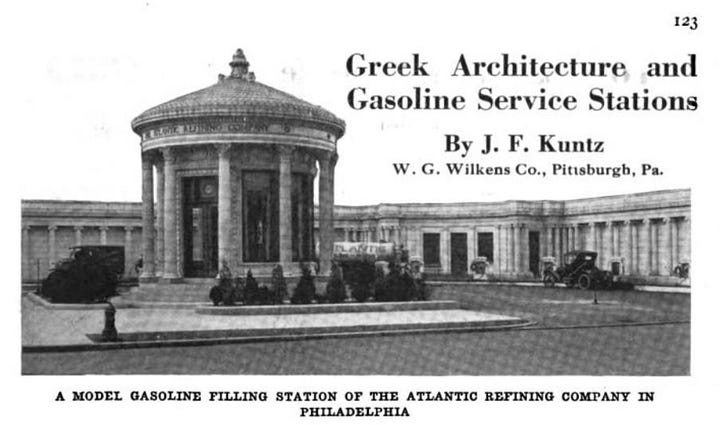
The classical gas stations are sadly all deceased, but Kuntz brought the same general style (particularly the ample terra cotta) to the Atlantic Building, albeit in a slightly less flamboyant and kitschy modality. The building opened to much fanfare in 1923:
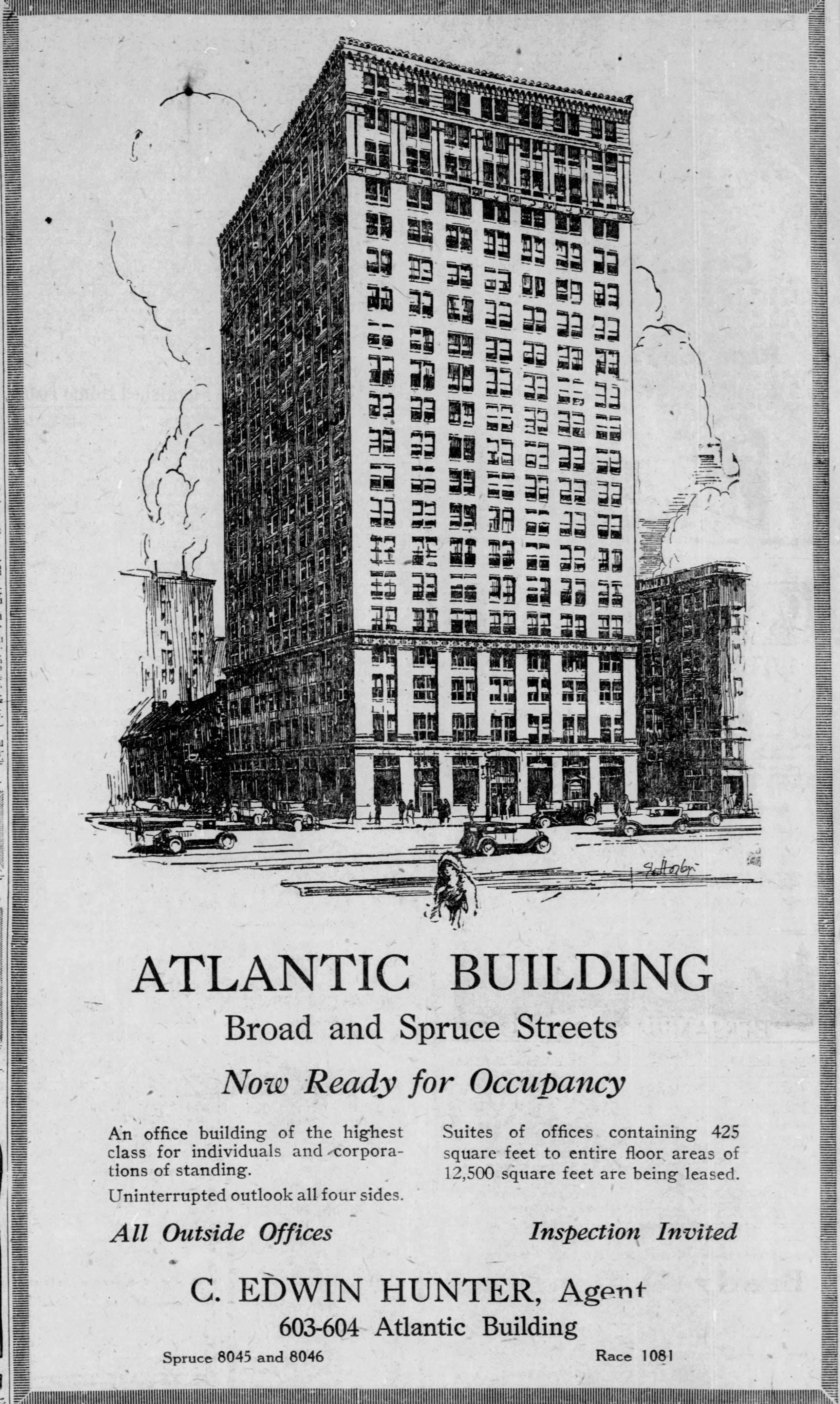
The Atlantic Building remained the Philly home of Atlantic Petroleum for the next 50 years. In 1963, the oil giant merged with Hondo, a Southwestern firm headed by wildcatter and aforementioned civic philanthropist Robert O. Anderson. The indefatigable Anderson was CEO within two years, and orchestrated in 1966 the much larger merger of Atlantic with the Los Angeles-based Richfield Petroleum, forming ARCO.
I can’t really do justice to how much of a surreal Renaissance man Anderson was. Per his 2007 Los Angeles Times obituary, he often wore a stetson hat and a bow tie, owned a staggering amount of ranchland, ran the Aspen Institute, and used ARCO funds to save failing cultural institutions like the London Observer and Harper’s magazine.
Perhaps it was no surprise, then, that when ARCO opted to move its Philly HQ to the then-new Centre Square complex across from City Hall in 1975, Anderson saw fit that the Philadelphia College of Art would inherit the building.
Beginning in the Bicentennial Summer, the Atlantic Building became a major hub for the school, hosting classes, performances, and street-level art galleries in its windows and lobby. In 1979, the College opted to name the building Anderson Hall in honor of its benefactor.
At a ceremony on a temporary platform in front of the Phuilding, Anderson, joined by ARCO Chemical CEO and major Philly arts booster Hal Sorgenti and College board chairman and local newspaper magnate Sam McKeel, offered a little dig at his new namesake building: “What it lacks in style, it certainly possesses in solid construction.”
Notwithstanding his faint praise for the Atlantic Building/Anderson Hall, Anderson had no such misgivings about Philadelphia at large, which he proclaimed, during a later celebratory dinner at the Hill-Physick House in Society Hill, “one of the foremost, if not the foremost city—historically, intellectually, culturally.” I’m not going to argue with that! 1
The Atlantic Building has had several incarnations since the uplifting Anderson Hall moment. In 1984, amid the burgeoning Center City office boom, the College sold the building to New York investor Martin Tepper and his Norwegian colleague Alexander Vik, who backed an extensive conversion/renovation back to an office building. A Ruth’s Chris steakhouse opened in the lobby level in 1988. And then, of course, the condo-Viñoly transformation of more recent years.
Perchance this little deep dive has cured me of the Baader-Meinhof phenomenon that has the Atlantic Building in my perpetual sights. I ultimately doubt, however, that this is the last time that this Phuilding’s significance will fly out of the historical record and into Archiveadelphia’s pages…
Ruth Seltzer, “American Lung Association Jubilee,” Philadelphia Inquirer, 6/8/1979.
No posts
Comments
Nothing yet. Say the first thing.
Sign in to join the conversation.