
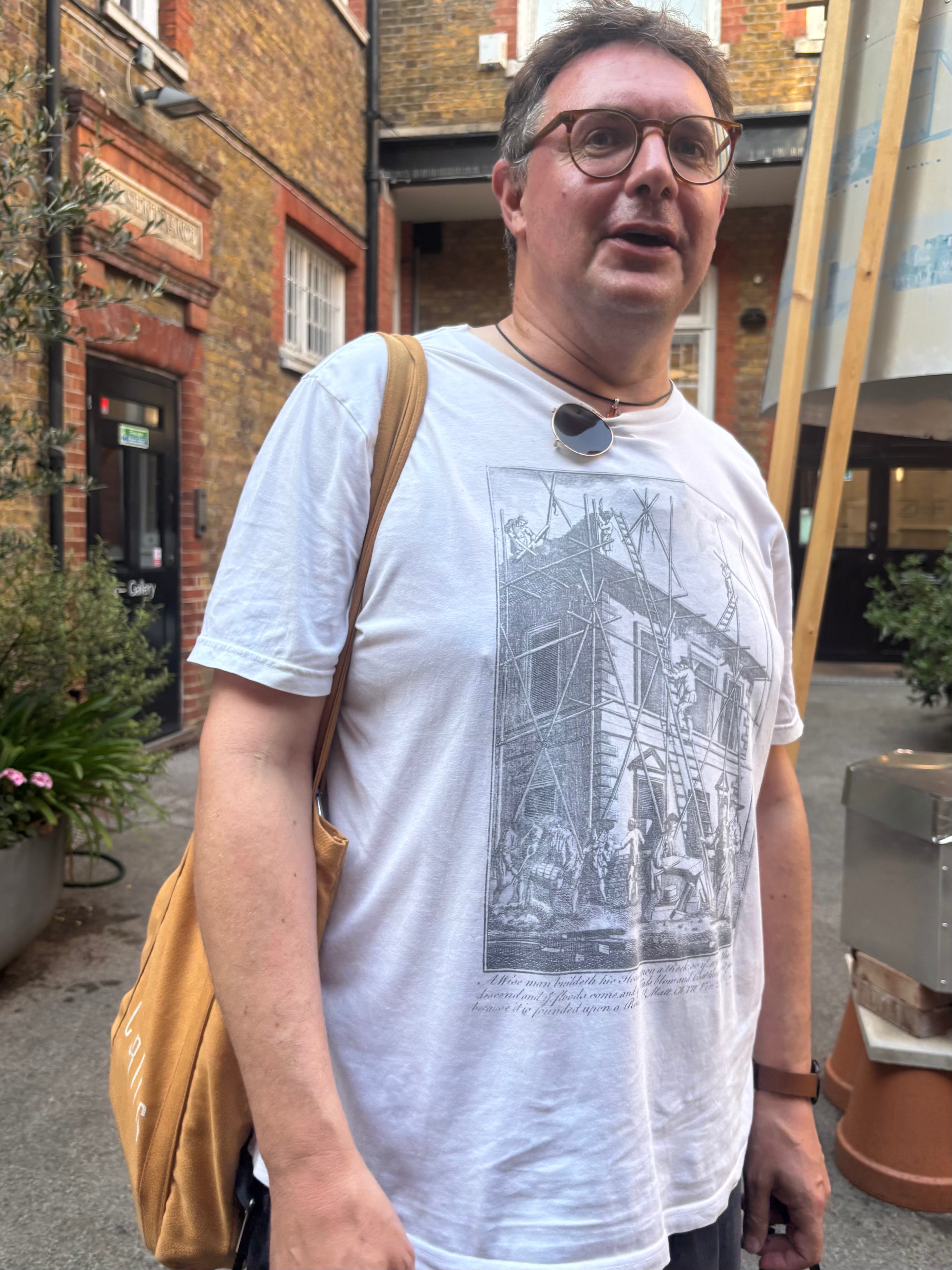
Dr Kent Rawlinson at POST PRESS (Ellis Woodman)
The second week of POST PRESS included two conversations led by James Pockson (IDK) and Neal Shasore (London School of Building) which set out to interrogate the dogmas and clichés of contemporary conservation practice. The contributors included the enviably T-shirted Dr Kent Rawlinson who had spent the previous week in the High Court defending the National Trust’s plans for the conservation of Clandon Park, a Palladian house in Surrey that was devastated by fire in 2015. This project, for which Kent is acting as creative director with Allies and Morrison serving as architects, controversially declines to attempt a facsimile of the interior’s lost ornamental plasterwork. In the course of the evening, Kent touched on the curatorial implications of that choice:
Who are houses like Clandon monuments to? Traditionally, Clandon has been understood as a monument to the Onslow family, who built it, or to Giacomo Leoni, the important early eighteenth-century architect who designed it. Of course, Leoni did not literally build it at all, but the house is nevertheless very much claimed as his. That was apparent in the court case last week, where there was repeated emphasis on the importance of “the Leoni house” and, in particular, “the Leoni roof”.
But a house like Clandon can be a monument in many other ways. One of the things the fire did was to strip away almost all the interiors. What was revealed was essentially a brick-built structure: extraordinary walls, about a metre thick, through which you can read the hierarchy of the house and the differences between its spaces. Above all, you encounter thousands and thousands of bricks. Even in a world where brick is everywhere, that remains remarkable.
Every one of those bricks was made very locally to Clandon. That was partly for simple economic reasons: a brick is heavy, a pallet of bricks is very heavy, and the roughly 3.2 million bricks in the house are heavier still. They were made locally by agricultural labourers, often in the off-season, digging up clay, preparing it, and forming the bricks. These were subsistence-level workers in early eighteenth-century society, often whole families, including women and children.
And making a brick is hard. I have tried it. You have to throw the clay into a mould, turn it out, and stack it. It is skilled, physically demanding work. So when we talk about embodied histories, that is not an abstract idea. Every single one of those bricks is handmade. Each one embodies the lives and labour of people for whom we may have no other record at all. The record of their lives is there in the fabric of the building.
That is why it is so frustrating when opponents of our approach speak dismissively of the “fire-damaged walls” at Clandon, as if they are merely bleak or empty. They suggest that, if you want to tell that story, you can do so in a panel or a guided tour, for people who happen to be interested in that sort of thing. What is missing is any recognition that an encounter with the building itself can be powerful and meaningful in precisely that way.
This is one of the things that motivates us. And to make it meaningful, rather than just an idea, one of the audience communities we are working with over the next four or five years, before the house opens, is tradespeople and craft workers. I do not mean only heritage craft specialists, although we have great relationships with them and value their expertise enormously. I mean bricklayers, masons, electricians: the people whose work the house is, in a very real sense, a monument to. It is a monument to their labour in the past.
That ought not to be controversial, but it is. Part of the difficulty lies in the way heritage is understood in this country, and particularly the way country houses dominate that understanding.
.
No posts
Comments
Nothing yet. Say the first thing.
Sign in to join the conversation.