
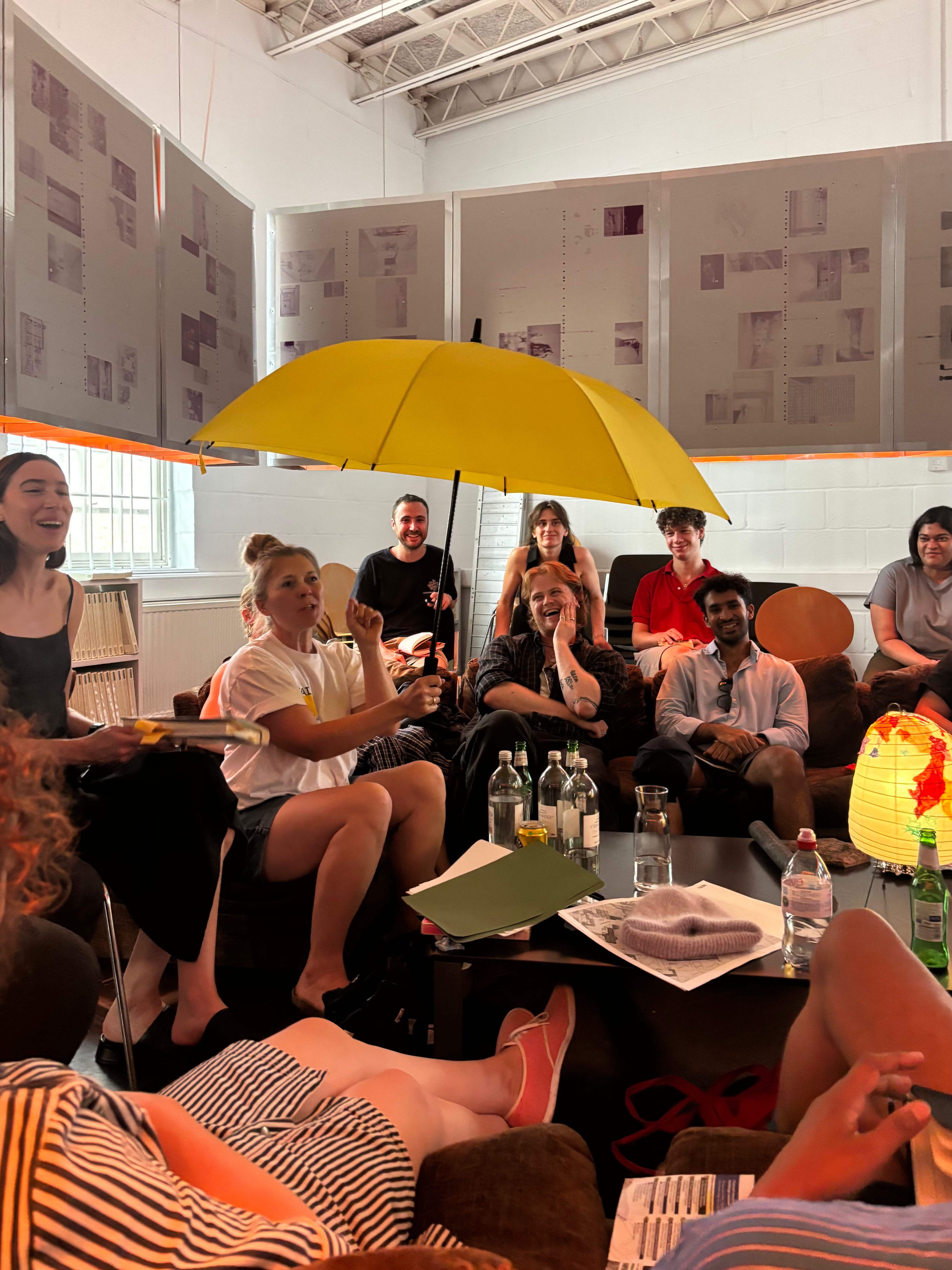
Polly brought her parasol to POST PRESS
At the end of a week of unprecedentedly hot temperatures, James Pockson and Neal Shasore chaired the second of their POST PRESS sessions interrogating the dogmas and clichés of conservation practice. One particularly timely contribution came from Polly Turton, the head of Climate Action and Public Health at Shade the UK, who argued that our built environment needs urgent adaptation if it is to retain resilience:
Earlier this week, I was at an event about the 1976 heatwave. The irony was not lost on me. It was framed as a huge moment in history: not quite a celebration, because that would be the wrong word, but an acknowledgement of a moment when the country became extremely hot. It was almost as hot as it has been this week, but it lasted longer, and apparently it changed British life and culture. Scientists at the event were explaining that, if the temperatures of 1976 happened now, in 2026, the impact would be much worse.
At the same time, as we were listening to these scientists saying that this means we have to act, Keir Starmer handed in his resignation. I was sitting there thinking: hang on, no one is running the country. We were talking about a historic heatwave and a theoretical future in which heatwaves become more common — and then the red alerts were issued: an extreme heat alert and a heat-health alert.
We need more shade. Whether it is a beautiful canopy projecting from a high-street façade above produce, a nail bar or a hipster coffee shop, that kind of shade would make a huge difference to businesses and to their energy bills. Some local authorities are receptive to that. On Upper Street, not far from here, there is encouragement for that sort of look and feel. If you look at historic photographs, Upper Street and Essex Road once had lots of awnings. Now it is patchy, like a row of broken teeth: there used to be a full set, and now there are bits missing.
But shade is not only about things we attach to buildings. It is also about the public realm, about trees, and about keeping trees green through water.
I took some thermal-imaging photographs this week. On a 35-degree day, a piece of grass under a mature tree on a typical Hackney housing estate — probably a 1930s estate — registered at about 26 degrees. That is almost a ten-degree difference. I did the same experiment on a piece of pavement. It wasn’t even the worst black asphalt; it was dark grey paving. That registered at 56 degrees. That is just surface temperature. I didn’t even have a thermometer to measure what it would feel like to a person standing there.
There is another metric called the Universal Thermal Climate Index, which is essentially a “feels like” temperature. It combines surface temperature, air temperature, humidity and wind flow to describe what a person actually experiences in a space. Thinking about shade means thinking about all of these things together.
No posts
Comments
Nothing yet. Say the first thing.
Sign in to join the conversation.