
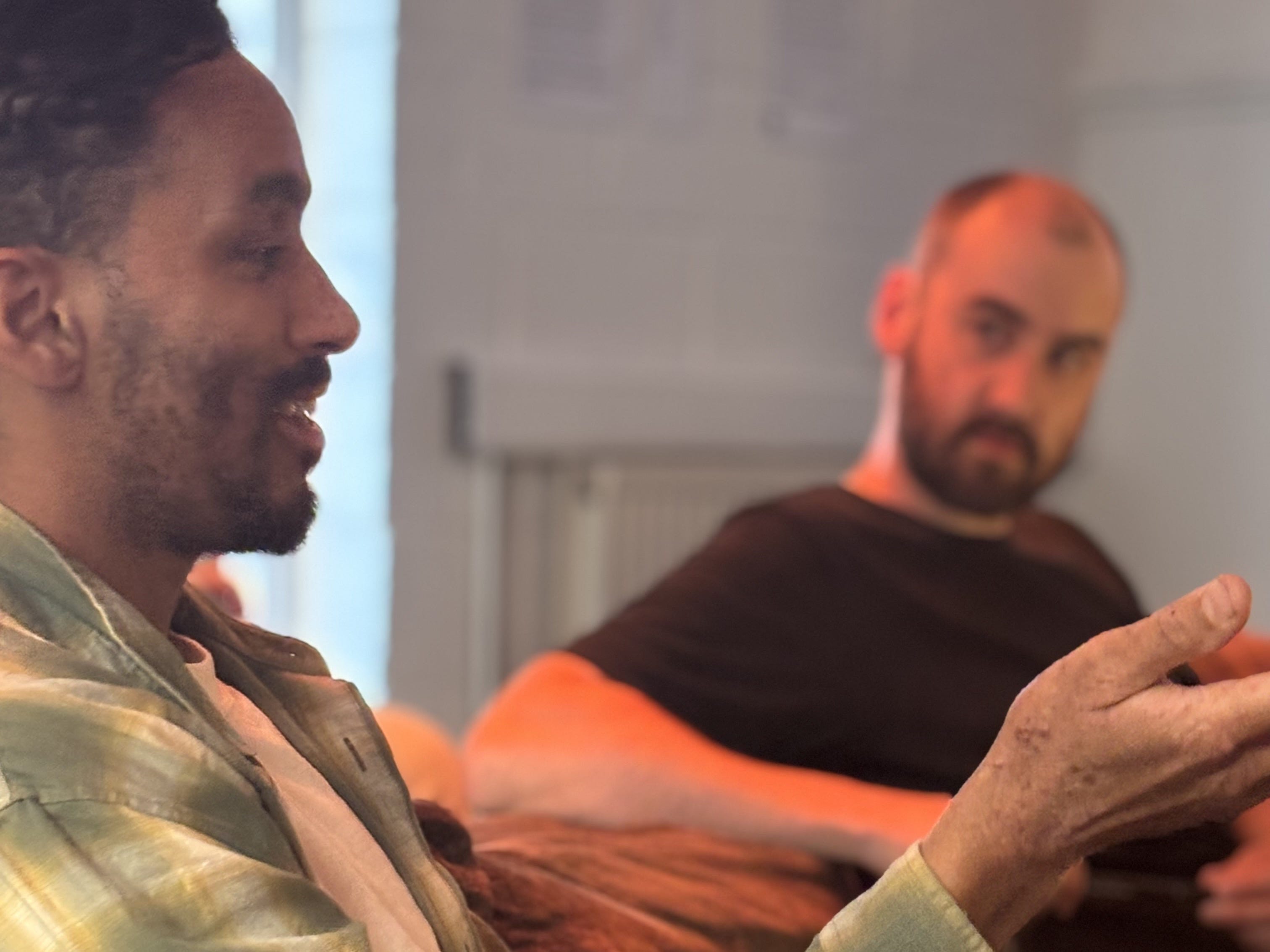
Andu Masebo (left) and James Woodcock (Ellis Woodman)
The Matthew Bonye Research Fellow at the Architecture Foundation, James Woodcock, is developing a book of interviews with fabricators, builders and craftspeople. As part of that project, he led a conversation at POST PRESS with two members of the team that had realised the recently opened V&A East in Stratford, East London. Andu Masebo spoke about the highly crafted timber bench that he designed and delivered within the permanent galleries and discussed the importance of making to his creative practice:
I studied ceramics at Central Saint Martins, and after that I started working in galleries installing artworks. Because I was around tools, I moved into building crates, doing fabrication and constructing gallery spaces. At first, fabrication was just a way of staying in London. When I finished my BA, I wanted to be around the people who excited me, to go to parties, to be in the city, and I needed a way to earn money.
Ten years later, I found myself working in a fabrication workshop in Kent. I was doing interesting projects, but I was underpaid, overworked, and probably shortening my life by inhaling chemicals and dust. I had this feeling that if you go to work covered in plaster, people look at you strangely on the train. I reached a point where I thought, “I’m done with making stuff.”
So I went to the RCA to study Design Products as a way of getting away from it. I wanted to put on a white shirt, save towards a pension, and become a serious professional in the world. But I made terrible work the whole time I was there. Looking back, I realised I had spent ten years working as a fabricator, and I had been able to do that because I have a naturally handy way of thinking. So much of how I understand the world is through doing. It is how I problem-solve.
By trying to leave that behind, I was cutting off a large part of my brain. I think we all have a relationship to how we think, and if we try to become something other than what we are, we are not going to be our fullest selves.
I also realised that a lot of the work I was making at the RCA was derivative. I would look at something by FormaFantasma and think, “I’ll make a video,” or “I’ll make a kiosk.” Their work at that time felt like the be-all and end-all of product design to me. But I was only seeing the surface of it. You can never really understand all the conversations, pain, reasoning, compromises and things that did not happen behind a piece of work. What you encounter is the veneer. I was looking at other people’s veneers and recycling them into something that was empty inside.
It was only by going back to making, in a way that I genuinely owned, that I found my voice. I found a way of putting something into the world that felt authentic. There are still difficult points — the V&A project certainly wasn’t easy sailing — but I feel I have found a way of being myself in my practice. The answers are somehow inside the process.
A lot of how I am as a designer comes from that period when I didn’t like what I was doing in the world. I felt I was making luxury goods for a world that didn’t care about the conditions in which those things came into being.
A lot of my work now is about reconnecting the process of making things with how they are felt in the world. That can move from the maker to the person who lives with or buys the object, or it can move in the other direction. It might be about teaching someone how to make something — not just so they can get it more cheaply because they made it themselves, but so they understand how something is made, and therefore know better and buy better. In that sense there is something Enzo Mari-esque about it.
There are many ways to reconnect people with the magic of making and with how things come to exist in the world. A big part of my practice has become about reaching out and bringing other voices into the work — voices that would not normally feel comfortable being there, or that might be underrepresented. It is about getting more voices into the room.
No posts
Comments
Nothing yet. Say the first thing.
Sign in to join the conversation.