
This newsletter for the week of May 25 wraps up Monograph Month, which featured four such architecture books over the last four weeks. Ironically, this week’s Book of the Week, Unfinished Atlas: 19 Projects by Manuel Herz Architects, asserts in its introductory essay, “This is not a monograph.” If not a monograph, what is it? And why is it my favorite of the four monographs I featured this month of May? Read on to see why, read about an earlier book by Manuel Herz, and check out this week’s new releases and headlines. Happy reading!
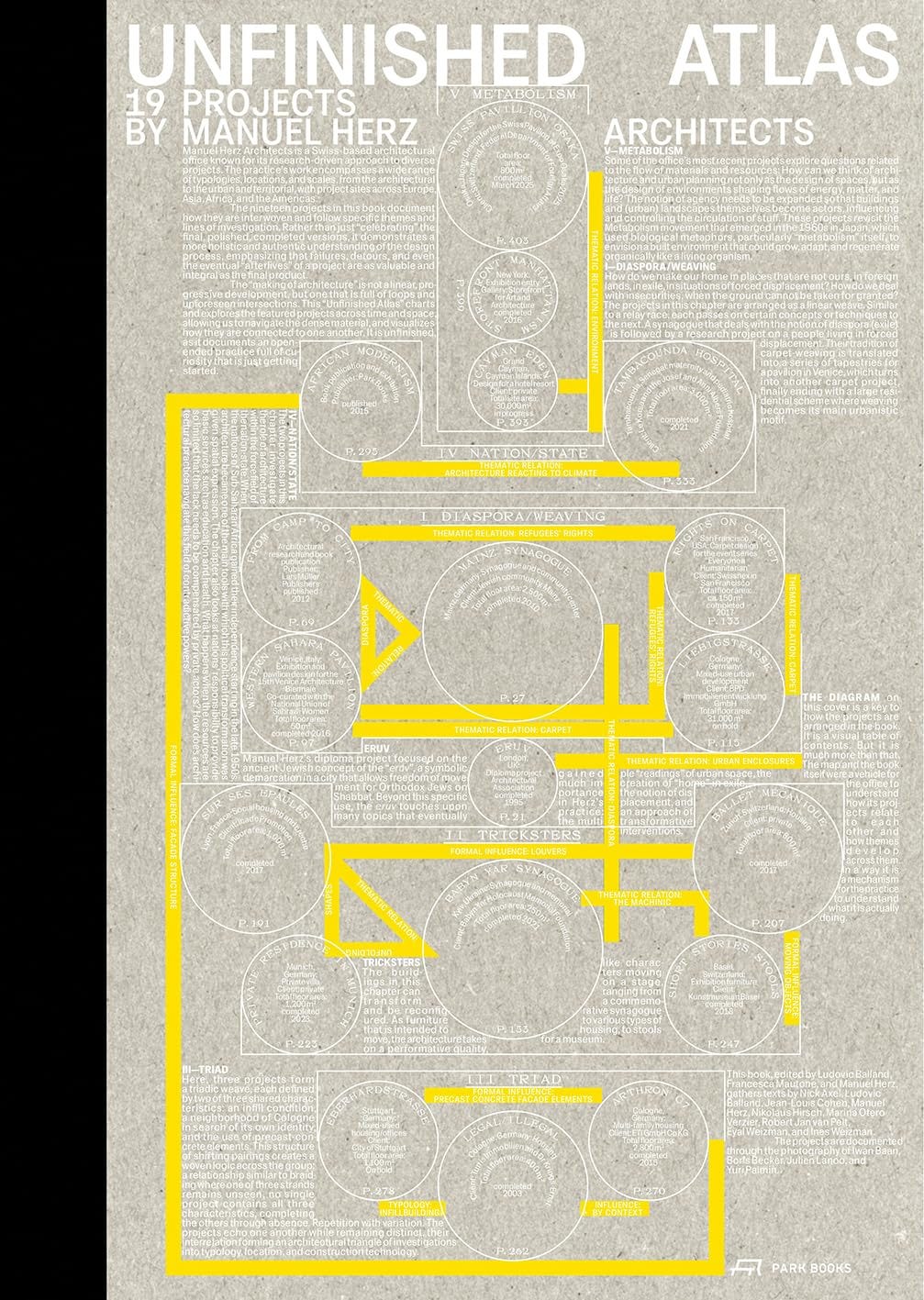
Unfinished Atlas: 19 Projects by Manuel Herz Architects, edited by Ludovic Balland, Francesca Mautone and Manuel Herz (Buy from University of Chicago Press [US distributor for Park Books] / from Amazon / from Bookshop)
“This is not a monograph.” So write architect Manuel Herz and graphic designer Ludovic Balland in their introductory explainer for Unfinished Atlas. There is the obligatory reference to René Magritte’s famous The Treachery of Images (This is Not a Pipe) and an admitted frustration with the monograph format, which “fetishizes” completed buildings via chronological or typological presentations that “hide more than explain … the process of making architecture.” While the book’s title hints at a geographic means of presenting Herz’s work, a format echoed by its folio size and the five pages of maps locating the nineteen projects that preface the introduction, the editors opt instead to organize the projects in five thematic chapters. This is hardly novel or un-monograph-like (I can think of a few monographs by marketing-savvy architects that are organized thematically), but the handful of themes (“Diaspora/Weaving,” “Tricksters,” “Triad,” “Nation/State,” “Metabolism”) are both unexpected for an architectural monograph and wholly appropriate for Herz, whose projects run the gamut from books and exhibitions to carpets and buildings.
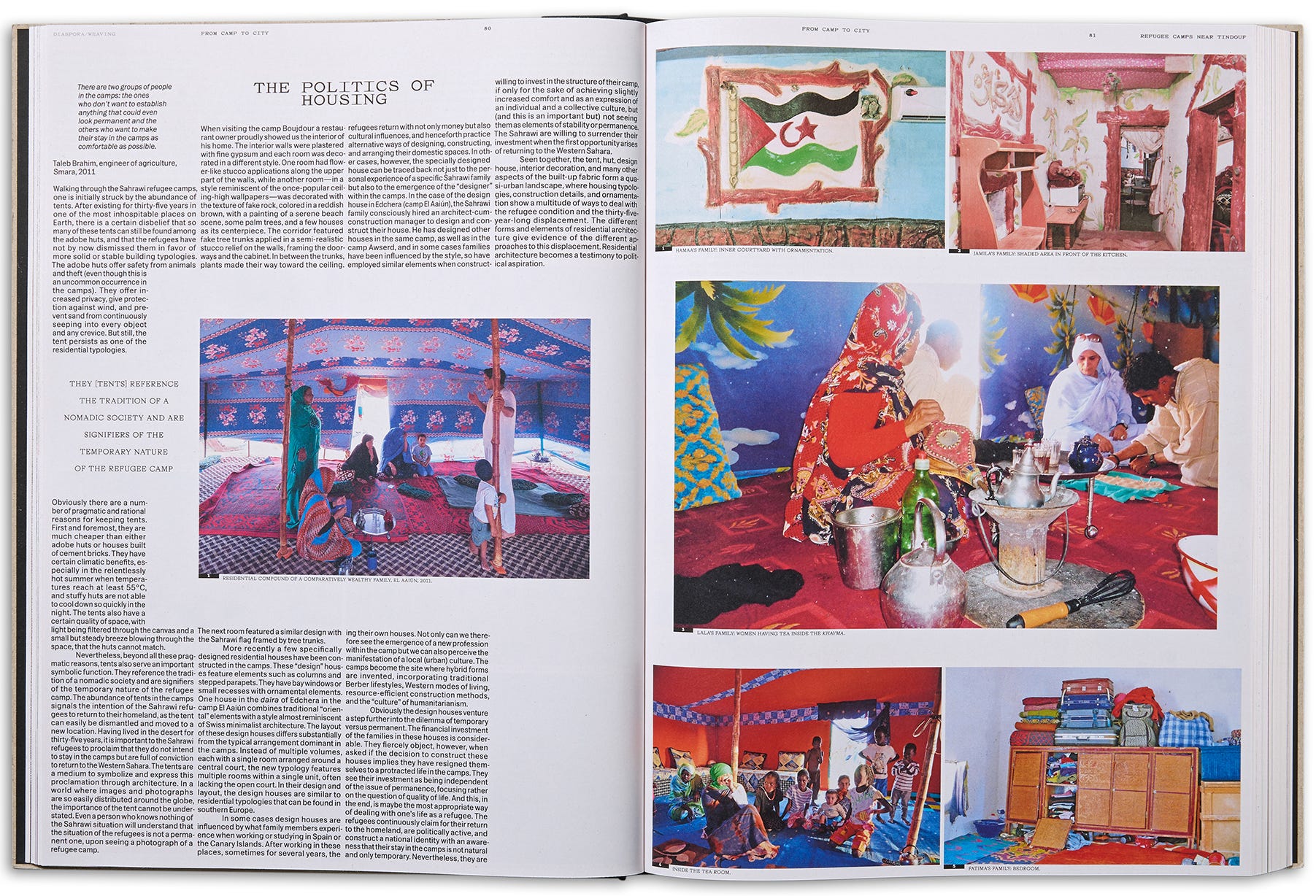
Another reference raised by Balland and Herz in the intro is The Whole Earth Catalog, the famous series of publications produced by Stewart Brand starting in 1968 as a countercultural resource for anyone who wanted to shape their own environment without harming it. They were fascinated by the “graphic quality” of the publication, which was subtitled “Access to Tools” and packed large, diverse amounts of information into its large pages; they found that it “resonated with our ambition to shape a monograph that could also act as a kind of manual.” Aha! Manual is an excellent alternative term to monograph for Unfinished Atlas, given both the large amounts of textual and visual information presented across its pages and the equal space afforded to process as much as to product.
Accordingly, one of the standout moments in my first flip through the book was reading Herz’s reply to an email from the Josef and Anni Albers Foundation inviting him to participate in a competition for the expansion of Tambacounda Hospital in Senegal. He turned down the invite because of a lack of resources in his office at the time but mainly because he believed “the project should develop out of a collaborative—not a competitive—process.” His assertion was strong enough for the Albers Foundation to reverse course on the competition and commission Herz directly. (The resulting building is a beauty.)
Although the book’s three editors explicitly depart from a chronological presentation of Herz’s projects, the book so happens to begin with Eruv, his 1995 diploma project at the Architectural Association London, and it ends with the Swiss Pavilion at Expo 2025 Osaka, Kansai, the most recent completed project before the book’s publication last year (it was released in early March 2026 in the US). These chronological bookends can be seen as a means of illustrating how Herz the student evolved into Herz the architect, with his eponymous Basel firm doing work well outside of Switzerland—in Africa, Asia, and other European countries. His three most well-known buildings exhibit the formal diversity found across his larger portfolio: the very contemporary Mainz Synagogue (2010) in Germany, with its jagged profile and green tile facades; Ballet Méchanique (2017), a small apartment building in Zurich cloaked in movable triangular panels; and Babyn Yar Synagogue (2021) in Kyiv, a small kinetic building that commemorates the massacre of approximately 35,000 Jews over two days in September 1941. What, if anything, unites these projects?
Herz contends that the goal of Unfinished Atlas is “to gain an understanding of our own work: knowing that the office has worked in radically different geographies and economies, with very different materials, programs, and formal expressions, we wanted to understand better what holds these projects together.” This goal led to the book’s thematic structure and resulted in the Mainz Synagogue falling into the “Diaspora/Weaving” chapter, and both Babyn Yar and Ballet Méchanique in the “Tricksters” chapter. Even before looking at their presentations, these three projects are united, in my view, by the paradoxical quality of being both opaque and revealing. The green-tile building in Mainz, for instance, hardly screams “synagogue,” but its silhouette acts as an abstraction of the five Hebrew characters used in the word “blessing” and the interior surfaces are covered with letters from religious poetry. Similarly, when closed Babyn Yar barely reveals its function, but when opened—like a book—it takes on the evident qualities of a space for prayer. Lastly, Ballet Méchanique also hides its function when fully closed but reveals the living spaces behind it when open even in varying degrees, not just when fully open.
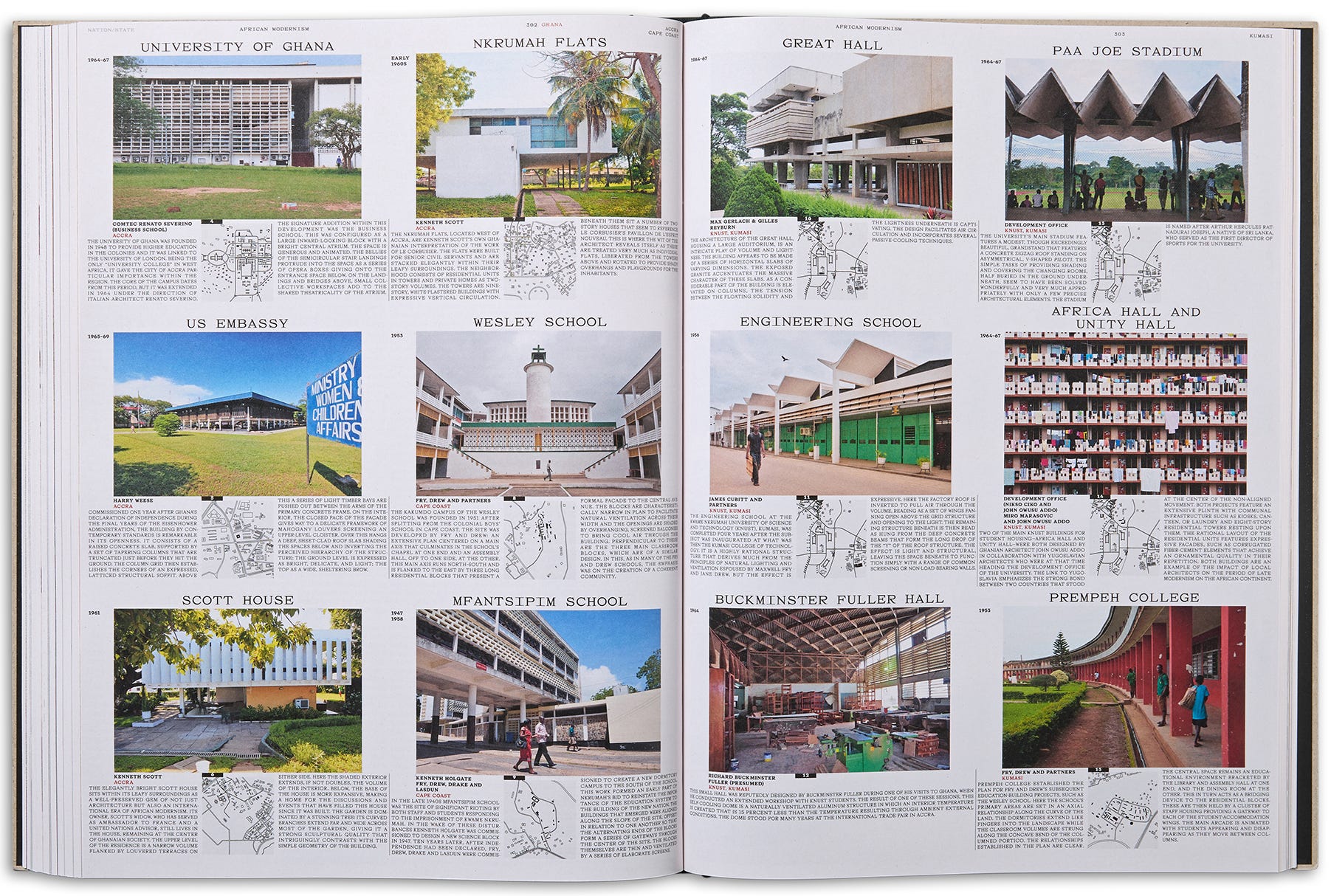
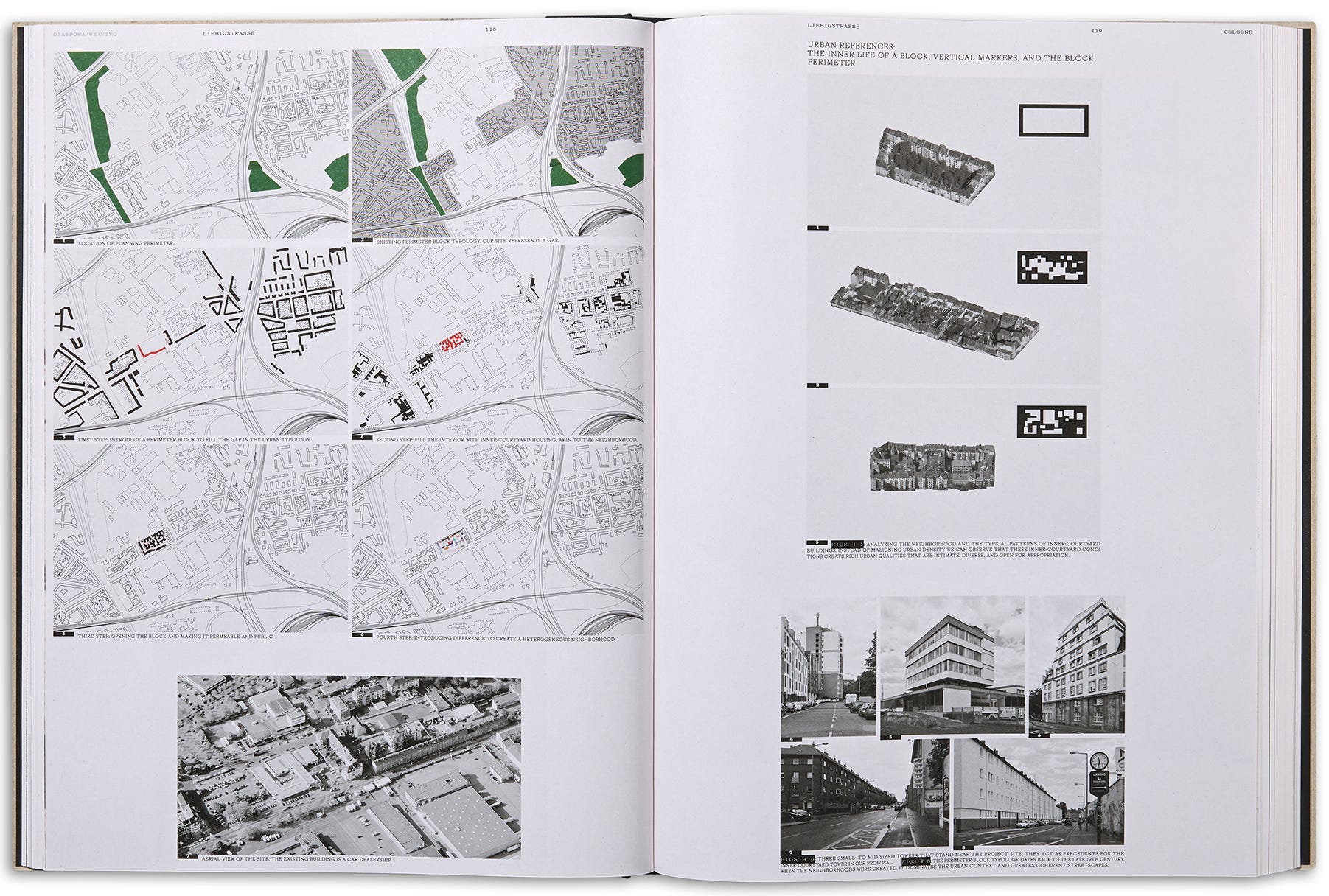
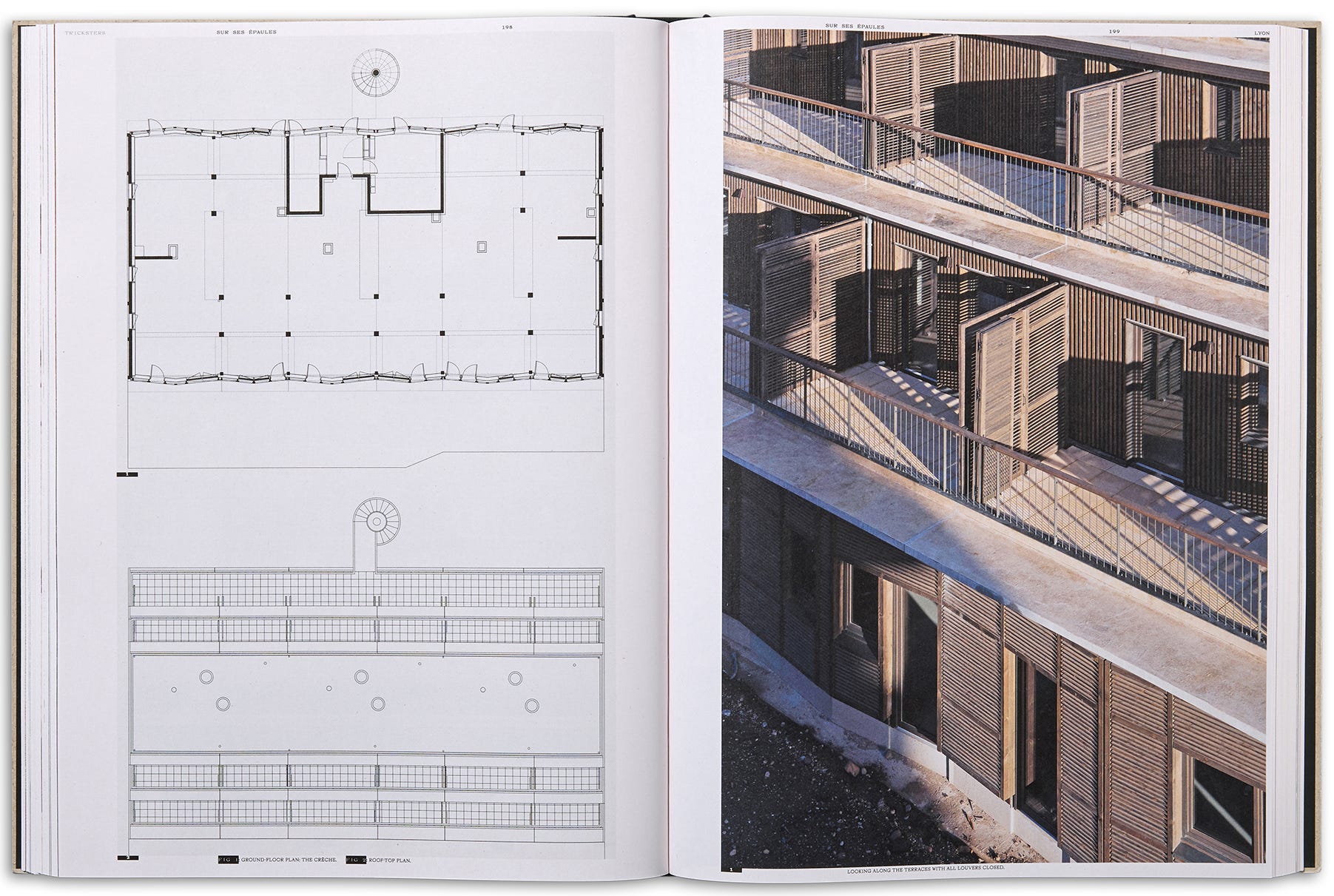
Although the spreads above do not illustrate the three projects I have chosen to focus on in this review, they give a clear indication of just how much information is packed into each page of Unfinished Atlas. They also reveal the diversity of Balland’s design, which veers from pages with four columns of dense text to pages with just a single image. Most page layouts are somewhere in between, but all of them are surprising—I can’t remember the last time I turned the pages in a book not knowing what would be coming next and finding joy in each spread. The book is a delight to absorb, be it reading the sometimes lengthy texts and interviews in depth or just looking at the photographs, drawings, and other images. It seems that Herz’s search for understanding his work was aided by how Balland turned the architect’s words and projects into book form. And while some design touches are questionable (e.g., the white text on black boxes for keying figures are hard to read and the near lack of margins results in some paragraphs uncomfortably close to the fold), Unfinished Atlas as an object is exquisite: a thing of beauty comparable to Herz’s best projects.
(In the United States; a partial, curated list)
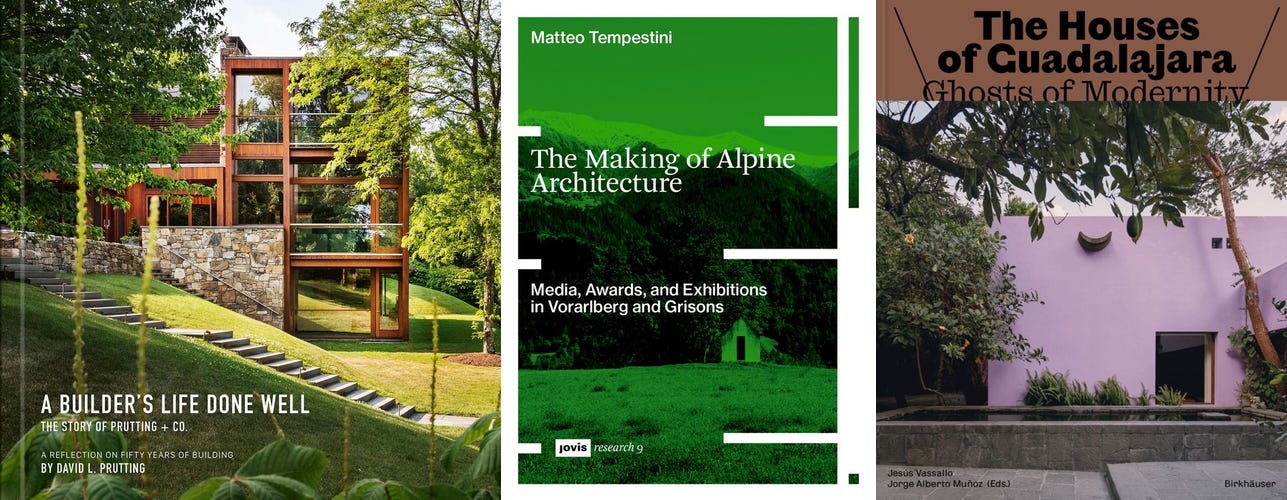
A Builder’s Life Done Well: The Story of Prutting + Co., by David L. Prutting (Buy from Images Publishing Group / from Amazon / from Bookshop) — “Custom homebuilder David Prutting takes readers behind the scenes to offer a unique perspective on building some of the most distinguished contemporary homes in the United States.”
The Making of Alpine Architecture: Media, Awards, and Exhibitions in Vorarlberg and Grisons, by Matteo Tempestini (Buy from Jovis / from Amazon / from Bookshop) — “What makes some regional architecture more famous than others? The Making of Alpine Architecture investigates the cultural construction behind contemporary Alpine architecture, exploring the events, publications, and buildings that have shaped architectural discourse on an international scale.”
The Houses of Guadalajara: Ghosts of Modernity, by X (Buy from Birkhäuser / from Amazon / from Bookshop) — “This book studies the origins and late evolution of modern Mexican architecture through a series of houses built by two generations of architects during the 1920s and 1980s in Guadalajara.”
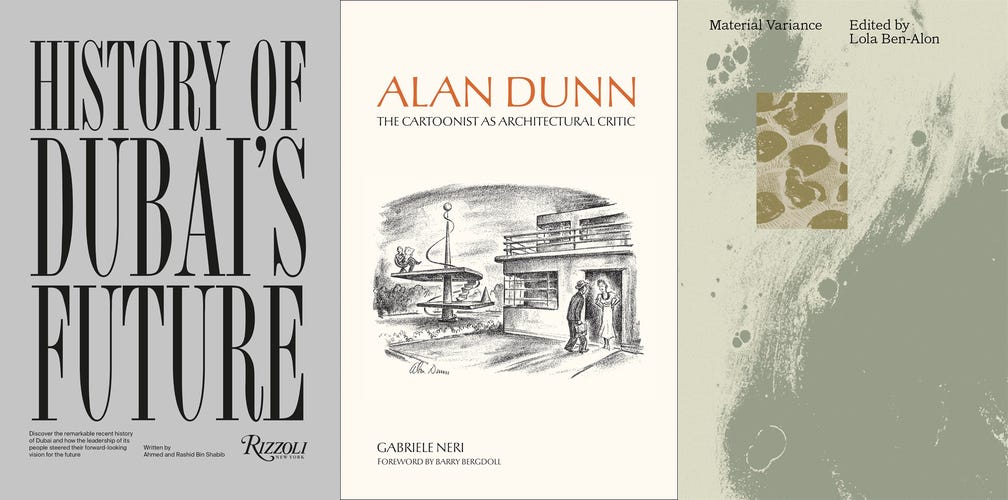
History of Dubai’s Future: The Visionary Perspective From 1960 to 2000, by Ahmed and Rashid bin Shabib (Buy from Rizzoli / from Amazon / from Bookshop) — “The first publication devoted to the remarkable history of Dubai and how the leadership of its people steered its forward-looking vision of the future.”
Alan Dunn: The Cartoonist as Architectural Critic, by Gabriele Neri (Buy from MIT Press / from Amazon / from Bookshop) — “The first in-depth study of American artist Alan Dunn (1900–1974), whose incisive cartoons mocked twentieth-century architecture and urban environments, expanding the field of architectural criticism.”
Material Variance, edited by Lola Ben-Alon (Buy from Columbia University Press / from Amazon / from Bookshop) — “Convening material researchers, building scientists, architects, and artists, Material Variance aims to collectively expand architecture and design’s material lexicon and unsettle its disciplinary boundaries.”
Full disclosure: As an Amazon Associate, AbeBooks Affiliate, and Bookshop.org Affiliate, I earn commissions from qualifying purchases made via any relevant links above and below.
The first installment in the new Book Review column in Jarrett Fuller’s Scratching the Surface newsletter features an interview with Mario Mainetti from Fondazione Prada about Diagrams: A Project by AMO/OMA, the 2025 exhibition in Venice and companion book designed by Irma Boom. (Scratching the Surface)
“What defines the best American architecture today?”: Mark Lamster reviews Out There: New Architecture Across America. (Dallas Morning News) A review on that book in this newsletter is forthcoming.
Congratulations to New York Review of Architecture in winning the 2026 National Magazine Award for Reviews and Criticism from the American Society of Magazine Editors (ASME). Specifically, it won for “The Brutalist,” by Thomas de Monchaux, “Megalopolis,” by Mark Krotov, and “Frickrolled,” by Thomas de Monchaux.” (ASME)
A highlight of Unbuilding Ageism, a collaboration between e-flux Architecture and the Chair of Architecture and Care in the Department of Architecture at ETH Zürich, is Deane Simpson’s “Forever Young-Old in the Villages.” The essay basically updates the chapter on The Villages from his excellent, now 11-year-old book Young-Old: Urban Utopias of an Aging Society, which I reviewed for the Architect’s Newspaper back in 2015. (e-flux architecture)
“XYZ Books, Lisbon: endorsing experimentation without compromise,” an interview with Pedro Guimarães and Tiago Casanova about their bookstore-cum-publishing house. (Lampoon)
The Society of Architectural Historians has posted some photos of bookstores from their SAHARA photo archive, including one by Dell Upton of Powell’s City of Books in Portland, Oregon, and one of Alvar Aalto’s “Book Palace” in Helsinki. (SAH)
If Unfinished Atlas is not a monograph, then my short review of Manuel Herz’s African Modernism: The Architecture of Independence. Ghana, Senegal, Côte d’Ivoire, Kenya, Zambia (Park Books, 2015), posted on my blog in 2018, is not a review. I say that partly because my write-up was part of my “Book Brief” series that I featured books with short first-hand reviews rather than long reviews, and partly because I revisited that 35th Book Brief five years later, amending my words with those generated by ChatGPT. That was in June 2023, a half-year after OpenAI released ChatGPT; I was among many writers playing with the technology at the time to see what it was like and when it would be replacing us. This week I decided to revisit that revisitation and see if the latest ChatGPT has made noticeable improvements over the last three years. So, below are the book blurb, my brief review, and two ChatGPT “reviews” of Manuel Herz’s African Modernism.
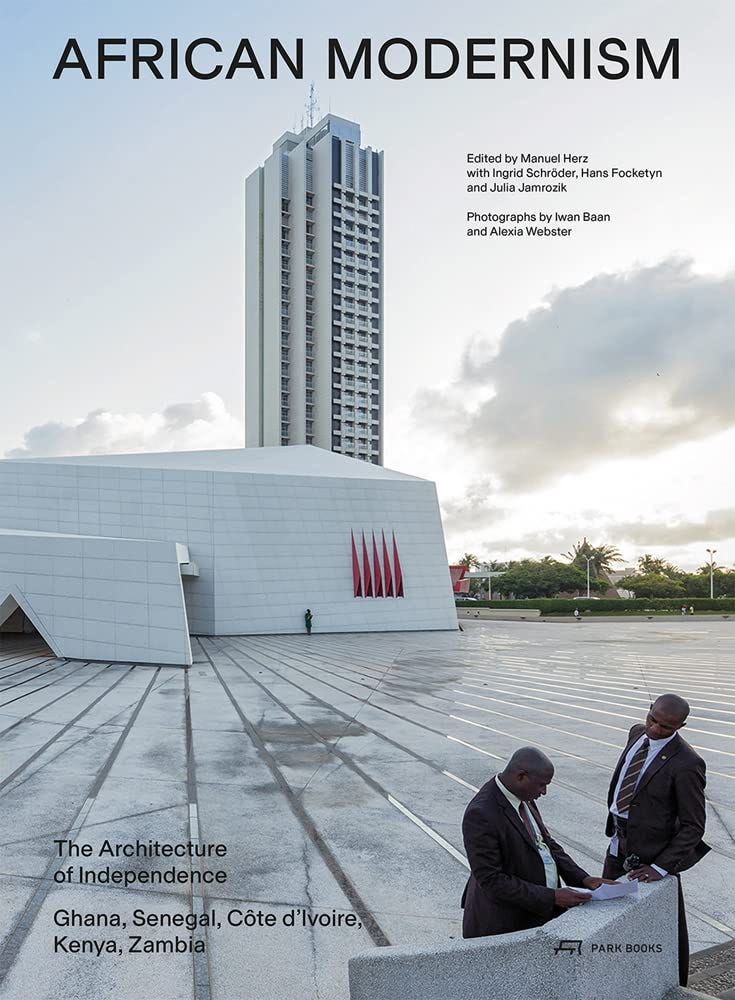
Here is the blurb from Park Books:
“In the 1950s and 1960s, most African countries gained independence from their respective colonial power. Architecture became one of the principal means by which the newly formed countries expressed their national identity. African Modernism investigates the close relationship between architecture and nation-building in Ghana, Senegal, Côte d’Ivoire, Kenya, and Zambia. It features one hundred buildings with brief descriptive texts, images, site plans, and selected floor plans and sections. The vast majority of images were newly taken by Iwan Baan and Alexia Webster for the book’s first edition. Their photographs document the buildings in their present state. Each country is portrayed in an introductory text and a timeline of historic events. Further essays on postcolonial Africa and specific aspects and topics, also illustrated with images and documents, round out this outstanding volume.”
This is what I wrote on my blog back in 2018:
Although the size of a coffee table book and graced by full-page Iwan Baan photographs, African Modernism is a deep, scholarly work, not just something to flip through. Focused on the five subtitled African countries that gained their independence in the late 1950s and early 1960s (5 of 32 countries on the continent that did so), the book examines how architecture played a role in expressing their independence and modernity. Each country is given an introduction, a timeline, a photo spread by Baan, documentation of important buildings in photos (most by Baan) and words, and an in-depth academic essay. Though many buildings show signs of wear (not surprising, given the time between their realization and today), the architectural quality is astounding. That the buildings in the book are largely unknown points to a deficit in architectural education and publishing — and the need for more books like this one and Adjaye Africa Architecture.
This is what Chat GPT-3.5 produced in June 2023 with the prompt, “Give a short, one-paragraph review of ‘African Modernism: The Architecture of Independence. Ghana, Senegal, Côte d’Ivoire, Kenya, Zambia’ edited by Manuel Herz.”:
“African Modernism: The Architecture of Independence. Ghana, Senegal, Côte d’Ivoire, Kenya, Zambia edited by Manuel Herz is a groundbreaking book that sheds light on the architectural legacy of African modernism. With a focus on five countries, the book explores the post-independence era and the architectural projects that emerged during this period of political and cultural transformation. The book’s rich collection of photographs, plans, and essays provides valuable insight into the unique blend of local and international influences that shaped African modernist architecture. It is an essential resource for anyone interested in the intersection of architecture, history, and cultural identity in Africa.”
This is what Chat GPT-5 Mini produced in May 2026 with the prompt, “Give a short, one-paragraph review of ‘African Modernism: The Architecture of Independence. Ghana, Senegal, Côte d’Ivoire, Kenya, Zambia’ edited by Manuel Herz.”:
“African Modernism: The Architecture of Independence — edited by Manuel Herz — is a visually rich, well-researched survey that compellingly documents the ambitious postcolonial architectural projects across Ghana, Senegal, Côte d’Ivoire, Kenya, and Zambia. Combining archival photographs, contemporary imagery, primary texts, and thoughtful essays, the volume situates these buildings within the politics of nation-building and international modernist discourse, revealing both bold formal experimentation and the complex realities of maintenance, climate, and cultural adaptation. While occasionally uneven in depth between countries, the book succeeds as an important corrective to Eurocentric architectural histories and a valuable resource for scholars, architects, and anyone interested in the material legacies of independence in Africa.”
Thank you for subscribing to A Weekly Dose of Architecture Books. If you have any comments or questions, or if you have your own book that you want to see in this newsletter, please respond to this email, or comment below if you’re reading this online. All content is freely available, but paid subscriptions that enable this newsletter to continue are welcome — thank you!
— John Hill
No posts
Comments
Nothing yet. Say the first thing.
Sign in to join the conversation.