
May is Monograph Month. This newsletter for the week of May 18 looks at the latest one on Henley Halebrown, the practice Simon Henley and Gavin Hale-Brown founded in London in 1995. Published last year by Lund Humphries, Henley Halebrown: Building for Society 2010–2022 presents a dozen works completed over the same number of years. The book from the archive is a history of modern housing projects built in London’s Camden borough, also published by Lund Humphries, and the usual headlines and new releases are in between. Happy reading!
Book of the Week
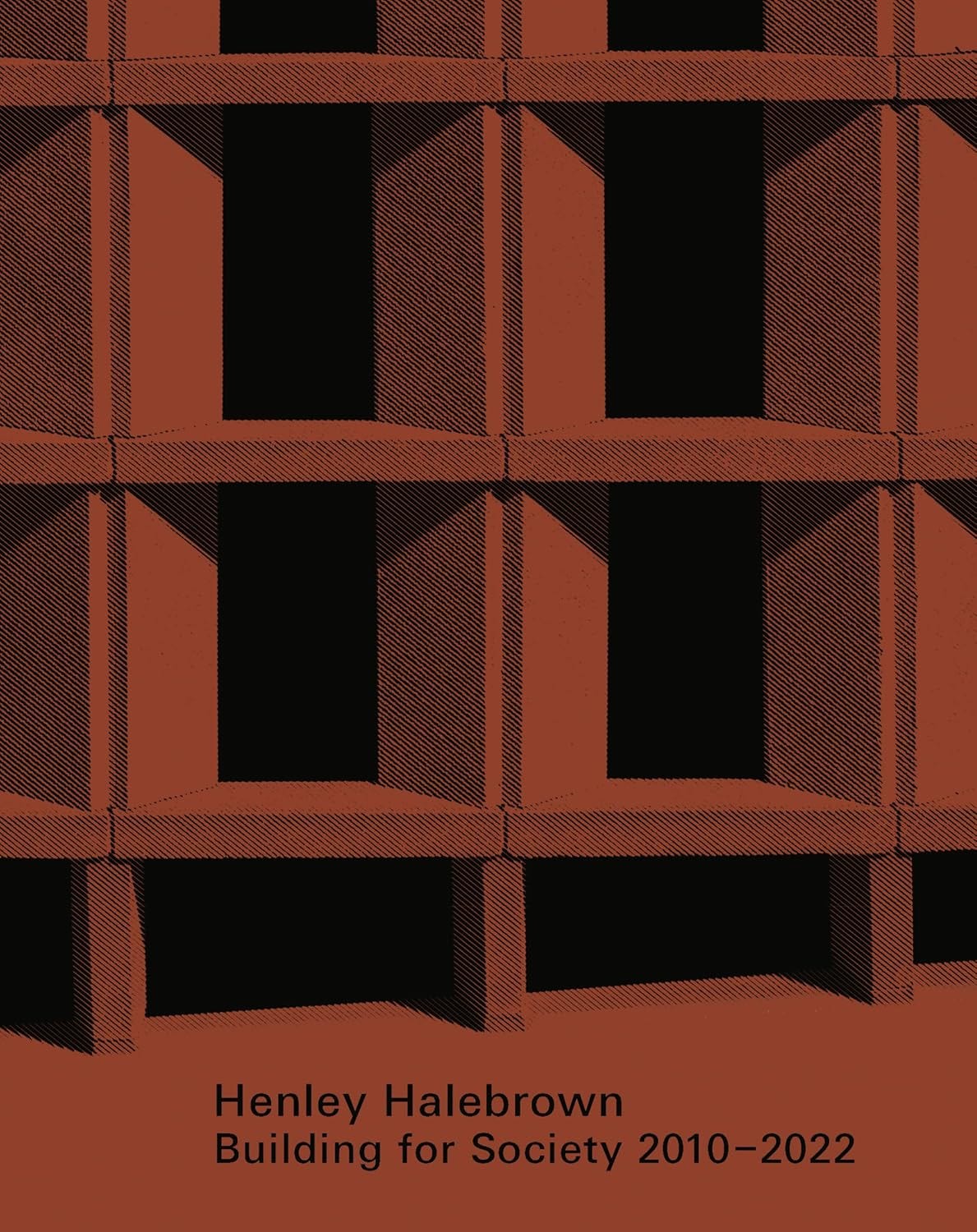
Henley Halebrown: Building for Society 2010–2022, by Tom Neville, Simon Henley and Gavin Hale-Brown (Buy from Lund Humphries / from Amazon / from Bookshop)
As someone who edits two weekly newsletters—one for World-Architects and this one devoted to architecture books—most of the monographs I come across are about architects I’m familiar with, architects whose reputations precede their publications. It is rare that a monograph catches me by surprise, but such is the case with Building for Society 2010–2022, the new monograph on Henley Halebrown, the London practice of Simon Henley and Gavin Hale-Brown, whom I had no familiarity with before being sent the book. I write that reluctantly and with a tinge of embarassment, since the twelve buildings spanning the book’s 336 pages are impressive and my job precludes me not knowing about a firm doing such good work. The lengthy selected bibliography at the back of the book reveals my ignorance was not from the firm’s lack of exposure. Although I’m at a loss as to why Henley Halebrown is new to me, it made flipping through Building for Society that much more enjoyable, with each page revealing more qualities about their projects.
Before reaching the projects, readers see the dozen projects on a two-page spread as floor plans and a couple spreads with white-on-black planometric drawings (à la San Rocco covers), both exhibiting the size of the projects relative to each other and revealing the architects’ formal consistencies. There is not a huge range between the smallest and largest projects, with buildings tending to be in the range of medium, in Koolhaas parlance. Also coming across is a clear focus on the wall—i.e., not curtain walls—as means of constructing and containing buildings. These are just two qualities that make their buildings appealing to me.
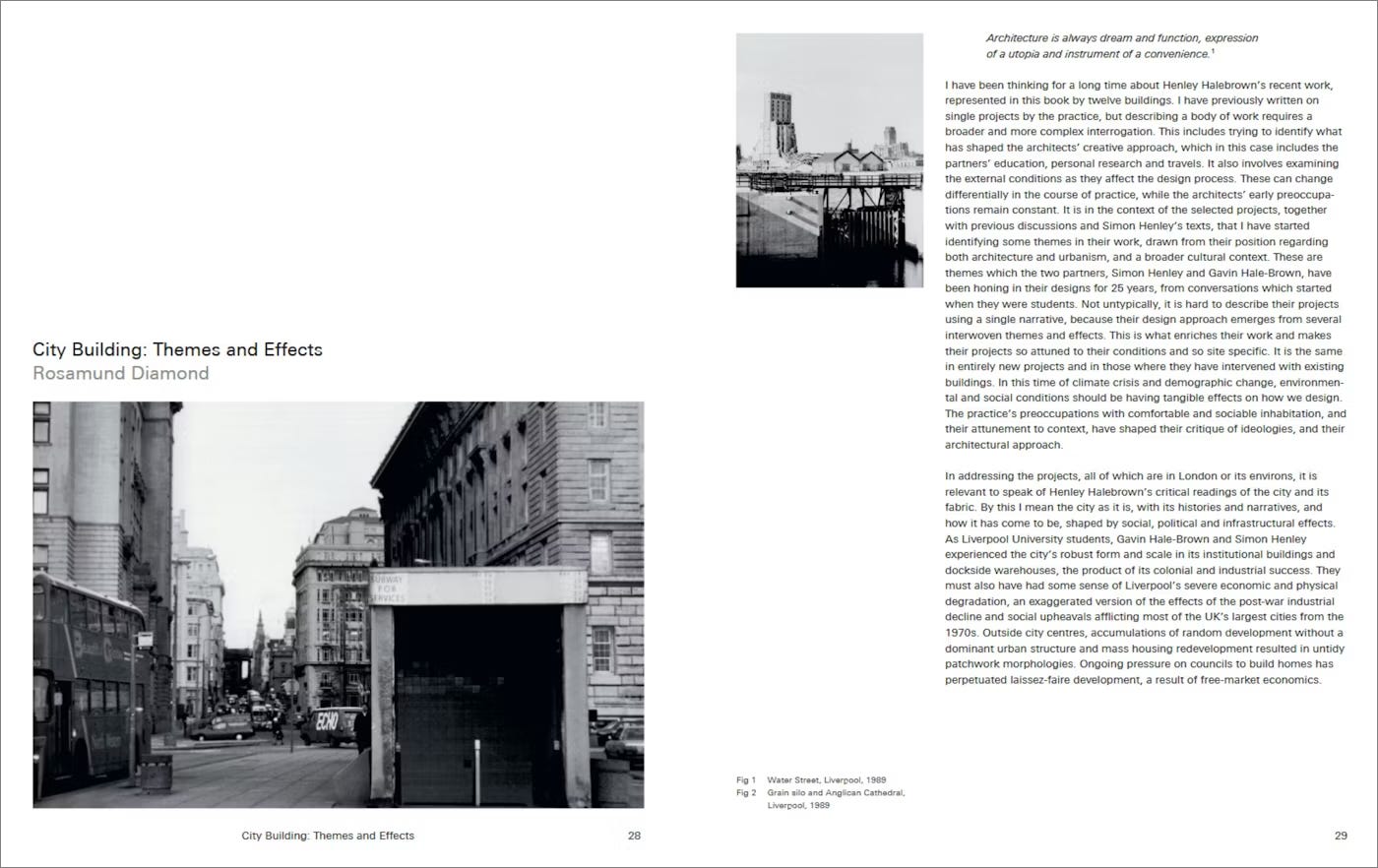
Readers also encounter a few text contributions before the first project: a conversation between Henley, Hale-Brown, and book editor Tom Neville; a 2023 conference paper by Henley that touches on some of the buildings in the book; and an essay by Rosamund Diamond that deeply examines various aspects of Henley Halebrown’s work. Diamond has two other pieces in the book, one previously published in an architecture magazine, the other consisting of walking tours of Henley Halebrown’s projects in Hackney—this text explicitly echoes Peter Smithson’s Bath: Walks within the Walls, which was first published in 1969 but, like Henley Halebrown, is completely new to me. The inclusion of texts—previously published and newly released—by Henley, Diamond, and a slew of other architects and critics (Tony Fretton, Hugh Strange, Adam Khan, Jay Merrick, Edwin Heathcote, and others) interspersed with the projects reminds me of Caruso St. John’s series of monographs, which also balance thorough project documentation and critical essays from various sources.
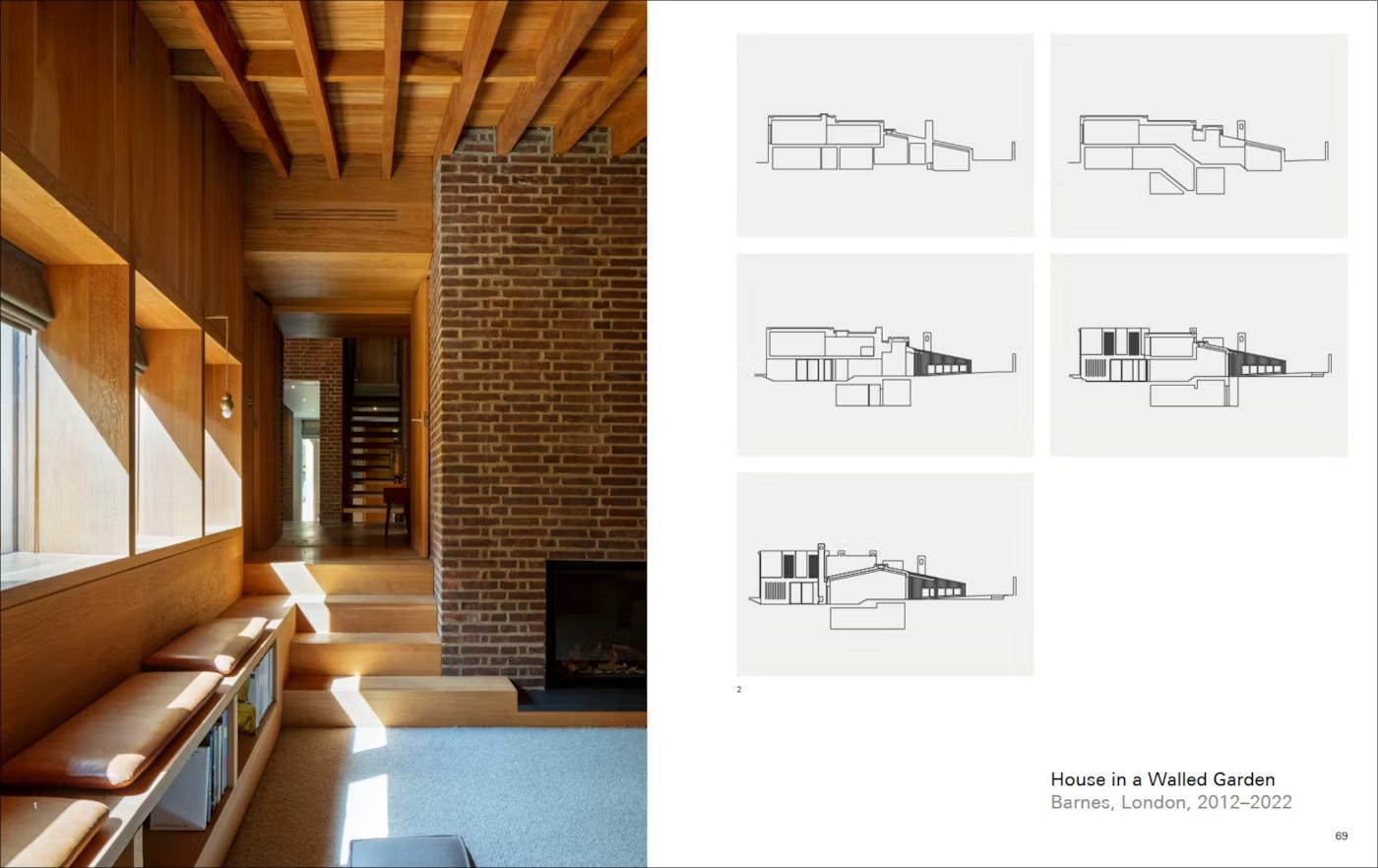
The first of the twelve projects in the book is Copper Lane, a grouping of seven houses around a central communal court. Completed in 2014, it is billed as “London’s first co-housing project.” Sitting in the middle of a large block that has terraced houses at its perimeter, the project is like an introverted oasis, with houses labeled accordingly: “A house for two academics and their two boys,” “A house and studio for a designer,” “A house and studio for an artist,” and so forth. The interior/outdoor, private/semi-private spaces are complex, and the photos and drawings are presented in a way that slowly reveals, page by page, how the houses fit together. The book’s back-cover contends that Henley Halebrown “produces buildings that take account of the way people actually use them and how they affect our sense of well-being.” They make buildings that “promote social interaction.” Validation of these statements is clearly visible at Copper Lane.

Curiously, given the emphasis on people using buildings, a sense of well-being, and social interaction, there are very few photos in the book that include people. There is one photo showing a party at Copper Hall, plus some photos of furnished houses that show signs of life there. Hackney New School (2015) has a couple photographs with students, as does the later Thames Christian School and Battersea Chapel (2022) and Hackney New Primary School & 333 Kingsland Road London (2020). (A great addition to the last is Suzanne Deakin’s elaborate drawing of “life” at the school, complete with an octopus, pterodactyl, and other creatures in addition to children.) But that is about it in terms of photographic displays of Henley Halebrown’s buildings for people. Instead, we primarily see their buildings as muted backdrops for living, learning, working, and playing—but what beautiful backdrops they are.
Books Released This Week
(In the United States; a partial, curated list)
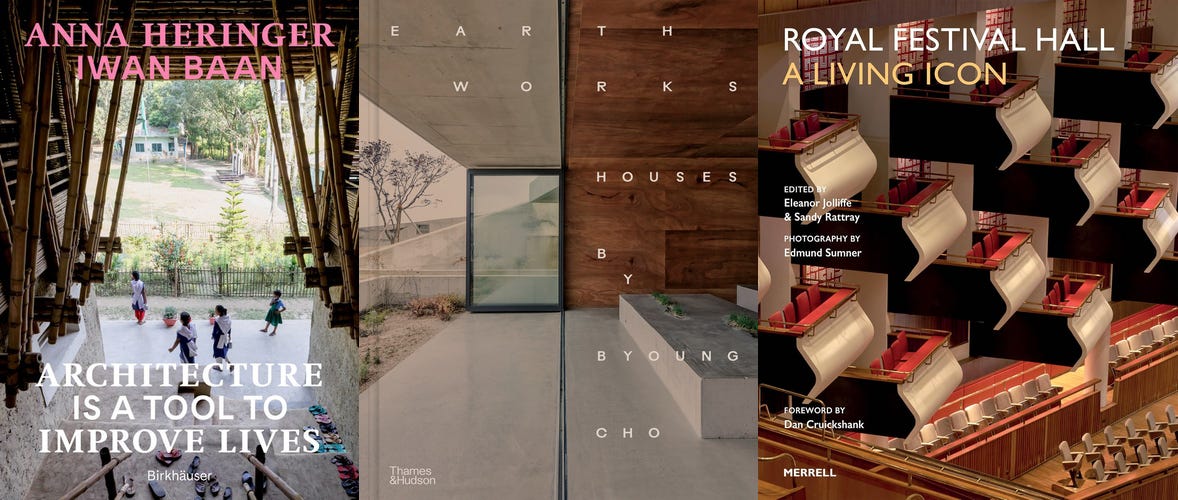
Architecture Is a Tool to Improve Lives, by Anna Heringer, photographs by Iwan Baan (Buy from Birkhäuser / from Amazon / from Bookshop) — “For her new book, [Heringer] traveled to Bangladesh with Iwan Baan to visit the buildings created there as well as her women’s empowerment project, Dipdii Textiles.” (A companion to Form Follows Love.)
Earth Works: Houses by Byoung Cho, by Byoung Cho (Buy from Thames & Hudson / from Amazon / from Bookshop) — “A new monograph on Korea’s most important architect, offering an exclusive look at his seldom-published houses.”
Royal Festival Hall: A Living Icon, edited by Sandy Rattray and Eleanor Jolliffe, photographs by Edmund Sumner (Buy from Merrell / from Amazon / from Bookshop) — “This book offers an invaluable record of the history of this celebrated building in the first 75 years of its life, and looks to its future as a center of cultural programming—both weathering and shaping change—for many more decades to come.”
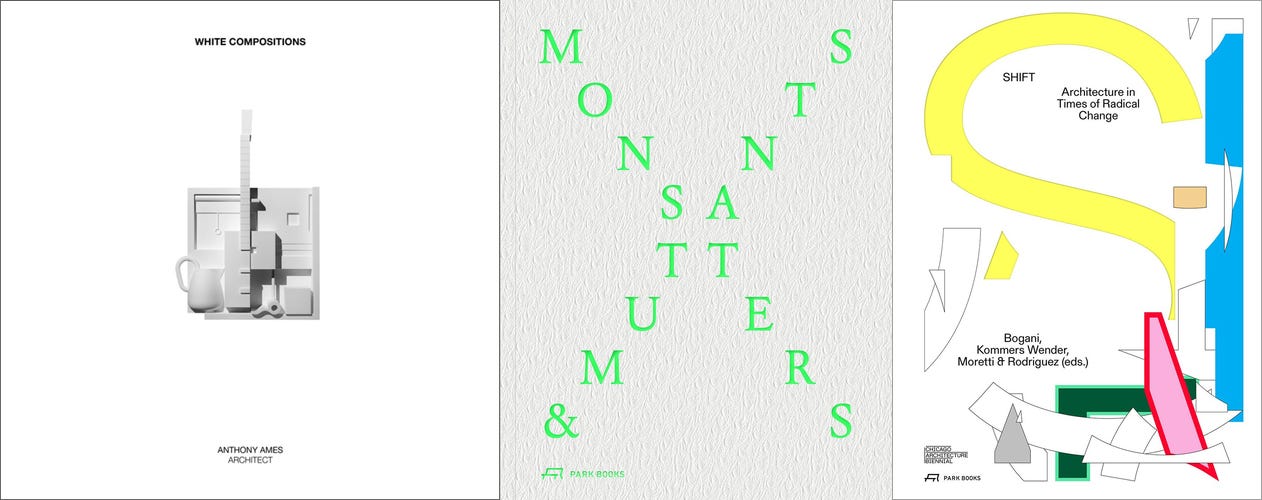
White Compositions, by Anthony Ames (Buy from ORO Editions / from Amazon / from Bookshop) — “The White Compositions are symbolically charged with highly specific references that speak to Ames’s work and life as an architect in Georgia preoccupied with modernism, art and basketball, among other cultural and literary meanings.”
Monsters and Mutants: Explorations in the Architecture-Nature Continuum, by Winka Dubbeldam (Buy from University of Chicago Press [US distributor for Park Books] / from Amazon / from Bookshop) — “Spotlights Archi-Tectonics’ novel architectural taxonomies that were implemented in the firm’s award-winning master plan from the 2023 Asian Games.”
SHIFT: Architecture in Times of Radical Change, edited by Florencia Rodriguez, et. al. (Buy from University of Chicago Press [US distributor for Park Books] / from Amazon / from Bookshop) — “SHIFT: Architecture in Times of Radical Change is published in conjunction with the sixth Chicago Architecture Biennial (CAB 2025) under the artistic direction of Florencia Rodriguez.”
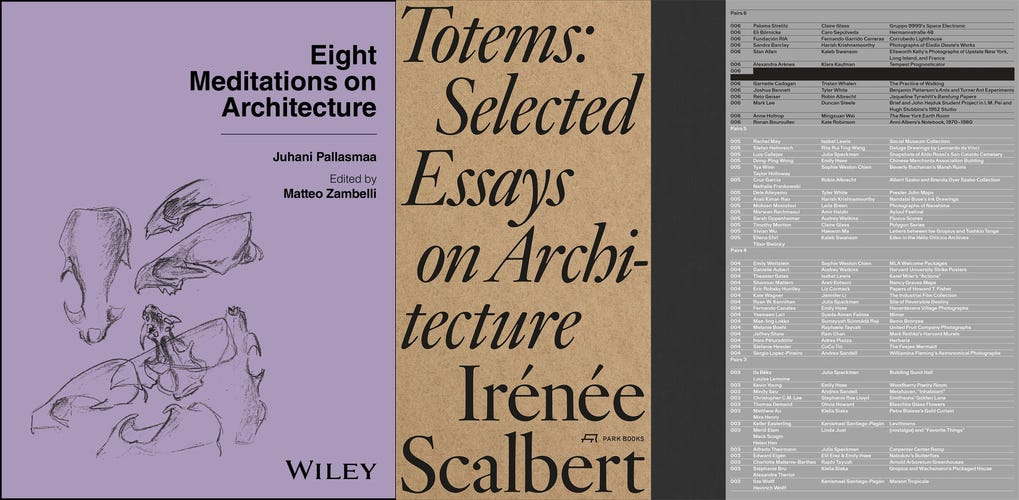
Eight Meditations on Architecture, by Juhani Pallasmaa and Alberto Campo Baeza, edited by Matteo Zambelli (Buy from Wiley / from Amazon / from Bookshop) — “Eight Meditations on Architecture offers a rare and illuminating dialogue between two of Europe’s most reflective architectural voices—Juhani Pallasmaa and Alberto Campo Baeza.”
Totems: Selected Essays on Architecture, by Irénée Scalbert (Buy from University of Chicago Press [US distributor for Park Books] / from Amazon / from Bookshop) — “Totems brings together ten texts by architect, historian, and critic Irénée Scalbert … written between 2001 and 2025…”
Pairs 06, edited by students at Harvard GSD (Buy from Harvard University Press / from Amazon / from Bookshop) — “Pairs 06 features conversations with Francesca Benedetto, Sahel Al Hiyari, Agnes Denes, Mark Lee, Jimenez Lai, David Chipperfield, Sandra Barclay, Stan Allen, Ronan Bouroullec, Anne Holtrop, Dima Srouji, Tim Rohan, Joshua Bennett, and Alexandra Arenes.”
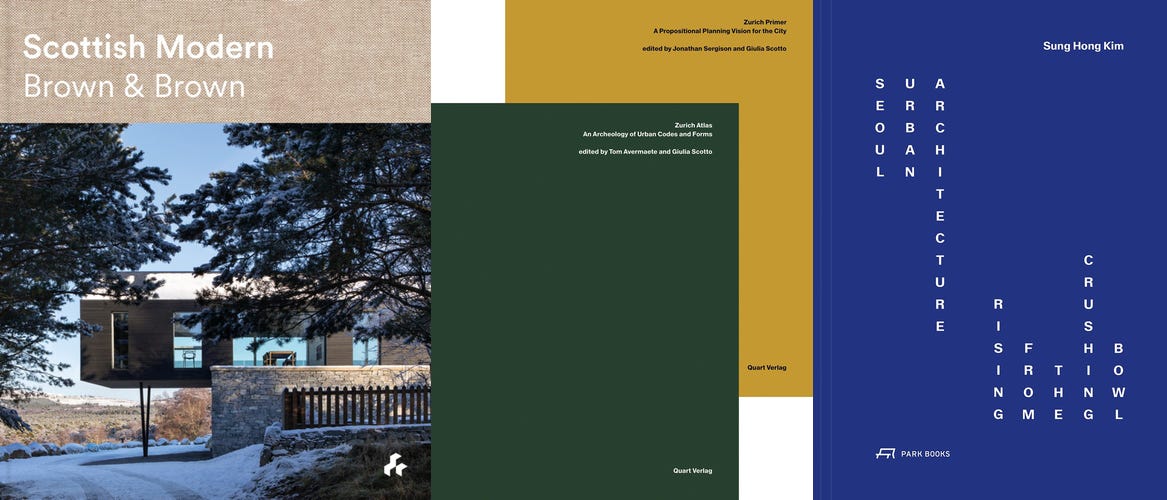
Scottish Modern: Brown & Brown, by Andrew Brown and Kate Brown (Buy from Artifice Press / from Amazon / from Bookshop) — “Scottish Modern is the first book by award-winning architecture studio Brown & Brown, showcasing its placing of contemporary homes in sensitive Scottish landscapes.”
Zurich Atlas / Zurich Primer 2 Vol. Set, edited by Jonathan Sergison, Tom Avermaete and Giulia Scotto (Buy from Simon & Schuster [US distributor for Quart Publishers] / from Amazon / from Bookshop) — “The Zurich Atlas is aimed at a broad audience interested in the dynamics of urban development and reveals the network of relationships between Zurich’s urban form and its urban codes. The Zurich Primer addresses urban growth and transformation in relation to urban codes and proposes densification scenarios for the city of Zurich in the context of the projected population increase.”
Seoul Urban Architecture: Rising from the Crushing Bowl, by Sung Hong Kim (Buy from University of Chicago Press [US distributor for Park Books] / from Amazon / from Bookshop) — “Seoul Urban Architecture is a powerful and original study of Seoul’s urban and architectural evolution, told through the lens of an architect and educator who has lived and worked in the city for over four decades.”
Full disclosure: As an Amazon Associate, AbeBooks Affiliate, and Bookshop.org Affiliate, I earn commissions from qualifying purchases made via any relevant links above and below.
Book News
Guiomar Martín, an associate professor at ETSAM Madrid, reviews architect and educator José Aragüez’s Dispositional Intelligence in Architecture, released by Actar last year. (World-Architects) Full disclosure: I edited this review for World-Architects.
Read some praise on Dean Karau’s “ground-breaking work on Kewanee [Illinois] Black American architect Walter Thomas Bailey.” (The Kewanee Voice)
“A book that asks all the right questions but hasn’t thought through all the answers,” the book being Jan-Werner Müller’s Street, Palace, Square: The Architecture of Democratic Spaces. (The Critic)
Not architecture books, per se, but the State Hermitage Museum in St. Petersburg is displaying The Architecture of the Book until June 7. (Meer)
From the Archives
One of the essays by Simon Henley in this week’s Book of the Week is “On Not Living in a Victorian Terrace House,” a pointed critique of the contextual qualities (or lack thereof) of Neave Brown’s housing projects in Camden, primarily Alexandra Road. That essay brought to mind Cook’s Camden: The Making of Modern Housing by Mark Swenarton, published by Lund Humphries in 2018. Below is the text from my June 208 review.
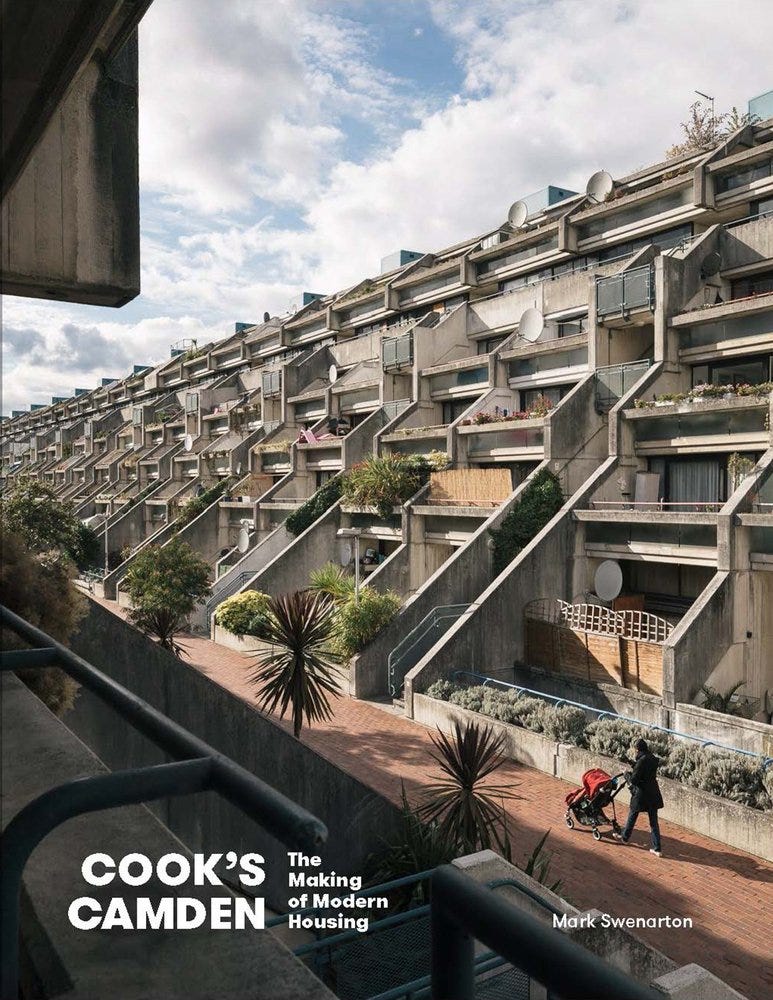
At the end of 1999, I took a trip with my family to London for the millennium festivities. Each day I would venture around the city looking at architecture and then join my family for dinner at a pub near the hotel. Most of my day outings focused on newer buildings, such as the Jubilee Line stations and Future Systems’ Natwest Media Center, but one of the older buildings I went to see was Alexandra Road Estate, a housing project designed by Neave Brown and completed in 1979. (It’s near Abbey Road, making it a two-in-one visit for an architect who is a Beatles fan.) The project is most noticeable for the long, curving concrete terraces facing a pedestrian walk, depicted on the cover of Cook’s Camden, an impressive history of modern housing projects built in that corner of London under Camden borough architect Sydney Cook. Although the book tells the stories of numerous projects undertaken by different architects under Cook in the 1960s and 70s, Neave Brown’s presence dominates, given that its 2017 release happened to coincide with the awarding of the RIBA Gold Medal to Brown, who died in early 2018 at the age of 88.
In turn, having only visited Alexandra Road, my reading of the book focused on it and Brown’s slightly earlier Fleet Road project (now Dunboyne Road Estate). There was some overlap between the two projects in terms of approaches to stacking, unit plans, and shared outdoor spaces, but the impact of Alexandra Road has been more lasting. It was given Grade II* listing status in 1993 (Dunboyne Road Estate was listed later, in 2010) and its park—also a notable work of architecture designed with Janet Jack, which I included in 100 Years, 100 Landscape Designs—was restored just a few years ago. The latter is significant since it was spearheaded by residents, signifying the appreciation of the estate by those who live there, not just by fans of modern architecture or architectural historians like Mark Swenarton.
Three of the book’s twelve chapters are devoted to Brown and Alexandra Road. Two of them tell the in-depth stories of Fleet Road and Alexandra Road estates, while the third is titled “Politics versus architecture: the Alexandra Road public enquiry of 1978-81.” (An appendix also reprints Neave Brown’s “The Form of Housing” essay from 1967.) This last chapter, the book’s eleventh, digs into why such a lauded project—lauded both at the time of its inception in the late 1960s and its listing three decades later—was seen in the interim as a “constructional disaster.” One product of the three-year inquiry was the near-impossibility for Brown to gain work in the UK; even though the protracted inquiry exonerated him, his subsequent notable projects were located in the Netherlands. Those drawn to Brown after his RIBA Gold Medal award will find much to learn in Swenarton’s book, though it’s also recommended to architects who prefer dense low-rise housing to the residential high-rises that tend to garner more attention today.
Thank you for subscribing to A Weekly Dose of Architecture Books. If you have any comments or questions, or if you have your own book that you want to see in this newsletter, please respond to this email, or comment below if you’re reading this online. All content is freely available, but paid subscriptions that enable this newsletter to continue are welcome — thank you!
— John Hill
Comments
Nothing yet. Say the first thing.
Sign in to join the conversation.