
For over a decade, my work has been motivated by a commitment to support women in self-managing their health with gray-zone medicine. What makes cannabis, psychedelics, and peptides “gray” is the lack of clinical evidence to spell out wtf is up in black and white, and greater interest and investment in research are at the heart of progress and safety. That investment is now under direct threat.
Early 2026 data show a 31% drop in active, funded NIH projects mentioning “women” or “women’s health” following administrative interventions. Competitive grants specifically addressing women peaked at nearly 2,000 in 2023, and now sit at ~1,200. HHS phased out funding for the Women’s Health Initiative, the largest long-term national health study of preventive strategies for women in U.S. history. And of the thousands of NIH grants terminated during this period, nearly 58% held by women researchers were cut, compared to 48% for men. The gender equity gap in biomedical science is not closing. It is widening, by policy.
Ahead of co-hosting Psychedelics & the Whole Self: A Gathering for Womxn together at historic Shulgin Farm on July 25(keep scrolling for more info), I sat down with Stephanie Karzon Abrams, a neuropharmacologist working at the intersection of clinical science, hormonal intelligence, and the generational knowing she calls The Wise Body. This conversation is a direct response to the gap the numbers above describe. Women need more research. more rigorous intake. more practitioners who understand that our bodies are not male bodies with different packaging. Steph is building the tools to close that distance, one protocol at a time.
Enjoy the episode, and please leave a review wherever you listen to podcasts!
Take care,
April
APRIL PRIDE is a reader-supported publication. To support my work, consider becoming a free or paid subscriber.
🔵 Episode Summary
The research on psychedelics was built around male bodies. Women were treated as a confounding variable — their cycles, hormones, and life stages filtered out of study designs rather than centered in them. The result is a clinical landscape where practitioners are guessing, women are underserved, and the knowledge that has existed for generations in women’s bodies and lineages is treated as anecdote rather than data.
Stephanie Karzon Abrams is the co-creator of GALILEA and founder of Beyond Consulting, a practice built to close that gap. She is a scientist, a clinician, and a woman from a lineage — Greek, Egyptian, Syrian — with a long relationship to the natural world and to plant medicine. In this conversation, recorded ahead of her presentation at Shulgin Farm on The Wise Body, she makes the case for psychedelic-informed female care: what it requires, what the research does and doesn’t tell us, and what women’s lived experience is already teaching practitioners who are paying attention.
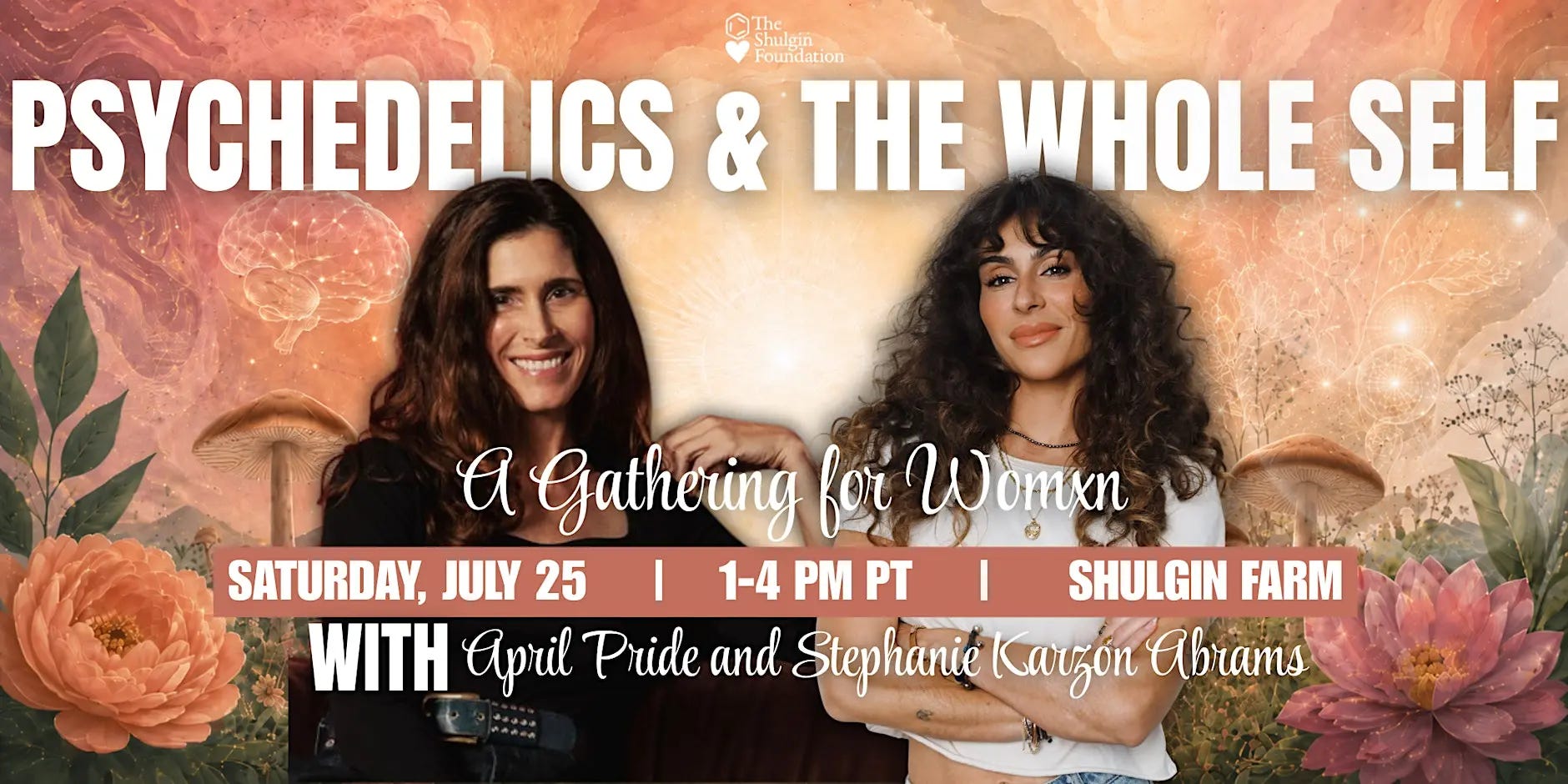
Join Steph K and April for this curated experience at Shulgin Farm, home to the chemistry lab of Sasha Shulgin, who held a DEA-exempt license and first synthesized MDMA. Also at the farm, Sasha’s wife Ann developed protocols for integration with MDMA et al., psychedelic compounds created in the lab. A historic setting to welcome 50 people for this womxn-focused event, ideal for practitioners and anyone navigating the presence or absence of female hormones.
🔵 Key Takeaways
Hormonal landscape will influence a woman’s psychedelic experience — but the research is contradictory enough that we cannot yet say with certainty in what direction.
GLP-1 medications slow gastric emptying and delay the onset of action of prodrugs like psilocybin, so delivery method, timing, and personalized planning are the solutions — there is no single protocol.
The distinction between knowledge and knowing is the foundation of the Wise Body framework. Knowledge can be published and replicated. Knowing is generational, intuitive, and lived.
Psychedelic therapy is more like surgery than a prescription. It requires preparation, skilled practitioners, and mandatory aftercare. Returning for more sessions is not a treatment failure.
Slowing down access expansion is not gatekeeping — it is harm prevention. We don’t yet have adequate data on how diversity, culture, comorbidities, and socioeconomic background affect outcomes.
🔵 Featured Guest
Stephanie Karzon Abrams is the co-creator of Galilea and founder of Beyond Consulting, a practice dedicated to psychedelic-informed female care. Her provider community, clinical toolkit, and consulting practice are open to practitioners at any stage of integrating this lens into their work.
Learn more about Steph K., GALILEA, and Beyond Consulting

🔵 Episode FAQs
Do hormones affect how psilocybin works in women’s bodies?
Hormones almost certainly affect how psilocybin works — but the field cannot yet say with confidence in which direction, or by how much. Estrogen actively modulates the serotonin system, including the 5-HT2A receptors that psilocybin acts on. Because women were excluded from most clinical trials until 1993, and menstrual cycle variables have rarely been tracked in psychedelic studies, the data to answer this question precisely does not yet exist. Women’s reported experiences — including variability across their cycle, after starting HRT, or through perimenopause — are the most consistent signal we currently have.
What is the Wise Body framework? How does it apply to psychedelic medicine?
The Wise Body framework is a protocol-building approach developed by Dr. Stephanie Karzon Abrams that centers women’s cyclical physiology rather than defaulting to male-normed baselines. It distinguishes between knowledge — published, replicable data — and knowing, which is generational, intuitive, and lived. In psychedelic medicine, this means treating a woman’s felt sense of her cycle, her hormonal history, and her somatic experience as clinical data, not anecdote.
Can GLP-1 medications like Ozempic or Wegovy interfere with a psilocybin experience?
Yes, in a specific and clinically important way. GLP-1 drugs significantly slow gastric emptying. Psilocybin is a prodrug — it has to be converted into active psilocin in the gut before it works. When gastric emptying is slowed, the onset can be dramatically delayed and unpredictable. Retreat clinicians are documenting very long onset times and muted effects in women on semaglutide or tirzepatide. In group settings, where the facilitator is timing the container within a predictable window, this poses a real risk. Delivery method, dosing timing, and personalized planning are necessary — there is no single protocol that accounts for GLP-1 use.
Is psychedelic therapy a short-term treatment or an ongoing practice?
Psychedelic therapy is more like surgery than a prescription. It requires preparation, skilled practitioners, and mandatory aftercare. Expecting resolution in a fixed number of sessions — or treating a second session as a treatment failure — is the wrong frame. The number of sessions needed varies by individual, history, and intention. What doesn’t vary is the need for integration support before and after, and practitioners who are honest about what they don’t yet know.
Why is slowing down psychedelic access expansion considered harm prevention, not gatekeeping?
The ecosystems and communities that have held these medicines for generations are not ready to be scaled at the pace the market is moving. Research gaps remain substantial: how diversity, culture, comorbidities, socioeconomic background, hormonal status, and prior trauma affect outcomes is not yet understood well enough to build safe universal protocols. Expanding access faster than the supporting infrastructure — trained facilitators, integration networks, equitable pricing, culturally competent care — can cause harm, particularly for the most vulnerable populations. Slowing down is not about restricting access. It is about building the conditions under which access is actually safe.
What should women tell their psychedelic facilitator before a session?
Women should disclose their full hormonal picture before any psychedelic session: where they are in their menstrual cycle, whether they are perimenopausal or postmenopausal, any hormonal birth control or HRT they are taking, GLP-1 medications, SSRIs, and any other substances that interact with the serotonin system. A qualified facilitator will ask. If yours doesn’t, raise it yourself. Timing, delivery method, and dose recommendations may all need to be adjusted based on this information — and a facilitator who doesn’t ask is working from a male-normed default that may not serve you.
🔵 Additional Resources
Psychedelics & the Whole Self: A Gathering for Womxn—A Salon at the historic Shulgin Farm, discussing women's health, hormones, and psychedelic-informed healing.
On Ozempic and Mushrooms: What Midlife Women Need to Know About GLP-1s, Psychedelics & Cannabis — April’s deep dive on the pharmacological overlap between GLP-1 medications, psilocybin, and cannabis in midlife women’s bodies.
Ep. 33 | Therapeutic Psilocybin Use: Tea, Lemon Tek, and Healing
🔵 Timestamps
🔵 Timestamps
[00:00:00] Disclaimer and welcome
[00:01:00] Why psychedelic research has failed women: built around male bodies, missing cycles, hormones, and life stage entirely
[00:02:00] The contradictory science: low-estrogen rats show higher psychedelic response in some studies, high estrogen in others — and the field cannot resolve it
[00:03:00] What we can say with certainty: estrogen and serotonin are in relationship. What we cannot say: which direction that relationship pushes the psychedelic experience
[00:03:30] Why HRT does not equal high estrogen — and why that nuance matters for clinical assessment
[00:04:00] The two things every practitioner should do now: collect reproductive and menstrual history, and stop building universal protocols. Women are not small men.
[00:04:30] The GALILEA toolkit: a growing Google Drive of practical resources for providers navigating medication tapering, psychiatric flags, and GLP interactions
[00:05:00] GLP-1 medications and psilocybin: how slowing gastric emptying disrupts the conversion of psilocybin into active psilocin — and why this becomes a container problem in group retreats
[00:06:00] When to wait, when to find another way: the decision framework for clients on GLP protocols before a psilocybin session
[00:07:00] Delivery method matters: inhaled, intravenous, buccal, and sublingual routes bypass the gut entirely — GLP interference is specific to oral ingestion of prodrugs
[00:08:00] What retreat clinicians saw first: delayed onset, muted effects, and the danger of redosing when a GLP is in the system
[00:09:00] Personalization over protocol: GLP dose, duration, urgency, and individual factors all shape the right response — there is no single answer
[00:10:00] The energetic cost of a disrupted container: when one person isn’t arriving with the group, the anxiety spreads — and unprepared facilitators can make it worse
[00:11:00] Women’s lived experience as clinical data: “This time of the month, I felt like this” is not anecdote. It is information that should shape care.
[00:12:00] Cycle phase and session timing: late luteal phase for lighter work, follicular and ovulatory phases for deeper integration — emerging practice, not settled protocol
[00:13:00] When a woman understands her own cycle, the shame lifts. That is therapeutic before any medicine is involved.
[00:13:30] Washington State just signed protections allowing workers to disclose perimenopause and menopausal symptoms to their employers
[00:14:00] Knowledge versus knowing: Steph’s distinction between what can be published and replicated, and what is carried intergenerationally — and why the Wise Body framework treats both as equal
[00:15:00] The women who held plant medicine were not unscientific. They were paying very close attention.
[00:16:00] Ancient wisdom did not stop in the year 2000. It is still in practice, still being carried forward — building with it, not just on top of it
[00:17:00] The psychedelic-informed lens is not optional for female care at this point. And there is no excuse for a clinician to say “I don’t know” when this much has been published and shared.
[00:18:00] The gap between what women need and what the system is producing will not close at the speed demand is growing
[00:19:00] Steph’s lineage: Greeks, Egyptians, Syrians — people in deep relationship with the natural world — and how that shapes what she brings into clinical practice
[00:20:00] Radical psychedelic ecology: ecology was theology once. The separation of those two things is modern. The return to the wise body is a return to before that split.
[00:21:00] Science and spirit as equal parts of practice — not a tagline, a clinical argument, especially as spiritual dimensions are being designed out of modern psychedelic medicine
[00:22:00] The most common question in ketamine intake: “How many sessions will this take?” Why that question sets an impossible frame — and how to reframe it
[00:23:00] Complex PTSD, treatment-resistant depression, major depressive disorder: eight sessions of ketamine will not change the diagnosis. It will change the life.
[00:24:00] Returning for more sessions is not failure. It is how ongoing support actually works.
[00:25:00] Ketamine and postpartum depression: why Steph wants insurance coverage for this in her lifetime — and why it is more achievable than it sounds
[00:26:00] The breast milk study: less than 10% of ketamine and active metabolites remain after 12 hours, making ketamine therapy compatible with breastfeeding with planning
[00:27:00] Psychedelic therapy as surgery: it requires a different level of commitment, preparation, and aftercare — and patients are expecting a six-session finish line that does not exist
[00:28:00] The stigma underneath the expectation: society rewards those who seem to need nothing, and casts shadow on those who need ongoing support. That framing is the real problem.
[00:29:00] Integration is a requirement, not an add-on. The growth and development opportunity grows tremendously with structured support.
[00:30:00] The access reframe: FDA approval does not obligate every clinic to offer these therapies. The surgery analogy holds — not every practice offers surgery.
[00:31:00] Slow rollout is not gatekeeping. It is how we ensure we do not dilute the experience, harm people, or move faster than the data.
[00:32:00] What the field is not yet tracking: how diversity, culture, comorbidities, and socioeconomic background affect psychedelic outcomes
[00:33:00] Synthetic is not the enemy of the plant — in some cases it is the preservation of it. The Sonoran toad and peyote are examples where synthetic sourcing protects ecosystems.
[00:34:00] The cannabis parallel: commercialization outpaced data collection, and the plant paid for it. Psychedelics do not have to follow that path.
[00:35:00] GALILEA’s community: over 100 providers and professionals, and growing — reaching people outside the psychedelic bubble who have an open mind and want tools
[00:36:00] What Beyond Consulting builds: programs that don’t exist yet, practices designed from the ground up, a diverse expert team, and a DoubleBlind webinar series coming soon
🔵 Transcript
April Pride, host: [00:00:00] Hey, this is April, and this show, discusses psychedelics. It’s intended for audiences 21 and over. Also, I am not a medical expert. If you are looking to engage with psychedelic substances, please consult your physician before doing so.
April Pride, host: Welcome back to the show. This is your host, April Pride. The question I hear most often from women is not, “What should I take?” or, “How much?”
April Pride, host: It’s some version of, “Why did it feel so different this time? Why did the same dose hit harder the week before my period? Why did microdosing seem to stop working after I started HRT? Why does everything I read seem as though it’s written for someone who is not managing female hormones? Those aren’t fringe questions. They’re the central question of women’s psychedelic health, and the honest answer is that the science has [00:01:00] not kept up with the bodies asking them.
April Pride, host: My guest today is Dr. Stephanie Karzon Abrams, a neuropharmacologist and founder of Beyond Consulting, as well as co-founder of Galilea. Steph, or Steph K, as you’ll find her on Instagram, works at the intersection of psychedelics, neurology, women’s health, integrative medicine, plant medicines, and clinical practice.
April Pride, host: She has my dream job. And I did not ask her this, but I wish that I had asked, “How did you know? How did you know?” This is not someone who talks around the gaps in the research. She names them, maps them, and builds practical tools for the providers who are working in the middle of them.
April Pride, host: Our conversation is a preview of the presentation Steph is bringing to Shulgin Farm in July, where she and I are co-hosting Psychedelics and the Whole Self: A Gathering for Women. [00:02:00] More details and the link to purchase tickets are in the show notes.
April Pride, host: And if you don’t know Shulgin Farm , Sasha Shulgin had a DEA exemption license, and the farm is his lab. He was the first to synthesize MDMA and hundreds of other compounds. So the spirit of this venue, of this setting , is profound, and I hope that if you’re in the Bay Area, you can join us. I’m flying down from Seattle, so perhaps you could travel to be there too. What you’re about to hear is a clinician who has spent years working in hospital settings, then in industry, and now back in clinical practice, watching the same gaps appear over and over.
April Pride, host: She comes to this work with scientific rigor and with something else, a lineage. She’ll talk about what that means. One note before we begin. This episode covers medication interactions, including GLP-1 drugs and psychiatric [00:03:00] medications. Nothing here is medical advice. If you’re navigating any of these combinations, please work with a qualified provider
Dr. Stephanie Karzon Abrams: The presentation that I’m going to give where do we begin? We begin by looking at research. The research has been inadequate and has failed us because it has built a system that is, centered around male bodies, and then it also has built a system where we don’t quite understand exactly how cycles, hormones, and life stage influence a woman’s experience when it comes to any kind of therapeutic intervention.
Dr. Stephanie Karzon Abrams: How will she respond to different interventions, whether they’re pharmacotherapies or they’re, other type of therapeutic modalities based on what her hormones are doing across her cycle, what her lived experience is, what her life stage is, we don’t really understand. And then to add another, layer, psychedelic medicines [00:04:00] are invoking the neurotransmitters, that are very much interconnected with our, hormonal response, we’re talking about serotonin, we’re talking about glutamate, which is like the most abundant excitatory neurotransmitter in the entire nervous system. Glutamate, so there’s a reminder in this presentation about what glutamate does and its role.
Dr. Stephanie Karzon Abrams: there’s a reminder about how estrogen influences the serotonergic landscape and how a woman’s brain chemistry and serotonergic landscape is much more dynamic than men’s. So here’s an opportunity to work in sync with the cycle, not against it, not exclude cyclical intelligent, as a confounding variable, but include it, right?
April Pride, host: Steph just named two neurotransmitters. Most people know serotonin. Glutamate is less familiar. Here’s a quick orientation. Serotonin is often called the mood-regulating neurotransmitter, and psilocybin works primarily by binding to serotonin [00:05:00] receptors, specifically the 5-HT2A receptor. Glutamate is different.
April Pride, host: It’s the brain’s main excitatory signal, meaning it’s responsible for activating neurons and driving the brain to process information. Think of glutamate as the accelerator and GABA, its counterpart, as the brake. Most classic psychedelics, including psilocybin, affect glutamate indirectly by changing how serotonin circuits communicate with glutamate pathways.
April Pride, host: This matters for women because estrogen affects both systems. It modulates serotonin receptor sensitivity, and it interacts with glutamate signaling. When estrogen shifts across the menstrual cycle, through perimenopause or with hormonal interventions, the chemical terrain that psychedelics act on shifts with it.
April Pride, host: Steph is building a protocol framework around exactly that interaction
Dr. Stephanie Karzon Abrams: And the research that we currently have [00:06:00] now is not adequate. Not only is it not adequate, it’s confusing. There’s contradictory information in the body of literature that has been published. I’ll give you an example we’re looking at low estrogen rats and we’re watching the psychedelic response and it is higher when we give them a serotonergic psychedelic like psilocybin.
Dr. Stephanie Karzon Abrams: Meanwhile, there’s other research that points to the fact that a high estrogen state would lead to a higher psychedelic response. Then you add on top of that, that different psychedelics have different mechanisms and that the 5-HT2 receptors don’t follow the same, sensitivity and pharmacological, mechanisms that other receptors do.
Dr. Stephanie Karzon Abrams: So while we can say with certainty that the, hormonal landscape and that serotonin and estrogen are in relationship, that the hormonal landscape is going to influence a woman’s psychedelic experience, we don’t exactly know in what direction. And it’s not just a question of saying high or low estrogen because some women are [00:07:00] no longer, having a regular cycle and the estrogen is low or fluctuating, and we’re giving them estradiol, right?
Dr. Stephanie Karzon Abrams: They’re on estrogen therapy. That doesn’t necessarily imply that they’re in a high estrogen state. They might just be at a normal estrogen state. So there’s all of that and then, the question becomes... It’s very nuanced. So what that leads me to say then is Number one, you should be recording and asking for, reproductive and menstrual history in your assessment of any new patient or client that you’re about to support.
Dr. Stephanie Karzon Abrams: Whether you’re going to give them a medication, a psychedelic therapy, or you’re just going to engage in therapy with them, there should be that history, right? So let’s improve our assessment of women. Let’s get a deeper understanding of, who they are and what their experience is. and then when it comes to offering an intervention, especially a psychedelic therapy, let’s get really personalized.
Dr. Stephanie Karzon Abrams: Let’s stop trying to build protocols that are universal because there is not one universal [00:08:00] human being, especially women. Women are not small men. We’ve all heard that said many times.
Dr. Stephanie Karzon Abrams: And then my friend Dr. Susan, on a podcast said, “The FDA is not your mom.” And I was just like, “Put that on a T-shirt and I will, I’ll make that my daily uniform.”
April Pride, host: the contradictory findings Steph just described are real. The research is genuinely pointing in different directions depending on the animal model, the estrogen state, the specific psychedelic being studied. That’s not a reason to dismiss the hormone question, it’s a reason to stop pretending the question has been answered.
April Pride, host: The deeper problem is structural, is systemic. Women were formally excluded from clinical trials until 1993.
April Pride, host: 30 years after pharmaceutical companies were required to demonstrate a drug’s effectiveness through adequate, well-controlled clinical trials and submit detailed results to the FDA before approval. [00:09:00] Menstrual cycle phase has rarely been tracked or controlled for in psychedelic studies.
April Pride, host: In any studies really . So the data that would let us say, “High estrogen produces this kind of response,” simply doesn’t exist yet at the scale needed to guide clinical practice. What practitioners are working with right now is a combination of mechanistic reasoning, the estrogen-serotonin interaction is real and established, and women’s self-reported experience.
April Pride, host: Steph’s argument is that the second category should be treated as data, not anecdote
April Pride, host: That’s great. I have a couple questions. One, I believe on the GALILEA website, you offer an assessment form that practitioners can use, right?
April Pride, host: so you’re trying to help, right? If you don’t know which questions to ask, this is a good place to start.
Dr. Stephanie Karzon Abrams: We created a toolkit, and the toolkit is growing. every time I present this information to groups, I offer them the toolkit.
Dr. Stephanie Karzon Abrams: It’s literally a Google [00:10:00] Drive folder that keeps growing with things that, providers of any kind can pick and choose from. There’s stuff like, how to support your client if they’re going through medication tapering. Maybe you’re not taking them through the taper, but you’re their therapist- And you’re going to be in very close, relationship with them, and there are things that you need to watch out for because there are psychiatric conditions that can develop during a taper.
Dr. Stephanie Karzon Abrams: you’re changing that person’s status quo as you start to remove the psychiatric medication that’s been supporting them for, 10 plus years. So as the therapist working with her and her mind and her body and her spirit, there are certain things that you need to look out for, and then there are certain things that you might need to escalate.
Dr. Stephanie Karzon Abrams: How do you do that? So we created a flag sheet. The other thing that’s becoming more, popular now are GLPs. And if someone is going to be on a GLP and engaging with psilocybin, we have to remember that the GLP is gonna slow gastric emptying. That’s going to affect the onset of psilocybin, which needs to be metabolized into the active [00:11:00] psilocin.
Dr. Stephanie Karzon Abrams: how do we frame that and prepare a woman, who might be on a GLP entering this experience? How do we prepare the vessel, the physical vessel? And how do we set expectations for the fact that the onset of, the medicine could come on really sporadically or unreliably, and how do we manage expectations?
Dr. Stephanie Karzon Abrams: When do we say, “Actually, why don’t you finish your GLP protocol and wait four to even eight weeks perhaps for that to, wash out and come back to baseline before we do this?” So there are a lot of little guiding tools, and the assessment that you mentioned is really fantastic because you can pick and choose what you want from there and just add that to your current intake.
Dr. Stephanie Karzon Abrams: Or if your current intake doesn’t have any of this, make it an addendum. ask some basic female health questions and use that to guide whether or not you then hand them an additional questionnaire.
Dr. Stephanie Karzon Abrams: At the end of the day, the mechanism of slowing gastric emptying is, common across all of these medicines, and [00:12:00] that’s something to know, right? If you’re not ingesting the psychedelic, if it’s something that you’re inhaling, if it’s something that’s going into your bloodstream, if it’s something that’s being absorbed buccally in your mucus membranes, you are bypassing, the digestion and the metabolism piece there.
Dr. Stephanie Karzon Abrams: So there isn’t that kind of interference. it’s really highly relevant for any medicine that needs to be converted into its active. So a pro drug like psilocybin. and it’s not a given, right? We’re in this new territory. So it’s like we had to come up against the experience to go “Oh, yeah, these are competing mechanisms.”
April Pride, host: . And I think it speaks to how important it is that practitioners feel comfortable discussing what’s coming up for their clients together, that not everyone’s underground and maybe not talking because I think the reaction to more and more clients being on GLPs very quickly I was hearing, “Oh, the experience is being changed.
April Pride, host: Onset is taking longer. We have people in group retreats, and some people are not getting there with the group,” and [00:13:00] we didn’t really know what was going on at first, right? And so coming up with a protocol which could be, wait until your protocol is complete in order to... But also it could be just choose a form factor that bypasses the liver might be the easiest solution.
Dr. Stephanie Karzon Abrams: But there’s other strategies, right? there’s lemon tekking, there’s different things you can do.
Dr. Stephanie Karzon Abrams: There’s different medicines. But this is why I say that it’s not black and white, and not just with women, but just with care in general. People have different situations and you have to meet them, and then you have to present the options, and it’s not just like a one-size-fits-all, “Okay, if you’re on a GLP, this is what we’re gonna do,” because maybe that solution is not going to really fit for that individual, right?
Dr. Stephanie Karzon Abrams: So it’s let’s figure out what the options are. Someone’s on a GLP, let’s get the medical history. Let’s understand the dose. Let’s understand how long they’re taking it for, and then how long they have left in their GLP protocol, and let’s make an informed decision about what’s best for this person.
Dr. Stephanie Karzon Abrams: Is it let’s wait till you’re done? [00:14:00] Is it urgency, and so let’s find another way, whether that’s Sulosin or whether it’s another medicine, or is there like holding your GLP for a couple of weeks, there are so many different strategies, but you need to have a really strong base of information and understanding in order to present them the strategies and then find the one that’s gonna work.
Dr. Stephanie Karzon Abrams: and the example that you mentioned about the group retreats, it’s not only like a question of competing like pharmacological agents, if you will. What about the experience of the expectation of all of the preparation? You go sit in this group and everyone is like coming up together and it’s just this...
Dr. Stephanie Karzon Abrams: and then you’re there and you’re like, what’s going on?” It disrupts the container. It’s disruptive and disappointing for your experience. If the people who are supporting aren’t prepared for that- That’s gonna really throw them for a loop, right? And so then it becomes this, energetic field now that is very disruptive, disrupted, and maybe, anxious
April Pride, host: Yes, anxious
Dr. Stephanie Karzon Abrams: And I think if we’re not informed, then the [00:15:00] instinct is maybe to redose or to up the dose, and then things could come on and hit all at once, and now you’re in this crazy intense experience that you weren’t prepared for. So there’s a lot to do on the front end, more than we’re realizing.
Dr. Stephanie Karzon Abrams: at the end of the day, it just goes back to, this personalization is key. we have guidelines, and then now it’s time to personalize, and, it’s worth it. It’s worth it to try to meet a human, exactly where they are, especially with women, given that we are hormonally more dynamic and that we transition more frequently in our identity.
April Pride, host: A clarification on the pro-drug point, because this is the mechanism that makes the GLP-1 interaction so specific. Psilocybin Is not the active compound. Our bodies convert psilocybin into psilocin in the gut and liver. Psilocin is what crosses into the brain and binds to those serotonin receptors.
April Pride, host: The conversion [00:16:00] happens in the digestive tract. GLP-1 drugs slow gastric emptying, meaning food and everything else stays in the stomach longer before moving through. That delay in transit disrupts the conversion timeline, so the experience doesn’t just come later, it can come unpredictably at a higher intensity than expected at a moment when the group container has already moved through its arc without you.
April Pride, host: The strategies Steph named are real options that practitioners are using now. Waiting until the GLP protocol is complete, pausing the GLP for a defined washout period, similar to what is asked of clients in terms of titrating off of their SSRIs or other pharmaceutical medication. Switching delivery method.
April Pride, host: Sublingual psilocin bypasses the gut entirely. Lemon tek, which involves pre-converting psilocybin into an acidic solution before ingestion, can [00:17:00] speed metabolism. None of these are universally applicable. All of them require a practitioner who asked the question in the first place I will link to a previous episode and which goes into lemon tekking
April Pride, host: So you can learn more about that way of preparing mushrooms.
Dr. Stephanie Karzon Abrams: So if you wanna, set the hormones and the science, to the side for a second and just looked at lived experience, a big part of this presentation that I’m going to give at the Shulgin Farm is about saying, “This is what we have in the science that we can anchor to. This is everything that we don’t know,” right?
Dr. Stephanie Karzon Abrams: “So let’s please motivate ourselves to fund the research and figure it out ‘cause it’s ... That rigor is important.” But in the meantime, we have women’s lived experiences. Women can tell you, “This time of the month, I felt like this. This time of the month, I felt like this.” When I gave birth, I went through six months of feeling like this, as I enter midlife, I’m all over the place. I feel [00:18:00] randomly anxious. I can’t focus. I can’t sleep. I feel hot. I feel cold. Okay. All right. Now you’re telling me that there’s all of this variation. that’s not just cool, fluffy information. That’s information that’s extremely valuable that’s going to inform how I’m going to care for you.
Dr. Stephanie Karzon Abrams: week after week, you can use that cyclical information, to guide how you offer your sessions, Maybe in the mid luteal or late luteal phase when women tend to report more sensitivity and more energy depletion, maybe that’s not when you go in and do really deep work.
Dr. Stephanie Karzon Abrams: Maybe that’s when you keep things a little bit lighter, right? And the focus is different. Maybe we’re focusing on, more positive experiences, things that are encouraging and motivating, that are gonna really make someone feel held. And in the high energetic phases of the cycle, like the ovulation and the follicular phase, that’s when someone maybe is more resilient and has more attention and capacity to go do deeper work, to do integration work, right?
Dr. Stephanie Karzon Abrams: and the same thing with, a woman [00:19:00] who’s maybe postpartum or a woman who might be going through menopause. The way we approach her based on her life stage is going to be completely different. So we need to listen, first and foremost. And then I’m gonna present some tips on how to use cyclical awareness, cycle awareness, and life stage in practice.
Dr. Stephanie Karzon Abrams: like, how to record the information, and then how to leverage it, not just to dictate, session timing and, dosing, but also to help, validate and, offer education that is very therapeutic here. Because when a woman understands, the shame lifts, doesn’t it?
Dr. Stephanie Karzon Abrams: ‘Cause there’s a lot of shame that we carry. “Ugh, I can’t show up this week.” And who do you call? You call your boss and you say, “Listen, man, I’m about to bleed for five days. I just... I can’t handle this workload today.” We can’t do that.
April Pride, host: In Washington State you can now if you-
April Pride, host: are experiencing perimenopause or menopausal symptoms. They just signed it last week. I can’t even believe it.
April Pride, host: I want to be precise about the clinical [00:20:00] weight of what Steph just described. The suggestion that late luteal phase may not be ideal for deep psychedelic work and that follicular and ovulatory phases may offer more capacity for it, that’s emerging practice-based guidance. It comes from practitioners working with real women in real sessions over time, and it is coherent with what we know about how progesterone fluctuations affect anxiety sensitivity and emotional regulation.
April Pride, host: It is not yet supported by controlled clinical trials. There are no published studies that randomized women to different cycle phases for psychedelic sessions and compared outcomes. That doesn’t make the guidance wrong. Rather, it’s provisional. Track your own experience. Tell your practitioner where you are in your cycle.
April Pride, host: Let that information shape the conversation. The absence of clinical data is not permission to ignore the signal
April Pride, host: So I wanna... A couple things. Everything that you’re saying goes back to teaching women [00:21:00] about the wise body. Yes. Which is about listening to our own body, right? so that we can better express to those that can help us what we’re going through and what...
April Pride, host: I think that this word wise, maybe it’s because I just turned 50, it’s really connecting with me. So how did you come up with... this foundation. I wanna learn.
Dr. Stephanie Karzon Abrams: we confuse knowledge and knowing. So when we talk about wise and wisdom, I make that synonymous with knowing.
Dr. Stephanie Karzon Abrams: And knowledge is something that you can replicate, you can verify, you can publish, and knowing is something that is a form of intelligence that is carried in generation after generation. It’s our intuitive power, it’s our lived experience, and it’s what we’ve been taught consciously, unconsciously over time.
Dr. Stephanie Karzon Abrams: what our lineage offers us, what our families, what our mothers have taught us unconsciously and consciously, [00:22:00] right? this intelligence predates any of the scientific method that we have designed today. And these plants, these medicinal plants, psychedelic or not, just this plant medicine has been here before any of this scientific rigor or conversation, has been around before society started telling people what’s good and what evidence counts or not.
Dr. Stephanie Karzon Abrams: something that I talk about in this presentation is that a lot of this medicine was held and offered by women, and these women were not unscientific. They were paying very close attention, And so when I talk about the wise body, it’s about remembering that we knew things before we were told that we didn’t.
Dr. Stephanie Karzon Abrams: And now today, we don’t have to choose between ancient and rigorous. We have to weave them together. And when people say we have to build on that foundation, I say yes, and it’s built with that foundation because the ancient knowledge and the wisdom that came before us didn’t just stop with the year 2000. it’s still in practice. There are people from those lineages that are still practicing in that way, that are still carrying that wisdom forward and teaching it to people in their modern society. So it didn’t stop at any point. It’s still very much there.
Dr. Stephanie Karzon Abrams: So when people say we have to build on that foundation, I understand what they’re saying. Yes, we do have to, but we’re actually building with it because it’s continuing alongside of us. And it’s also about honoring not only the research and the data that’s coming out of those academic centers, but it’s also about listening and amplifying the voices of those who are dedicated to this work, who are just independent investigators too.
Dr. Stephanie Karzon Abrams: So citizen science or science from the [00:24:00] underground, or science from the jungle is as equally as valuable as whatever’s coming out of your state university. And so that is the return to the wise body. It’s that remembering that we knew things before we were told that we didn’t. That’s really how I see it.
Dr. Stephanie Karzon Abrams: Yeah, and especially in the female, experience that is like innately one of continual transformation. And these plants and these psychedelics are transformational medicines. So it really goes to show me that the psychedelic informed lens is mandatory at this point in female care.
Dr. Stephanie Karzon Abrams: And I’ll say this in my presentation, and I’ll say it over and over again to whoever wants to listen, it’s not a requirement of practice, but it’s an expanding of your understanding. And we’re at a point now where there’s so much that’s been published, there’s so much that’s been shared, there are communities, there are harm reduction strategies.
Dr. Stephanie Karzon Abrams: There’s absolutely no excuse for a clinician at this point in time to be telling their patient, “I don’t know” or, “I can’t talk [00:25:00] about it.” And GALILEA wants to close that gap. If you’re a clinician or a provider that doesn’t know, no problem, we’re here for you. We’ll point you to the publication if that’s what speaks to you.
Dr. Stephanie Karzon Abrams: We’ll point you to the community that, pushes harm reduction forward. Whatever channel makes you feel like you can have a supportive and safe conversation with your female patient, we will introduce you to it
April Pride, host: No, really, it is a huge gap. It’s a huge gap, and it will not get filled in the amount of time that demand from women and others are, needing that information for their wellbeing.
April Pride, host: So yeah, I know that what you’re doing is needed. And I’m... As a person whose work presents the rigor that you just mentioned, and I don’t know you well, but I do sense that there is a huge part of you that is informed by what’s not coming out of academic institutions. [00:26:00] Where are you drawing your information, your, inspiration?
April Pride, host: how are you weaving those things together? Yeah, as any human being, I have my own lived experience. I hear from the women around me. I read things, I hear things, so there’s definitely that.
Dr. Stephanie Karzon Abrams: And yes, my lived experience has definitely influenced this work. I work within the clinical setting as well, so I see the gaps. I saw the gaps when I worked in hospital setting for years, Then I went into industry, did something a little different, but now I’m back in clinical setting for the last, five years, and I work in clinics.
Dr. Stephanie Karzon Abrams: I see what patients are reporting, I’m seeing what they need, and I’m seeing where we can close the gaps. And then importantly, I come from a lineage of, women, and I talk very openly because I’m proud of where I come from. I come from ancient people, Greeks, Egyptians, and Syrians, and these people were in a deep relationship with the natural [00:27:00] world.
Dr. Stephanie Karzon Abrams: and I love this. I thought about this, quite extensively, with a presentation or a panel that I was on a few weeks ago about radical psychedelic ecology and what that meant to me. And what it really came down to was a little bit about what I expressed about knowing versus, knowledge, but that ecology was theology once upon a time.
Dr. Stephanie Karzon Abrams: we lived in a deep relationship with the natural world. We were in harmony and symbiosis and, modern times has really changed our relationship with the world, with Earth. for me, in my work, it’s about really blending my scientific rigor, what I find in literature reviews, what I find in publications, with this deep sense of knowing that I come from a long lineage of people who carried that wisdom and who practiced medicine and care in the way that I think we need more of today.
Dr. Stephanie Karzon Abrams: I’m very much guided by a mission to bring the, [00:28:00] psycho-emotional and spiritual dimensions of health back into clinical practice. They don’t have to be separate because whatever spiritual relationship we have or not, that lived experience, is going to influence how we evolve, how we respond to treatments, right?
Dr. Stephanie Karzon Abrams: And so it’s, like my guiding principles. it’s a true blend of, the science and the spirit, and I know that’s, a tagline that gets thrown around a lot, but that’s really what I’m here for because I truly believe that we do need two equal parts in practice.
April Pride, host: Yeah. I know what you mean by it being a tagline. science and spirit is, it does seem like a tagline, but I don’t think that it can be stressed enough because the spirit part of things is being...
April Pride, host: Because that’s, this is the way that our system works, right? It’s just being designed out of modern psychedelics. And so to have people who are people of science that are talking [00:29:00] about the spiritual aspect of it there just aren’t going to be enough people stressing that.
April Pride, host: So those of you who are willing to talk about both, it is important.
Dr. Stephanie Karzon Abrams: Getting down to the root Cause of anything at this point, I think we’ve realized is key, right?
Dr. Stephanie Karzon Abrams: And sometimes we think “Okay, we get down to the root cause, it means that we’re gonna be able to cure ourselves.” And I think that’s a dangerous and like slippery slope that sets really impossible expectations for people. I talk to a lot of patients, who are interested in ketamine therapy or preparing for ketamine therapy, and I always get the question of “What’s the difference between doing ketamine therapy and taking my oral antidepressants?”
Dr. Stephanie Karzon Abrams: And, “How many sessions is this gonna take?” That’s like the number one question, and we need to reframe how we answer that question because even though a lot of people are gonna communicate that ketamine or psychedelics are not a magic bullet or a magic pill, right? We hear that a lot,
Dr. Stephanie Karzon Abrams: There is still this [00:30:00] expectation that getting down to the root cause, using a psychedelic therapy that’s gonna allow you to connect more deeply with yourself and solve, problems that have become deeply ingrained, are going to lead to more of a cure. in many cases people do make a complete 180, there are many people who will continue to be challenged by whatever they’re presenting for the rest of their lives.
Dr. Stephanie Karzon Abrams: The more complex the issue is, complex ps- PTSD, especially a form of PTSD that is rooted in something like sexual abuse, right? Treatment resistant depression, major depressive disorder. This is not a transient, circumstantial, situational type of depression. This is something that is so deeply intertwined with our lived experience, with our identity, with our neurochemistry [00:31:00] that eight sessions of ketamine are probably not going to change that diagnosis for you.
Dr. Stephanie Karzon Abrams: Will it change your life? Yeah, it probably will because now you are going to connect with yourself and develop tools that are going to make you feel more supported, more resourced, and more able to face the day-to-day. Next time you come up to a challenging life experience, you have something to anchor to and to show up with in a better, more resourced, resource prepared way.
Dr. Stephanie Karzon Abrams: Life is not gonna suddenly be glorious and easy just because you did eight sessions of ketamine therapy. Life is life. It’s gonna continue to throw difficult moments at us, and all we can do is prepare ourselves to show up as best as we can so that we can handle them. But if you have to return to your clinic for more ketamine or for more therapy, that’s okay.
Dr. Stephanie Karzon Abrams: That’s not [00:32:00] abnormal and that’s certainly not a failure of the treatment or of the team that was supporting you. But I will say that it’s better than taking an oral antidepressant forever in some cases. And for people who feel very stable and managed with the oral antidepressant, fantastic. But for those who aren’t satisfied, here’s something that’s going to teach you more about yourself.
Dr. Stephanie Karzon Abrams: here’s a therapy that’s transformational. It’s not just pharmacological. This isn’t just about treating your depression.
April Pride, host: a harm reduction note here that I think Steph would agree with. The reframe she’s describing, returning to treatment as continuity, not failure, matters most for the people who won’t hear it. The expectation gap is real, and it causes concrete harm. People who feel let down by a course of ketamine therapy sometimes stop pursuing support entirely, or they conclude that they are the problem rather than the frame if you are preparing for any psychedelic-assisted therapy, the most useful question to bring to your first [00:33:00] intake is not, How many sessions will this take?” It’s, “What does ongoing support look like?” That question tells you something about the practitioner.
April Pride, host: A good answer involves integration, follow-up, and an honest acknowledgement that healing is not linear. A non-answer is information too
Dr. Stephanie Karzon Abrams: at Shulgin Farm. We’ll hear from Melissa Whippo , she asked me to join her study, on ketamine and, postpartum depression.
Dr. Stephanie Karzon Abrams: I wanna see Ketamine therapy covered by insurance for postpartum depression. in my lifetime, and I think it’s very possible, with ketamine being a drug that has been around for so long and having such a deep understanding, the mere fact that we practice with it the way that we do in the States is actually a blessing because there are other coun- Like I was just on the phone with a colleague in France, and he was telling me how injectable ketamine is not used rather in France, and all of the red tape around that kind of intervention in Europe.
Dr. Stephanie Karzon Abrams: We’re very lucky that [00:34:00] here there’s a little bit more, openness, and this, opportunity. The other thing that’s in our favor is that we have this incredible pharmacokinetics in breast milk study from, I think it was 2024, maybe 2023, and it is a very important body of work because now we know that there’s less than 10% of ketamine and its active metabolites left in the breast milk after 12 hours.
Dr. Stephanie Karzon Abrams: So as long as a mother ensures that her baby will take the bottle, she can store breast milk, do a pump and dump- ... and then maybe skip a few, breast feedings, but can give baby the bottle and it’s not disruptive. And a ketamine session, usually you’re in session maybe from beginning to end, like three hours.
Dr. Stephanie Karzon Abrams: that’s doable. This is manageable without being very disruptive to the relationship of a new mom to her baby. And again, as a psychedelic-assisted therapy, this isn’t just about managing her depression and her symptoms, this is about [00:35:00] coping tools and processing the identity shift that is happening.
Dr. Stephanie Karzon Abrams: You can go much deeper than just solving for the feelings of depression here.
Dr. Stephanie Karzon Abrams: These types of therapies need to be looked at completely different. sometimes I like to compare them to a surgery. It’s a different kind of procedure.
Dr. Stephanie Karzon Abrams: Takes a different level of commitment and investment, and so I think like we absolutely need to reframe how we’re setting those expectations for patients because patients are expecting this “I’m gonna do six sessions and I’m done.” They’re not expecting a one and done, but they’re expecting like a six and done.
April Pride, host: Yeah. And then they feel some type of way when they have to return. It’s “Why didn’t it work for me?” Or “It doesn’t work,” or something like that, but that’s not the case because compare it to the fact that you were taking a daily pill And you are probably gonna be on it forever. Is this not better?
Dr. Stephanie Karzon Abrams: This is just the intervention or the support that you need. It can look like different kind of work for different [00:36:00] people. Like perhaps someone else it’s EMDR sessions, or somatic type of therapy, and it doesn’t diminish your value as a person, that you need something that is a little bit more- Yeah
Dr. Stephanie Karzon Abrams: interventional. And so I think there’s that too, ‘cause like society seems to, reward those who like need nothing, or seemingly need nothing, or like people who seem to be more resilient and self-sufficient and then we cast like a shadow on those who need help.
Dr. Stephanie Karzon Abrams: So it’s just like the core of the issue is just way beyond someone on the phone setting an expectation for a patient. It’s about totally reframing the way we talk about mental health. There’s so much stigma still. You’re not lesser than. At the end of the day, you’re not lesser than anything or anyone just because your work looks different than your neighbor’s, or the intervention that you need requires more than someone else.
April Pride, host: I wanna say that comparing the [00:37:00] process of choosing a psychedelic intervention to surgery, it’s the first time I’ve ever heard that, and it implies that aftercare is mandatory, and that is great. Because I feel like that is obviously the step that the integration part gets overlooked so much.
Dr. Stephanie Karzon Abrams: it’s a requirement. Of course you can have an experience and then not, integrate it formally. Maybe you just- go home and you think about it, or maybe you don’t even think about it at all and you’re just like showing up for your weekly ketamine IV and whatever comes up, and then you go about your day.
Dr. Stephanie Karzon Abrams: But yeah, the opportunity for your growth and development grows tremendously when you have that additional support.
Dr. Stephanie Karzon Abrams: And yeah, comparing it to surgery I think also reframes how we think about access, right? So we have different channels of access, right?
Dr. Stephanie Karzon Abrams: So you can go to a ketamine clinic, you can go to a therapy center in Colorado or Oregon and sit with psilocybin there. You can get- ... your [00:38:00] medicines from your homie. You can go sit in a ceremony, whether that’s local, some people are holding ceremonies. You can sit in a ceremony or a underground therapeutic session.
Dr. Stephanie Karzon Abrams: You can go to the jungle. You can go to a retreat. You can participate in a clinical trial. There’s all these different methods. But as access starts to become more part of our modern system with descheduling, with FDA-approved medicines- I think that there’s this unrealistic expectation that once it becomes FDA approved or part of our system because of legislation changes, that now the systems have to supply the demand.
Dr. Stephanie Karzon Abrams: And maybe this is gonna sound a little controversial, but I don’t think we need to supply the demand. I think that these therapies can be transformational, life-changing, and can save lives, especially for people who are at the end of their rope and they’ve tried everything, right? And I want people to access them.
Dr. Stephanie Karzon Abrams: But we’re stepping into such a new landscape with these medicines now that the expectation that it has to roll out to everyone as soon as possible, and all the clinics have to offer them, and we have to get everybody trained so we can treat as many people, and we have to lower the financial barriers so we can give access to everyone.
Dr. Stephanie Karzon Abrams: Let’s take a beat. We need to roll it out slowly, and part of it being offered in select places by select people is not any kind of exceptionalism or gatekeeping. This is how we ensure that we do not dilute the experience and turn it into something that it’s not, and make sure that we don’t harm people.
Dr. Stephanie Karzon Abrams: We need to take note and account of how we’re integrating these into a modern medical system, and we also have to watch people’s responses and document them because we haven’t been doing it this way for very long. I can appreciate that we know a lot from the [00:40:00] ancients, and we can factor that in But our studies and even in clinical or real world practice, we’re not really taking note about how diversity and culture and socioeconomic background and comorbidities are affecting people’s responses.
Dr. Stephanie Karzon Abrams: So slow right now is mandatory and necessary. and the thing about the surgery, just to go back to that, is think about surgery. Not everybody needs surgery, not everybody gets surgery, and not every single medical practice out there is offering surgery. So I think it’s also about looking at these types of interventions as interventions, as procedures, and not as how we dispense medication at a pharmacy.
Dr. Stephanie Karzon Abrams: I think that if we think about it like that, I think it’ll appease people who are really focused on giving access to as many people as possible. Yes, of course we want that. We wanna help people who have not been helped and people [00:41:00] who need to be helped. but in order to do that, we need to, slow our roll, and we also need to accept that we don’t have to supply the demand, and that’s especially true when it comes to plant medicines and the ecosystems, the natural ecosystems, the people in the small villages that are now becoming eco tourisms.
Dr. Stephanie Karzon Abrams: They’re not ready to receive 50 of you at once on a bus, and they might not even want that. and so when people say, “I want the natural route, I want the natural route,” because, ugh, synthetic. Synthetic is synonymous with biotech and pharma and what’s evil, capitalism.
Dr. Stephanie Karzon Abrams: Yeah, but not necessarily, peyote isn’t endangered. the Sonoran bullfrog is at risk, and as much as I see the tremendous value of sitting with a plant because it’s of this earth and we are of this earth and I want that connection, we also have to come to the, [00:42:00] reckoning that- Maybe in certain cases a synthetic source will actually save the very ecosystems that you wanna preserve.
Dr. Stephanie Karzon Abrams: Totally. So I also encourage people to rethink that whole relationship to synthetic and realize that it could mean preservation in many ways. Of not just the plants, but the people.
April Pride, host: When you talk about slowing our roll, I think about cannabis, and there were no data points that were being taken along the way and, it was just a free-for-all. The commercialization of that plant is very different than nature intended, for our bodies to interact with in many cases.
April Pride, host: At the same time, I’m, grateful that people have access to it without breaking the law, this has been a wonderful conversation. I wanna make sure that people can access your work
Dr. Stephanie Karzon Abrams: On our, priority list the community is really key. We have an online, WhatsApp community and it surpassed 100, providers and professionals growing that community’s really important because we can all be resources [00:43:00] to each other, and the more people having this mindset of psychedelic informed care in female health of, hormonal and life stage intelligence across all medicine, I think is how we improve care because there are so many different caregivers and providers.
Dr. Stephanie Karzon Abrams: They all have, their style, their methods of how they do things, but if these are, two important foundational elements to how you practice, I truly believe that you are now leveling up the care that you’re giving. So I think that’s huge, and I’m really trying to reach people who are not in the psychedelic bubble because those aren’t the people that need, necessarily convincing or that need to be pointed towards the information.
Dr. Stephanie Karzon Abrams: I really wanna reach people who have an open mind, an open spirit to understanding why. Why psychedelics for transformational experiences for these important life transitions? What are psychedelic therapies addressing that our conventional medicines aren’t? And how do we [00:44:00] blend these two, types of medicines and therapies because they can be used in conjunction, we’re starting a webinar with DoubleBlind as well, while you have all this free access, there are people out there who really wanna put it into practice in an intentional way with, education, with operational structures.
Dr. Stephanie Karzon Abrams: we have this, sub-consultative group within Beyond Consulting that will come in and help you. we have a team, a very diverse team of experts, and we’ll bring in exactly who you need. We’re here to build the programs that don’t exist that you wish to build
Dr. Stephanie Karzon Abrams: we design practices from the ground up. So the Galilea, method can come in at any point during that journey, then the third is
Dr. Stephanie Karzon Abrams: the team- of research interns is growing, to, reach our goals in terms of education and research.
April Pride, host: What Steph is building is a clinical argument for something that women have been reporting for years, that their experience of psychedelics is not the same week to week, that their hormonal [00:45:00] status is not a confounding variable to be controlled away, but information to be used, that the gap between the research canon and the reality of women’s bodies is not a niche problem, it is the problem.
April Pride, host: The honest answer to the question, do hormones change how psychedelics work in my body, is still almost certainly yes, and we don’t yet know how to quantify it. What Steph is doing is building the intake infrastructure, the assessment tools, the practitioner training that makes it possible to collect that information systematically before we have clinical trials to guide us.
April Pride, host: The surgery comparison stays with me, not as a metaphor for complexity, but as what aftercare actually means. Surgery has required follow-up built into its standard of care for as long as there has been surgery. Psychedelic therapy is still negotiating whether integration is optional, and really, the results are in.
April Pride, host: It isn’t, and pretending otherwise does the most harm to [00:46:00] the people who are already the least resourced. If you’re a practitioner, Steph’s GALILEA Toolkit and its community is a place to start. If you’re a woman preparing for any psychedelic experience, reflect on your hormonal history and be prepared to share it, all of it.
April Pride, host: Cycle phase, birth control, HRT, GLP status. A practitioner who doesn’t ask you should be informed by you. Steph and I will be continuing this conversation in person at Shulgin Farm next month, July 25th, Psychedelics and the Whole Self: A Gathering for Women.
April Pride, host: Space is limited because the site is small. Link is in the show notes. Find Steph’s work at beyondconsulting.life, also in the show notes. The science that doesn’t exist yet for women’s psychedelic health is being built by people like her
April Pride, host: Thanks for joining me for this episode. Take care.
[00:47:00]
Comments
Nothing yet. Say the first thing.
Sign in to join the conversation.