
We tend to cover current and future trajectories in this Substack, but today, we start the story waaay back. In 1920, worried that the French population was shrinking after WWI (a depopulation panic is not new news!), the National Assembly passed a law making it a crime to sell contraceptives or even talk about them in public:
Reproductive behaviours in France changed over the course of the eighteenth century: a large share of the many couples seeking to control their family size began using the withdrawal method. The result was that contrary to the situation in neighbouring countries, French birth rates began falling sharply—a cause for considerable concern. The country’s defeat to Prussia in 1871, followed by the massive loss of life during World War I, gave weight to pro-birth discourses calling for the “repopulation” of France. The fear of “French depopulation” reached its apogee on 31 July 1920, when the parliament passed a law prohibiting pro-contraception propaganda and the sale of “anti-conceptional” devices. - INED
Like most French law of the era, it didn’t just stop at the border in France. It traveled to every French colony, including our country this week, Chad, which was then part of the federation known as French Equatorial Africa.
Thanks for reading Demography Matters! Subscribe for free to receive new posts and support my work.
The modern contraceptive prevalence among women in Chad stubbornly sits somewhere in the single digits (5-7%, below), regardless of marital status. Traditional method use is even lower, below 5%. For reference, according to UN data, some of the countries with the lowest modern contraceptive prevalence in the world are in West and Central Sub-Saharan Africa. It’s not a coincidence.
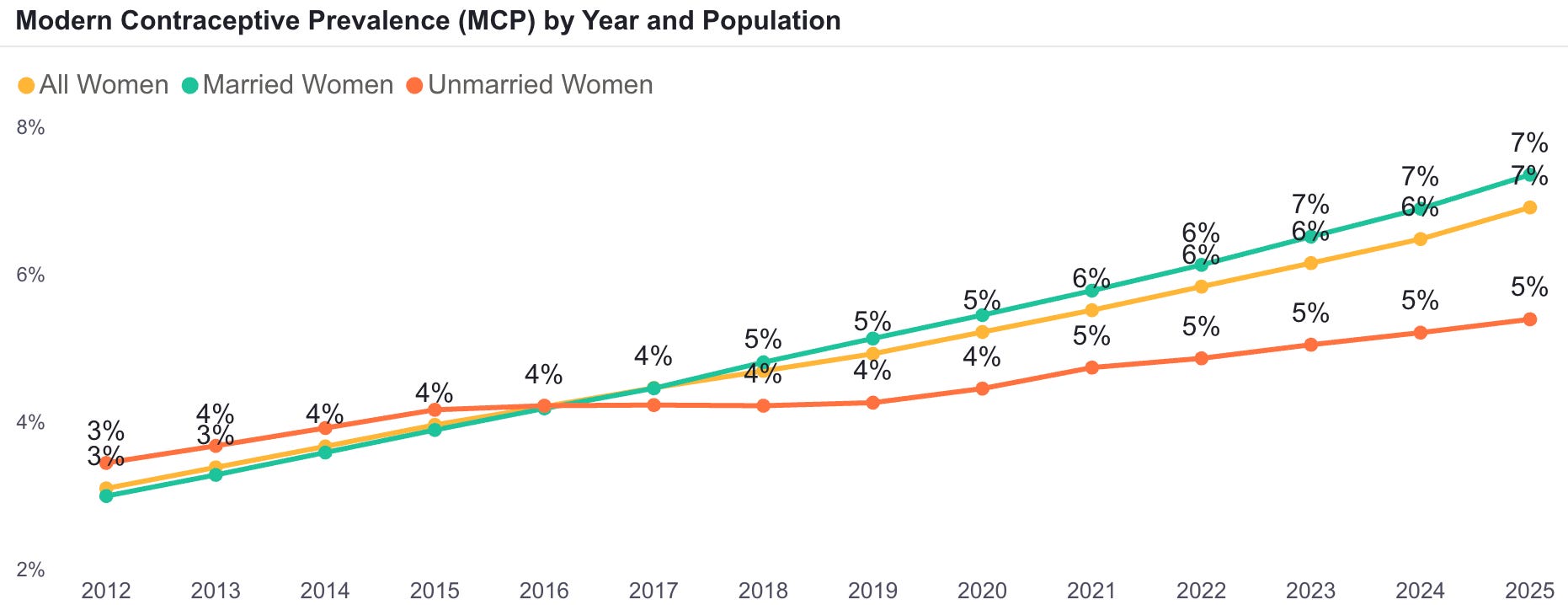
Source: FP2030
Thailand, the demographic twin from last week, sits north of 70%. It’s tempting to reach for culture and/or poverty to explain a gap that massive. This week, I want to go several layers past that, starting at the law, notable barriers, geography, and so much more.
Colonization and the law
This section will be better written by someone like my dear friend, Julianne (hi!), but I am going to give it a go. The “scramble for Africa” began in earnest in the 1880s-90s, resulting in about 90% of Africa being controlled by Europeans. Britain and France built the largest empires in Africa, but others like Belgium, Germany, Portugal and Italy had colonies too (see below).
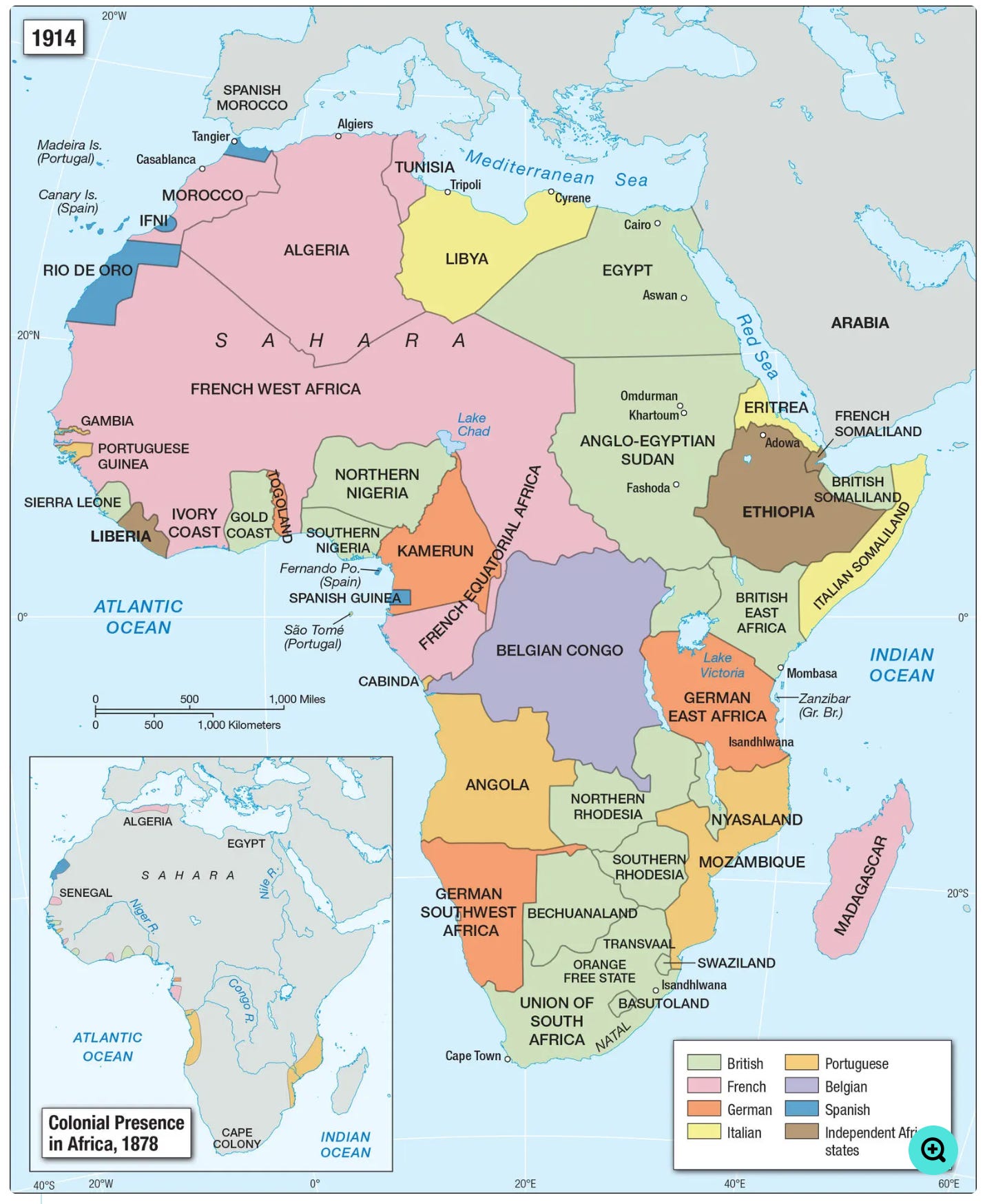
Source: Facing History
Crucially to this story, the French and British empires took distinct legal routes to regulate fertility, which then created distinct institutional inheritances that continue to echo across former colonies today. In short: Pronatalism was central in France while neo-Malthusian and eugenic concerns predominated in Britain.
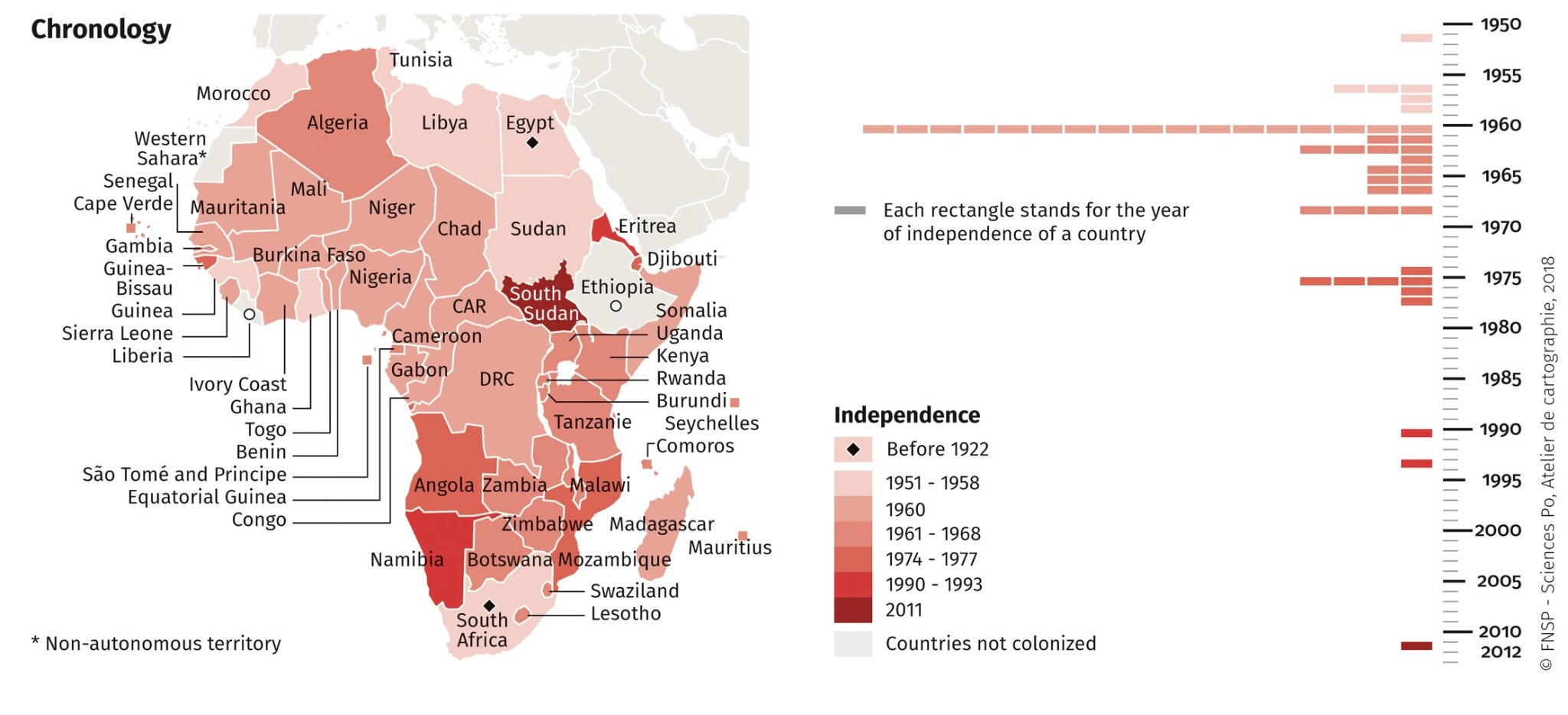
I mentioned the French law in the 1920s basically criminalizing abortion and the sale, display, or advertising of any contraceptive information. This trickled down to the colonies as well. Contraception was subsequently legalized in France in 1967 and abortion in 1975, yet, the legal codes across much of Francophone Africa remained frozen. Even decades after independence (timeline below), many Francophone countries still had colonial-era statutes outlawing family planning. So much so, that sub-Saharan African countries with more liberal contraceptive laws still experience significantly higher rates of contraceptive use, and that former French colonies retain stricter legal legacies than former British colonies, resulting in a smaller increase in contraceptive uptake even when modern laws are liberalized. The wave of reform followed the 1974 UN World Population Conference, after which countries began actively repealing it, most of them by 1990. My back of the envelope calculation is that 6/10 countries that are currently in the bottom 10 of contraceptive use globally, are former French colonies.
Chad, specifically
Chad spent much of the years since independence in wars, which didn’t make for great conditions for needed legal reform as noted above. So, because of the French 1920 law, government health facilities could not legally provide contraceptives, and family planning programs operated in a legal gray area or were heavily restricted. Eventually, Chad passed the Reproductive Health 006 law in 2002 that guarantees an individual’s right to reproductive health regardless of age or marital status. On paper, there was no discrimination based on marital status, you didn’t need your husband’s or parent’s permission. The reality was quite different (which we get into below). To add to that, the family code governing marriage, consent, and household authority in Chad through the early 2000s dated to 1958 which was 2 years before independence. When the government tried to replace it with a gender-equal family code in 2006, the backlash from religious leaders was fierce, and it was stalled.
Is fertility even a conscious decision?
A restrictive law is not the whole story. Researchers have been conducting informative studies to actually sit down with Chadian women, men, midwives, community health workers to ask them directly. In short:
Participants described multiple reasons for contraceptive non-use, including that it contradicts with their religious beliefs, community stigma and widespread misconceptions, particularly around long-acting reversible contraceptives. Husbands played a large role in a couple’s contraceptive decision-making, as either a major facilitator or barrier depending on the individual. - Allambademel et al (2025)
[The most recent DHS data for Chad is from 2014-15, so keep that in mind for this next section, it’s the most recent data that I could find.] Demand for modern contraception is low at around 28%, which is comparable to neighboring countries, but lower still compared to the regional average. Chad’s TFR sits around 6, and is the highest in the world.
If I asked you what you thought the mean ideal number of children you think women and men in Chad have, based on information so far, what would you guess? I guessed something like 5-6. It’s actually closer to 8 for women and 11 for men (!) Plus, almost a quarter of women and 15% of men don’t give a number at all: it’s “up to God”, or “don’t know”. So of course contraceptive use is low, and as the study I mentioned above also showed, most non-users described pregnancy as something that was not in their hands, but of a higher power. It was not an access issue or related to adverse side effects, which are other main reasons for not using contraception. And unlike other countries where “ideal” sizes and actual fertility diverge because women end up having more children than they wanted to, in Chad, that does not seem to be the case. Women aren’t, on the whole, having that many more children than they want. They’re having roughly the family size they say they want.
To be clear, pointing to a 1920 colonial law isn’t an argument that French statutes magically dictated personal family preferences a century later. A desire for large families, faith etc drive the high ideal family size we see in the data. But what the law did do, was starve the supply side. By banning contraceptive distribution, training, and discourse for decades, it built a vacuum where family planning was never normalized or integrated into public health (however weak those systems were).
The husbands, religion, and other stigma
In Chad, a husband’s opposition to family planning has been the most commonly cited reason for contraceptive non-use among the roughly quarter of participants in a study that named opposition of any kind. A separate study using the DHS found that women who make health decisions jointly with someone were nearly 3x as likely to use modern contraception compared to women who do not participate in those decisions at all. So importantly, a woman having agency in her own healthcare is critical to reproductive decision-making.
I mentioned the law that passed in 2002 guaranteeing access to contraception regardless of marital status and without needing a husband’s permission. Well, that guarantee needed an implementation decree, essentially the actual administrative document telling health workers how to apply it in practice. And that decree wasn’t signed until 20 years later in 2022. Reproductive health advocates who’ve worked on this in Chad point to various reasons for the delay ranging from staff turnover at the Ministry of Health, and the government’s attention pulled toward a crisis you’ll recognize from elsewhere in our Substack journey: displaced and refugee populations. So women were living in the conditions and implications of this mismatch until fairly recently. From one midwife,
“I argued that there was a law in place which protected these women’s rights, but they would hear none of it,” she explains. “I stood my ground, and at some point, my colleagues and I stopped calling husbands for their approval before providing family planning services. Why should a woman get approval from somebody when she needs health care?”
She paid the price for her unflinching commitment to women’s bodily autonomy when she was arrested for giving a woman contraception without her husband’s consent (he then filed a complaint). However, her teammates and manager protested outside the police station, threatening to shut down all their services unless she was released. - Ipas
I have written about religion’s role before, with Thailand just last week. In Iran, fertility fell to replacement level in record time right after the government secured religious leaders’ fatwas declaring that contraception was compatible with Islam. Chad has not quite had that moment yet. Part of why is structural. There is no dominant religion, with Pew reporting a 56% Muslim, 39% Christian split. While I couldn’t find a specific study on religion and contraception in Chad, the closest regional proxies provide contradictory findings. A study from Burkina Faso found broadly unfavorable attitudes toward family planning among religious leaders, consistent with other conservative Muslim settings in the region. On the other hand, a study from Senegal found imams making the opposite case, citing Quranic verses on breastfeeding and birth spacing as support for family planning (similar to what we saw in Iran).
Stigma follows age to an extent. Among married women, there is sometimes a belief that contraception is a “white” or foreign import (no doubt with roots in colonial distrust). Among unmarried women and adolescents, it’s a fear of being labeled promiscuous for seeking services, a fear that is universal. From a study in Senegal, stigma outranked distance or cost as a top-cited barrier to use. Indeed, misconceptions about contraception are rampant around the world, and are amplified recently by social media influencers. If you have the time and/or interest, this series from SEICUS is amazing and breaks down the myths, misinformation, and political agendas surrounding contraception.
Anyway, the bottom line is this: None of these operate independently. A husband’s opposition is often just downstream of what a religious leader told him, or what he’s worried the neighbors will say about his wife.
The geography does not cooperate
Even with the legal and social context as complicated as we just saw, Chad’s health system runs into another problem: distance. Chad is huge! It’s bigger than France, Spain, and Germany combined and is spread across the Sahara desert in the north, savannah in the middle and forest in the south. Its population density is quite low, at just 15.3 people/km². More than 75% of the population lives in rural areas and works as subsistence farmers or nomadic pastoralists, the latter following livestock and rainfall rather than having one fixed location. If you think way back when we talked about Papua New Guinea and its rurality and attached consequences, you will see linkages with Chad too. Specifically with respect to health infrastructure. Chad’s health system is quite weak and services are concentrated around the capital, N’Djamena. While it is unfair to contrast this with demographic twin, Thailand, it is informative of what is possible. The country sustained investment in primary health care which slashed premature mortality and improved care for noncommunicable disease. [In this great piece, Atul Gawande, USAID’s former Global Health chief talks about USAID’s investment in primary health care in Thailand and other countries, and its impact.]
BTW, there’s echoes in colonial history when it comes to the dispersed geography and infrastructure as well. The uneven map of health workers, doctors, roads, and clinics that the country has today traces the same lines the colonial administration drew a century ago. So for instance, infrastructure investment is concentrated in the cotton-growing south, and long stretches of the arid center and north barely have clinics. This matters for so much, including but not limited to family planning. Take the example of immunization. A study of nomadic families in rural Chad found a 64% dropout rate between a child’s first and third required vaccine dose within a single campaign, simply because families had moved on by the time health teams returned for the follow-up visit. The same logic can be applied for other healthcare, that requires some level of in–person interaction, like putting in devices like implants or handing out monthly pills.
There are, encouragingly, people trying to solve exactly this. Chad’s Ministry of Health has been rolling out a One Health outreach model that combines child vaccination, livestock vaccination, and other preventive services into a single visit to nomadic settlements. The logic being that pastoralist families already show up reliably for their animals’ care, so bundling human health services onto the same visit means one trip covers both instead of two health systems each separately failing to reach the same people. I love this so much. It’s easy to look at a vast, sparsely populated map and assume geographic isolation is an insurmountable barrier to modern healthcare. But models like One Health prove that rurality isn’t destiny, it’s just a design challenge. When health systems adapt to nomadic patterns rather than forcing mobile populations into fixed clinics, bridging the access gap becomes entirely possible.
Is the denominator accurate?
Now who would I be if I didn’t talk about data but also something extremely random like dating in that context? So as you know, the DHS and other household surveys are the basic foundation of data for many countries. Pastoralist communities are admittedly difficult to capture in household surveys because of factors including their high degree of mobility over remote terrain, fluid domestic arrangements, and cultural barriers. The typical DHS sampling methodology draws enumeration areas from the country’s census, after which sample households are drawn from a list of households, typically actual dwellings. That leaves nomadic populations kind of in flux, since they are by definition, on the move. There are ways that DHS is able to get around those challenges, namely using high-resolution satellite imagery to identify rural and urban areas and then creating lists of temporary nomadic settlements (most recently in Somalia), but the methods are not perfect. Plus, if a refugee camp was set up after the sampling frame was drawn, it may then include populations that don’t show up in the DHS, etc. All of this to say, that Chad’s already low contraceptive prevalence numbers likely also miss the people from whom access is hardest.
I came across the excellent photo essay with the excellent title, There are no dating apps in the desert: How Chad’s Wodaabe nomads find love and had to read it in full. The Wodaabe are a nomadic Fulani subgroup who move cattle across Chad, Niger, Nigeria, and Cameroon in the pursuit of rain. Their courtship customs are fascinating: at the annual Gerewol festival, men spend the day elaborately painting their faces and dancing for hours in the extreme heat while women watch and choose their own partners (woo!) It reminds me of the mating dance of birds of paradise and delights me. It is a strikingly different story for who holds power over a sexual or marital decision than the husband as the gatekeeper pattern we have seen in earlier sections today. But what of their partnership dynamics? Their contraceptive use, access, knowledge? Do health statistics accurately capture these populations?
Looking forward
I went back and forth with other things I wanted to flesh out the connections with family planning. For instance, Chad is currently at the intersection of a shrinking Lake Chad (which has lost 90% of its water mass between 1963 and 2013, Boko Haram insurgency, and also a refugee crisis that has pulled in over a million people from Sudan, Central African Republic, and Cameroon. You can pull at all these threads to make a connection back to health and family planning. Armed conflict reliably collapses reproductive health services in particular, lack of safe water is linked to increased maternal mortality (and well, water scarcity tugs at so much that we covered in the Iran post), gender based violence is infuriatingly common in refugee camps, many which lack supplies of emergency contraception, and so on. All of these things are real and important, and none of that makes the central thesis of this piece any easier.
But things are improving from the perspective of metrics, possibly helped by the low baseline. Between 2012 and 2025, Chad was one of 3 countries in the world (along Guinea and Mali) to triple its number of modern contraceptive users. A 2025 Lancet study found that Chad was among the countries with the biggest reduction in income-based inequality in contraceptive access.
That said, there is a tension in the family planning world about what the goal of programming even should be. Should it be increasing contraceptive use? Or should it be increasing reproductive agency? (which could mean the choice not to use contraception). There has been work on “demand creation,” essentially building awareness and shifting cultural views on modern contraception. But is going to be received as a paternalistic argument in a country (“well, we know better”) where ideal family size and actual fertility are not so far apart? Yes, despite the many known benefits of contraception that we covered last week. This piece started with a government deciding in 1920 what women’s bodies should do to serve the state’s demographic anxieties. A demand creation campaign aimed at women who don’t actually want fewer children is arguably doing that again, 100 years later. But meeting family planning needs isn’t about coaxing women into having smaller families to satisfy global demographic targets; it’s about providing the tools to do things like space births safely. And then there is the question whether population growth is sustainable not just for education, health and jobs, but also the living conditions for people? The Lake Chad example from above is informative:
Lake Chad’s shrinkage occurs against a backdrop of escalating water demand, increasing scarcity, growing uncertainty, and greater weather extremes. Both climate change and global population growth are adding to strains on water use and water supply. - World Bank (2024)
There is a contingent that thinks the reaction against “population control“ went so far that legitimate conversation about population growth and resource pressure became taboo by association.
So what happens next? The thing is, Chad’s maternal mortality ratio is around 748 per 100,000 women, among the highest in the world. A huge share of that risk has to do with how close together they arrive. The WHO recommends waiting at least 24 months between pregnancies, specifically because shorter intervals raise the risk of hemorrhage, uterine rupture, and death. Meeting reproductive and maternal health needs for women in Chad is estimated to cut maternal deaths by a staggering 71%. None of that requires women to want a smaller family, it just requires her to be able to space the family she wants safely - something that modern contraception can absolutely do.
The Food!
Given the colonial throughline in this piece, I thought to cook something with French influence. Or maybe I should have gone the complete opposite way, who can say. It turns out, jarret de boeuf (beef stew) is not only popular, it’s downright delicious! We used a blend of two receipes, paired it with kachumbari (added peaches and chat masala) and rice, took a hideous picture (below), and called it a day.
We listened to music from Matibeye Géneviève, and regaled in Kimaya’s fun facts about traditional musical instruments like the kafaki, and a surprise a research crossover on maternal mortality.


Thanks for reading Demography Matters! Subscribe for free to receive new posts and support my work.
Comments
Nothing yet. Say the first thing.
Sign in to join the conversation.