
We have explored a bunch of foundational demography concepts through this Substack (kind of the point). What if I told you that today’s topic is not only foundational to demography, but also for so much more, is also extremely controversial and caught in political storms, and where I spent much of my professional life? I guess the last part is neither here nor there, only so much to say that it is where my passion lies. It’s (access to, awareness of, use or not use of, satisfaction of, and impact of) contraception.
One of my most vivid memories from a professional conference was in 2022 at the International Conference on Family Planning (ICFP) in Pattaya, Thailand. There was a parade down the main convention hall, and there were hundreds of people dressed in colorful clothes, dancing and waving signs. Fun, right? When you got a little closer, and if you squinted, you could see that some of the clothes was actually made of condoms (see dress below if you don’t believe me. A moving masterpiece!)

Nerds as we are, we were tickled not just because: haha, a family planning conference. It was a lovely hat tip to the country hosting the conference, thanks to Mr. Condom himself, Mechai Viravaidya (and if you got a MPH anytime since the ‘90s, you probably learned about him). He spent his career trying to make condoms and family planning as ubiquitous as cabbages, among many other accomplishments. Indeed, Thailand is now globally recognized for its incredible success in uptake of voluntary family planning and strong support for its diverse populations and their unique needs. So today, we dig into a country that made remarkable efforts to increase contraceptive awareness and use (14.8 to 70.6% from the early 1970s to 1990), and still sits near the top of the table.
First, if you are reading this in the US, you probably refer to contraception as “birth control.” Elsewhere, “contraception” and “family planning” get used interchangeably. And if you live somewhere it’s spoken about in hushed tones, you might call it something innocuous like “chocolate” (as I innocently found out while working at an HIV clinic in India). Technically the terms differ: contraception is the act of preventing a pregnancy; family planning is the whole suite of deciding when, if, and how many children to have. For this piece I’ll be annoying and use them interchangeably. (Our field loves its terminology and denominators and squabbles; if you want the minefield of “need” vs “want” vs “demand,” my friend Madeleine has written it up.)
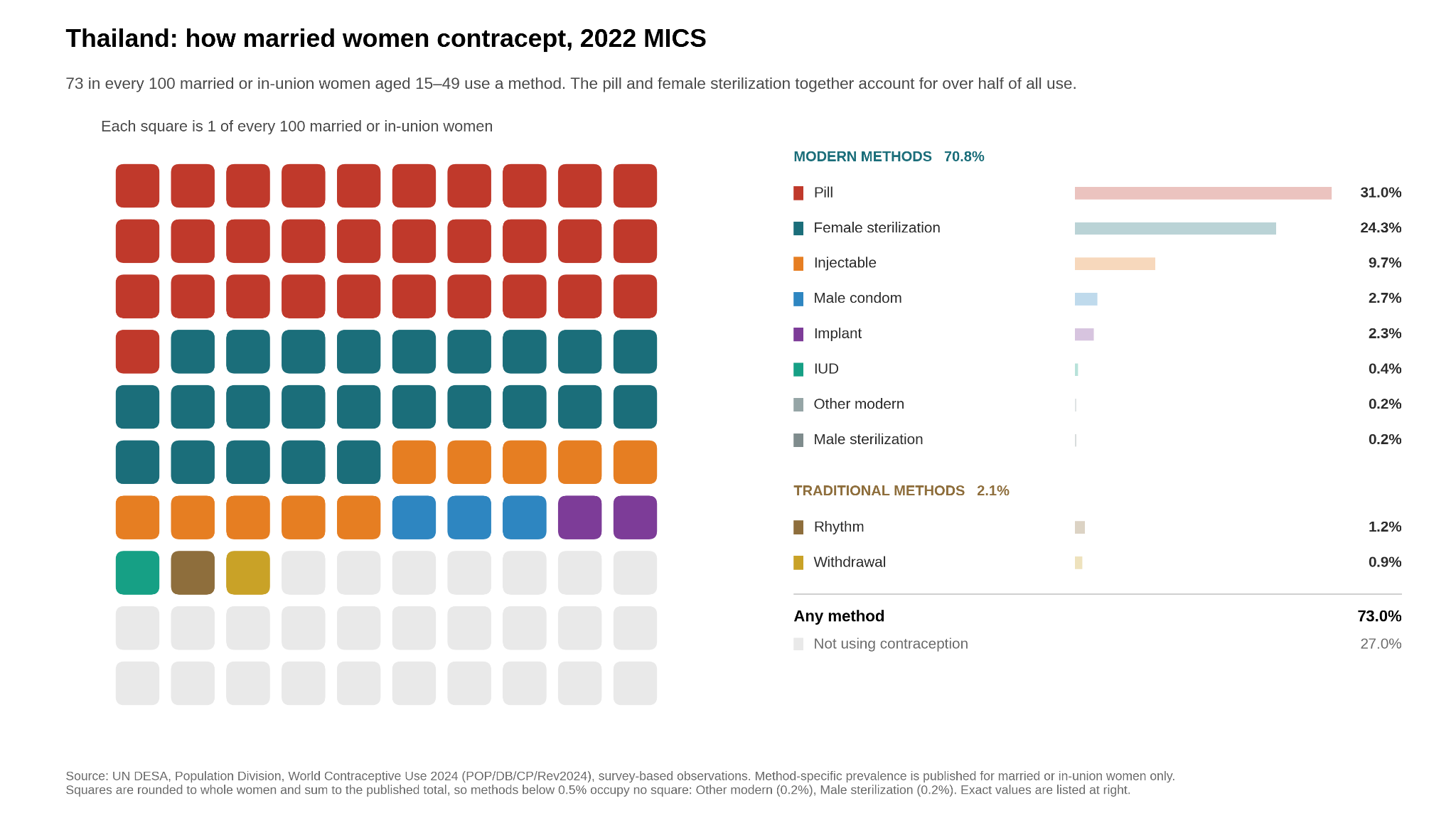
One distinction I will keep, because Thailand hinges on it: contraceptive prevalence comes in two flavors. Modern methods: the pill, IUDs, implants, condoms, sterilization, anything depending on a product, procedure, or protocol. And traditional methods: withdrawal, periodic abstinence, folk methods (herbs, amulets, timing). Modern methods are more effective, and the mix tells you a lot about a country. Thailand’s is a modern-methods story.
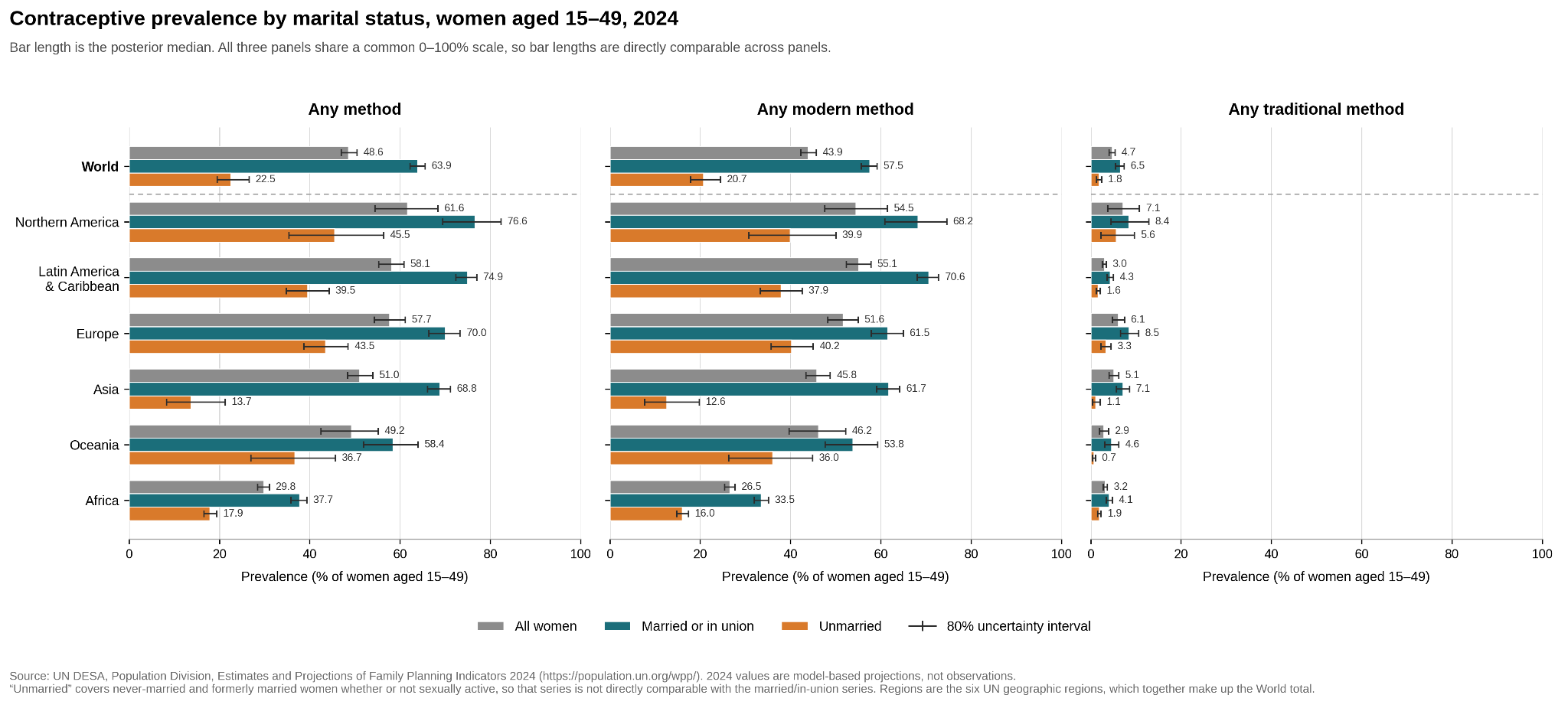
Source: Data from UNDESA’s Estimates and Projections of Family Planning Indicators 2024
Is Thailand the country with the highest modern contraceptive prevalence? Nope. But is it very interesting? Yes. Is it also a country whose food we wanted to cook this week over, say, Finland? Also yes. Did I want to talk about Mr. Condom? Of course. [That said, Our World In Data notes that Thailand (71%) is preceded only by Finland (82%), China (81%), Colombia (76%), and Ecuador (73%).]
Thailand’s story is driven almost entirely by married women, with 73% using a method and 71% a modern one, while use among unmarried women stays low. The whole apparatus we will get into was built around married women. It’s going to matter more than it looks by the end of this story.
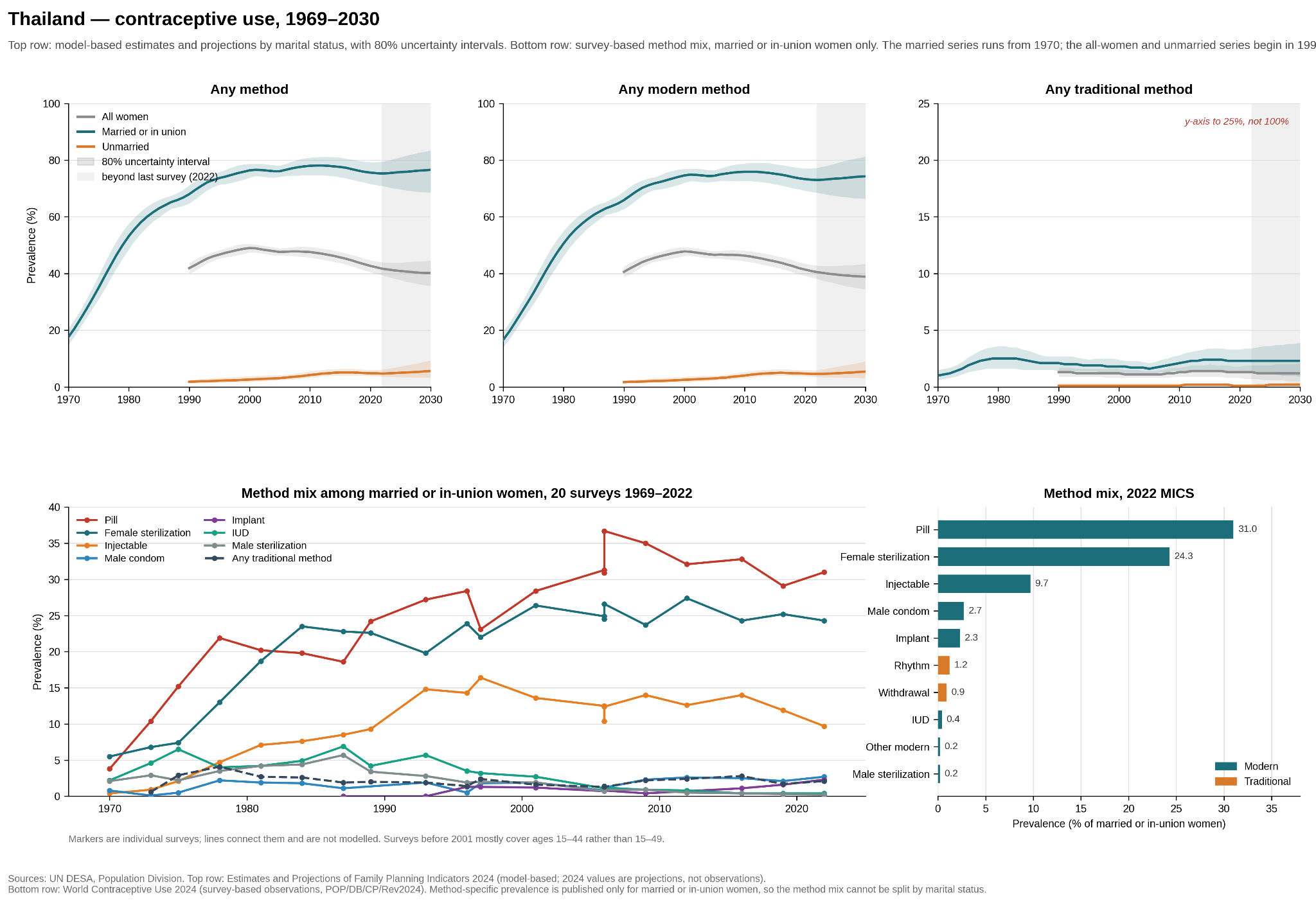
Source: Data from UNDESA’s Estimates and Projections of Family Planning Indicators 2024
Dollar for dollar, I believe contraception is one of the highest-leverage things humans have figured out. Simply put, the WHO notes that by helping individuals avoid unintended pregnancies and plan births, contraception/family planning reduces pregnancy-related health risks, particularly for adolescent girls. Beyond health, family planning enables women to pursue education and employment opportunities, helping families and communities thrive. If you are reading this in the US, you will be familiar with the fact that the introduction of the birth control pill in the 60s afforded women unprecedented freedom to plan childbearing, their careers, and so much more.
The numbers show it. Guttmacher’s Adding It Up 2024 (big ups to the team!) finds that of the 928 million women in low- and middle-income countries who want to avoid pregnancy, 78 million have “unmet demand” (women who want to avoid pregnancy, are not using any contraceptive method, and say they intend to use contraception in the future or are open to future use ). This is notable because about 96 million unintended pregnancies occur every year, which is 47% of all pregnancies, which we know are not all brought to term. And this isn’t hypothetical good it might do. The modern contraception that 714 million women in these countries already use is quietly preventing the bulk of the unintended pregnancies, and the deaths that follow. The fight is over the 78 million still left out.
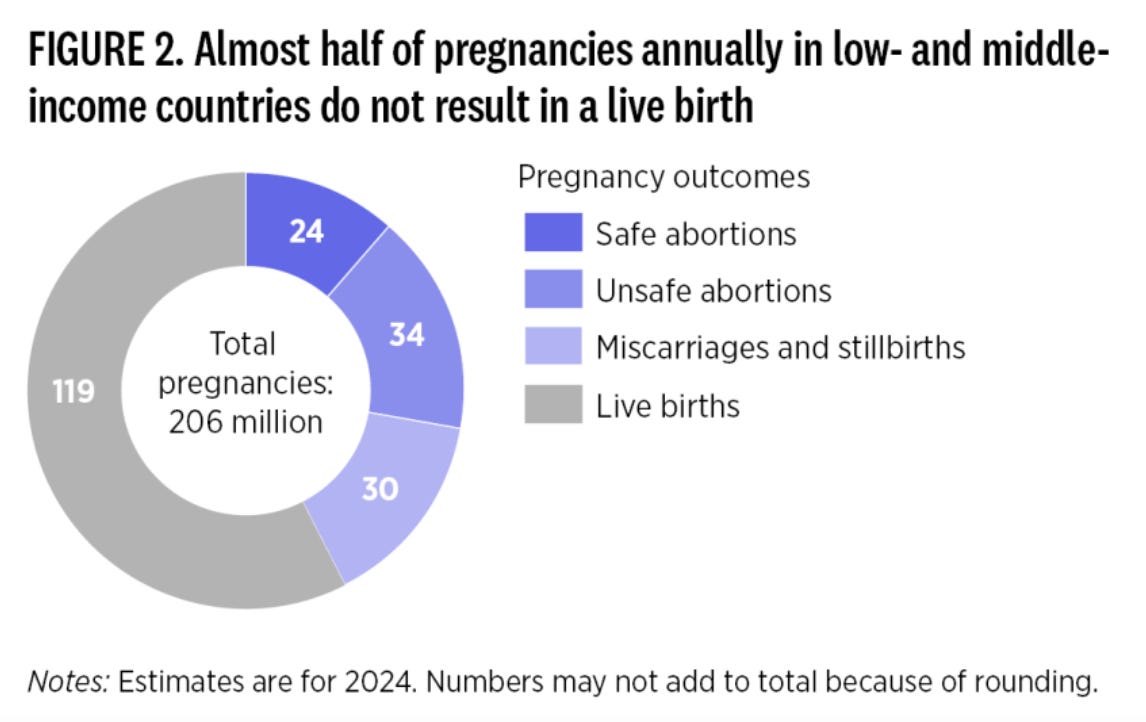
It saves the lives of mothers and babies. Fully meeting the need for modern contraception would prevent roughly 70,000 maternal deaths a year — a 23% drop — from contraception alone, before you improve a single delivery room. And it saves newborns: spacing births and heading off the highest-risk pregnancies makes it a frontline tool against infant death (recall our MMR and IMR pieces).
It pays for itself: Every additional US$1 spent on contraceptive care saves about $2.48 in the maternal, newborn, and abortion care you’d otherwise need downstream. And the global price tag is embarrassingly small: closing the entire contraceptive gap serving all 78 million women with unmet demand runs about $14 billion a year. (Hold that number for the funding-cuts section below.)
It builds economies and is linked to economic empowerment. The falling dependency ratios contraception unlocks are the raw material of the demographic dividend (the growth window I’ll spend a whole piece on soon), and that Thailand, as we’ll see, rode and is now aging out of.
It frees up lives. It’s hard to finish school or hold a job when you can’t time your pregnancies. More on this later.
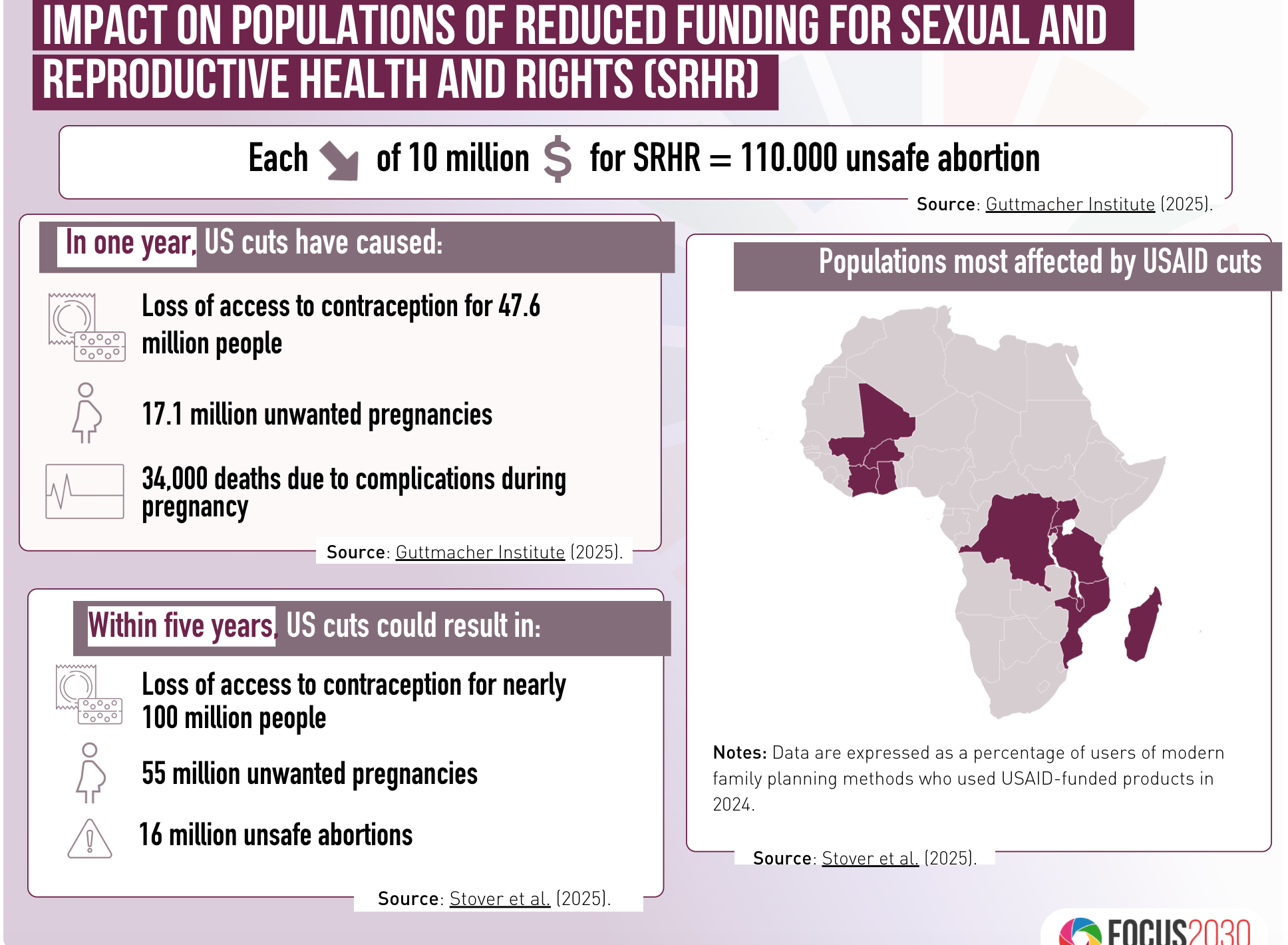
Some have argued that the stated impacts of family planning are overblown. My own view is that it’s necessary but not sufficient for women’s empowerment. But what’s not up for debate is that fewer women die. Fewer girls are pregnant at fifteen. And women who want to decide whether and when to have children can. Yet, the US government cut aid for family planning by roughly 94% last year anyway, and other governments have followed with devastating effects already:
Source: Focus2030
We know the what: contraceptive use in Thailand jumped from about 15% to 70% in roughly 20 years, and the country still sits near the top of the modern method table. The questions worth exploring are how it pulled that off, why it worked here when it didn’t elsewhere, and what it’s costing now. And underneath all three sits the one that has haunted my field since its ugliest chapters: did Thai women choose this, or were they made to? Because there is a version of low fertility that comes from coercion, and a version that comes from freedom, and everything that follows turns on which one Thailand is.
Mr. Condom’s genius was not the condom itself, it was the distribution. Instead of waiting for women to find their way to a faraway and likely under-equipped clinic, he took contraception to them. It was a community-based distribution model, in which the person who already sold you your eggs and fish sauce was trained to hand out oral contraceptives and talk you through them. And you listened because this was a person you actually trusted. Then he took the stigma out of it: he held condom balloon-blowing contests at fairs, “cops and rubbers” days with teachers and traffic police involved in distribution. He basically wanted contraceptives to carry positive (and maybe even) funny associations, to become, as he put it, just one more thing shoppers picked up alongside the soap, toothpaste, and dried fish. Importantly, he involved the religious establishment. Thailand is a majority Buddhist country, and he persuaded Buddhist monks to bless condoms, distributing videos of the ceremonies. And he stood the whole thing up on a network of 350,000 teachers and 12,000 village leaders; the same network that later helped cut Thailand’s HIV rate by an estimated 90%.
And at the heart of it, and the answer to that haunting question: none of this was force. No quotas, no sterilization drives, no penalties. Thailand got to a lower fertility rate than China achieved with its coercive one-child policy, and got there by persuasion, cabbages, and a monk’s blessing.
But a charming man with a bucket of condoms accomplishes little in most countries. The condoms were the supply. The reason they caught is that the demand was already there. Thailand was, in the demographers’ word, ripe. In their own words:
The Thai population, however, was ripe for using contraception when it became available due to 1) mass media creating a desire for consumer goods, 2) the increased costs of education to parents, 3) the willingness of parents to trade off “parent repayment” from many children for a few quality children, 4) couples’ autonomy in fertility decision making, 5) the high status of women in Thailand, and 6) the fact that Buddhism poses no barriers to contraception. - Knodel, Chamratrithirong & Debavalya, Thailand’s Reproductive Revolution (1987)
You’ve met these forces before in this Substack. Thai women already had unusual standing: they ran the markets, held the household money, and decided family size with their husbands rather than deferring to a mother-in-law or a clan; contraception only moves when the woman using it has the standing to decide, which is exactly what Somalia didn’t have. The religion lined up, the way it did in Iran, where clerics issued fatwas endorsing contraception. And the state could actually deliver: the mortality weeks we explored were all about exactly this, the functioning rural health systems that separate an Estonia or an Australia from a South Sudan or a Sierra Leone. (Mass media did its part too: much as K-dramas now model tiny families in Korea, TV showed 1970s Thais a small, prosperous, modern life and made them want it, the same effect that later, in Brazil, dropped fertility region by region as the soap-opera signal arrived.) Mechai seemed to grasp this before academics began to quantify it!
Which settles an old argument in my field, and answers a question you might be forming yourself: was it the availability that drove this, or the wanting? Economist Lant Pritchett famously argued that family planning programs barely matter. Birth rates fall only when people already want fewer kids. John Bongaarts and the Matlab experiment in Bangladesh (where a program cut fertility without waiting for incomes or schooling to rise) argue the opposite: wanting fewer children does nothing if you can’t get the means. Thailand is the neat answer: it was both. Latent demand, met by supply, taken up freely. The steepest part of the crash: 3.4 children in 1980 to 2.1 by 1990 happened while secondary enrollment was still only 31%, so the program plainly did real work; but it worked because the wanting was already there. You did not have to force anyone.
If the six social conditions seen above made 1970s Thailand fertile ground for contraception (pun intended), six modern realities may explain why young Thais are stepping back from parenthood altogether.
Media: If mass media in the ’70s taught people to want consumer goods (and to have fewer children to afford them), social media amped it up. Young Thais now scroll through an aspirational, hyper-consumerist life against a backdrop of stagnant wages, unaffordable housing, and a pessimistic read on Thailand’s economic and political future. The mechanism that once nudged families from six kids to two now nudges them from two to none.
Education: While mandatory primary education historically drove parents to prioritize quality over quantity in child-rearing, modern educational costs have surged further. Hidden fees in public schools combined with the price of English immersion and private academies now make having additional children cost-prohibitive. In one NIDA poll, the single most common reason people gave for not wanting children was, simply, the cost of raising them.
Quality over quantity: In the ’70s, parents traded larger families for a few “quality” children partly because children were also old-age insurance: the deep Thai value of katanyu katavedi, the debt owed to those who raised you. That logic is unraveling in Thailand and other parts of the world. Younger Thais worry noticeably less about who will care for them in old age, expecting (or hoping for) the state instead. So one of the oldest reasons to have children at all has weakened. And the obligation now runs the other way: many are already stretched caring for their own aging parents, which crowds out starting a family of their own.
Autonomy: The original framing meant autonomy within marriage, i.e. the freedom to decide how many children to have. That freedom has since expanded into the freedom not to marry at all. The share of never-married women aged 35–39 has roughly doubled, from about 7% to 12% since 2001, more than half of Thai women now say they’d prefer to stay single.
Status of women: If Thai women managed household finances, held property rights, and sought contraceptive services in Thailand then, women today outnumber men in higher education and have wage parity. Plus, a university degree cuts a woman’s probability of marriage by nearly 15%, the rise of what Thais call the “Gold Miss.” Facing the old career-versus-motherhood trade-off (with one of Southeast Asia’s stingiest maternity leaves (98 days) and thin childcare), plenty are choosing the career. Status was the enabler of the fertility decline; it’s now one of the engines of the fertility collapse, precisely because Thailand never built the supports that would let a woman have both.
Buddhism: The same religious neutrality that let contraception spread with a monk’s blessing offers no counter-pressure now: no “be fruitful and multiply” mandate, no doctrinal guilt attached to a childless life.
And now the word I told you to hold onto: married. Unmarried women were not driving the contraceptive revolution. But today’s fertility decline is very much running through people who may never marry at all.
All in all, the implication is that Thailand is getting old before it is getting rich:
Thailand has a developed country’s ageing population, but a developing country’s per capita income. Its neighbours aren’t in the same bind. Of the ten ASEAN members, only Singapore and Thailand are nearing the United Nations’ definition of an “aged society” (more than 14 percent of people are aged 65 or more). And Singapore is already on a par with wealthier regional states, eclipsing countries like Australia in many respects. - AsiaLink (2022)
Thailand became an aged society in 2023, is on track to be super-aged by the early 2030s, and is hitting that milestone at a fraction of the income Japan or Italy had when they aged. In 2024 it recorded fewer than half a million births, its lowest in more than 70 years; deaths have outnumbered births since 2021; its median age is 41 against an ASEAN average of 29; and life expectancy is high. The country that once exported the world’s model for shrinking a population now imports workers to fill the hole, largely from war-torn Myanmar. And the politics have flipped completely: the state that paid Mechai to hand out condoms now, like Singapore before it, dangles baby bonuses to coax the birth rate back up. It likely won’t work as Iran found when it threw its own program into reverse, fertility is far easier to push down than to pull back up. The transition is a one-way door, South Korea is what waits on the other side, and Thailand is walking through it, having gotten most of the way to rich, but not all.
Does that mean that countries should not focus on family planning/contraceptive programs now in fear that they will reach the point of no return and be contending with low fertility and all the ensuing challenges (and benefits!) of having an older population? No, and the question itself is a trap.
First, denying people reproductive autonomy today to solve a hypothetical labor shortage forty years from now is both bad ethics and terrible public policy. Contraception is fundamentally about health, rights, and agency. Reducing maternal mortality and unlocking educational opportunities aren’t nice to haves. They are essentials.
Second, Thailand’s story isn’t a cautionary tale against family planning; it’s a lesson in policy inertia. The mistake isn’t helping people space their pregnancies. It’s failing to adapt their social, economic, and care infrastructure when society inevitably changes. Thailand successfully created the conditions for smaller families, but like many nations, it didn’t build the modern workplace, affordable childcare, or eldercare systems required to support the generation that followed.
The lesson for the rest of the world isn’t to slow down on rights. It’s to remember that demography is not a static target or a goal. When you give people the freedom to plan their families, you have to spend the next thirty years building a society that actively supports the choices they make.
We knew immediately we wanted to make Khao Soi (my mother’s favorite Thai dish) and then of course we needed papaya salad. It was a 10/10. If you make it, take the extra 10 mins and make the paste yourself instead of buying it from the store. It’s soooo good! The kids got back on the research bandwagon finally. Eymir regaled us with stories about the Thailand-Burma bridge (he is still in his WWII era), and Kimaya told us all about the full moon party/rave and I am a little worried about her future party era. Trust Ekim to be fully up to date on psychedelic music from Thailand (nay, any country): he introduced us to Khun Narin.


Comments
Nothing yet. Say the first thing.
Sign in to join the conversation.