
Every so often, my office at USAID revisited criteria to “graduate” countries from assistance in family planning. Details of those metrics aside, we also debated what to call it. “Graduation” seemed paternalistic, and “transition” seemed boring (to me, at least). I suggested “withdrawal” and was extremely pleased with the pun. It didn’t stick, but it remains something whose memory makes me giggle. It is also the theme for today.
I really was not going to do a three-parter, but there is one elephant left in the contraception basket: traditional methods. By this, I don’t mean herbs and tinctures, although they have been used forever as spermicide. I mean withdrawal (pulling out) and periodic abstinence (calendar or rhythm method where couples avoid sex on estimated fertile days), which constitute a majority of this family planning category. We talked about modern methods for the last 2 weeks: Thailand where use is high and Chad where use is low. Family planning research and programming defaults to modern methods as markers of “success,” and modern method use is climbing in every region on Earth. But traditional methods are still used and even preferred in some parts of the world. Nowhere is that more evident than our country this week, Albania.
Globally, traditional method use sits in the single digits: 5% of all women of reproductive age as of 2023. But in Albania, 42% of married women rely on withdrawal alone today (with 46% using any method at all) and that’s down from a record high of 58% in 2008. And Albania keeps company with a very specific cluster: the top locations for traditional method use (mostly withdrawal) are dominated by countries in the Western Balkans and the South Caucasus, despite widespread availability of modern methods. So, what gives?
Here’s a look at the data from Albania’s most recent DHSs:
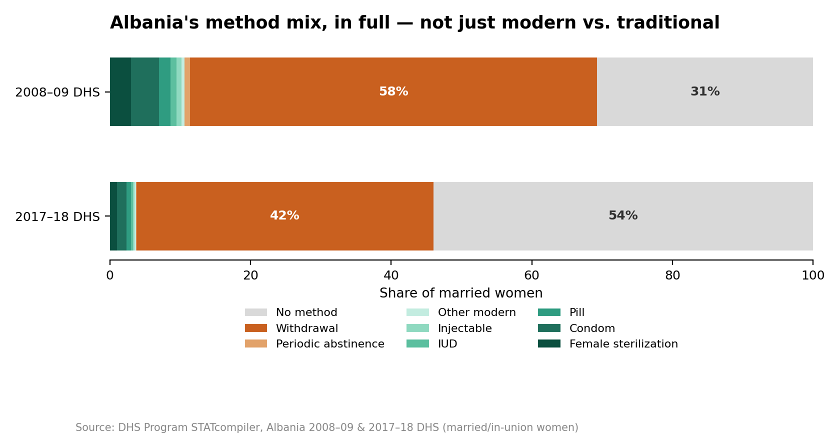
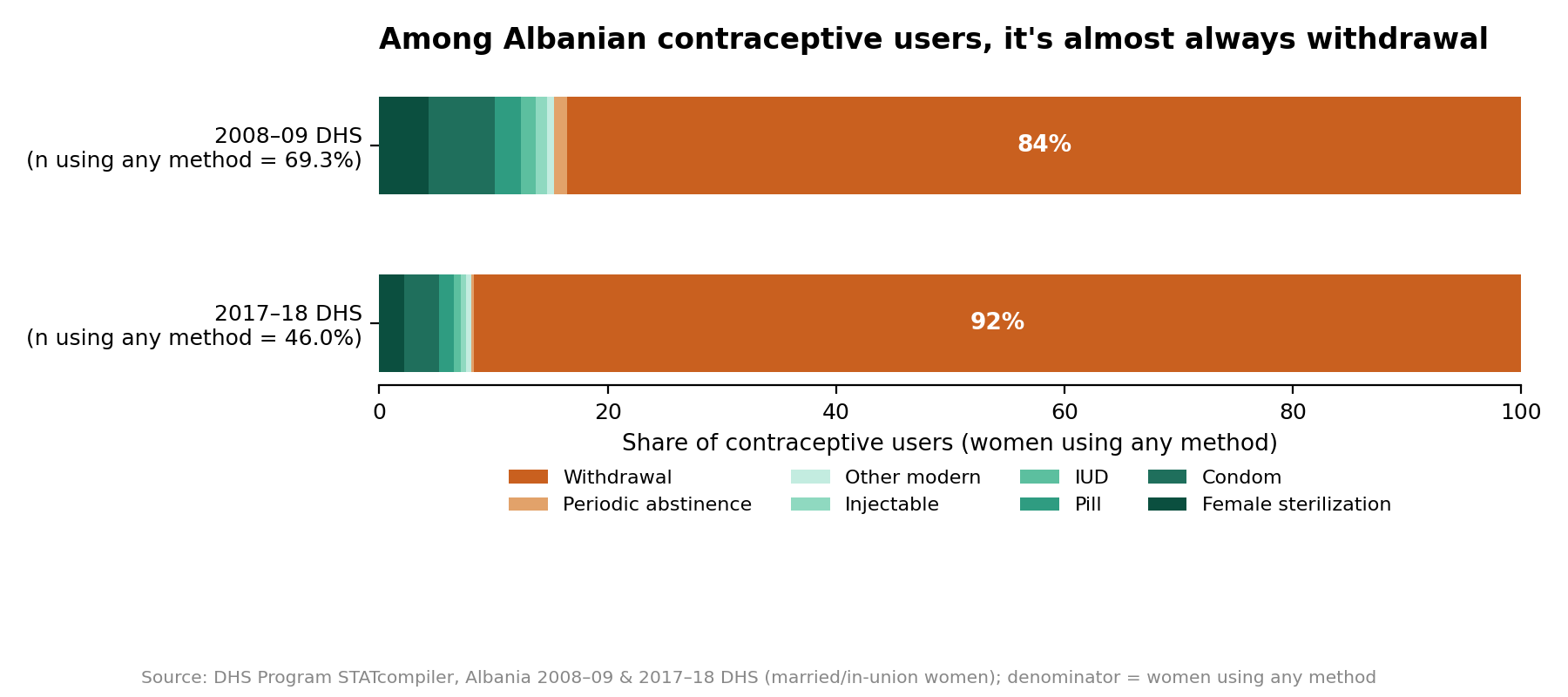
Essentially, fewer Albanian women are using contraception at all, and the ones who still are have narrowed almost entirely onto this one method.
Traditional methods include withdrawal, periodic abstinence, and a long list of folk methods (herbs, amulets etc). A recent review of evidence (from Chelsea Polis and Sarah Bradley among others, hello, ladies!) on contraceptive effectiveness found that during typical use in the first year, withdrawal results in an unintended pregnancy rate of roughly 17% to 20% (and 15% to 19% for calendar), compared to 85% for no method at all. Essentially, traditional methods are less effective, but better than nothing.
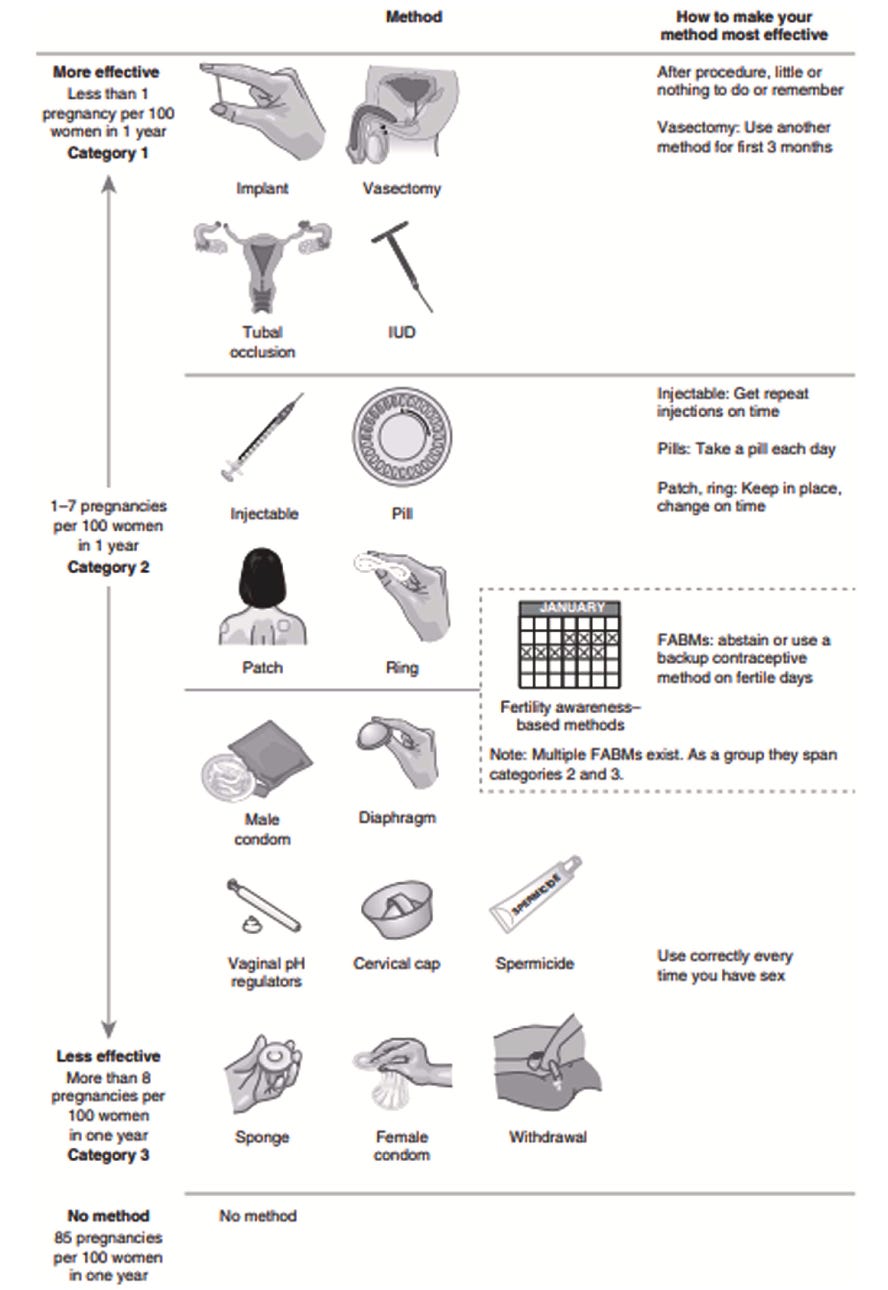
Source: Polis et al. (2026)
Given that there are so many assumptions about hormonal contraception, I can see this being appealing to some women (particularly young women?) For others, there is a real issue of limited access to modern methods or cultural practices that discourage modern methods, which bear out in some of the data we see. And there’s the constant politicization of birth control, particularly hormonal methods, which almost certainly shapes people’s beliefs, behaviors, and access all at once.
Thankfully, a new paper (with Vladimira Kantorova and Jamaica Corker among others, also hello!) has parsed out trends and projections in traditional method use so I don’t have to. Globally, periodic abstinence declined from 2.6% to 2.1% of all women between 1995 and 2020, but withdrawal remained largely steady at about 2.5% in that time period. But “steady” hides a real split: reliance on withdrawal fell across North America/Australia, NZ, while it rose in Central and Southern Asia (India, Pakistan, Iran). India is a particularly interesting case here, with a recent paper finding that almost a fifth of married women (that are not sterilized, the primary method of contraception in the country), use traditional methods.
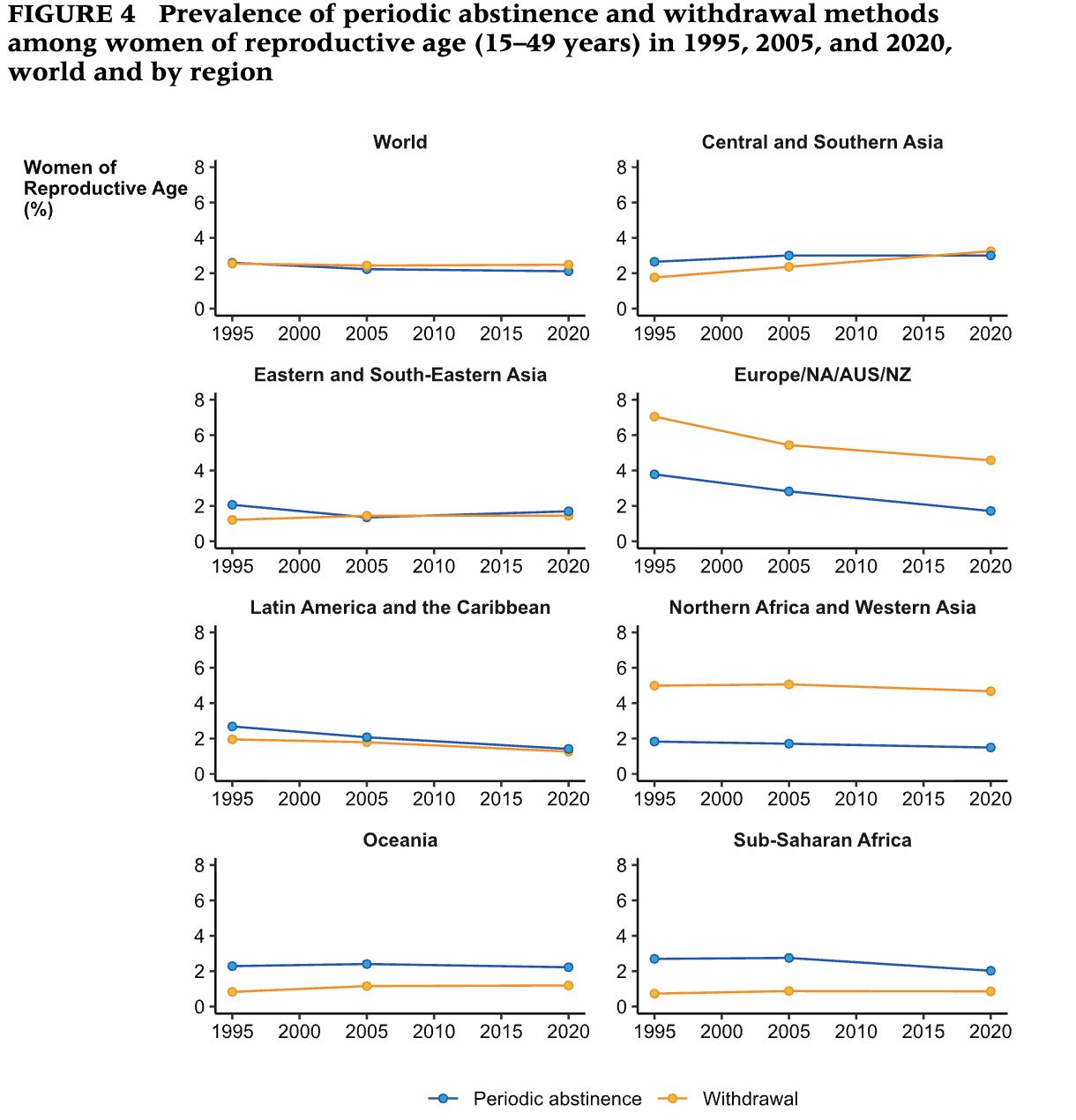
Some might argue that programs should actively move people off traditional methods, given the effectiveness gap I showed you above. But traditional methods are discreet, free, require no product or provider, carry no side effects, and are always at your disposal. Additionally, in committed partnerships, withdrawal operates as shared male responsibility, lest contraception mostly be the responsibility of women to bear. Fear of side effects of modern methods and perceived effectiveness are top reasons why people choose traditional methods, even where modern methods are technically available. If you are thinking that these methods are thus likely favored among poorer couples with lower levels of education than others, it’s a little more complicated than that. Researchers have found that it could be a deliberate preference, not an absence of choice, particularly among more educated, urban, and weather couples. Across sub-Saharan Africa, better-educated, urban women are consistently more likely to use periodic abstinence. In Ghana, a study found that a meaningful share of women officially coded in their DHS are using no method at all, were actually using traditional methods. [This led to a revision in questionnaire to better capture traditional methods in subsequent rounds of the survey]. Honestly, this all makes sense. It rewards things that educated, urban women are more likely to have: literacy to track a cycle accurately, media exposure to know the method exists and how to use it well, and often more negotiating power with a partner to sustain a method that requires his cooperation too.
So, traditional method use isn’t one behavior with one set cause. It can be ignorance. It can be deliberate. And in some cases (like Albania), it can also be path dependency.
The paper I mentioned earlier found that the rates of withdrawal and periodic abstinence are highest today in postcommunist countries in Eastern and Southern Europe and Western Asia. They contend that it likely “reflects the legacy of communist-era restrictions on modern contraception that led to widespread reliance on traditional methods, along with abortion, to control fertility during that time.” They note that most postcommunist countries saw traditional method use collapse after 1990 as modern methods and legal abortion rights expanded. In Albania, though, it didn’t. And there is no single cause that explains why that was the case.
The structural origins of Albania’s contraceptive profile stem from the regime under Enver Joxha for 40 years (until the late 80s). Unlike counterpart socialist states that legalized abortion and integrated state-sponsored family planning during the mid-1950s, Albania implemented aggressive pronatalist policies to build their domestic labor capacity. Relevant to this story, the period under his rule was marked as a “paradox of progress.” The Hoxha era opened up avenues for education and employment for women and outlawed arranged marriages. However, cultural values meant women were still expected to provide all the labor within the household, and treated as “ideological instruments”:
Adding to the burdens, Hoxha’s policies limited women’s reproductive choices by prescribing dramatic increases in the national population, coercing women to have and care for more children as they continued their paid labor responsibilities. In turn, access to abortions was deemed illegal and contraceptives were available only by prescription. As a result, population growth in Albania during the late 1980s was at 2.3 percent, the highest in Europe.
Critical to our story on traditional methods and to today’s rise in pronatalism seen worldwide: Contraception and abortion were both banned from public discussion, and absent from medical training entirely. There was also a ban on religion, with the government declaring Albania the world’s first atheist state in 1967. I thought back to Chad and Thailand where we discussed the role of religion in the acceptance (or not) of family planning. There is no clean corollary here because of this decree, but maybe there is some literature here that I couldn’t find.
Motherhood was recast as a patriotic duty rather than a personal choice:
The honorary title of “Mother Heroine”, awarded to women with ten or more children, epitomized the state’s approach to combining traditional values with socialist ideals. While the Party promoted gender equality through economic participation, it simultaneously controlled women’s reproductive rights, making maternity a patriotic duty rather than a personal choice. - Politics and Rights Review (2024)
The human cost of this bargain was borne by women with no legal pathways to prevent a pregnancy, up to half of all pregnancies in Albania are estimated to have ended in abortion during that period. Since they were performed clandestinely and with unsafe practices, Albania ended up with one of the highest maternal mortality rates in Europe. Against its own political peer group (the rest of state-socialist Europe), Albania's maternal mortality tracked almost exactly with the bloc average through 1990. What's more surprising is what happened next: Albania's rate then fell faster than the rest of the bloc, ending up well below the state-socialist average for most of the next two decades. I imagine this reflects abortion being legalized and moved from the backstreets to clinics.
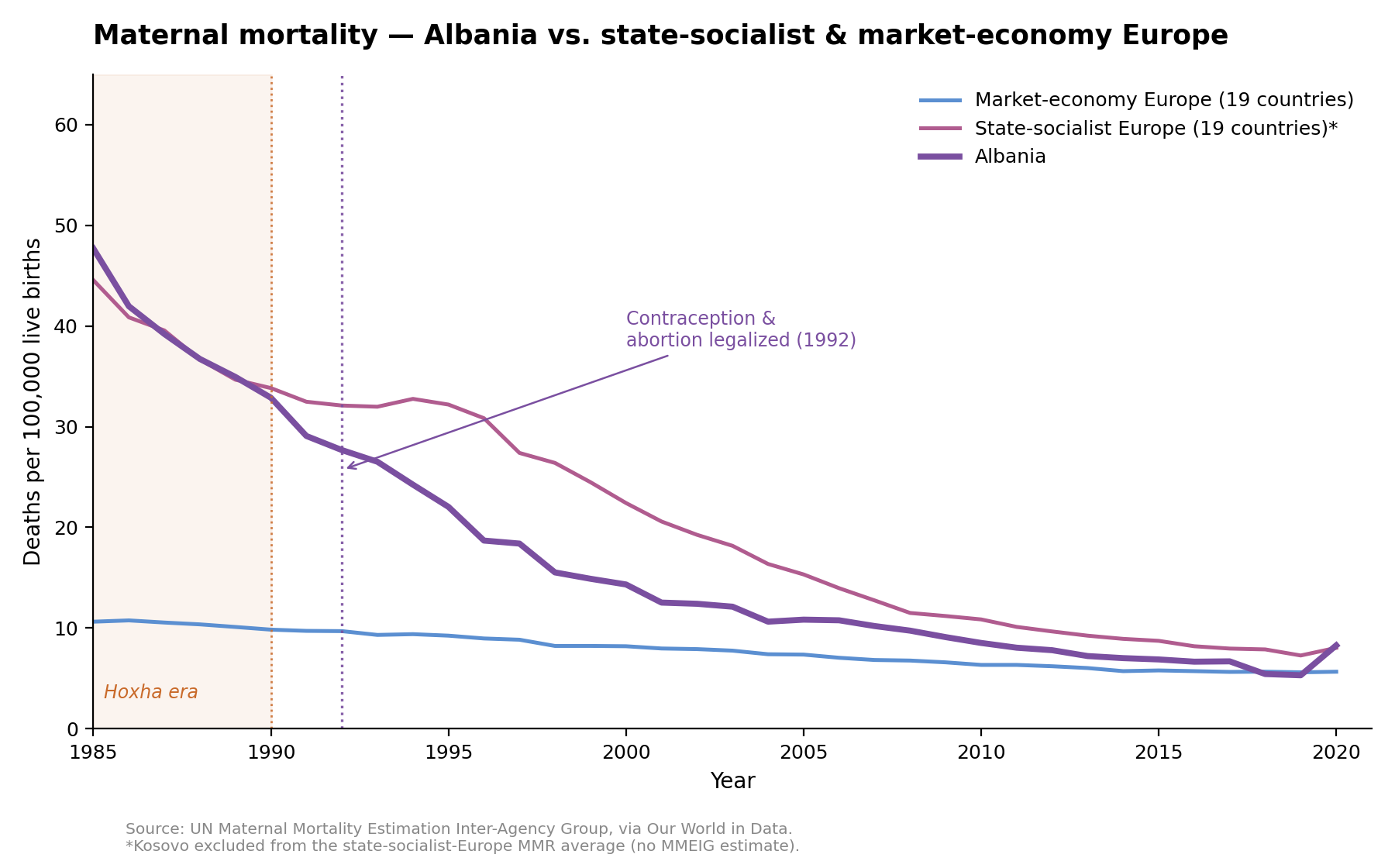
When the regime fell and the ban was lifted, contraceptives were legalized in 1992, accompanied by free distribution at public health centers. But Albania’s uptake stalled, instead of spreading quickly (like neighboring countries). So public discourse regarding sexuality, anatomy, and family planning was effectively suppressed, reinforcing cultural taboos around sexual health. Whole generations were legally permitted one method (withdrawal), and habits like that didn’t change fast.
Where one might expect attitudes to change, is that of providers first. They didn’t.
A study of retail pharmacists in Tirana found that pharmacists were both uninformed and misinformed about reproductive health technologies in general, and hormonal contraceptives in particular. Additionally, very few reflected on their own biases that were perpetuating misinformation that their patients had. Now, it could be that if almost nobody is asking for modern methods, there’s little pressure for them to be up-to-date about them. But that doesn’t make the outcome any less real for a client at the pharmacy. Another study on emergency contraception (also provided in pharmacies), found that even though it is legally available without a prescription, a fourth of women surveyed didn’t know that, and more than a third didn’t think it was safe to use. “Train the providers” is necessary, but not sufficient on its own.
This is consistent with a qualitative study on barriers to modern contraceptive use in the country, which found that the barrier was not the distrust of medicine broadly or health providers (like we saw in Sierra Leone). It was a specific belief shared by patients and providers, that withdrawal works about as well as anything else out there. Add to that, there are chronic stockouts of modern methods like pills and IUDs at public clinics, lack of contraceptive counseling folded into post-abortion care, and more that further diminishes interest in other methods.
While digging, I learned about “kanun” in Albania and the word is shared in Hindi so it piqued my curiosity. It also kind of helps explain what’s going on here (demography is everything!)
Northern Albania has centuries of codified customary law: The Kanun of Lekë Dukagjini which is built around patrilineality, patrilocality, and male lineage preservation. Under it, only sons inherit things and daughters are understood as marrying out of the household. Hoxha’s regime treated the Kanun as a rival source of authority and squashed it. The practice went dormant for about 4.5 decades. BUT, when the regime collapsed, the Kanun came roaring back, particularly in the absence of other structures. So with courts, police etc too weak or absent to function, people began settling their disputes and organizing family life by the old code. With internal migration, it didn’t stay in the North alone, it percolated through the capital and other areas.
The rupture of the regime (and state authority) was the same time that contraception was legalized on paper and opened the door to modern methods. One study found that the Kanun’s revival “strengthened the role of men in the domestic and public spheres, weakening women’s position to actively participate in socioeconomic decision-making.” So at the precise moment that modern contraception became legal, was the precise moment that the customary system reasserting male household authority came back from dormancy. Withdrawal then was one of the only options.
When we discussed the skewed sex ratio in Azerbaijan, I talked about the three-ingredient framework for a skewed sex ratio at birth: son preference, fertility low enough that families can’t just keep trying, and access to technology to act on it early. Most countries that check all three boxes get there deliberately. A couple may decide they are done, then use the ultrasound to make sure the last child is the “right” one. Albania’s version of the third ingredient is specific and ties back to this story. Withdrawal keeps failing, decade after decade, which means a steady supply of unplanned pregnancies. Widespread ultrasound access is then landing on top of that. A woman may be at the clinic already because the withdrawal did not work, thus needed confirmation of her pregnancy, or is there for other reasons. Then, the same ultrasound used at clinics that confirms a pregnancy can just as easily reveal its sex.
From there, you can expect what happens. Albania’s sex ratio at birth moved from the biological norm of about 105 up to 114 boys per 100 girls through the late 1990s and 2000s, the same post-1990 window when ultrasounds became widespread. If you look at neighbors in the region, there’s more overlap with withdrawal and skewed sex ratios.
Despite state prohibitions and low interest in switching from traditional to modern methods, Albania still initiated its demographic transition - it just wasn’t “textbook.” Fertility fell from roughly 7 children in the late 1950s to about 3 by 1990 by a web of things we discussed. That decline happened entirely under a regime that had banned the tools usually credited with a fertility decline, and it outpaced even the rest of the state-socialist bloc:
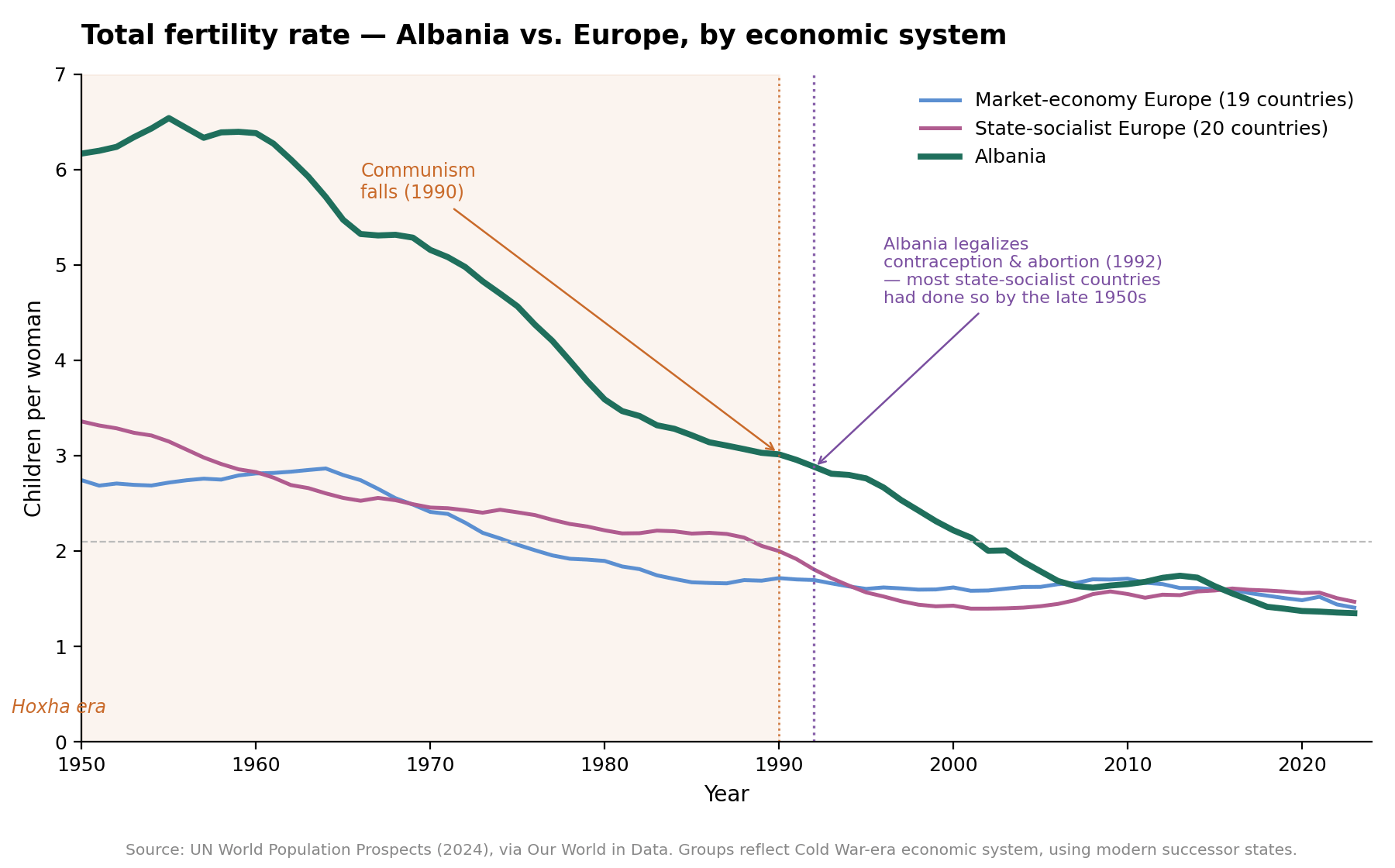
The withdrawal paper conducted analysis of countries that reached replacement level fertility (2.1) and finds Albania and Kosovo among a small recent cluster that got there only in the last decade or so, while traditional methods still accounted for a quarter or more of contraceptive use at the moment they crossed that line. This was decades after the historical cohort that did it the same way had already switched to modern methods. Albania did the old way, just late. It’s another complication to the “contraceptive transition” framework which assumes that traditional method use fades out as a country modernizes.
And as we know, contraceptive use is related to the larger picture of population change. Albania’s population has fallen from 3.2 million in the early 1990s to about 2.8 million today. It loses an average of 33K people a year to emigration on top of a fertility rate that’s already very low (1.3 or so). So the same emigration cohorts that are hollowing out the reproductive age population are also gutting the workforce that would be needed to remain in the country in the first place. Nearly 40% of Albanian medical and nursing students say they intend to work abroad. And the pronatalism during the Hoxha regime is playing out all over the world today, which we have covered in previous substacks. If there is one thing to learn from this experiment is that decades of pronatalist, zero legal contraceptive services all still contributed to a fertility decline anyway alongside a high maternal mortality to match. If that’s one data point to anyone currently confident that restricting reproductive access reversed a fertility decline, it’s this one.
Is Albania stuck then? Maybe not forever, but I don’t think the golden fix is a modern-method awareness campaign. Nothing in this piece is an argument that Albanian couples are making some obviously wrong choice. Plenty of them may be choosing withdrawal deliberately, not out of ignorance. I guess my argument is narrower - that choice never really got a fair shot. Choice is not really a choice sometimes (we talked about this in the Somalia piece). You can respect reproductive autonomy and still notice that autonomy only means something then the options on offer are real and trusted. Until Albania can rebuild a health system worth trusting, it will keep exporting exactly those people (the future providers!) who could make a case for it.
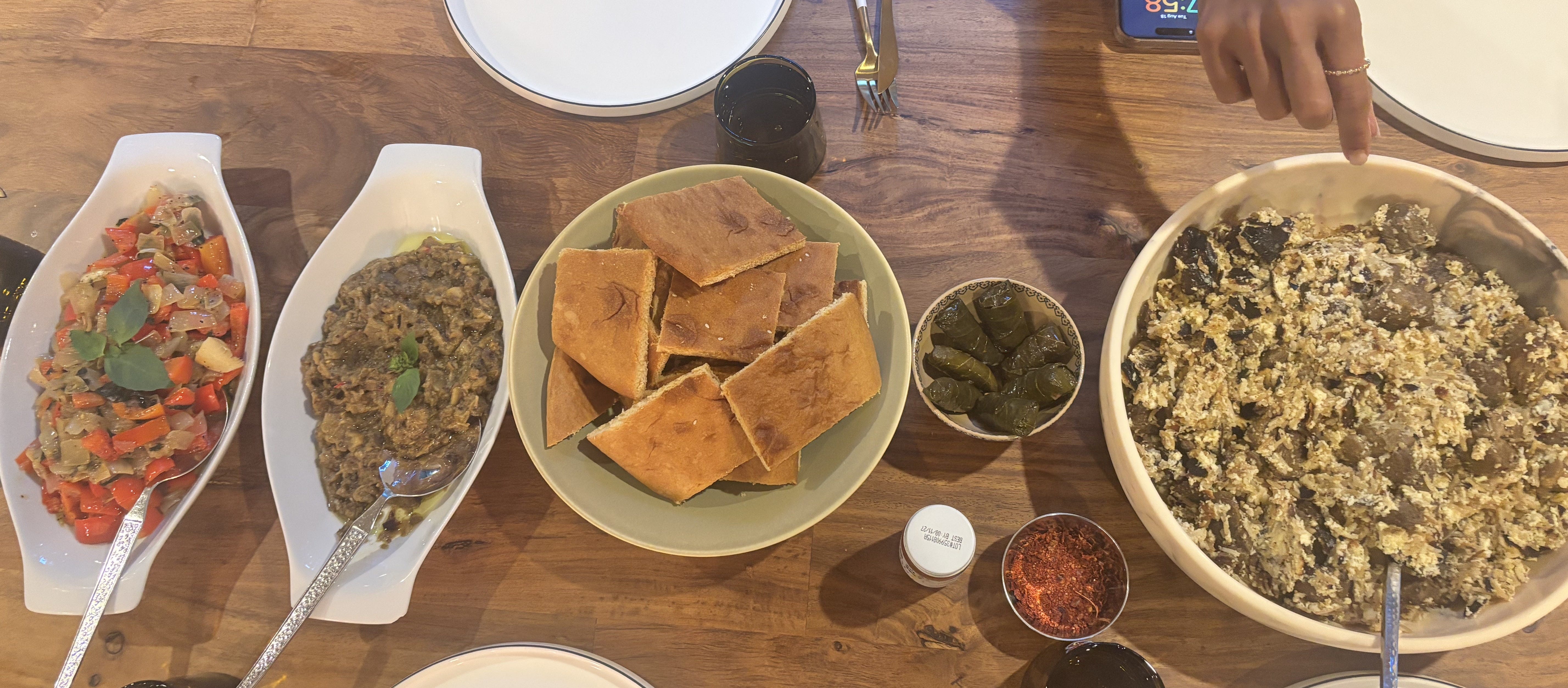
We made the national dish, Tavë Kosi. It was kind of like a lamb biryani cooked in a yogurt/egg sauce. I have an aversion to baked eggs so maybe that’s why I reacted this way, but I really really did not vibe with this dish. Or, I should say, my version of it. Others didn’t think it was bad! We made eggplant ajvar and a red pepper salad on the side. We have family in town so absolutely nobody did any research, but we did have a unique playlist. From Albanian/British queen Dua Lipa all the way to Albanian Iso-Polyphony.
Comments
Nothing yet. Say the first thing.
Sign in to join the conversation.