
There was news just this week that Türkiye has introduced a new long-term strategy to address demographic challenges by monitoring changes in family structure and population trends. The new “Family and Population Decade” comes as Turkish Statistical Institute (TÜİK) data show that Türkiye’s TFR was about 1.48 in 2024, and has been below replacement for 8 years. The President has also been calling for Turks to have 3+ children (new day, same pronatalist pressure). I assumed that these numbers included citizens and non-citizens alike, given that the country has hosted an unprecedented number of Syrian refugees in the past decade or so. But it’s more complicated (as is birth registration, particularly for Syrians). Essentially, Syrian babies born in Turkish hospitals are registered with the local population directorate. But, they aren’t counted as part of Türkiye’s population at all, and sit in a separate register.
While international organizations and media commonly refer to Syrians in Türkiye as “refugees,” their formal domestic legal status is Beneficiaries of Temporary Protection (Geçici Koruma Altındakiler). This allows them to get access to public services and healthcare, enroll children in school etc, (some) work, but not a path to regular residency or citizenship, and are not counted in official population statistics (they are counted in a parallel system). At its peak, Türkiye hosted about 3.6 million Syrian refugees, comprising a significant 3-4% of the total population (unprecedented really), dispersed across the country (largely in southern border provinces and major industrial hubs). There has been a large wave of return (which we discussed last week and I will say more in the later sections of this post), following the fall of the Assad regime. This week, I attempt to explore what all this means: both for the largest refugee population in the country, and the people in the country who receive them.
Thanks for reading Demography Matters! Subscribe for free to receive new posts and support my work.
Why Türkiye, and the scale in numbers
As we established last week, most refugees (~65%) end up in a country bordering their own. Türkiye shares a 900km border with Syria, making it a natural choice. The choice was quite an open door actually, with Turkish president, Erdoğan, wrapping the welcome in a religious frame (and made economic sense). In an analysis of his speeches, researchers found that he emphasized the religious and historical fraternity between Turkish citizens and Syrian refugees, as well as in his assertions about Türkiye’s restored willingness and ability under his leadership to protect the oppressed around the world. The assumption at the start (2011) was that this would be a brief hosting period; not a 13 year affair. Over time, these assertions changed (among the ruling party, but also others), with researchers identifying 6 phases in the political and social discourse: temporariness, fraternity, civilizationist humanitarianism, rights-based humanitarianism, burden, and repatriation. That said, it is worth noting that for a large share of arrivals, Türkiye was never meant to be the final destination. It was simply a corridor to Europe. In 2015, something like 860,000 people crossed from Türkiye to Greece. In 2016, the EU-Türkiye deal slammed that shut, and in doing so, converted a transit country into a destination country.
To understand the scale in numbers, see the chart below. I made that using data from official Turkish statistics and the UNHCR. It excludes anyone who became Turkish citizens (more on that soon), since naturalizing moves you out of that temporary protection count. Importantly, it also maps policy changes and disasters to give you a sense of what explains the ebbs and flows.
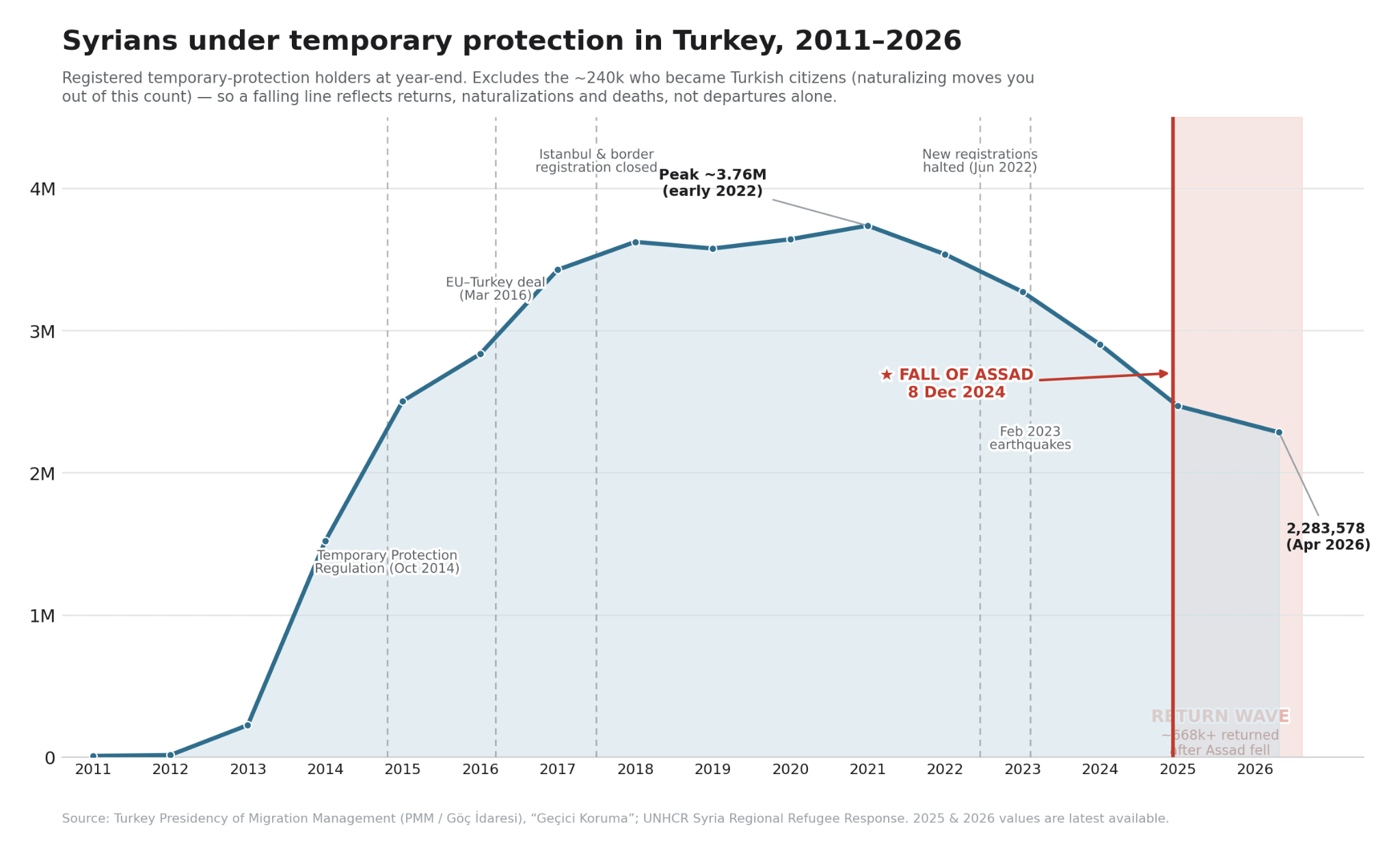
Source: Made using PMM / Göç İdaresi “Geçici Koruma” (Temporary Protection) statistics and UNHCR data.
I mentioned that the population was dispersed. That’s because unlike the classic image of refugee life (a tent in a camp), most Syrians (close to 98%) live across all provinces (including in the major cities) and not in camps. This is commendable and important because it makes Syrians visible in a way that camp populations are not. There are store signs in Arabic, kids in classrooms, people out and about in the street- which likely feeds the backlash.
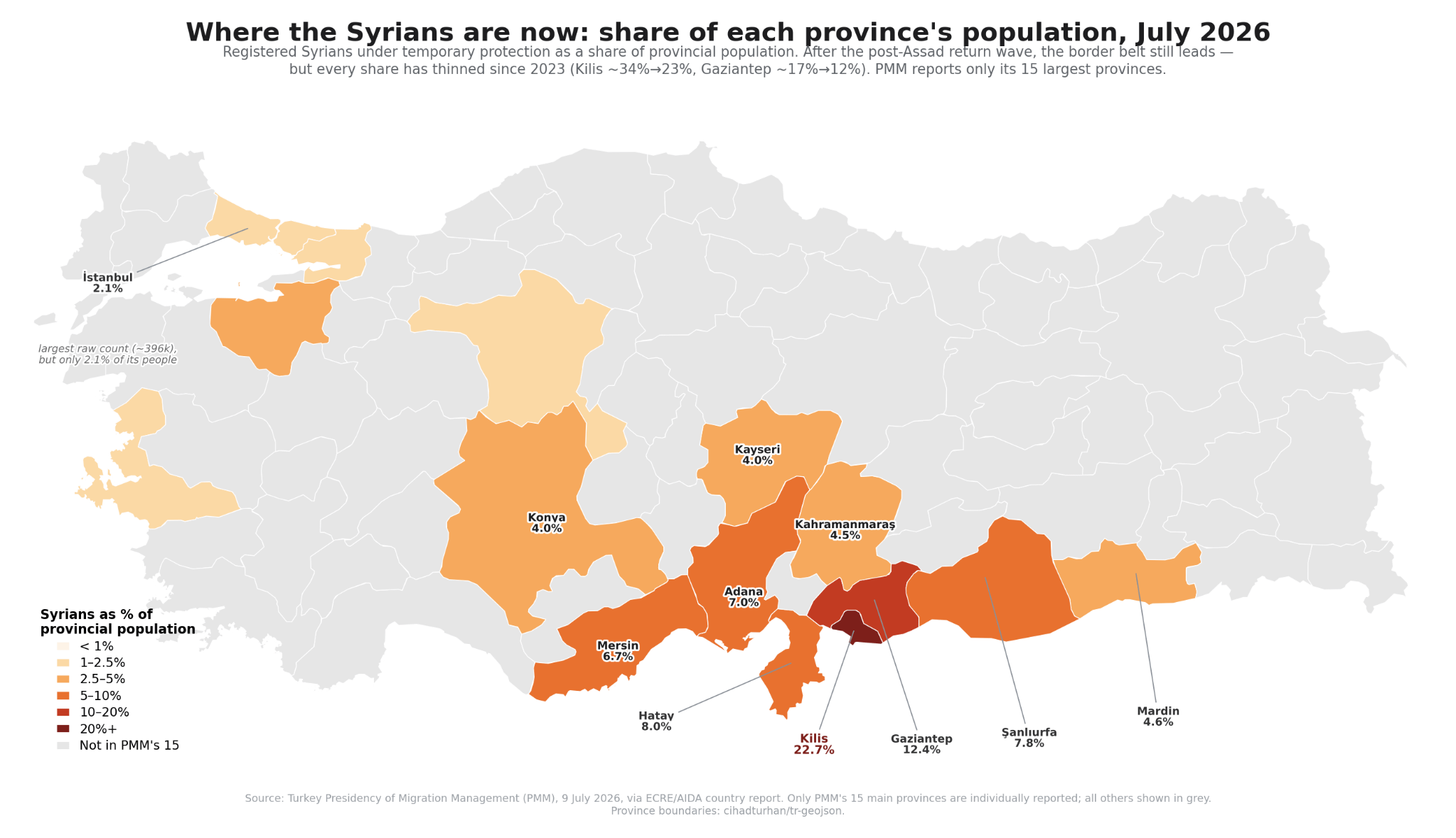
Source: Made with data from AIDA (2026)
The Burden: Real and Perceived
The real economic impact is a tale of two Türkiyes. Because Syrians mostly couldn’t work legally, they poured into the informal economy. Think construction, textiles, agriculture, off the books. The Turks they competed with were the ones already there: the least-educated, the youngest, and women, many of whom left the workforce entirely. But in the formal sector the same cheap labor made firms more profitable, drew in capital, and lifted wages for formal-sector Turkish men, particularly in manufacturing. So the shock didn’t just cost or benefit the country homogeneously. It redistributed upward, from the precarious to the propertied.
Then there’s the money. The EU eventually paid €6 billion (and billions more since) under the 2016 deal to keep Syrians on the Turkish side of the Aegean, while Erdoğan claims Türkiye has spent more than $40 billion of its own. Take the number with a grain of salt (and a side of garlicky yogurt, because, Türkiye), but the grievance is real and politically useful.
And then there’s the perceived burden, which turns out to matter more than the real one. The 2023 Syrians Barometer (the annual UNHCR-backed survey of Turkish and Syrian opinion) found that almost 80% of Turks believe Syrians live “with the help of the Turkish state,” i.e. off the taxpayer. The reality is close to the opposite: only about a third of Syrian households received any aid, and roughly 32% of Syrians aged 12+ are working, overwhelmingly in insecure, informal jobs (casual day-labor rose to 52% of Syrian employment, and just 2.4% hold a registered job). The country that thinks it is feeding a dependent population is in fact hosting a working one it refuses to formalize. That gap between what Syrians cost and what Turks believe they cost is the political and social tension.
Why did the welcome curdle? (like yogurt - OK I will stop) It’s demographic change!
This is where things get really interesting. The Syrian Barometer has tracked some of the same questions since 2017, and the trends are something. Turkish society moved, in earlier mentioned researchers’ own words, from solidarity to “fragile acceptance” to “tolerance” to “rejection.” In 2017, the most common thing Turks said about Syrians was that they were “victims fleeing persecution and war” (57.8%). By 2023 that empathy had collapsed to 25.6% and fallen to last place, while the new leading description was “people who will cause social and economic problems in our country” (50%). The share of Turks who say Syrians should “be sent back to their country” reached 89% in 2023, crucially, one that holds almost regardless of political or socio-economic differences.
But which fears drive these responses? You’d expect the anxiety to be about jobs or crime, i.e. the usual grievances. On the Barometer’s 0–5 agreement scale (figure below), the fears that score highest are about identity — becoming citizens (4.1), harming the socio-cultural structure (3.9), corrupting Turkish identity (3.8) — while “they’ll take our jobs” (3.6) and “they’ll harm me and my family” (3.4) sit at the bottom. So the Barometer found that actually, Turks’ concerns about identity and demographic change rank above their concerns about jobs, wages, or crime. The single greatest anxiety, at a record 84.4%, is that Syrians will become citizens. And asked flatly whether Syrians should be granted citizenship, 91% said no. The thing Türkiye fears is not that Syrians will take something. It’s that they will stay, belong, and change what it means to be Turkish.
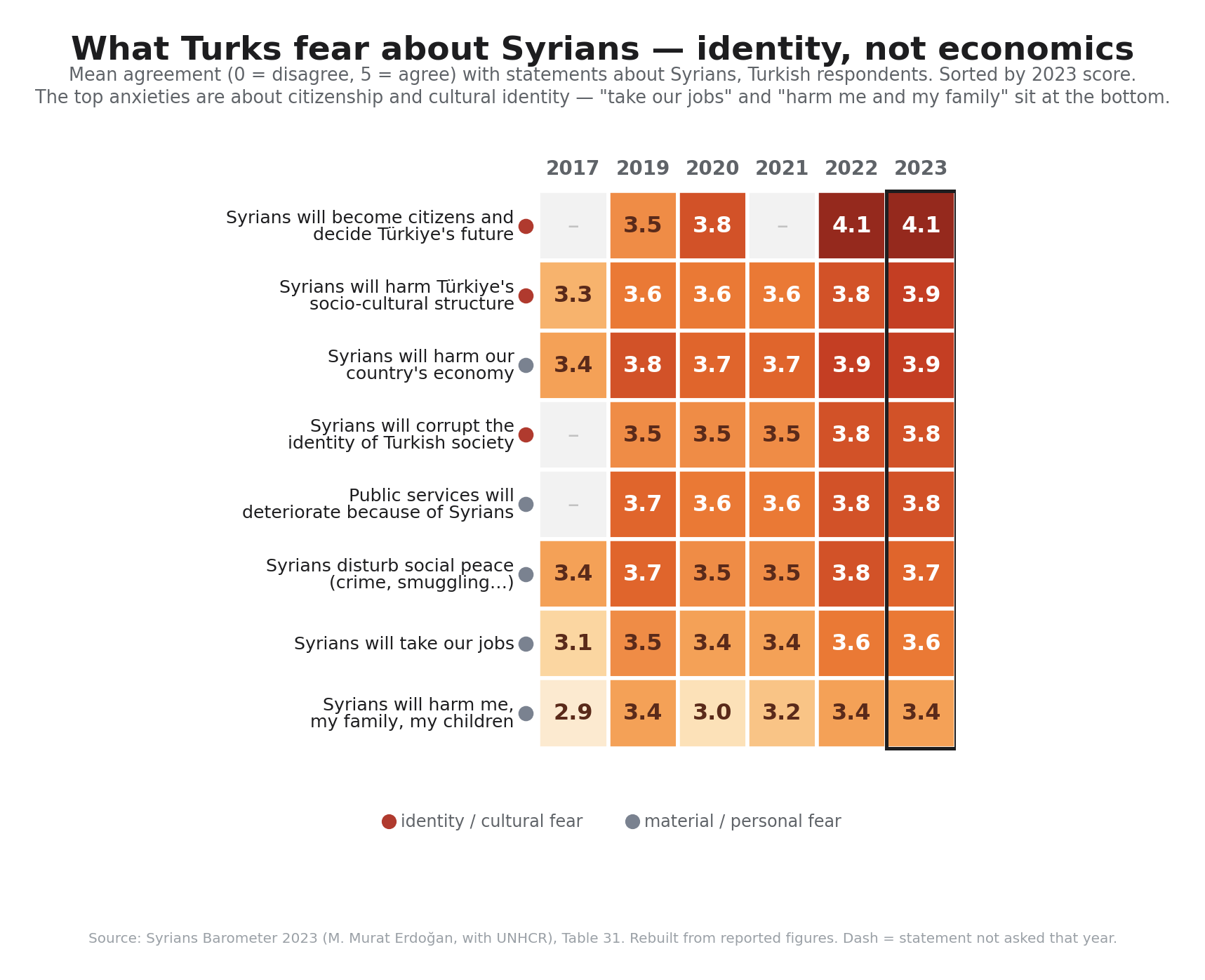
Data from the Syrian Barometer (2023)
Where political science meets demography
Becoming a naturalized citizen comes with benefits such as the ability to vote in elections. And therein lies a contradiction. In public, Syrians are a flashpoint: recent data from the (annual, informative) Syrian Barometer has Turks wanting the border closed and the guests sent home (something like 90% of all people, regardless of political affiliation). Ümit Özdağ built the Victory Party (2021) around repatriating migrants, and by the 2023 election both Erdoğan and the main opposition were promising to send Syrians home. Yet, the same state kept converting a slice of those “guests” into citizens: more than 210,000 Syrians naturalized since the war began, a figure that has climbed past 240,000. Crucially, this wasn’t ordinary naturalization: temporary protection is walled off from the normal citizenship track, so the only door was “exceptional citizenship” (Article 12 of the Citizenship Law), granted on a discretionary basis with no transparent, published criteria for who is selected. The opposition’s camp accused the government of granting citizenship to refugees to gain an advantage at the polls, and the numbers on naturalization are opaque enough that no one could fully refute it. But the math deflates the alarm: of the naturalized Syrians, only around 140,000 had reached voting age by 2023, many of whom wouldn’t vote, thus negligible in an electorate of nearly 61 million.
How native Turkish citizens actually voted in response to the refugee influx further complicates this narrative. Empirical research analyzing voter behavior across Turkish provinces reveals that while the arrival of millions of refugees deepened partisan polarization, it induced only a surprisingly modest net drop in support for the ruling party, AKP. Crucially, disgruntled AKP voters did not swing to the major opposition parties; instead, most retreated into indecision or abstention. As a result, the native backlash failed to translate into a decisive electoral penalty for Erdoğan.
On the other side of the ballot box, the picture for naturalized Syrians was equally pragmatic. They voted heavily for Erdoğan, but not out of ideological loyalty. With both the president and his challenger promising to send Syrians back, Syrians who could vote chose the man who at least called the return voluntary. One new citizen put it flatly: she’d vote AKP not from belief but for better odds her family wouldn’t be deported. So the picture isn’t a manufactured voting bloc delivering an election, nor a massive native backlash dismantling the incumbent; it’s a small, defensive electorate voting less for a future than against the worse one on the ballot, while a native electorate (frustrated yet hesitant) chose abstention over structural realignment.
The deepest Turkish anxiety we found above (the 84.4% who fear Syrians becoming citizens) is a demographic anxiety (I told you! Everything is demography!) Türkiye’s refugee politics and its pronatalist panic are the same politics seen from two angles: both are arguments about whose children, and whose future, get to be Turkish.
Counting, educating, and ensuring the health of the next generation
While we just talked about the minority of the refugee population that is counted as citizens, I mentioned earlier that there is a massive number of children that are or stateless. Let me elaborate. Türkiye does not grant citizenship by birth to the children of refugees; very few countries do. Fine, you think then the child is simply Syrian. Except Syrian nationality passes through the father: a Syrian mother can transmit her nationality to a child born outside Syria only in narrow circumstances. So picture the ordinary case: a baby born in Türkiye to a mother whose husband is dead, missing, or undocumented, with no birth certificate naming a Syrian father. Türkiye won’t claim the child. Syria can’t confirm it. The child is claimable by no state at all. Estimates put the number of Syrian children born in Türkiye at around 750,000, a large share of them at real risk of statelessness. I keep drawing the line between fewer people and fewer people counted. Statelessness is the far end of that line: not a person miscounted but a person counted by nobody. But, physically present in every school, clinic, and stairwell, absent from every register of actual personhood or belonging.
There is a massive flow of refugees out of Türkiye and into Syria, numbering around 640,000 since the Assad regime ended. Pushing these families “home,” and the child lands in a Syria that cannot document them either. Plus for those children, Türkiye has always been the only home they have known. At one point there were over a million school-aged Syrian children in the country (a mind-boggling feat honestly), and Türkiye moved them first into Arabic-language “Temporary Education Centers,” then, deliberately phasing those out by 2019-20, into mainstream Turkish public schools alongside Turkish kids (with funding help from the EU). But it sets up a bind: a Syrian child integrated in Turkish faces low returns if the family is pushed back to Syria, while a child kept in Arabic forfeits any future in the country they actually live in.
Health is the same, and turns out to be a demographic gift (but not one currently seen as such). Rather than dump 3.6 million people onto mainstream clinics, the country built a parallel system - quite amazing really. Registered Syrians got free primary care and health-insurance coverage (!), and the government stood up ~178 Migrant Health Centers plus hundreds of two-person units in high-density provinces staffed by retrained Syrian doctors and nurses, and funded substantially by the EU (the €300 million SIHHAT project, carved out of the deal money to keep Syrians out of the EU). It seemed to solve two problems: the language barrier (Arabic-speaking clinicians for Arabic-speaking patients) and the load (diverted away from Turkish family-health centers). And here’s the punchline for a country panicking about its own aging: this population is young. The Barometer puts the median age of Syrians in Türkiye at 22, against 34 for citizens, with 42% under the age of 15. Türkiye spent years framing these people as a drain while they might just be a way out of the demographic crisis the government is framing they are in.
The Sorting: Who the country keeps and who it loses
In the Syria post I noted that returnees aren’t a random sample: the people going back are disproportionately those who never got farther than a neighboring country, while those who reached Germany mostly stay, leaving Syria to rebuild with a skewed skills distribution. From Türkiye’s side, the same sorting runs: the Syrians most able to stay are those who won the opaque, discretionary “exceptional citizenship” Erdoğan reserved for doctors, engineers, teachers; the easiest to return are the undocumented and informally employed.
But the added layer is that Türkiye is itself hemorrhaging its own young and skilled. I’m married to one (glad he left!) who left after college in Istanbul for his masters in Italy and then finally the US for his doctorate. 2023 was a record year for emigration: about 715,000 people left permanently, including 291,000 Turkish citizens (a 53% jump) overwhelmingly aged 25-34, heading to Germany and the Netherlands. The outflow is led by exactly the people a country can least afford to lose: the highest emigration rates are among IT (6.7%) and engineering graduates (4.4%).
Why are they leaving? Because for young Turks the future feels foreclosed on two fronts at once: economic and political. About 32% of youth 18-24 in were neither employed, in school, nor in training, a rate that placed the country just behind South Africa and was more than double the average among OECD members. Layered on top are years of currency collapse and inflation, and a politics that has narrowed: tightening control over universities, the press, and, after the 2025 arrest of Istanbul’s mayor, the streets.
So the flows stack: Syria loses its skilled to Türkiye and Europe; Türkiye loses its skilled to Europe; and Türkiye pushes its less-skilled Syrians back to Syria. A country wringing its hands about demographic decline is simultaneously expelling the young, high-fertility population it hosts and watching its own young walk out the door.
Looking ahead
Since Assad fell, Türkiye has moved fast to become post-war Syria’s dominant economic partner, raking up more than $11 billion in energy and airport contracts and eyeing a reconstruction market some put in the hundreds of billions. And the engine of the trade rebound that made this possible was the refugees themselves. There are over 30,000 Syrian-founded companies in Türkiye, thousands in manufacturing, and it’s their cross-border networks (entrepreneurs who know both markets, both languages), that helped make Türkiye Syria’s largest trading partner. Turkish manufacturers are now scouting production zones inside Syria. The reason? Well wouldn’t you know it, labor in Türkiye has gotten harder to find and more expensive. And perhaps the worst plot twist (that you can see coming): Syria’s reconstruction is bottlenecked precisely because the war drove out its doctors, engineers, and entrepreneurs who have not returned.
So here we are: a government that launches a “Family and Population Decade,” pleads with Turks to have three children, and frets over a fertility rate that won’t stop falling. While, for a decade, it hosted millions of the youngest, highest-fertility people in the country and declined to count them. It walled them off from citizenship, then feared, above all else, the day they might get it.
Now, it’s easy for me to say all this from Seattle. A multicultural city, in a country built (for all its current denials) by migrants and refugees, where there was never really one “American” identity to protect in the first place. So I don’t want to end by waving away the worry about identity, as though it were simply small-minded. Of course it matters. And with my in-laws from and living in Türkiye, I hear about it a lot (and hope I got all this right. I am sure I will hear about it, if not!) It matters more for a country like Türkiye, largely homogenous for most of a century, than it does for mine. And it’s the same knot Japan and others are now trying to untie as they weigh opening up to immigration against their own demographic math.
But here’s the thing a country in this corner eventually runs into: you only get to hold two of these three at once. You can have a shrinking, aging population; you can insist on a single, unchanged national identity; and you can decline to fold in the newcomers already living inside your borders, but not all three, not forever. Türkiye has spent a decade treating the identity question and the demographic question as separate things, managed by separate ministries. But in reality, weren’t they always the same?
The Food!
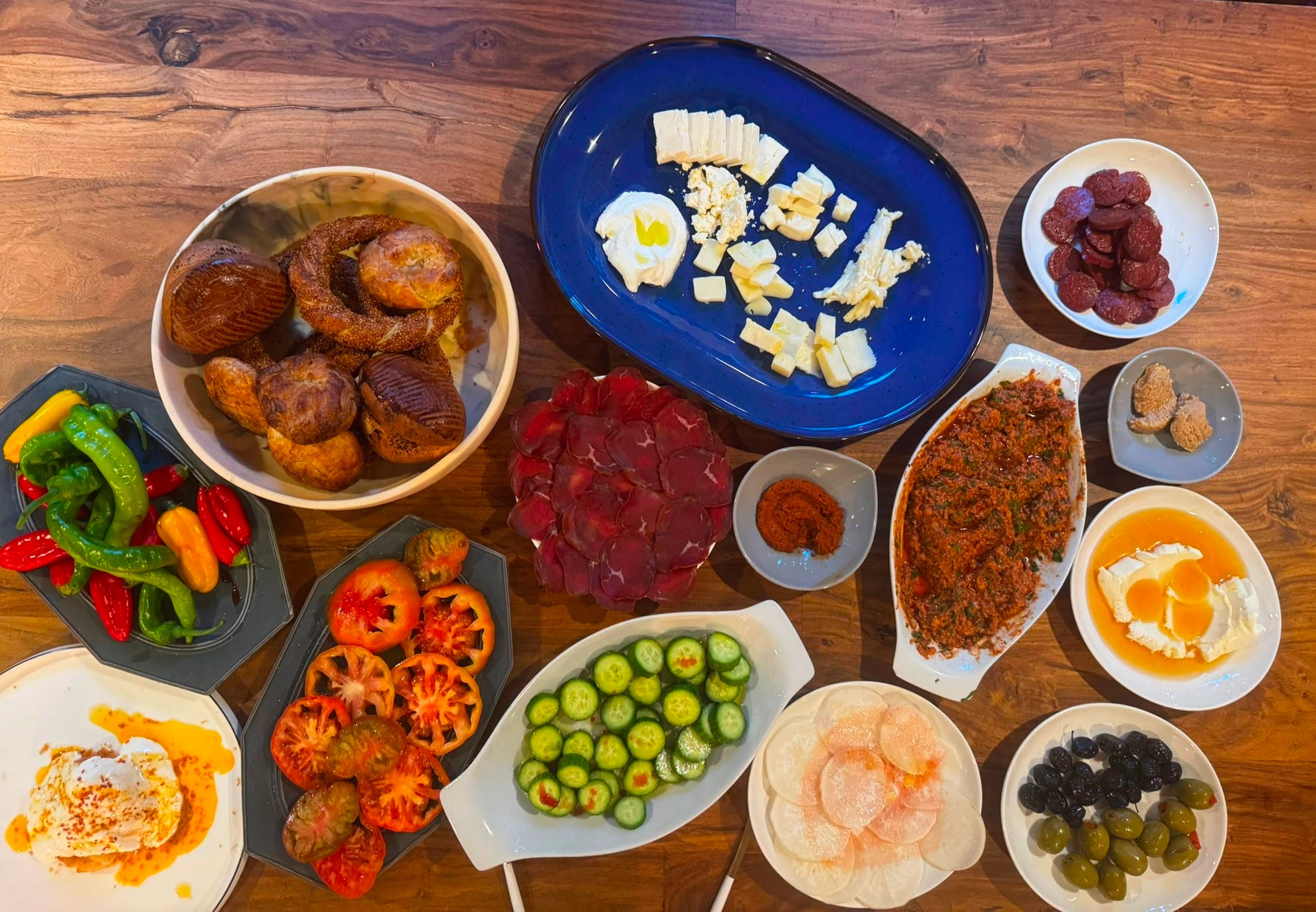
There’s many benefits to being married to a Turkish person (and some drawbacks - the Turkish Süper Lig (soccer) season will start soon), and I would wager that a top 3 reason is the food, specifically the breakfast. It is best consumed over multiple hours on lazy weekends, which we regrettably rarely have these days. So, we had it for dinner: A variety of cheese, bread, meats, veggies, dips, condiments oh my! We had some of our favorites of all the favorites: sucuk (spicy sausage), pastirma (cured meat), my husband’s interpretation of my father-in-law’s Çökelek Salatası (cheese/spice/herbs concoction whose actual recipe I have not been privy to), kaymak (clotted cream), simit (bagel), pogača (stuffed bread), acuka, olives, hazelnut spread - ok you get the picture. We listened to a perennial favorite (no, not Tarkan!): Islandman. Enjoy!
Thanks for reading Demography Matters! Subscribe for free to receive new posts and support my work.
Comments
Nothing yet. Say the first thing.
Sign in to join the conversation.