What is Python?
Python is a programming/scripting language that can be used on many different computers and operating systems, including Windows, Unix, Macintosh, etc.

Python is a programming/scripting language that can be used on many different computers and operating systems, including Windows, Unix, Macintosh, etc.

It’s very straightforward and easy to read and write. It’s now one of the most popular programming languages.

The first and most obvious thing to do is download Python and start playing!
Django provides the contenttypes framework that allows us to create generic relationships between models. This can be useful when you want to implement, for example, a comment system where you can comment on posts, user profiles, images, and even comments themselves. In this tutorial, we will use the ContentType model, GenericForeignKey field, and GenericRelation to implement a comment system where users
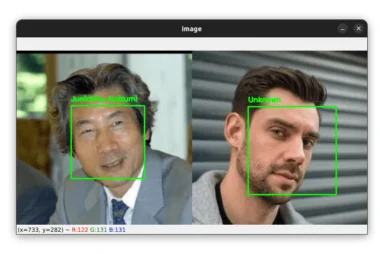
In this tutorial, we will see how to perform face recognition using the Dlib library and deep learning. The OpenCV library will be used for performing some simple image processing tasks such as converting the image to grayscale, resizing it, and so on. We’ll use a pre-trained network provided by Dlib. This network has been
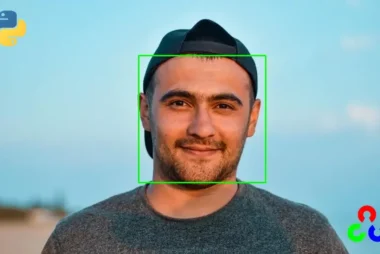
In this tutorial, we are going to see how to detect faces with OpenCV and Haar cascade then we will use image blurring to only blur the part of the face on the image. Face detection is a computer vision technology that consists of detecting human faces in digital images, videos, and real-time video streams.
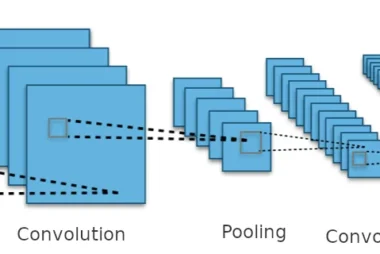
In deep learning, a convolutional neural network is a class of deep neural networks that have been used with great success in computer vision tasks such as image classification, object detection, image segmentation, … Neurons in a convolutional layer are not fully connected to every pixel in the input image like in a traditional neural network.
In this tutorial series, we are going to build a blog application with Python and the Django web framework. We will start from the configuration of the project then we will implement the following features: authentication, reset password, change password, comment, create a post, and finally we will deploy the application. Dependencies To check the
In this tutorial, we will see how to create a blink detector/counter using Dlib, Python, and OpenCV. We will first use the face detector from Dlib to detect faces in a video. Then we will use the shape predictor from Dlib to determine the location of the eyes in the face. Finally, we will use

The authentication system that comes with Django works fine for most cases, but it is recommended to use a custom user model with every project you start as it just requires a bit of configuration, and you’ll be able to customize it as you see fit. When you want to extend the built-in user model
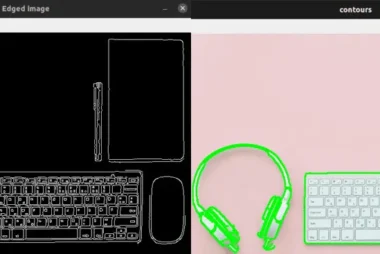
In this tutorial, we are going to see another image processing technique: detect edges and contours in an image. Edge detection is a fundamental task in computer vision. It can be defined as the task of finding boundaries between regions that have different properties, such as brightness or texture. Simply put, edge detection is the process of
In this article we are going to see how to use the following morphological operations: Morphological operations are some transformations applied to grayscale or binary images. Morphological operations apply a structuring element to add or remove some pixels from the boundaries of objects in an input image. A structuring element is a matrix that defines the neighborhood
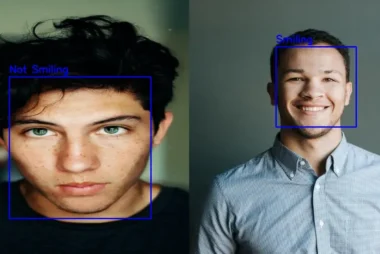
In this tutorial, we will use deep learning to build a more robust smile detector than the one we built in the previous tutorial where we used a Haar cascade smile detector. We will use the SMILES dataset to train our convolutional neural network. Once our model is trained, we will follow the same steps as in