The AI cheat code
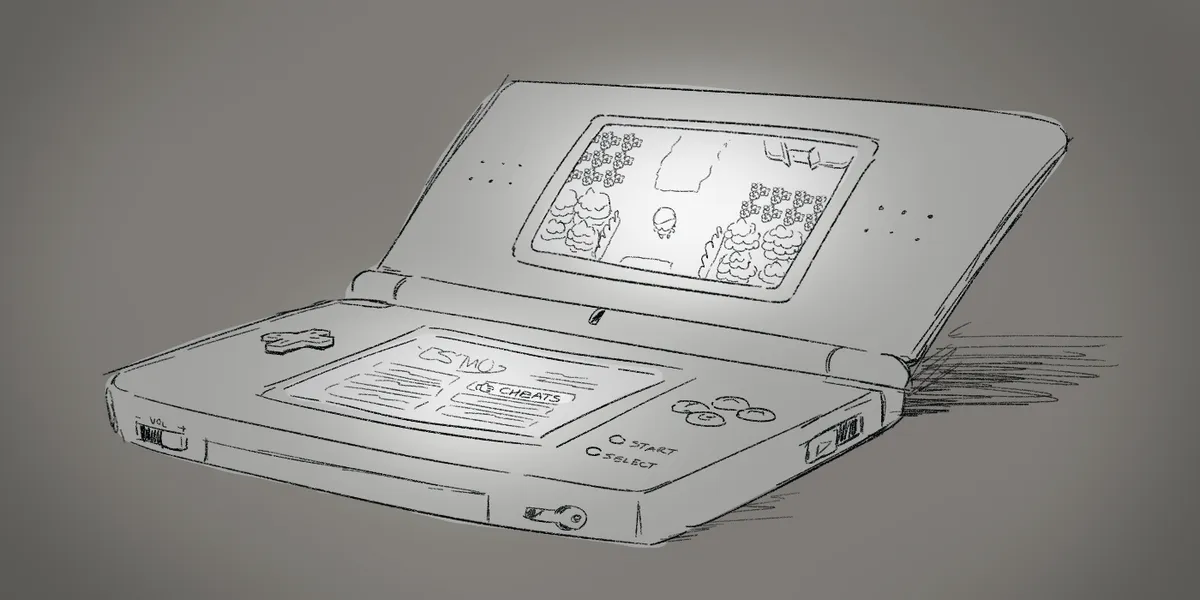
I absolutely loved playing Pokémon Diamond as a kid. It was my very first Pokémon game, and it would be the start of my love and fascination for the series. I had no prior knowledge to how the games worked other than there were creatures you can catch and fight alongside with, and very quickly, kid-me was enraptured by such a world.
It's cute looking back at it now. The dumb thought of trying to catch another trainer's Pokémon, the genuine shock of finding out that Cynthia was the champion, the excitement of discovering never-before-seen creatures through either finding them or evolving them. Some of those moments seem so trivial or obvious to me now, but they were wondrous to l'il ol' me. I kept playing it for hours on end, even after beating the game. I searched every corner to fill the dex and even found my first shinies after learning to shiny hunt. But there's only so much you can cram in a game cartridge.
But I knew there had to be more, because after finding all 150 Pokémon you can encounter, the game rewards you with the National Dex. Suddenly, there were hundreds more, all listed as unknown and uncatchable in the game's setting. I immediately started looking these up and found out that you can only get them through online trading. And for a little bit, I tried doing that, but young me also found out of an alternate method that was available to me.
I didn't question it much at the time, but I found out that I was using a flashcard, a third-party cart that allowed you to load games into a microSD card and play them as if they were genuine copies. Additionally, for the card I was using, it was also possible to load and even create your own cheat codes in-game. So when I found out there were already cheat codes loaded in for my game, my young self immediately shifted gears.
Side-tangent! I do NOT condone pirating games that are available to you!
The line gets blurry for hard-to-find, outdated, or even unavailable games. But generally speaking, if it's available at a storefront that a person can reasonably buy, then please do so. I just didn't know any better! I was a kid that saw a shiny game and went with it!1 Anyway...
It didn't take long before I started using them to find critters I'd never find otherwise. I was excited to find more, and it snowballed into making more manufactured 'mons. I remember even learning how to hack Pokemon into my game with a computer, for the purpose of trading them off to people online. I don't know why, but I found that fun back then apparently.
But eventually, that excitement sort of just...faded away. The magic dissipated when there was nothing more to conquer, especially now with an impossibly overpowered team. I don't recall how quick it was, but it was sudden enough to notice that everything felt dull. And soon after, I had moved on to other games.
It's probably the case that it's just because I reached the end of the game's content, which I'm sure is part of it. But I can definitely recall a few other times where I turned on cheats midway through a game, and the abuse of them simply took away the exciting parts. It was fun at first, sure; but sticking to that as if it was normal gameplay just made it feel hollow.
I know this is a long-winded and somewhat silly analogy to make, but in a weird way, I found myself recalling that feeling when I look at the current state of how people can create things, especially with this push for this supposed utopia of machine-driven creation.
AI-generated art is obviously the loudest example, especially with all those artificial Ghibli doppelgangers lately and the few, loud cases of people "correcting" other people's art with generative models (which is incredibly rude and tactless, to say the least). But now there's apparently vibecoding, where you direct a model to build software just by prompts and feelings alone, without much thought into what's underneath2. And there's probably other areas that I haven't really thought of much before, like writing or video editing or music or even just making a meme.
Let me entertain a hypothetical...
Let's say in the near future, these hypothetical models are capable of, at least most of the time, translating your words into exactly what you want. A masterpiece of art, a perfectly riveting story, an awe-dropping animation, anything. I still doubt that such capacity will ever happen, but let's say I was proven wrong. It's supposedly widely available, cheap, user-friendly, and amazingly versatile.
I'm putting aside my bias against it as a replacement utility and my artist's perspective of why people make things, because I'm genuinely curious if this rings similarly to my feelings with my childhood game:
Won't it get old after a while?
This isn't asked out of retaliation to the "AI bros" or a grandstanding in favor of naturally human creation. Like...won't it start feeling hollow and boring, making the absolute best creations with comparatively very little effort? That excitement of seeing a computer-made work of art, won't it be ephemeral and dwindle away? And even then, is that excitement truly from making something or is it just from typing successful prompts?
Now that practically everyone can do it and make these completely decked out paintings and writings, does it still feel special? Or would it feel even less personal in the sea of generated works? Would it still feel worth doing after enough times, even if that lessened effort gives less reward?3
I know this can still be seen as biased, or that I don't know what I'm talking about or what it's capable of. Which is ironic because I'm in this uncommon position of being both a hobbyist artist for years and a CS engineer who took a few master-level classes about this stuff and has written machine learning code, hah. If anything, I know more than the average person and can see a good part of both sides of that coin. So I can't help but think about that catch-22.
I still think it's impossible to reach that level of mimicry and capacity of the human brain, let alone its full ability to create, so it becomes this fruitless gold rush to overcome those diminishing returns. But even if it hypothetically gets to that point of perfection, wouldn't it eventually lose its shine and grow dull? You can make everything you want in only a few paragraphs, but if anything feels boring and not worth doing, doesn't that defeat the entire point?
Despite it all though, I still think AI, on paper and aside all its ethical and environmental problems, has a lot of great potential. It's easy to overlook where it's helped greatly in fields like medicine and science, or how we've been using it without realizing it. This technology has been around far before the boom of GPTs, after all.4 And I mean, we evolve our ways as tech advances. We use barcodes, translators, and GPS systems in our phones instead of their traditional equivalents nowadays. Entire industries had to change in response.
But I still think this is different, where instead of improving and streamlining the monotonous parts of our daily lives, there's this aggressive push to make it the omnipotent replacement to anything and everything. It's gotten to the point where even the things we love to make and perceive are among the golden targets to replace with generative AI.
I've already said my piece about my issues with it regarding art, and my thoughts haven't changed since then. But honestly this kinda applies for just about anything. If you reduce something you love to just a few sentences or a simple drag-and-drop, I'd say that'd get monotonous real fast. I wonder if it'd feel like an office job at that point, hah!
I suppose that's why I'm not at all intimidated by this whole "AI will replace us all" thing. Maybe it's the optimist in me, but it just doesn't make sense on the long run, which is why I still think it'll eventually pivot into more specific and actually useful purposes. And there is this little hope that all these mega-corporations pushing so hard will fail spectacularly to make that impossible dream real, resulting in a more even playing field, so to speak.
And the poetic irony about my little story about cheating in my first Pokémon game? I think I gained a growing appreciation in programming that way. I remember reading up on how cheat codes were made and how to manipulate memory through them. So even if it was confusing at first, I tried making my own and experimented what I could do. Even though I'd never use them in a regular playthrough, I absolutely love dismantling a game and piecing together how it works underneath. And doing that on my own was fun and worth doing.
It's kinda silly to be connecting a childhood game's experience with my distaste with today's hyper-push of AI in many fields. Maybe it's because it and its controversies just never seem to go away (and I'm being hypocritical by adding to the flames with this whole spiel). But even if this sounds naively hopeful, eventually it has to fade out. I don't think it's sustainable at such a grand scale, and I don't think it's worth doing on the long run for the individual end user.
I do think it's gonna stick around at some capacity, whether people like it or not. But I am confident that, despite everything, there are some things that are just worth doing with your own hands. And the future will show that as people continue to do so.
...there's more?
So...this whole monologue was supposed to end here. I thought I had wrapped it up well enough to give this an ending. But this has been in the drafts since the start of April, and of course, AI doesn't stop being in the limelight.
On the Discover page alone, there have already been writings about lamenting the suffocating presence of AI everywhere, the interesting, yet bumpy experience of vibecoding an end-to-end app, and in contrast, someone breaking up from vibecoding in favor of the process.
And honestly, all of these made me feel a bit more confident in my outlook of this whole landscape, both in the people and how those tools are used. (It also made me feel better about my assumptions of the problems of vibe-coding anything bigger than a personal experiment, ahah)2
But then, right when I was about to send this, a video from Answer In Progress came out, talking about the worth of generative AI through art. It would behoove me to not at least watch it first, and I did. It was intriguing to see Sabrina explore how people defined art's value (through the oddities of modern art) and learn about how context and background play a big role.
But after watching it and about an hour or two later, I found out that the video went private (I'm keeping the link here just in case it goes back up). It's possible that there was some early backlash or second thoughts about its conclusions. I haven't found any statement or explanation about it, so I can only guess that how it concluded had at least mixed reception.
Towards the end, Sabrina interviewed two artists: a "natural" artist and a "generative" artist. And she saw that they both sort of have similar goals, even though they had opposing reasons and methods. She was conflicted because she agrees with points from both sides, saying she could see value for both sides (though she was clear that one side was more impressive than the other).
And I'll be honest, I don't completely disagree with that (and Sabrina was right that we will still have disagreements on this). And yes, that includes the Midjourney artist in the interview5. As much as many artists wishes it didn't exist, I do think there's some denial in saying that it's worthless. It's capable of doing it, as soulless it may be. Why else would all these big companies push so hard for it? But what I do wholeheartedly believe is it's not worth it on the long run, especially with how it's being treated today.
The video has an inconclusive ending. There's some thoughts about both ends, and that it's hard to wrap things nicely when it's this very new technology with a suffocating presence everywhere you look (which is fair). But even if there are some things I agree and disagree with, there was a quote in there that I think encapsulates my beliefs on it very well.
Forgive me because I'm going off of memory here (since the video is currently inaccessible), so you have every right to be skeptical and take it with a grain of salt. But I remembered it along the lines of this:
"If the use case was narrowed and backed by fundamental knowledge, I think AI can be a really great tool. But it can also be a weapon. Right now, it is built on theft and its constant use causes a huge impact to the environment. If we continue and use it to strip away the humanity in what we do or only please shareholders (...), then the benefits won't outweigh the costs."
Again, it has to plateau somewhere if we continue down this road, let it be by technological limits, by environmental and legal concerns, or by apathy from an oversaturation of generated content. If only we could just halt it all, pull back, and address not just the problems within it, but also the raw goal in its future. If we could just do that, maybe we would have a more productive conversation.
It's ironic because my parents were very protective of what I could and couldn't play, with Pokémon being very off-limits (for not very good reasons). It was only because of that flashcard that I was able to play that and other cherished games from my childhood↩
And don't get me started on how laughably prone it is to security flaws, troubleshooting hell, and outdated, spaghetti code. It's probably fun as a small experiment, but what a world of hurt you'll be in if you ship it as a scalable product.↩
Heck, I'd dare say that human-made creations would become even more coveted and special, because it'll be rarer just by the influx of artificial works, as dystopian as that sounds to most people.↩
People nowadays say all the time that Google search has gotten terrible because of AI, which I don't think is entirely wrong. But I don't know how many people know that this has already been around for a decade↩
Honestly what I will say is that at least she was more tactful than the usual generative artist. She said she only posts stuff that was generated from public domain works, and those that were generated otherwise are personal pieces that have never been posted. I do think there's still some wrong in it (like, Midjourney still is built from a conglomerate of everything and not everyone is okay with having their style snatched for computer-generated replicas without a say, even for personal reasons), but if all that's true, there's at least some respect to some degree as opposed to some other people.↩