Pixel Scroll 7/16/26 Going Over Niagara Files In A Pixel

(1) NEW SINO-AUSTRALIAN SFF MAGAZINE. [Item by Ersatz Culture.] Crux Dragon is a new magazine that describes itself as “a Sino-Australian science fiction and fantasy literary magazine featuring original fiction, essays, and literary scholarship from writers in China and Australia.”

The blurb goes on to say:

This inaugural issue explores themes including artificial intelligence, cyberpunk, mythology, history, post-apocalyptic futures, and the human experience. It brings together science fiction, fantasy, non-fiction, and academic writing from authors, translators, researchers, students, and independent creators.

Created to promote cross-cultural literary exchange, Crux Dragon introduces readers to diverse voices and perspectives through speculative fiction and creative collaboration.

Whether you enjoy science fiction, fantasy, or discovering new voices in world literature, Crux Dragon: Singularity offers a unique collection of stories from China and Australia.

Contributors to the first issue include Hugo finalists RiverFlow, Arthur Liu and Ren Qing.

The magazine is available in both English and Traditional Chinese.  The Chinese language announcement on Xiaohongshu/RedNote only mentions availability through Amazon (either as a paid download, or via Kindle Unlimited) and currently only an ebook edition is available (EnglishTraditional Chinese), but the copyright page says that a paperback edition (97817644410625) should also be available.  The Chinese edition is also readable in-browser here.

(2) TOP 25. [Item by Bill.]  “The 25 most influential works of American culture” in the Washington Post. (Behind a paywall.)

Are we a young country or an old one? By the standards of ancient Egypt, or China, we have been on the map for the smallest blip of time. But what an astonishing interval that has been. Since the founders put their names to the Declaration of Independence, there have been revolutions in science, technology, medicine, art and literature. We have seen the camera transform memory and politics, we have doubled our average lifespan, and we have been to the moon….

The 25 most influential works of American culture (one each decade):

Includes several genre and related items –

  • ‘The Legend of Sleepy Hollow’ and ‘Rip Van Winkle’ by Washington Irving
  • Mickey Mouse
  • ‘Earthrise’ photo by William Anders
  • ‘Doom’ video game
  • ‘The Matrix’

Obviously much to dispute – how did Michael Jackson’s Thriller album beat Star Wars?

(3) KING NOVELLAS BANNED. “Utah bans Stephen King novella collection from public schools” reports the Guardian.

A collection of Stephen King novellas that inspired classic films including Stand by Me and The Shawshank Redemption has been banned from Utah public schools.

Published in 1982, the collection, titled Different Seasons, contains four novellas: Rita Hayworth and Shawshank Redemption: Hope Springs Eternal, Apt Pupil: Summer of Corruption, The Body: Fall from Innocence, and The Breathing Method: A Winter’s Tale.

But earlier this month, the Davis, Jordan, Tooele and Washington school districts decided to remove the collection from their libraries, triggering a statewide ban by the Utah state board of education on 6 July. The book had previously been available to students in grades seven through 12, according to the board.

A book is removed from all public schools in the state if at least three school districts – or at least two school districts and five charter schools – determine that a book contains “objective sensitive material” defined under Utah code, according to Utah law….

(4) TROTTING ALONG. “Was the Trojan Horse Real? What Historians Actually Think” according to Mental Floss.

…To this day a lot of people think that the city of Troy didn’t really exist, and that the Trojan War never actually happened. The ancient city is placed in the same category as Atlantis: possibly inspired by real-world events, but ultimately a work of fantasy.

However, most historians agree that the city of Troy really did exist. What’s more, it’s believed the city was located in modern-day Turkey, at an excavation site first discovered by German archeologist Heinrich Schliemann in 1873.

While evidence of the Trojan War is difficult to come by, the city’s ruins are full of battle scars. Throughout time, archeologists have discovered skeletons, stashes of sling bullets, and fortifications that appear to have been damaged, repaired, and damaged again….

…Writing for History Today, Julia Kindt, a historian and author of The Trojan Horse and Other Stories: Ten Ancient Creatures That Make Us Human, wonders if the Trojan Horse was really a poetic metaphor for a ship. “After all,” she writes, “Homer calls ships ‘horses of the deep’ and the Greek playwright Euripides compares the horse with ‘the dark hull of a ship.’”

At the same time, she recognizes that the ancient sources—Homer included—all describe the Trojan Horse as a unique, custom-made object. Among other things, they note it was designed by the master carpenter Epeius, built using wood from Mount Ida, and mounted on wheels….

(5) LITERARY TRAIL OF PRATCHETT’S DEMENTIA. “Scientists spot hidden dementia warning signs buried in Terry Pratchett’s novels”.

…Turning Discworld into a neurological case study

To understand what was happening inside Pratchett’s mind, researchers first had to turn his fiction into something that could be measured. A team working in Jan used digital tools to examine the language of his fantasy series, treating each Discworld novel as a snapshot of how he was thinking and writing at the time. They focused on structural features such as vocabulary range, sentence patterns and the balance between different parts of speech, on the premise that these elements often shift when the brain starts to struggle with complex tasks.

In their brain study, the group built a detailed profile of Pratchett’s style across his career, then compared earlier and later works to see where the curves began to bend. The Methods section explains that the team analysed 33 Discworld novels by Terry Pratchett, explicitly contrasting linguistic features before and after a potential turning point in his health. By anchoring their approach in quantitative metrics rather than literary impression, they aimed to separate normal artistic evolution from signs that might be linked to dementia.

The adjective “narrowing” that gave the game away

One of the clearest signals the researchers found was a steady contraction in the variety of descriptive words Pratchett used. Across Pratchett’s later novels, there was a clear and statistically significant decline in the diversity of adjectives he used, even as his plots and characters remained as intricate as ever. I find that detail striking, because adjectives are where his comic inventiveness usually ran wild, and a shrinking palette there suggests a specific kind of cognitive strain rather than a general loss of talent.

The team behind the linguistic work argued that this pattern was unlikely to be a simple stylistic choice, because it emerged gradually and consistently over multiple books. In their account of the project, they note that this adjective narrowing was the most robust signal when they compared different measures of language change, and they link it to how dementia can influence how people use language. Their analysis, shared in a Jan commentary that explains how Across Pratchett the later works, this decline stood out, suggests that tracking such subtle shifts could help identify problems long before everyday conversation sounds obviously impaired….

(6) SNOOZE ALARUM. James Davis Nicoll highlights “Five SFF Works Based Around Sleep or Sleeplessness” for Reactor readers.

…Science fiction and fantasy authors have long been aware of sleep’s potential where plots are concerned—not simply as a means of transporting people from one era to another, as useful as that is. Sleep can figure in so many ways, as these books demonstrate….

On his list is –

Harriet the Invincible by Ursula Vernon (2015)

Princess Harriet receives delightful news on her tenth birthday. The wicked fairy Nightshade had cursed Harriet. When Harriet turns twelve, she will prick her finger and fall into a deep, magical sleep. So it is written. So shall it be.

Harriet reasons that she can only suffer her doom if she is still alive at twelve. Therefore, the curse will protect her until then… and therefore, Harriet is functionally indestructible. There is no reason why Harriet cannot spend the next two years vanquishing evil. When her curse does arrive? Well, by that time Harriet will be an experienced adventurer. Who knows what could happen?

There is a lot of ground between “must be alive, and retain sufficient cognitive ability that sleep and wake can be distinguished” and “invincible.” Horribly injured people can sleep. Badly brain-damaged people can sleep. Luckily for Harriet, this novel appeared under the author’s Ursula Vernon byline and not her T. Kingfisher horror-oriented persona, or Harriet’s fate might have been much darker.

(7) OCTOTHORPE. Episode 164 of the Octothorpe podcast, “WSFS and ESFS and All Sorts of SFSes”, discusses Eurocons, including MetropolCon, with roving reporter Alison Scott. Then John Coxon and Liz Batty dive into the WSFS business meeting agenda because it’s the SUMMER OF FUN! Uncorrected transcript here.

John and Liz are behind two large stacks of paper with text reading "WSFS Agenda… D… E… E… F… F7… more F7… secret squirrel" whilst Alison sits in the stands of Lord’s. Words above say “Octothorpe 164” and “It’s the summer of fun!”.

(8) TODAY’S BIRTHDAY.

[Written by Paul Weimer.]

July 16, 1928Robert Sheckley. (Died 2005.)

By Paul Weimer: I came to Robert Sheckley’s work through an oblique angle. Somehow, through all of the reading I did in the late 70’s and early 80’s, I missed or didn’t recognize, his short story work (although it’s dollars to donuts I came across a story or three in the many anthologies I read during that period. (And a check in the writing of this shows a couple of Sheckley stories in 100 Great Science Fiction Short Short Stories).  But I didn’t recognize his work and his genius and his skill until 1992. 

It wasn’t until the movie Freejack came around that I started looking for Sheckley’s work specifically, since the movie proudly announced in its credits that it was based on “Immortality, Inc. by Robert Sheckley”.  Yes, this is the movie where Emilio Estevez is a car driver transported to the future, with Mick Jagger (!) of all people as the major antagonist.

The name sounded familiar even so, and as was my practice at the time (Total Recall leading me to Philip K. Dick in similar fashion), I decided that I needed to investigate his work, starting with Immortality, Inc. The novel was very different than the movie by a long show, but I was immediately hooked on his writing. 

I found his work sharp, twisty, clever, devilishly entertaining, and especially for his short stories, with a sting in the tail. It was no wonder to me that his work has been so adapted so frequently, and with such great effect. And while science fiction is generally not explicitly in the prediction business, “The Prize of Peril” pretty accurately and sharply predicts and shows the consequences of television devoted and focused on Reality Television for clicks. “The Perfect Woman” shows the consequences of wanting the perfect mate, straight from the factory, and the consequences of a lack of quality control.  

My favorite Sheckley story might surprise, but it is “Death Freaks” from the “Heroes in Hell” shared world verse. With the ability of throwing anyone who is anyone into their shared world version of Hell, the editors got a story from Sheckley involving the Marquis de Sade, Baudelaire, Lizzie Borden, Jesse James, and an 8th Century BC Greek Hoplite. Sheckley, perhaps out of all of the authors in the series, best “understood the assignment” and let his imagination run wild.  It’s a story that’s a lot of fun and full of the unexpected, entertaining all along the way. That’s what Sheckley could, and did do, with his fiction.

Robert Sheckley

(9) COMICS SECTION.

(10) FAREWELL YANCY STREET. “Marvel Comics to Leave New York and Move Staffers to L.A.”The Hollywood Reporter has the story.

After calling the Big Apple home for almost 90 years, Marvel Comics is moving out of New York City. And heading to Hollywood.

The relocation was revealed to staff at a town hall Thursday at Marvel’s New York office in Midtown, where employees were informed that its publishing division will be pulling up stakes and transferring operations to Burbank, California, the current headquarters of Marvel Studios and corporate parent, The Walt Disney Company.

The development is accompanied by a changing of the guard at the top. Stephen Wacker, a respected veteran comics editor who also earned an Emmy nomination for his work in the company’s forays in animation, has been named Marvel’s new editor-in-chief, replacing outgoing chief C.B. Cebulski, who had steered the division since 2017. Cebulski will still remain part of the family, however, as he will be moving to Japan to spearhead the company’s push into manga, among others things, as editor, Asia originals.

Both changes are meant to reinvigorate the comic book side of the company, which has been overshadowed in recent years by the success of Marvel’s movies, and by a creative slump that saw it lose its position as comics market share leader for the first time this century. Marvel chief Kevin Feige’s installing of the new leadership and the relocation of its comics side to Disney’s Burbank base represents a long-term investment in what he believes underpins the source of Marvel’s storytelling….

(11) UNEXPECTEDLY PREPARED. “What if disabled astronauts are just better suited to space?” asks Phys.org.

The UK Space Agency and space startup Vast just signed an agreement to send Paralympic sprinter and below-knee amputee John McFall into orbit as early as 2027. Most coverage framed it as a victory for inclusion. As a space health researcher, I think something far more interesting happened.

For 70 years, spaceflight has assumed a rigid archetype: a healthy white man with a military background. The assumption was that physical uniformity minimized risk. As we prepare for Mars, the evidence increasingly suggests the opposite.

Star Trek understood this decades ago: Exploration rewards difference. The further you travel into uncertainty, the more kinds of human experience you need. It debuted in 1966 with a Black female communications officer, a Japanese helmsman, a Russian navigator, a biracial Vulcan and a captain who made mistakes and felt his humanity down to the last drop.

What strikes me now as a scientist is not how idealistic that vision was, but how practical. Despite decades of spaceflight, we still cannot reliably predict how one person’s health will change in space. Consider Mars 500, a 520-day simulated isolation mission between 2007 and 2011, during which six male crew members under identical conditions differed dramatically in psychological resilience. Two participants remained stable; three developed severe sleep disturbances; and one suffered persistent depression.

Additionally, around 17% of astronauts experience significant physical deterioration in spaceflight despite following identical exercise regimens. Disability does not necessarily introduce uncertainty into spaceflight; uncertainty is already the norm….

… Researchers are finally investigating this issue by asking whether amputees, who carry less mass and respond differently to microgravity, offer advantages in space. People with lower-limb mobility impairments or vascular differences may be naturally adapted to the headward fluid shifts of weightlessness that cause brain swelling and vision changes in around 70% of astronauts.

When a cooling leak filled Italian astronaut Luca Parmitano’s helmet with water during a 2013 spacewalk, it left him nearly blind and deaf to mission control. He survived by navigating back to the airlock using touch alone. On Mars, where dust storms reduce vision to near-zero, blind people would have an advantage because they depend on other senses….

(12) WORLDCON MASQUERADE HISTORY. Video of the Noreascon Three Masquerade (1989) is available on YouTube.

All 52 Costumes – Pauses and Delays cut out! All the Awards! Close-ups, Freeze Frames, and Credits!

[Thanks to SF Concatenation’s Jonathan Cowie, Chris Barkley, Mark Roth-Whitworth, Ersatz Culture, Thomas the Red, Bill, Paul Weimer, Dennis Howard, Kathy Sullivan, Steven French, Mike Kennedy, Andrew Porter, John King Tarpinian, and Cat Eldridge for some of these stories. Title credit belongs to File 770 contributing editor of the day OGH.]


Pixel Scroll 4/28/26 Whisper Scrolls Of Pixel, Let It Be

(1) LONG TIME PASSING. “Where Have All the Book Reviews Gone?” asks the New York Times. (Link bypasses NYT paywall.)

…Even before the rise of A.I. there was a near-extinction-level wipeout of the American book review. It has gotten eerily quiet out there — it’s as if the bees, those kibitzing and sometimes stinging pollinators, have vanished — and few have noticed.

Only yesterday, it seems, nearly every American newspaper, dozens and dozens of them, even in midsize cities, ran book reviews by local critics. The alternative weeklies (I wrote for many of these) had feisty and clamorous and occasionally nutty book sections. “Sometimes an off-the-wall review,” Norman Mailer said, “can be as nourishing as a wild game dinner.”

Time, Newsweek and other weeklies had serious critics who mattered to the conversation and knocked their heads together like bighorn rams. So much of this is gone. The strangulation sounds of early dial-up should have served as warning.

The recent shutting of The Washington Post’s Book World, one of the nation’s last free-standing books sections, feels like the end of something larger. It marks an inflection point in America’s literature, which can’t thrive without serious, fervent and quick-witted criticism: public talk, back and forth, between competing voices, in something like real time. The thin crust of American intellectual life, long flaking, has begun to show bald patches.

It’s a grim business to linger on the numbers. In the 1960s, a good first novel might receive 90 individual newspaper reviews in America and England, the novelist Reynolds Price wrote in his memoir “Ardent Spirits.” By 2009, the year “Ardent Spirits” was issued, he reckoned the number was 20 at best. What would it be now? Two? Three?…

…But here’s a catch with A.I. It’s easy to tell when a reference, or a comparison, or a sentence, doesn’t belong to a writer. Erudition and style aren’t forgeable for long; they still must be earned. As for A.I.’s sleek, space-efficient text, we’ve already grown accustomed to what that sounds like — the flat, consistent tone, the pert little summary bits, the repetitions, the impersonal and fluorescent-lit mood. Reading it, you feel you’ve been through the desert on a horse with no name.

It will get much better. Like a Nakamichi Model 500, perhaps, A.I. models will probably someday be programmed to calculate range and trajectory and to spit out rich critical prose….

(2) CENTURY’S BEST MOVIES SO FAR. [Item by Mike Kennedy.] Collider named Mad Max: Fury Road tops in their list: “Collider’s 100 Greatest Movies of the 21st Century, Ranked”. The list has so many genre films it’s pointless to name them all here. But the next highest-ranked sff film is Parasite at number two, followed by The Lord of the Rings: Fellowship of the Ring at three.

(3) BERNHARDT Q&A. “William Bernhardt on Comics, Superman, and the Legal Drama Behind an Icon’s Creation” at CrimeReads.

Keen-eyed readers of William Bernhardt’s last novel, Justice For All, might have noticed the dedication: to Jerry Siegel, Joe Shuster and Bill Finger, three legendary figures in the world of comic books. Published in 2024, Justice For All dives deep into the legal machinations a comic book artist must go through to win back the rights to his characters. The initial idea, that of art vs. commerce, served as a springboard for Bernhardt to explore the tragic tale of Siegel and Shuster….

Bernhardt’s nonfiction tome, The Superman Warstells their story. An attorney as well as a writer, Bernhardt spent more than two years researching what Siegel and Shuster endured.

Their initial publisher found himself squeezed out by two men with mob connections—Harry Donenfield and Jack Liebowitz—who benefited from the Superman radio series, movie serials, television shows and merchandise sales. By the time George Reeves donned the familiar costume for the 1950s The Adventures of Superman television series, Siegel and Shuster were practically destitute—fired after having the nerve to sue the publisher in 1947….

LWH: The mob ties kind of threw me. I didn’t realize the publishers were connected.                              

WB: Harry used to brag about it. He wasn’t embarrassed in the slightest about that. He ended up getting a house on Long Island near Frank Costello. Harry did some rum running back in the day. He was indicted twice for pornography. That was another appeal of Superman for him – doing something that was clearly for children. It was not what those guys called a “Sing Sing job,” meaning it’ll end you up in prison….

(4) CENSORS WILL COUGH UP COOL MILLION. “Huntington Beach ordered to pay $1M in legal fees for censoring library books” reports LAist.

Huntington Beach [CA] suffered another courtroom loss in its culture war battles this week when a judge ordered the city to pay $1 million in legal fees for restricting minors’ access to library books.

The City Council passed a resolution in 2023 prohibiting children from accessing books deemed to contain sexual content in the city’s public libraries. Critics said the policy amounted to illegal censorship, and that it was actually an excuse to restrict books with LGBTQ characters and themes.

In September 2025, Orange County Judge Lindsey Martinez found the policy violated California’s newly passed Freedom to Read Act.

The city had also established a citizen review board with the power to censor children’s books at the library. Voters repealed that review board in a special city election in June 2025….

(5) RARE SFWA EPHEMERA. Michael Capobianco continues his series with “A Brief History of SFWA: The Nebula Awards Report” at SFWA’s Planetside.

Giving democratically chosen awards for writing isn’t easy. When the authors themselves are designing the process, there is additional pressure to make the process “fair.” It was even tougher before the Internet, when nominations and updates had to be mailed. In what was then called Science Fiction Writers of America, a small group of dedicated volunteers carried most of that burden. They were the Nebula Awards Report (NAR) Editors….

…Seven SFWA volunteers have been given the Kevin. O’Donnell, Jr. Service to SFWA Award because of their work on the NAR: Chuq Von Rospach (NAR Editor 1989–1996), Brook and Julia West (NAR Editors 1989–2008), and Vonda N. McIntyre (NAR Editor 1972–1976). Other members who have taken a turn: C. L. Grant, George W. Proctor, Frank Catalano, Elizabeth Waters, Orson Scott Card, and Mark Van Name.

So, why did the NAR end? Rule changes made the Nebula more and more cumbersome to administer, and the awards were no longer tied to a specific year. Former SFWA President and current SFWA Operations Manager Russell Davis offers this summary: “The Nebula Award rules when I took office in 2008 were extraordinarily convoluted.” In 2009, the nomination process  changed to the simpler one still in place in 2026….

(6) BRIAN KEENE AMONG PLAINTIFFS. Publishers Lunch says “Authors’ Copyright Suit Against Databricks Will Continue”. (See the Complaint filed with the court at the link.)

Another copyright lawsuit from authors against a tech company for AI training is allowed to continue in Northern California federal court, a judge decided. Plaintiffs Stewart O’Nan, Abdi Nazemian, Brian Keene, Rebecca Makkai, and Jason Reynolds claim that MosaicML, which provides training data for AI companies and is owned by Databricks, used the Books3 dataset to train their own large language model, called MPT, and Databricks’s LLM, called DBRX.

Judge Charles B. Dreyer denied the defendants’ motion to dismiss, stating “Defendants may ultimately prevail on this issue, but for now, Plaintiffs’ allegations are sufficient.”

The tech company did succeed in getting an earlier version of the authors’ complaint dismissed last year, stating that the claims weren’t specific enough.

(7) STEVE MASLOW (1944-2026). Oscar-winning re-recording mixer Steve Maslow died April 28. The Hollywood Reporter profiles his career here: “Steve Maslow Dead: ‘Empire Strikes Back,’ ‘Lost Ark’ Sound Man Was 81”.

Steve Maslow, the top-notch re-recording mixer whose seven Oscar nominations for best sound included wins for The Empire Strikes BackRaiders of the Lost Ark and Speed, has died. He was 81.

Maslow died Monday at a therapy facility in West Hills after a battle with cancer, his wife, Ronna Maslow, told The Hollywood Reporter.

The Los Angeles native also landed Oscar noms for his work on Dune (1984), Waterworld (1995), Twister (1996) and U-571 (2000).

Maslow did 200-plus features during his career, teaming with fellow mixer Gregg Landaker on more than 130 of them, starting with Star Trek: The Motion Picture (1979). He specialized in dialogue and music while Landaker focused on sound effects, and he shared all his Oscar noms with him with the exception of Dune.

“Maz” also collaborated with John Carpenter on Escape From New York (1981), Halloween II (1981), The Thing (1982), Halloween III: Season of the Witch (1982), Christine (1983), Starman (1984) and Escape From L.A. (1996) and with Tim Burton on Beetlejuice (1988), Edward Scissorhands (1990) and Batman Returns (1992)….

… He segued into the movie business and worked on four films released in 1978, including the documentary The Last Waltz, and other music films followed, including Hair (1979), The Kids Are Alright (1979), Rust Never Sleeps (1979) and Stop Making Sense (1984).

Before he knew it, Maslow was working with producer George Lucas on More American Graffiti (1979), The Empire Strikes Back (1980) and Raiders of the Lost Ark (1981) and picking up Oscars in consecutive years.

Maslow’s impressive film résumé also included The Wanderers (1979), 10 (1979), Ordinary People (1980), The Postman Always Rings Twice (1981), Dead Men Don’t Wear Plaid (1982), My Favorite Year (1982), The Dead Zone (1983), St. Elmo’s Fire (1985), Teen Wolf (1985), Ferris Bueller’s Day Off (1986), Children of a Lesser God (1986), Angel Heart (1987), Broadcast News (1987), The Naked Gun: From the Files of Police Squad! (1988), Pet Sematary (1989), Ace Ventura: When Nature Calls (1995), Patch Adams (1998), Bruce Almighty (2003), The 40-Year-Old Virgin (2005), X-Men: The Last Stand (2006), Rocky Balboa (2006), The Town (2010), The Great Gatsby (2013), The Conjuring (2013), Non-Stop (2014) and Mad Max: Fury Road (2015). There are too many movies to mention….

(8) TODAY’S BIRTHDAY.

[Written by Paul Weimer.]

April 28, 1948Terry Pratchett. (Died 2015.)

By Paul Weimer: It took a second bite at the apple for me to fall for the works of Terry Pratchett.  My first attempt was in the 90’s, when I had vaguely heard about his work, and picked up The Color/Colour of Magic.  I thought it was fine and I also tried the Light Fantastic and Sourcery.  But it really didn’t gel for me. I thought at the time Pratchett was an okay writer, and maybe the humor wasn’t quite what I was looking for in fantasy at the time.  (To be fair, the humor in those early Discworld novels is a lot broader than the later more refined ones). 

Terry Pratchett in 2011.

It took over a decade and my late friend Scott to get me to try Pratchett again.  Scott was passionate about a number of writers. Zelazny, which we had in common. Lois M. Bujold, which we also had in common. Michael Scott Rohan. And Terry Pratchett.  Scott encouraged me and “talked me through” finding where I would best enjoy Pratchett’s oeuvre.  I found an affinity for Pyramids (and the best Mathematician on all of Discworld), but when it came to The Night Watch, I really started understanding the Discworld Project and what it was doing.  From then on, Pratchett was on auto-buy.  Vimes and company remained my favorite, although The Librarian is probably my single favorite minor character, if only for the fantastic idea of L-Space. 

Beyond Discworld, there is also Good Omens of course, and also the Long Earth series. The latter feels a lot more the work of his co-author Stephen Baxter than Pratchett but there are moments, scenes, images where the utter magic of Terry Pratchett’s work and writing and humanism comes through. 

One of my not-in-a-Pratchett bits that involves Pratchett is a bit in the late Vernor Vinge’s Rainbows End. In that novel, in its (now a) alternate history, Pratchett went on to write many many more Discworld novels, and became so popular that people would use VR to cosplay as being from the new area of the Discworld these imaginary novels were set (basically an entrepot more along the lines of Alexandria, Egypt).  I could wish, Zelazny style, to walk into that world and bring home copies of those “lost” Pratchett novels. I would love to read them. 

And, sadly I never got to meet him in person. My loss. 

(9) COMICS SECTION.

(10) NOT AFRAID OF NEEDLES. “Man breaks Marvel comic book heroes tattoo record” – BBC has the count. (Subscription required for readers outside UK.)

A man has broken the Guinness World Record for the number of Marvel comic book characters tattoos.

Tom Radford, from Hull, has 63 of the superheroes covering most of his body.

The 40-year-old said he has spent more than £18,000 and 350 hours under the needle getting the work done. 

He started with an image of Thanos in 2016 and managed to meet the actor Josh Brolin who plays the character in New York, adding his autograph to the body art.

Radford describes himself as a Marvel obsessive who collects “anything and everything Marvel-related”.

“When I got Thanos tattooed I wanted it placed at the top of my thigh because if it wasn’t perfect I could always hide it,” he said.

“Needless to say it was better than perfect and the urge for more began.”…

(11) ANIMATED STRANGER THINGS SPINOFF RENEWED. “‘Stranger Things: Tales From ’85’ Renewed for Season 2 at Netflix — Showrunner Eric Robles Teases What’s Ahead” in The Hollywood Reporter.

Netflix has renewed the Duffer Brothers’ animated spinoff Stranger Things: Tales From ‘85 for a second season. 

The Hollywood Reporter can exclusively reveal that the series, from animation veteran and showrunner Eric Robles, will return to Hawkins and the Upside Down sometime this fall. The show’s renewal comes just four days after season one’s debut, which saw Tales From ‘85 take the No. 7 spot on the streamer’s global top 10 list with 2.8 million views.  

The 10-episode first season has also officially landed in Netflix’s top 15 animated series debuts of all time. The spinoff’s renewal and season one success comes just four months after Stranger Things proper — the Duffer brothers’ original live-action series — concluded its decade-long, five-season run at the end of 2025. Following the release of that massive final season, the Stranger Things franchise has continued to perform across social media and with audiences….. 

(12) LOVE TO SHOVE. [Item by Mark Roth-Whitworth.] You thought your luggage was treated badly before? “Humanoid robots to become baggage handlers in Japan airport experiment” reports the Guardian.

Japan’s famously conscientious but overburdened baggage handlers will soon be joined by extra staff at Tokyo’s Haneda airport – although their new colleagues will need to take regular recharging breaks.

Japan Airlines will introduce humanoid robots on a trial basis from the beginning of May, with a view to deploying them permanently as a solution to the country’s chronic labour shortage.

The Chinese-made humanoids will move travellers’ luggage and cargo on the tarmac at Haneda, which handles more than 60 million passengers a year.

JAL and its partner in the initiative, Japan Airlines GMO Internet Group, hope the experiment – which ends in 2028 – will lessen the burden on human employees amid a surge in inbound tourism and forecasts of more severe labour shortages.

In a demonstration for the media this week, a 130cm-tall robot manufactured by Hangzhou-based Unitree was seen tentatively “pushing” cargo on to a conveyer belt next to a JAL passenger plane and waving to an unseen colleague.

The president of JAL Ground Service, Yoshiteru Suzuki, said using robots to perform physically demanding work would “inevitably reduce the burden on workers and provide significant benefits to employees”, according to the Kyodo news agency.

Suzuki added, however, that certain key tasks – such as safety management – would continue to be performed by humans….

(13) BIG SQUEEZE. “Could the moon ever be blockaded? Experts predict cislunar space could be the next Strait of Hormuz” at Space.com.

…The closure of the Strait of Hormuz should inform our thinking about inhabiting the moon and defending cislunar space, said Feldman and Hugh Taylor, also a co-founder of the [Center for the Study of Space Crime, Piracy & Governance]. They authored the 2025 book Space Piracy: Preparing for a Criminal Crisis in Orbit.

“Just as the Strait of Hormuz is a narrow waterway, cislunar space, though seemingly large, actually contains a few unique and exclusive points of transit through which all lunar travel must pass,” said Feldman.

Like the Strait of Hormuz, cislunar space is a critical, strategic passage, Taylor and Feldman explained. “If it falls into the wrong hands, all of NASA’s and Elon Musk’s nascent lunar enterprises — the first steps in a multi-trillion dollar space economy — may have to be written off.”

Could cislunar space be shut down or interdicted in a similar way in the future?…

(14) I PREFER MY UNIVERSE LUMPY. [Item by Mark Roth-Whitworth.] …like us lumpyproletariat. “100-year-old assumption about the universe may soon be overturned” in New Scientist. (Subscription required.)

Assumptions that physicists have made about the universe for over a century may be about to be overturned. Evidence is emerging that it is far lumpier than we had thought – a finding that could solve some of today’s most puzzling cosmological mysteries.

When modelling the universe, cosmologists can’t describe every single galaxy, so they make simplifications. Typically, they assume that the universe on the largest scales is homogeneous and isotropic, meaning that it is roughly the same no matter where you look….

(15) HELP WANTED. NASA Science says “You Can Help Humans Thrive in Space” through volunteer work.

The second Artemis mission took four astronauts around the moon and back – the first crewed deep-space flight since 1972. Not everyone gets a chance to put on a space suit, but you can still be an important part of NASA’s human space exploration story by doing NASA science!

Volunteers with NASA’s citizen science projects have tested chili pepper plant varieties to grow in space, monitored active regions on the Sun, and analyzed data from experiments on how life adapts to the low-gravity, high-radiation environment of space. Participation does not require citizenship in any particular country – you only need a love of science and a desire to help. Join one of the projects below and help NASA make space travel safer and healthier.

Here’s one example of a NASA project:

Are you a classroom teacher for students in grades 6-12? Through Growing Beyond Earth, middle and high school students and their teachers collaborate with Fairchild Botanical Garden scientists to grow candidate plants that are being evaluated as astronaut food. Today, on the International Space Station, astronauts tend to some of the same experimental leafy greens and hot pepper plants to unlock the secrets of how best to space farm terrestrial species. On really long missions, it won’t just be a question of easing the monotony of packaged/prepared foods – astronauts will have to grow their own food to supplement their diets. Sign up here to learn more.

[Thanks to Kathy Sullivan, Steven French, Mike Kennedy, Andrew Porter, John King Tarpinian, Cat Eldridge, SF Concatenation’s Jonathan Cowie, Chris Barkley, Mark Roth-Whitworth for some of these stories. Title credit belongs to File 770 contributing editor of the day Jon Meltzer.]

Pixel Scroll 4/26/26 This Pixel Is Your Pixel, This Pixel Is My Pixel, This Pixel Is Made For Files And Scrolls

(1) 2026 WEBSTER AWARD WINNER. The Clarence Howard “Bud” Webster Award was founded in 2018 to recognize outstanding achievements in writing by Virginia authors. The award is presented at RavenCon.

Congratulations to the 2026 winner:

  • Mike Allen — Trail of Shadows

(2) JAMES BACON ON IRISH NATIONAL RADIO. James Bacon told Facebook readers today:

I was delighted to be asked onto RTE Radio 1’s History Show with Myles Dungan to speak about my book Irish Conflict in Comics in the 20th century: Rebellion, Nazi Spies and The Troubles.

You can hear the segment online, my part begins at 45.05 but the two previous pieces were superb.

Some great questions posed by Myles and I’m very grateful to the RTE team.

National Radio – I’m chuffed!

The link to the show is here: “The History Show Sunday 26 April 2026”.

(3) RAMSEY CAMPBELL Q&A. Skulls in the Stars presents “An interview with author Ramsey Campbell!”

I’ve posted many times on this blog about the work of Ramsey Campbell, and he is not only my favorite horror author but one of my favorite authors of all time. In my opinion, his ability to build a sense of subtle dread in the mundane aspects of modern life is virtually unmatched, and his stories are some of the few that have genuinely unsettled me when reading them.

I recently received a complimentary copy of his recently reprinted novel Incarnate from Flame Tree Press, and the publisher also offered me the opportunity to do an email interview with him, which I jumped at the chance to do…

Incarnate is an explicit tale about the power of dreams, though many of your stories (The End of a Summer’s Day and Run Through come to mind) very effectively use the logic of nightmares. Is there something in particular about this type of story that draws you back to it?

“Run Through” was based on an actual dream, just about the only tale of mine that is. I value the experience of them—free surrealist films—including nightmares, from which I tell Jenny not to wake me, since its my impression they contain their own release mechanism if they become unbearable. I suppose it follows that similar narratives, even if more logically or consciously constructed, appeal to me. For instance, I’m a great admirer of Ishiguro’s The Unconsoled. The only piece of writing I’ve done that felt like dreaming onto the page was Needing Ghosts, where I came to my desk every morning impatient to discover what might happen next. As Ted Sturgeon said of his tale “It”, it was very easy and I wish I could do it again….

(4) FOR YOUNG READERS. [Item by Steven French.] The Guardian’s latest “Children and teens roundup – the best new picture books and novels” list includes.

 The Lost Robot by Joe Todd-Stanton, Flying Eye, £12.99

When a little robot wakes on a rubbish dump, it knows it shouldn’t be there; but when it tries to go home, everything has changed. Is there a place for it anywhere in the world? A beautiful, heartwarming picture-book fable of repair, renewal and found family.

The Mud Princess by Beatrice Alemagna, Thames & Hudson, £12.99
Annoyed with her big brother after school, Yuki throws her keys down a maintenance hole – only to discover the twiggy-haired Mud Princess, who lives on edible anger in a strange, blobby underworld with touches of unexpected beauty. This strikingly memorable 4+ picture book vividly evokes children’s intense and complex feelings.

(5) OLDER WRITERS GRANT NEWS. The Speculative Literature Foundation’s $1000 Older Writers Grant opens for submissions on May 1. Guidelines at the link.

Since 2004, the SLF’s Older Writers Grant has been awarded annually to writers who are at least fifty years of age and who are just beginning their careers as speculative fiction writers. This $1,000 grant may be used as each writer determines will best assist their work.

(6) WHEN MAGIC WENT POSTAL. “What allowed occultism to blossom in the United States at the turn of the 20th century? Linotype machines, cheap pulp paper, and newly improved postal networks. Allan Johnson investigates the forgotten history and (still living) world of mail-order magic.” “Magic by Return of Post: How Mail Order Delivered the Occult” in The Public Domain Review.

…The rise of mail-order magic was, in many ways, both an upshot and a parody of modernity. America’s long nineteenth century had already seen its fair share of religious transformation, with movements like Mormonism, Seventh-day Adventism, Christian Science, and the Shakers, among others, emerging from the spiritual fervour of the Second Great Awakening, each grappling in their own way with the relationship between the individual and society at large. In 1917, German sociologist Max Weber famously argued that “the fate of our times is characterized by rationalization and intellectualization and, above all, by the ‘disenchantment of the world’”. To Weber’s mind, the progress of the modern world had eradicated the need for spiritual practice, with the purposes it had once held now being carried by the cold logics of bureaucracy, science, and instrumental reason. From the vantage point of hindsight, however, Weber’s Entzauberung thesis seems less terminal than he had imagined….

(7) MEMORY LANE.

[Written by Cat Eldridge.]

Lucius Shepard’s “The Man Who Painted the Dragon Griaule” (1984)

Lucius Shepard’s “The Man Who Painted the Dragon Griaule” is a remarkable work of fiction.  He created a fascinating world, a world separated from our own, as he said, “by the thinnest margin of possibility.” 

There, in the mythical Carbonales Valley, he found the setting for “The Man Who Painted the Dragon Griaule”, the classic account of an artist—Meric Cattanay—and his decades long effort to paint—and kill—a dormant, not quite dead dragon measuring 6,000 feet from end to end. 

It was first published in The Magazine of Fantasy & Science Fiction in their December 1984 issue, forty years ago.

The story was nominated for multiple awards including an Hugo at Interaction and is now known as one of its author’s most outstanding works. It’s in Modern Classics of Fantasy, both paper and epub. 

(8) COMICS SECTION.

(9) FAN OF PRATCHETT. [Item by Steve French.] Joe Dunthorne, prize-winning Welsh novelist and author of Children of Radium, on the books of his life: “Joe Dunthorne: ‘Growing up in Swansea, I developed an allergy to Dylan Thomas’” in the Guardian.

My favourite book growing up

At 10 years old, I read only Terry Pratchett. As far as I was concerned, there were no other authors. I loved everything he wrote but my favourite was Mort, where the eponymous protagonist is Death’s young apprentice. He learns the skills of the trade: traipsing between appointments, meeting the soon-to-die and reaping their souls. I liked how it made the afterlife seem ordinary, even bureaucratic, with the Grim Reaper more like a taxman – unwelcome wherever he goes.

(10) CHRISTMAS IN APRIL. NO FOOLIN’. “Hallmark Just Revealed Their 2026 Disney Christmas Ornaments!” and AllEars.Net has full coverage of the different themes. Here are the highlighted Star Wars ornaments. (Click for larger image.)

(11) SPIDER-MAN NOIR TRAILER. The Hollywood Reporter introduces the “Spider-Man Noir Official Trailer: Nicolas Cage as Web Slinger”.

The official trailer for Prime Video’s Spider-Man-based drama series features a gumshoe Nicolas Cage facing off against Brendan Gleeson’s super villain.

Marking the Oscar winner’s first leading TV series role, Cage plays Ben Reilly, an aging and down-on-his-luck private investigator in 1930s New York, who is forced to grapple with his past life as the city’s one and only superhero. In the new trailer (below), Reilly discovers his powers and faces off against an Irish crime boss (Gleeson), who is apparently Silvermane from the comics. The trailer was dropped in Mexico City for the pop culture festival CCXPMX26….

(12) STRANGE NEW WORLDS UPDATE. The Hollywood Reporter was also on hand as the “Star Trek: Strange New Worlds Season 4 Trailer, Premiere Date Revealed” The fourth season will premiere globally on July 23.

…In the first footage, La’An Noonien-Singh (Chong) warns Nyota Uhura (Gooding), “Any of these missions could be our last.” The trailer ends with James T. Kirk (Wesley) declaring, “Let’s boldly go.”…

[Thanks to Chris Barkley, Mark Roth-Whitworth, Kathy Sullivan, Daniel Dern, Steven French, Mike Kennedy, Andrew Porter, John King Tarpinian, Cat Eldridge, SF Concatenation’s Jonathan Cowie for some of these stories. Title credit belongs to File 770 contributing editor of the day Mark Roth-Whitworth.]

Pixel Scroll 4/16/26 Once Is Happenstance, Twice Is Coincidence, Three Times Is Pixel Scrolls

(1) 2026 GUGGENHEIM FELLOWS. Namwali Serpell, author of the 2020 Clark Award-winning The Old Drift, and Marlon James, whose Black Leopard, Red Wolf won a 2020 Locus Award, are among the 233 Guggenheim Fellows announced today.

Chosen through a rigorous application and peer review process from a pool of nearly 5,000 applicants, the Class of 2026 Guggenheim Fellows was tapped based on both prior career achievement and exceptional promise. 

The fellows span 55 different disciplines.

(2) A SFF MURDER. Pratchett’s here – “6 Mystery Novels with Unorthodox Settings and Setups” at CrimeReads.

Terry Pratchett, Snuff

The Discworld series, starting in 1983, quickly evolved from its parody nature to a dense universe and a perfect setting for whatever ideas Pratchett wished to explore. Commanders Vimes is a character that evolved with it, a grizzled police veteran with an adamantine sense of justice. In Snuff he finds himself on vacation in a small country town so, of course, there is a murder.

Terry Pratchett’s skill for blending relatable characters, affectionate pastiche and cuttingly incisive satire are all on fine display here. It explores small-town politics, racial prejudice and corruption all through the fine tunes comic style that Pratchett made his own.

(3) MEDICINE AFTER THE WORLD ENDS. Jason P. Burnham speculates about “Post-Apocalyptic Antibiotics” at SFWA’s Planetside.

Whoopsie-doodle! Your protagonist has just been written into a world where the infrastructure for antibiotic production no longer exists. Perhaps you’re writing in the near future, and climate change has progressed to the point of the complete collapse of global commerce. Perhaps the aliens from the first Independence Day movie have blown up all the major centers of production around the world. Or maybe the antibiotic production infrastructure has yet to be invented because you’re writing in the past or a pre-technological fantasy world. Wherever you’re creating, no one is making antibiotics. Protagonists living a “life after antibiotics” (or before, as may be the case) is becoming an increasingly relevant theme/scenario for modern speculative fiction. What’s a protagonist (and author looking to write such a setting with believable medical accuracy) to do?

Before we dive into what your main character’s options are for making/acquiring antibiotics, first we must consider the spectrum of conditions for which you might need antibiotics. Some common bacterial infections are those of the urinary tract, lungs (pneumonia), ears, skin and soft tissue, bones, and meninges (meningitis). Add to that diarrheal illness and sexually transmitted infections. If there are no antibiotics, what can your protagonist do for the afflicted? …

… Bald’s Eyesalve is just one example—perhaps your protagonist has access to other forgotten or dismissed remedies. An ancient text, only recently discovered. An Indigenous remedy known only through oral tradition, in danger of being phased out of history by colonial violence. Lost scrolls from antiquity stumbled upon in a cave, desert, or island that are previously unread, but provide crucial insights into antibiotic properties and preparations from commonly available plants, fungi, insects, or other plot/world-convenient source. It is entirely plausible!…

(4) THE CUTTING ROOM. The Unofficial Hugo Book Club Blog dissects the 1991 Best Dramatic Hugo results in “A Fantasy Of Suburbia (Hugo Cinema 1991)”.

…More than 800 people voted in the category, as there were strong feelings expressed about the top two contenders. Paul Verhoven’s Total Recall had been the standard-bearer for fans of hard-edged classic science fiction, while Tim Burton’s gothic fable Edward Scissorhands was beloved by the more whimsical factions of fandom. The winner was decided by just six votes — a margin of less than 0.7 per cent. The shortlist was rounded out by the top-grossing movie of the year, Ghost, a well-liked sequel to the Hugo-winning Back To The Future, and The Witches, the last theatrically-released movie from iconic puppeteer Jim Henson….

(5) INTERVIEW SUBJECT. Mental Floss reveals “The Tragic Real-Life Inspiration Behind ‘Interview with the Vampire’”.

…In 1972, Rice lost her five-year-old daughter Michele to leukemia. The child’s death led to the creation of Interview with the Vampire, which became Rice’s first published novel when it came out in 1976. 

“Some time after, in grief, and madness, a dreadful fiction was born to me out of the tragedy—a book that was most certainly allegorical though I never noticed—Interview with the Vampire in which the child vampire Claudia, created by two males clearly married to each other, realizes that though she is immortal like her parents, she will never grow up,” Rice wrote in a 2019 Facebook post….

(6) UP ABOVE THE WORLD SO HIGH. James Davis Nicoll spotlights “Five Vintage SF Works About Traveling to the Moon” at Reactor.

People the world over welcomed the distraction offered by astronaut Jeremy Hanson as the Canadian and some others made their way to and around the Moon in the spacecraft Artemis II.

Now, the idea of a journey to the Moon is nothing new. The Moon has been in the sky for a very long time. I have no doubt it will still be there when humans are a fading memory1. It’s only natural that storytellers have long pondered journeys there. Before the nineteenth century, these journeys were only fantasies. Of late we have begun to imagine Moon travel via technology. You might enjoy these early works….

One of them features comics hero The Spirit

The Spirit on the Moon by Will Eisner, Jules Feiffer, and Wallace Wood (1952)

The Interplanetary Flight Commission is determined to put men on the Moon. The problem is that any man with the requisite skills has far better options than a quite-possibly-one-way trip to an airless, deadly world. Any free man, that is. Hardened convicts can be enticed into volunteering, in return for freedom should they return.

Someone will have to accompany the crooks, to keep them on-mission and ensure the success of the venture. That man is, as the title suggests, masked crimefighter Denny Colt, AKA the Spirit. But is even a two-fisted man of action up to the challenges of keeping panicky convicts alive on an alien world?

Sending masked crimefighters to the Moon? What next? Dick Tracy?

Efforts to test crewed spaceflight with animals infuriated animal welfare agencies. Nobody seems all that bothered about sending convicts. This is just one reason why this atypical Spirit arc is incredibly depressing…the art, the Spirit’s internal monologue, and the unpleasant fatalities all play a role.

(7) BUCKET LIST ADDITIONS. “By the Power of Grayskull: The Masters of the Universe Popcorn Bucket Is a Castle and the Sword of Power Is a Drink Container”Fantasy Land News tells all about them.

The Masters of the Universe Cinemark popcorn bucket, collectible tumblers, Sword of Power drink container, and plush lineup have been officially revealed ahead of the film’s June 5, 2026, theatrical release, with the full lineup unveiled at CinemaCon 2026 in Las Vegas. Cinemark’s Masters of the Universe collectibles feature a Castle Grayskull popcorn bucket with a built-in drink holder tower, a full-face Skeletor sculpted tumbler with red glowing eyes, a He-Man figure cup, a Sword of Power drink container that unscrews in three sections and uses the hilt as a straw, chibi-style Skeletor and Beast Man plush toys, and a Skeletor Bust Popcorn Bucket….

…What makes this one genuinely special is the dual functionality. Popcorn fills the main Castle Grayskull body, while one of the side towers functions as a dedicated drink compartment — making this a complete all-in-one concession piece that holds both your popcorn and your drink simultaneously….

… The Skeletor face tumbler. The skull face, red glowing eyes, and purple hood are all rendered in three-dimensional detail, wrapping the front of the cup in a character portrait that reads as a genuine collectible figure rather than a branded cup. Comes with a black lid and straw. Skeletor is played by Jared Leto in the 2026 film, and the sculpt captures the classic animated Skeletor design rather than a film-specific likeness. Expected to be priced around $17.99

The He-Man figure cup features a fully articulated He-Man figure sculpted onto the dome lid of a blue translucent cup, with He-Man’s likeness also embossed through the cup body itself — the hero raising the Power Sword against an embossed rocky landscape visible through the translucent blue walls. The figure on top stands free of the lid and is detailed enough to function as a standalone display piece. The blue translucent design is a clean and distinctive execution that stands apart from the darker tones of the Skeletor and Castle Grayskull pieces.

(8) MEMORY LANE.

[Written by Cat Eldridge.]

April 16, 2007Ray Bradbury Awarded Pulitzer Board Special Citation

Columbia University President Lee C. Bollinger (on the left) presents Michael Congdon (accepting for Ray Bradbury) with the Pulitzer Prize Special Citation.

Eighteen years ago, a special citation went to Ray Bradbury from the Pulitzer Board for his distinguished, prolific and deeply influential career as an unmatched author of science fiction and fantasy.

But the Pulitzer Board doesn’t give out such an Award without picking a specific work and this is the full language of their announcement:

Bradbury came of age as a writer before the postwar ascendancy of the paperback book as a publishing medium. Instead, during the Golden Age of Science Fiction, short stories published in pulp magazines like Astounding Science-Fiction, Thrilling Wonder Stories and Amazing Stories stood at the forefront of the field. As such, many of his novels are actually “fixups”—a term coined by SF legend A.E. van Vogt to describe novels assembled from previously published short stories that were buttressed with new interlinking maCulled from Bradbury’s late 1940s output, The Martian Chronicles is a sweeping account of the colonization of Mars amid nuclear war on Earth. Its literary structure (patterned after Sherwood Anderson’s Winesburg, Ohio) earned plaudits from such notable critics like Christopher Isherwood, who read the book after a fortuitous encounter with the younger writer (and fellow Angeleno) at a bookstore. In his review, Isherwood deemed Bradbury “a very great and unusual talent,” a tastemaking assessment that charted the course of the rest of his career.

(9) COMICS SECTION.

(10) EO-POOH. “Pooh in pencil: sketches for original Winnie-the-Pooh book shared for first time” – see them in the Guardian.

Previously unseen drawings of Winnie-the-Pooh that show the honey-loving bear before he was introduced to generations of readers in the 1926 book have come to light.

Two preliminary pencil sketches by E H Shepard have been shared for the first time by his family to mark the centenary of one of the most loved books in children’s literature.

Having been abandoned at the very earliest stage of the book’s creation, the drawings offer a rare glimpse into Shepard’s working process and imagination as he brought AA Milne’s character to life. They depict passages that are familiar to readers but were not accompanied by illustrations in the original published book.

A pencil drawing, captioned: “Climbing very cautiously up the stream”, shows Pooh and his adventure-loving friends Christopher Robin, Piglet and Owl. It was intended for Chapter VIII, in which Christopher Robin leads an “expotition” to the north pole….

(11) ‘UNC’ GAMES. [Item by Steven French.] If you ever wondered what an ‘unc’ game is, Keza MacDonald explains all in the latest “Pushing Buttons” newsletter: “Long live the ‘unc game’” in the Guardian.

While researching women’s experiences in multiplayer video games recently, I came across this thread on the subreddit about Bungie’s latest live shooter, Marathon. “I’ve played a lot of shooters, and as a feminine-presenting player tbh it’s often a struggle,” it reads. “I’ve heard all the ‘get back to the kitchen’ jokes … ​But Marathon has been completely different, guys. I haven’t had a single issue, people have been incredibly kind and helpful… ​The community feels genuinely welcoming to everyone.”

The top-voted reply? “Benefit of being an unc game.”

What the heck is an unc game? It didn’t take me long to discover that “unc” (short for uncle) is the latest semi-disparaging gen Z name for anyone over about 30. Further back, it originated as AAVE slang. “Uncslop” refers to the implicitly terrible games beloved by this older generation of players; basically anything made in the 1990s or 2000s, from Knights of the Old Republic to World of Warcraft. An unc game, then, is a game predominantly played by millennials (and older) – and Marathon is one of them. A week or so later, I read Emanuel Maiberg’s article for 404 Media, which dug into the game’s unc credentials.

I’ve been waiting a long time for this cultural milestone: the point at which video games have been around long enough for old games (and older gamers) to become fundamentally embarrassing. I’m totally here for it – long live the unc game. May uncs enjoy slower-paced shooters and 12- to 15-hour cinematic narrative games for ever, while simultaneously decrying the frenetic pace and aesthetic overwhelm of young-people games. This is the eternal generational cycle, and it should be embraced and enjoyed.’…

(12) NEW D&D PLAY SHOW. “Dungeons and Dragons Launches Official Actual-Play Show”Variety has details.

Hasbro’s Wizards of the Coast is putting their trademarked D back in DM-ing with the launch of a new “Dungeons & Dragons” actual-play TV series.

Launching with its first two episodes available on YouTube on April 22 at 6:30 p.m. PT, the new show, titled “Dungeon Masters,” stars Jasmine Bhullar (“DesiQuest,” “Dimension 20”) as the Dungeon Master along with players Mayanna Berrin (“Dispatch,” “StoryQuest”), Christian Navarro (“13 Reasons Why,” “Forgotten Realms: Tears of Selune”), Neil Newbon (“Baldur’s Gate III”) and Devora Wilde (“Baldur’s Gate III”).

For the uninitiated, an actual play show features people who are really playing “Dungeons & Dragons,” or another table-top roleplaying game. The format has become widely popularized in recent years through the web series “Critical Role” and Dropout’s “Dimension 20,” both of which focus on D&D-style game mechanics, but without using the official D&D products or licensing. (Instead of Dungeon Masters, you have game masters.)…

(13) UNKNOWABLE TV. ComicBook.com can’t forget “7 Unsolved TV Show Mysteries That Still Haunt Us Years Later”.

… A show must hook viewers from its first episode; otherwise, they risk being suddenly cancelled. That means creators who plan for multiple seasons risk leaving the story unfinished if the audience numbers are not to the liking of the executives in control of content planning.

When a series builds its entire identity around a puzzle, the contract with the audience is particularly binding. Occasionally, creators soften the blow after the fact, such as when Mike Flanagan shared his planned resolution for The Midnight Club following Netflix’s decision not to renew it. More often, the creators move on, the IP stays locked in corporate vaults, and the audience is left with a half-told story and no explanation in sight.

Here’s one of their unanswered questions:

2) Who Was Ciaran and What Was His Plan in 1899?

1899, created by Jantje Friese and Baran bo Odar, the duo behind Dark, premiered on Netflix in November 2022. The series follows a group of European emigrants aboard the steamship Kerberos who discover a ghost ship and descend into a reality-fracturing nightmare. The first season’s climactic twist reveals that the entire historical setting is a simulation, that the passengers are sleeping in pods aboard a spaceship in the year 2099, and that the simulation was originally built by protagonist Maura Franklin (Emily Beecham) to preserve her dying son. The season ends with Maura waking in space to find a message from her brother Ciaran, who has been manipulating the simulation from the outside and whose larger purpose was never explained. 

Friese and Odar had designed 1899 as a three-season story, with Season 1 functioning as Act One of a complete arc. Sadly, Netflix cancelled the series in January 2023 without explanation beyond the platform’s standard data-driven criteria. Ciaran’s identity, his relationship to Maura’s original world, and the nature of the simulation’s origins remain completely unresolved, turning what should have been a first chapter into a permanent cliffhanger.

(14) FIRST MOVIE ROBOT. “A Rare 1897 Film Discovered in an Old Trunk in Michigan Features the First On-Screen Appearance of a Robot”Smithsonian Magazine chronicles the discovery.

In a battered trunk full of his great-grandfather’s nitrate film rolls, a Michigan man discovered a relic of filmmaking history: a copy of “Gugusse and the Automaton,” a long-lost 45-second film by French auteur Georges Méliès, a pioneer of early cinema.

The slapstick short film, created around 1897, was famous for containing the very first on-screen appearance of a robot—preceding the term itself by more than two decades. But no watchable copies of the film were known to survive.

Last fall, however, retired teacher Bill McFarland of Grand Rapids brought his great-grandfather’s collection to the Library of Congress’ National Audio-Visual Conservation Center….

(15) VIDEO OF THE DAY. Past America’s video about The Day The Earth Stood Still (1951) covers casting decisions and a “Banned Secret Ending and Hidden Truth They Tried to Hide”.

[Thanks to SF Concatenation’s Jonathan Cowie, Mark Roth-Whitworth, Kathy Sullivan, Olav Rokne, David Doering, Steven French, Mike Kennedy, Andrew Porter, John King Tarpinian, and Cat Eldridge for some of these stories. Title credit belongs to File 770 contributing editor of the day Bill.]

Pixel Scroll 3/20/26 Project Hello, Dolly!

(1) SFWA NEBULA AWARDS POLICY VS. LLM-USE. SFWA President Kate Ristau today responded to File 770’s questions about “How SFWA Is Administering the Nebula Awards Policy Against LLM-Use”.

Seven of the 61st Nebula Awards finalists announced on March 15 were labeled with an asterisk denoted as meaning —

*Provisional nomination; awaiting acceptance and response on LLM-use.

File 770 asked SFWA (1) what is the deadline for providing the response, and (2) will finalists be removed/replaced if they do not comply?…

Answers at the link.

(2) ONE WEEK LEFT TO NOMINATE FOR THE HUGOS. LAcon V today reminded everyone this is the last week to make your nominations for the 2026 Hugo Awards. Nominations close Saturday March 28, 2026 at Noon Pacific. (You are only eligible to nominate for the Hugo Awards if you became a member of LAcon V by January 31, 2026, or were a member of the Seattle Worldcon 2025. )

(3) HOME GROWN RONDO NOMINEE. Congratulations to Steve Vertlieb whose File 770 article “Merian C. Cooper: A King And A God In The World He Knew” is a finalist in the 2026 Rondo Awards Best Article category.

The awards voting is open to the public and Steve would be delighted to have your support. He asks, “Please send your vote along with your name and e-mail address to [email protected].”

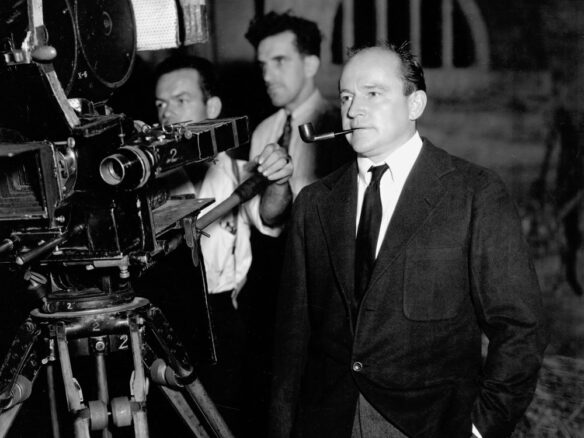
Merian C. Cooper as a director.

(4) MINDING THE STORE. Deadline says “Box Office: ‘Project Hail Mary’ Headed To Strong $71M+ U.S. Opening”.

 Amazon MGM Studios‘ Project Hail Mary is shooting for a massive $31M today (including previews) and the best opening of 2026 so far with $71.1M at 4,007 runs. That’s also the best opening ever for an Amazon MGM Studios movie, ahead of Creed III‘s $58.3M back in 2023.

(5) HAIL DIRECTORS. The New York Times asks “What the ‘Project Hail Mary’ Directors Learned From a Firing” – the link bypasses the paywall.

Lord and Miller have long relished tackling concepts that shouldn’t work, since their directorial debut, “Cloudy With a Chance of Meatballs” (2009), the animated adaptation of the classic children’s book, which has very little by way of story other than falling food. Next, they leveled up, turning a kitschy retro television property into a critically acclaimed comedy with “21 Jump Street” (2012). Their sequel to that, “22 Jump Street” (2014), came out the same year as “The Lego Movie,” which, instead of being the crass brand extension you might have expected, was a beloved, zany hit that celebrated creativity.

But the two filmmakers had not actually directed a feature in 12 years. They were working on Lucasfilm’s Han Solo spinoff movie, before being fired over “different creative visions” and replaced by Ron Howard, who would complete “Solo: A Star Wars Story” (2018). Since then, they have become best known as the Oscar-winning producers of the “Spider-Verse” movies, featuring adventurous animation that has often been imitated.

“Project Hail Mary,” with a screenplay by Drew Goddard, represents their return to directing and it does so on a grand scale….

…After the “Solo” job didn’t go the way you hoped, what did you think your path was going to be?

LORD We’ve been busy the whole time. But I think we’re always looking to find ways to do something that no one else is doing. When we set out to make “Solo,” what I love about those movies is they’re independent films, so we were interested in that and in that character. And that’s the energy we brought to “Spider-Verse.” We can do something in animation that hasn’t been done yet.

Approaching [“Project Hail Mary”], it was almost contrarian to make a movie that’s so affirming about a topic that is on everyone’s mind, which is this idea that we’re doomed. What I love about Andy’s book and what we’ve always tried to do in our work is not just present problems but try to suggest solutions. This movie is suggesting that we are capable.

Hopefully the audience comes out and they feel a little more capable in part because Ryan was really interested in this choice that he was only going to be good at one thing, and he was going to be bad at everything else. He’s bad at space, he’s afraid constantly. Clumsy. And he has social anxiety, but he’s really good at microbiology….

(6) AN SF MOVIE WITH SCIENCE? [Item by Steven French.] Astrophysicist Sara Webb gives her considered verdict on the movie Project Hail Mary: “Project Hail Mary is packed with hard science. An astrophysicist breaks it down”.

As an astrophysicist, my world revolves around the wonders of space and the mysteries of the universe. This means I can be a tough critic of science fiction books and films that explore these topics.

But when I walked out of a recent preview screening of the film adaptation of Andy Weir’s 2021 science fiction novel “Project Hail Mary,” I had tears of joy in my eyes. The filmmakers had done justice not just to the original story, but also to the science at the heart of it.

(7) PUBLISHER TAKES DOWN HORROR NOVEL WITH SUSPECTED AI INVOLVEMENT. [Item by Ersatz Culture.] “Hachette pulls horror novel Shy Girl after suspected AI use” reports the Guardian.

Hachette Book Group has withdrawn a horror novel after allegations circulated online that its author relied heavily on artificial intelligence. The book is to be discontinued in the UK after being published in November 2025, and its US launch date has been cancelled.

The book, Shy Girl by Mia Ballard, had been scheduled for release in the US this spring under Hachette’s Orbit imprint. However, the publisher confirmed it had halted publication after an internal review. The title has also been removed from online retailers including Amazon, and will no longer be distributed in the UK.

The decision was first reported by the New York Times and comes after weeks of online speculation about the novel’s origins, during which readers on platforms such as Goodreads and Reddit had questioned whether sections of the text bore hallmarks of AI-generated prose…

And here is the New York Times story, “Horror Novel ‘Shy Girl’ Canceled Over Suspected A.I. Use” (behind a paywall.)

Hachette Book Group, one of the largest publishers in the United States, pulled a forthcoming horror novel on Thursday in a decision that followed widespread allegations online that the author, Mia Ballard, relied heavily on artificial intelligence to write the book.

On Thursday, a day after The New York Times approached Hachette citing evidence that the novel appeared to be A.I.-generated, the company said it was pulling the book from publication. By Thursday afternoon, the novel was removed from Amazon and the Hachette website.

Hachette told The Times that its Orbit imprint decided not to publish “Shy Girl,” which was due out in the United States this spring, after conducting a thorough and lengthy review of the text. Hachette said it will also discontinue the book in the U.K., where it was published last fall and has sold 1,800 print copies, according to NielsenIQ BookData.

“Hachette remains committed to protecting original creative expression and storytelling,” a Hachette spokeswoman said. She added that Hachette requires all submissions to be original to the authors, and asks authors to disclose to the company whether they are using A.I. during the writing process.

In an email to The Times late on Thursday night, Ballard denied using A.I. to write “Shy Girl,” contending that an acquaintance she hired to edit the self-published version of the novel had used A.I.

“This controversy has changed my life in many ways and my mental health is at an all time low and my name is ruined for something I didn’t even personally do,” she wrote, noting that she could not elaborate on how the book had been edited with A.I. because she was pursuing legal action….

This Reddit post from two months ago has a good write-up, and links to earlier investigations, YT videos, etc: “Shy Girl by Mia Ballard. Does anyone else think this was written by ChatGPT?”

Ersatz Culture also reports the UK publisher listing had some author blurbs, including 3-time Hugo Best Fan Writer finalist Bitter Karella.  The blurbs are all for this particular book, not for other work by this author that might not have been AI. The booksellers websites have taken down most of these by now:

MEG SMITHERMAN, author of Thrum and Entity

Lyrical prose gives way to a visceral nightmare in this gripping downward spiral of a novel. Both horrifying and gruesomely cathartic, Shy Girl is a study of female agency and bodily autonomy that is relentless and sickening in its violence, yet deeply satisfying. Not for the faint of heart, Shy Girl is a must read for all the weird girls out there.

HANNAH WHITTEN, New York Times bestselling author of The Foxglove King

Completely unique and utterly bonkers. Shy Girl is the most disturbing book I’ve read in years – and I mean that as high praise.

RACHEL EVE MOULTON, author of Tantrum [from Waterstones, still online at this time]

Gia’s desperation leads her to Nathan – a potential sugar daddy who might just solve all her financial problems. When Gia says ‘yes’ to his specific predilections, the result is viscous unraveling of autonomy that teaches Gia – and the reader – about the long-game of revenge. Shy Girl demonstrates the resilience of women, a lesson on the pleasure of going feral. A gore-filled ode to feminist rage that I will never, ever forget. Warning: this book may just make a girl go feral.

BITTER KARELLA, author of Moonflow

Mia Ballard has crafted a chilling, terrifying tale of romance gone awry, luring you in with head pats and skritchies and then fucking disembowels you. Hard to read, impossible to put down! I loved it! You will never look at puppy play the same way again!

OLIVIE BLAKE, New York Times bestselling author of Girl Dinner

This book put me THROUGH IT. Shy Girl is a gut punch of a story, as much about violation and horror as it is about agency and revenge. Mia Ballard is a f*cking powerhouse.

(8) TODAY’S BIRTHDAY.

[Written by Cat Eldridge.]

March 20, 1932Jack Cady. (Died 2004.)

So let’s see… Ghost stories are a good place to begin I think. McDowell’s Ghost gives a fresh spin on the trope of seeing a War Between The States ghost, and The Night We Buried Road Dog is another ghost story set in early Sixties Montana. 

Jack Cady

Now The Well is not quite a ghost story as such but it’s a haunted house story of sorts heavy on the horror, really heavy on the horror. 

Not a ghost story as such but equally impressive is Inagehi which is the story of a young Cherokee woman who inherits a mountain and the mystery of her father’s death. 

Now Dark Dreaming with Carol Orlock reminds me just a bit of He Who Shapes in its use of the darker side of dreams. Well much darker than Zelazny ever did. Don’t read later at night.

Cady’s The Man Who Could Make Things Vanish is a tale of a man who make anything disappear against an organization that might or might exist wanting to rule the world. 

He wrote more novels than that but those are the ones I’m familiar with. 

He also wrote quite a bit of short fiction, some sixty pieces I figure. Phantoms: Collected Writings, Volume 1 and Fanthoms: Collected Writings, Volume 2, both done a decade ago, collect about forty-five pieces of short fiction. Both are available at the usual suspects. 

Those ‘Wards? He won a Nebula and Stoker for a novella, “The Night We Buried Road Dog”; the World Fantasy Award was for a short collection, The Sons of Noah & Other Stories; and the final one was the International Horror Guild Award a warded for Outstanding achievements in the field of Horror and Dark Fantasy.

(9) COMICS SECTION.

  • Bliss knows two superheroes who need a better greeting.
  • Dinosaur Comics points out what the Romans lacked. 
  • Lio tries to pick a direction. 
  • Thatababy looks forward to gardening.
  • xkcd makes star formation sound like a bad thing.

(10) PENGUIN UK COVER DESIGN COMPETITION SHORTLIST. Last year Penguin Books UK announced the Penguin Cover Design Award as an opportunity for ambitious artists:

Do you want a career in design or illustration, but are yet to land your first role?   

Would you like to experience real book cover design briefs and receive feedback from an Art Director?

The Penguin Cover Design Award is your opportunity to take on the role of a book cover designer and build your portfolio. 

Prizes include a six-month mentorship with a designer at Penguin, as well as a Wacom Intuos Pro Medium tablet and Penguin books to the value of £100. 

This month 20 2026 shortlisted entries were posted on the Penguin website. They’re very impressive!

Both of the covers (adult and children) that contestants were asked to design are SFnal, namely Pratchett’s Night Watch and L’Engle’s A Wrinkle in Time. 

The winner will be announced in April.

(11) BIN THERE, DONE THAT. The Guardian’s Stuart Heritage has an entertaining and thoughtful article about Oscar ceremony waste: “The Oscars red carpet was in a skip. Then a woman took it home for her flat. What else could be repurposed?”

…The story goes that, prior to the Oscars, while out on a walk, Thalia noticed rolls and rolls of pristine red carpet still encased in plastic wrapping. This made her wonder what happens to the carpet after the awards, which in turn sent her out on a mission around the back of the Dolby Theatre on Monday morning. While filming herself for TikTok, Thalia found a giant (and clean) skip filled with dozens of rolled-up pieces of carpet. “These are huge. Is it insane to take a huge piece?” she asked her viewers. Long story short, she now has a huge piece of the Oscars red carpet in her living room….

(12) ADD THIS TO YOUR COLLECTIBLE BUCKET LIST. “’Super Mario Galaxy Movie’ popcorn cauldron has made history. See how”USA Today shows us.

A teeny tiny popcorn bucket, made with a miniature Bowser in mind, just made history.

The recordholder for “World’s Smallest Popcorn Container,” according to Guinness World Records, is a snack container inspired by a tiny cauldron featured in the upcoming “Super Mario Galaxy Movie”.

Dubbed a “faithful replica” of Bowser’s tiny cauldron, the concession accessory serves as a “playful homage” to the new film, opening in theaters April 1.

Measuring 2.6 inches at its widest point, the tiny cauldron can hold anywhere between five and 11 kernels of popcorn, making it the “smallest functional popcorn vessel on record,” according to Guinness.

In recent years, movie theaters have garnered attention for their wacky popcorn buckets, including the sandworm-like bucket for “Dune Part Two,” disappearing illusion box for “Now You See Me: Now You Don’t” and a baby sling carrier for “Despicable Me 4,” worn on the front of the chest….

(13) NO FOOLIN’. “Nasa returns moon rocket to pad and targets 1 April launch” reports the Guardian.

Nasa has begun returning its towering SLS rocket and Orion spacecraft to its Florida launch pad before a planned flyby of the moon, after completing necessary repairs.

Artemis engineers began the manoeuvre, which can take up to 12 hours, at 8pm local time. The US space agency will then begin the final preparations before its next launch window opens on 1 April.

The immense orange-and-white Space Launch System rocket and the Orion vessel will be slowly wheeled out of the assembly building at the Kennedy Space Center in Florida and painstakingly moved 4 miles (6.5km) to launch pad 39B.

If the tests are satisfactory, three US astronauts and one Canadian will head to the moon and fly around Earth’s satellite….

Update: And today NASA sent subscribers this news flash:

At 11:21 a.m. EDT on Friday, March 20, NASA’s Artemis II SLS (Space Launch System) rocket and Orion spacecraft arrived at Launch Pad 39B after an 11-hour journey from the Vehicle Assembly Building at the agency’s Kennedy Space Center in Florida. 

NASA’s crawler-transporter 2 began its 4-mile trek with the integrated SLS and Orion stacked on top of the mobile launcher at 12:20 a.m. EDT. Moving at a maximum speed of just 0.82 mph, the crawler carried the 322-foot-tall Moon rocket and spacecraft slowly and steadily toward the pad. 

Now that the rocket is at Pad 39B, NASA teams are gearing up for the final stretch of prelaunch preparations ahead of launch as soon as Wednesday, April 1. 

(14) I AM A MOUTH AND I MUST SCREAM. [Item by N.] In the penultimate episode of the indie animation hit The Amazing Digital Circus everything finally comes to a head.

[Thanks to Andrew Porter, John King Tarpinian, Cat Eldridge, N., Ersatz Culture, Danny Sichel, SF Concatenation’s Jonathan Cowie, Mark Roth-Whitworth, Kathy Sullivan, Steven French, and Mike Kennedy for some of these stories. Title credit belongs to File 770 contributing editor of the day Daniel Dern.]

Pixel Scroll 3/12/26 I Can’t Compile, ‘Cause I Owe My Scroll To The Company File!

(1) WHAT WOULD HE BE THINKING NOW? Christopher Lockett considers “The Pragmatic Sir Terry Pratchett”. “Thoughts on cruelty and design in Discworld.”

… A year later, our odious stew has become, well, stewier, a toxic brew of hate and avarice, autocratic ideation and fascistic consolidation….

All of which has me thinking about cruelty and its necessary corollary, which is the dehumanization of others. It is here that Sir Terry has much to say. For, as Granny Weatherwax insists, evil begins when we stop seeing people as people and start seeing them as objects. A little over a year into Trump 2.0, eleven years after we lost Sir Terry to the embuggerance, we are more than ever in need of the latter’s particular species of humane humanism. Above all else, the philosophy developed in his Discworld novels and all his related writing and statements is pragmatic—both in the sense that it offers a useful rubric for understanding and action, and also in the sense of embodying the tenets of philosophical pragmatism such as first conceived by William James and John Dewey, later developed by such thinkers as Judith Shklar and Richard Rorty, and which has its roots in the pioneering humanism of Michel de Montaigne….

…Sir Terry was, among other things, an ironist, both in the sense of employing a healthy amount of irony in his fiction, as well as having a profoundly ironic sensibility. I don’t mean “ironic” here in the more stunted popular understanding it developed in the 1990s of a disinterested, cool detachment,1 but in the sense of being open to and aware of the contingent nature of one’s given reality, of its contradictions and tensions and how it is shaped by perception. In Contingency, Irony, and Solidarity (1989), Richard Rorty defines an “ironist” as

“the sort of person who faces up to the contingency of his or her most central beliefs and desires—someone sufficiently historicist and nominalist to have abandoned the idea that those central beliefs and desires refer back to something beyond the reach of time and chance.” (xv)

Or in other words, someone whose sense of reality is not rooted in an extrinsic or transcendent externality but is under constant negotiation. Such indeed is the basic premise of Discworld, in which all those concepts traditionally understood as objective absolutes existing (and pre-existing) outside of us—Death, gods and divinity, fate and destiny, among others—appear as products of human thought and imagination2 or, in the case of Death, exist as predicates of mortal life.3

(2) BY UNPOPULAR DEMAND. “Grammarly Is Pulling Down Its Explosively Controversial Feature That Impersonates Writers Without Their Permission” reports Futurism. “Contrary to the apparent belief of some tech companies, it is unlawful to appropriate peoples’ names and identities for commercial purposes, whether those people are famous or not,” says a lawsuit filed against them.

Grammarly infuriated journalists, authors, and academics with its “Expert Review” feature, which impersonated writers — both dead and alive — without their permission.

In Grammar’s telling, the tool allows users to “take your writing to the next level” by making suggestions inspired by “leading professionals, authors, and subject-matter experts.”

The feature, which was only accessible beyond a free trial via the company’s $12-a-month Pro subscription, caused an explosively negative reaction.

“You rapacious information and identity thieves better get ready for me to go full McConaughey on you,” seethed tech journalist Kara Swisher, whose advice the feature claimed to offer. “Also, you suck.”

Now, Shishir Mehrotra, CEO of Grammarly’s owner Superhuman, has announced that the company is “disabling” the offending feature “while we reimagine the feature to make it more useful for users, while giving experts real control over how they want to be represented — or not represented at all.”

“Over the past week, we received valid critical feedback from experts who are concerned that the agent misrepresented their voices,” he wrote in a post on LinkedIn. “This kind of scrutiny improves our products, and we take it seriously.”

“We hear the feedback and recognize we fell short on this,” he added. “I want to apologize and acknowledge that we’ll rethink our approach going forward.”

The feature left much to be desired, highlighting persistent pain points plaguing large language model-based tools like it. Even when author and copy editor Benjamin Dreyer copy-pasted paragraphs of lorem ipsum, which is dummy placeholder text commonly used in graphic design, the feature offered him tips from writers including the venerable novelist Stephen King.

The company seemed to want it both ways — to benefit from the implication of an association with prominent writers while distancing itself in the fine print. A disclaimer spotted by Platformer‘s Casey Newton buried deep in the company’s documentation hedges that references from these experts “are for informational purposes only and do not indicate any affiliation with Grammarly or endorsement by those individuals or entities.”

Nonetheless, the company’s use of people’s names without their sign-off became a bitter flashpoint in the AI discourse. Even a virtual version of Newton himself was found handing out writing advice….

(3) BRICKS IN SPACE. “The ‘Project Hail Mary’ Lego Set Is a Must-Have for Sci-Fi Fans” says Gizmodo.

…Clocking in at $100 and 830 pieces, the Project Hail Mary set is, of course, the Hail Mary ship itself, complete with its three massive fuel tanks. The set also comes with stands and figures of the film’s main characters, Ryland Grace and Rocky the alien. It’s a relatively short build, taking about four hours in total, but it is incredibly fun to create and play with. Plus, it somehow gets cooler once you’ve seen the film itself.

First, you build the characters, the mini-fig of Ryland Grace and Rocky the alien. You can display them together, separated by the window of Rocky’s ship, or click them into the base of the ship itself (seen in the final image of this article).

From there, it’s on the main section of the set, which, to be completely honest, was relatively challenging. It’s a very detailed Technic build with lots of tiny parts that requires your 100% full attention to get exactly right. And yes, Lego is considered a kid’s toy, and the instructions are very clear, but there are easy-to-build Lego sets and less easy-to-build Lego sets, and this is a less easy-to-build one….

(4) MINECRAFT’S UNCENSORED LIBRARY ADDS A UNITED STATES WING. The New York Times knows “Where Censored Words Find a Safe Haven: Inside Minecraft”. (Article is behind a paywall.)

I’m standing in the middle of a cavernous hall, watching the Statue of Liberty drown in a pool of her own tears. Twin blue streams run from her emerald eyes, collecting in a reservoir that submerges the statue up to her waist.

A series of lecterns line an observation deck beneath this tableau. Each displays a divisive text: Stephen Colbert’s interview with a Senate candidate that he said CBS barred from television; a report on sea-level rise that was scrubbed from government websites in President Trump’s second term; a two-volume interactive timeline of the Jan. 6, 2021, riots at the Capitol.

On the far wall, flanked by torches, is a mural of Ann Telnaes’s rejected cartoon for The Washington Post, featuring tech moguls like Jeff Bezos and Mark Zuckerberg bending the knee to Trump, offering up bags of cash. Hanging just above is an enormous American flag, stars and bars rendered in pixel.

Welcome to the new United States wing of the Uncensored Library, an unlikely stronghold of online press freedom within Minecraft, the best-selling video game of all time.

Since 2020 the Uncensored Library has functioned as a devilishly clever, and thoroughly modern, information loophole. Because the library is enmeshed within Minecraft, governments cannot ban access to its content — more than 300 examples of censored or restricted work from writers across the globe — without banning Minecraft outright. A player in Riyadh can visit the library’s Saudi Arabian wing and read the assassinated dissident Jamal Khashoggi’s writings at the click of a button.

Even in countries where Minecraft is constrained — its servers in Iran have been shuttered because of U.S. sanctions, while China has released a state-approved version of the game — players can use a virtual private network to gain access to the library.

The new U.S. wing, opening on Wednesday just before the World Day Against Cyber Censorship, is one of 10 rooms dedicated to writings from specific nations struggling with press freedom. Americans may balk that their country shares synthetic real estate with Belarus, Brazil, Egypt, Eritrea, Iran, Mexico, Russia, Saudi Arabia and Vietnam, but the team behind the Uncensored Library says this is very much the point….

(5) OVEREXPOSED IN WESTEROS. “Ed Sheeran Looks Back on Everyone Hating His ‘Game of Thrones’ Cameo” at Gizmodo.

In 2017, Ed Sheeran was at the height of his popularityDivide had come out in the spring, and “Shape of You” dominated the airwaves. Given its own history of musician cameos, you might be forgiven for the team behind what was still one of the biggest TV shows on the planet at the time, Game of Thrones, putting two and two together and letting Sheeran take a side quest in Westeros. And yet.

When Sheeran showed up as a Lannister soldier (with musical inclinations) appropriately named Eddie, encountered by Arya just after she’s gotten her revenge on the Freys in “Dragonstone”, it immediately became a topic of controversy. Was Sheeran too famous for a cameo? Was it too much of a reminder of the real world in Westeros? Did people just find him really annoying, anyway?

Nearly a decade later, Sheeran’s inclined to agree with all three.

“I think at the time I was very omnipresent and just everywhere. So, I think it was quite jarring,” Sheeran recently reflected in an appearance on Benny Blanco’s Friends Keep Secrets podcast, before adding that the adverse reaction he got from audiences “[happened] quite a lot in my career. I just get shit on for things.”

Sheeran was quick to point out that he was far from the only musician to appear on the show at the time. “Members of Coldplay [were] at the Red Wedding. [Gary Lightbody] from Snow Patrol’s in there. Chris Stapleton’s in it as, like, a White Walker,” Sheeran added. But the key difference between those cameos and his own was, as he said, his omnipresence. The scene, even though Sheeran’s soldier leaves much of the talking to other Lannisters and Arya herself, is drowned out by his presence and recognizability. He’s just there, Ed Sheeran in Lannister armor, not even a helmet or much makeup to change his appearance….

(6) CHINESE SF SCHOLARSHIP. Chen Qiufan reviews a book by Migwei Song, Fear of Seeing: A Poetics of Chinese Science Fiction at Ohio State University’s Modern Chinese Literature and Culture Resource Center. This section includes a comment about the Chengdu Worldcon 2023 Hugo scandal.

…In chapter 8, Song proposes a new “planetary consciousness,” which he describes as “a twenty-first-century invention that sees different places and peoples as intimately connected” (253). He places my novel Waste Tide (荒潮) alongside David Mitchell’s Cloud Atlas, treating it as a Chinese instance of global SF. In the same chapter, he traces the translingual metamorphosis that SF texts undergo as they cross linguistic and cultural boundaries, using the English translation and reception history of Liu Cixin’s 刘慈欣 work as his primary material, and tracks Chinese SF’s ascent from “a fairly marginal phenomenon” in domestic literature (mentioned above) to a “planetary phenomenon” in world literature (255).

Several events since 2023 demonstrate that the realization of this planetary consciousness intimately interconnecting places and peoples is far more complex than textual analysis alone can elucidate. In March 2024, Netflix’s adaptation of The Three-Body Problem (三体) triggered a substantial transnational cultural dispute. Chinese state media characterized it as an exercise of American cultural hegemony; the issue and related topics attracted a cumulative readership on Weibo that exceeded two billion. The controversy unfolded across multiple registers: the internationalized casting was read as a concession to political correctness, the retention of Liu Cixin’s original Cultural Revolution opening was interpreted as deliberate defamation, and the narrative’s shift from China to London was taken as an erasure of the original’s Chineseness. Meanwhile, Tencent’s thirty-episode series, more faithful to the source text (although it mitigates Liu’s representation of the Cultural Revolution), earned high acclaim from domestic audiences. Zhang Yiwu of Peking University identified the fundamental dilemma facing the Netflix version as the inevitable audience segmentation that accompanies the global export of Chinese cultural products.[2] The core of this dispute extends far beyond the quality of a single adaptation; it exposes the power structures in which SF texts are embedded as they circulate transnationally.

Another notable event was the Hugo Award controversy at the Chengdu Worldcon (October 18-22, 2023)The disqualification of several authors’ nominations due to political considerations, followed by the leaking of internal emails and the resignation of the administration, exposed geopolitical fissures in the global governance mechanisms of the SF community.[3]

These events collectively point toward a dimension that Song touches on but does not fully develop in chapter 8. His analysis focuses on the metamorphosis of textual form, tracking how SF works acquire new meanings as they travel across cultures….

(7) HARPER SERVICE. Michael Harper’s Funeral Service will be held Saturday March 14 at 3:00 p.m. Eastern.

You can view it live at two spots on YouTube, here and here.  

It will also be livestreamed through the funeral director’s website, which was prepared in memory of Michael and contains the service details, obituary, preferred charities for donations, and a guestbook.  

(8) MICHAEL HAGUE (1948-2026). Illustrator Michael Hague died March 10 at the age of 78. The Wikipedia notes:

…Among the books he has illustrated classics such as The Wind in the WillowsThe Wizard of OzThe Hobbit and the stories of Hans Christian Andersen. He is known for the intricate and realistic detail he brings to his work, and the rich colors he chooses….

(9) TODAY’S BIRTHDAY.

[Written by Cat Eldridge.]

March 12, 1925Harry Harrison. (Died 2012.)

So let’s talk about  Harry Harrison who I’d say is best known for his extraordinarily excellent Stainless Steel Rat series. James Bolivar diGriz, aka “Slippery Jim” and “The Stainless Steel Rat” is one of the most interesting characters I ever had the pleasure to read. 

The Stainless Steel Rat showed up, not surprisingly in a story called “The Stainless Steel Rat” sixty-seven years ago in Astounding in their August issue. 

There are 12 works in the Stainless Steel Rat series, of which I’m absolutely certain that I’ve read and immensely enjoyed the first one, The Stainless Steel Rat, and after that is where it gets complicated. I’m looking now on the other iPad at the list of the novel titles and I can’t say that I remember any of them. I know that I’ve read at three or four of them, and liked reading them, but can’t tell you which, but I’m betting that they were the earlier ones. 

I do know that I read all of three of the Deathworld series with Jason dinAlt, a professional gambler, as the central character. They’re fun SF pulp, all three originally written as serials in the Sixties. A fourth, Return to Deathworld, for the Russian market was co-written with two Russian authors and hasn’t been translated into English.

His third series, Bill, the Galactic Hero, first appeared in the “Starsloggers” novella in sixty years ago in the December issue of Galaxy. Bill the character is among the silliest that I’ve ever read about. I’m really fond of truly silly SF, however, though I read the first one I didn’t go beyond that.

Of course, worth noting is that Alex Cox directed an animated version of Bill, the Galactic Hero which was created with his students at the University of Colorado at Boulder, completed and released a decade ago. You can see it here.

Harrison’s Make Room! Make Room! became Soylent Green with Charlton Heston. I’ll confess I’ve not read the novel, nor ever seen the film. I see the film was nominated first a Hugo at Discon II and won a Nebula for the film.

I’m only going to note two other Awards, one is Sidewise Award for Best Long Alternative History, the Hammer and the Cross trilogy, and a Grand Master Nebula. 

I’ll admit I’ve not read enough of his shorter works to form an informed opinion, so I’ll let y’all tell me about that aspect of his fiction.

Harry Harrison. Photo by and (c) Andrew Porter.

(10) COMICS SECTION.

(11) COMIC BOOK ARTIST EXHIBITS IN GALLERY. The New York Times is on hand as “Batman and Daredevil Artist Klaus Janson Flies Solo in Gallery Show”. Link bypasses the paywall. Lots of art in the article.

Klaus Janson, the veteran comic book artist, in his work with the writer-artist Frank Miller helped save Daredevil from cancellation and catapulted Batman to new heights. For his latest achievement, Janson is flying solo.

His pages and covers featuring Daredevil, Batman, Spider-Man, Superman and other characters will be on display in an exhibition of his work at the Philippe Labaune Gallery in Chelsea, running through April 11.

For Janson, 74, the show represents how far the appreciation for comic art has come. “Sequential narrative deserves recognition,” he said in an interview. “That’s part of my motivation for doing this exhibition and I hope that people walk away from the exhibit with a growing appreciation of what comics can do.”

(12) BINIAM SOLOMON RELEASED. BBC reports “Cartoonist freed after 15 years in prison without charge in Eritrea”. (Subscription required for readers outside UK.)

A well-known Eritrean satirical cartoonist has been freed from prison after spending 15 years in detention without charge, his family and friends have told the BBC.

Biniam Solomon, now in his early 60s, was arrested in the capital, Asmara, in 2011 but was never tried. The reasons for his continued imprisonment were not made clear.

Known by his pen name Cobra, Biniam gained fame for his critical and witty cartoons tackling political and social issues.

The authorities have not said why he was set free but it is the latest in a string of similar releases. Nevertheless thousands remain in prison, incommunicado and without trial, in a country long criticised for alleged human rights abuses….

(13) HE TOLD THEM. “Bill Kurtis to Leave NPR’s ‘Wait Wait … Don’t Tell Me!’” reports the New York Times. (Article is behind a paywall.)

Bill Kurtis, the veteran broadcast journalist known for his rich voice, is retiring from the irreverent National Public Radio news quiz show “Wait Wait … Don’t Tell Me!” after serving as its judge and scorekeeper for a dozen years.

Kurtis, 85, said in a statement that was sent to NPR’s editorial staff on Monday that there was no better way to stay young than to give voice to jokes written by people who are fearless in taking down anything and anyone.

“What an incredible chapter ‘Wait Wait … Don’t Tell Me!’ is in my life,” he said. Before joining the show in 2014, Kurtis was a co-anchor of “CBS Morning News” and narrated the true crime docuseries “Cold Case Files” on the A&E Network.

A representative for NPR declined to comment on Tuesday beyond the note sent to the staff.

“Wait Wait … Don’t Tell Me!,” which started in January 1998, is a weekly hourlong quiz program that asks contestants, including call-in listeners and celebrity guests, to test their knowledge of current events in a series of lighthearted, comic segments. Winners — and with Kurtis’s generous score-keeping, the odds are often in contestants’ favor — receive a custom voice mail greeting recorded by one of the show’s regulars.

The humorist Peter Sagal has hosted the show essentially since its beginning. The show’s first scorekeeper was Carl Kasell, another broadcast journalist with decades of experience. He died in 2018 at the age of 84.

[Thanks to Andrew Porter, John King Tarpinian, Cat Eldridge, Arnie Fenner, Dave Rowe, Andrew (not Werdna), SF Concatenation’s Jonathan Cowie, Mark Roth-Whitworth, Kathy Sullivan, Steven French, and Mike Kennedy for some of these stories. Title credit belongs to File 770 contributing editor of the day Kip Williams.]

Pixel Scroll 1/28/26 File, You Fools!

(1) GREG KETTER IN LOCAL MPLS NEWS. The Minneapolis Star-Tribune headlined today’s story, “Viral images turn local bookstore owner into symbol of Minneapolis anger”.

When Greg Ketter learned that federal law enforcement agents had killed a second Minneapolis resident, he got in his car and drove the 30 minutes from his home in Andover to Nicollet Avenue, where Alex Pretti had been fatally shot.

He hadn’t witnessed ICE agents in Minneapolis like other residents have, he said. But he knows it’s happening. He’s been to a few of the protests and marches and visited Renee Good’s vigil.

He couldn’t quite explain why he felt compelled to make the drive, he said.

“I didn’t have a motive or other reason,” Ketter said. “I just felt I had to go down there. I wanted to be in that spot.”

Ketter didn’t know until later that photographers and videojournalists had captured his reaction and circulated it online. A friend in Madison, Wis., was the first to share the social media posts with him.

In one widely shared image, Ketter emerges from a cloud of tear gas in a purple beanie, black scarf and red flannel jacket. He’s not wearing any protective gear.

In a video, he stands on the sidewalk, arms at his sides, shouting into the haze, “I’m just angry. I’m 70 years old, and I’m [expletive] angry,” before the gas engulfs him.

The images quickly drew attention to Ketter, the owner of DreamHaven Books & Comics, a Minneapolis institution he’s run for nearly 50 years.

Almost immediately after the photos and video were shared, the store’s website crashed, Ketter said. Four days later, it was still down. The shop’s Google page filled with hundreds of new reviews from Minnesotans and from people across the country who said they had been moved by what they saw.

Ketter said the store typically receives 10 to 15 mail orders a week. By Tuesday, there were more than 300.

The phone hasn’t stopped ringing. Some callers are hoping to place orders while the website is offline; others just want to tell Ketter how much they admire him.

Ketter said he was reminded of a TV interview he saw after Good was fatally shot by a federal agent a little more than three weeks ago. A man about his age, in tears, said he was ashamed of the direction the country was heading.

“I feel that way, too,” Ketter said. “This is not America. This is not where we should be, and I don’t know what to do about it.”

A few people have offered suggestions. Some have urged him to make T-shirts using a graphic from the now-viral video. Others tracked down a GoFundMe page created after DreamHaven was damaged during the George Floyd protests and made new donations. Ketter said he plans to pass along any money raised to a local food shelf.

A steady stream of customers has come through the door to thank him in person, including Matt Dosser, 53, of Stacy, Minn., who had his own moment of local celebrity 13 years ago when he stopped a robbery at a Minneapolis neighborhood market.

“There’s something about an older man risking his life at that point, sucking in all that tear gas,” Dosser said. “It’s got me tearing up. Look at how they’ve treated people. They could have very easily knocked him on the head.”

It was Ketter’s defiance that resonated, Dosser said, prompting another customer to ask if he could “get a word in with the man of the hour.”

Inside the shop, the two men told Ketter they heard people saying the photo should be a Time magazine cover. Another shouted, “Hey, I just want to say you’re my hero” as they exited.

(2) KETTER ON TV. CBS’ Minneapolis affiliate WCCO interviewed Ketter for a report aired January 26: “Minneapolis bookstore sales climb after widespread photo of owner at demonstration”.

(3) PUBLISHERS WEEKLY COVERS MINNEAPOLIS BOOKSELLERS’ ICE RESISTANCE. “Minneapolis Booksellers Resisting ICE Go Viral, See Sales Spike” reports Publishers Weekly. Their article begins with a long segment about Greg Ketter.

What a difference two weeks can make in a Minneapolis bookseller’s life—and bottom line.

On January 13, DreamHaven Books and Comics owner Greg Ketter told PW that he ascribed slow sales at his store to the economy and to the weather, and that he “really hadn’t witnessed” the ICE agents that have been swarming the Twin Cities since late December. “Maybe I’m out of touch,” Ketter said.

Now, thanks to social media, Ketter has become one of the most recognizable faces and voices of the Twin Cities’ ongoing resistance to ICE.

Ketter became a social media phenomenon over the weekend, when MS Now aired a video of him pacing half a block away from where Alex J. Pretti had been murdered by agents an hour earlier, cursing the 50-100 armed ICE agents keeping the crowd back. That video, as well as a photo taken minutes later by freelance photo-journalist Theia Chatelle of Ketter walking through clouds of tear gas, immediately went viral.

Life for Ketter has not been the same since. The store landline has been ringing off the hook, he told PW, and DreamHaven’s website has received so many hits, that it went down for several days. A GoFundMe campaign for the store that’s been dormant for four years received more than $5,000 in donations since Saturday, according to Ketter, who said the money will be donated to local food pantries, as well as an influx of supportive letters and emails.

Counting only sales through AbeBooks and eBay, DreamHaven’s current sales are 10 times that of a typical January, Ketter said, noting that on Tuesday morning, there were more than 100 eBay overnight orders awaiting him. Two retired employees are now helping Ketter and his sole employee, who is new and still being trained, process orders and ship books. There are orders big and small of “$5 books,” he said, with titles on tyranny and on the Constitution proving the most popular.

“We’re trying to keep up,” Ketter said. “We don’t have that many books in stock. I mean, if I have five copies, that’s probably a lot, so we’re ordering books every day, trying to get them in as quickly as possible. We’ll have everything under control before the end of the week, but the orders are still coming in.”…

And here’s a bit about the other bookstore mentioned in the article.

..Ketter is not the only Minneapolis bookseller whose profile has been raised amid the ICE protests thanks to social media. On January 16, Victoria Ford, the owner of Comma: A Bookshop in Linden Hills, responded to a post on Threads that was “looking for businesses in Minnesota that didn’t support ICE.”

Ford, who says she is “far from a social media expert,” commented that Comma was one such business, and that it hosts a resistance book club, distributes whistles, and raises money for mutual aid against ICE. The comment went viral after being shared on BookTok.

“That gave us national attention,” Ford said, “Since then, we’ve been shipping hundreds of orders from around the country.”…

(4) KETTER’S OWN STATEMENT. And Ketter posted a statement of his own on Facebook on January 26.

Wow. So much to address.

First things first. FUCK ICE. They murdered Alex Pretti on Saturday in cold blood. I won’t accept any other explanation. The young man is dead because of Donald Trump, Kristi Noem and the rest of that ghoulish group.

Because of this I was angry enough to go to the site of Alex’s murder to pay respects and witness for myself the ICE thugs who support these actions. I got there about an hour after the murder and went right up to the intersection that ICE had taped off and stood guard. There were perhaps 50-100 of them and several hundred observers/protesters milling around. Some were right up front yelling and swearing. I became one of them.

No one made a move toward the agents but suddenly several canisters of tear gas were thrown into the crowd. A number of agents broke the tape and ran after people along a side street to my left for no reason I could see. I stood where I was as more tear gas and flash bombs (they were loud) were thrown at us. There was shooting, probably pepper balls. Most people had backed off but a few had gas masks and stayed near the line. I had no gas mask and I don’t know what made me stay but I did. And I was screaming even louder.

I was screaming and sobbing, not from gas, but from Fury and sadness. I don’t think the gas had affected me at this point. A gas-masked camera man had been circling around near me asked if I was OK. I was physically fine but I had snapped. I was so angry that people hired by our government could do this to innocent people. Hence the rant which seems to have gone viral.

People have been so kind – from the concerned people there at the scene offering me help to the many, many thousands who have watched the video and offered their support. Those who ordered books from us (it will take a bit to get things sorted out) and eventually crashed our website (working on that too), I thank you. People discovered the old GOFUNDME we had after the riots after George Floyd was murdered and our store was heavily damaged and have been making donations there. I’m greatly touched by that but I would like to offer that money to our local food shelves if donors wouldn’t mind. The store is intact and doing well and the money should go to a greater cause.

I’ll have more for you later today and in upcoming days. Thank you all and stay strong. I’m still fucking angry!

(5) 2026 ANDREW CARNEGIE MEDALISTS. The American Library Association (ALA) has selected A Guardian and a Thief, by Megha Majumdar (Knopf) as the winner of the 2026 Andrew Carnegie Medal for Excellence in Fiction, and Things in Nature Merely Grow by Yiyun Li (Farrar, Straus and Giroux) as the winner of the 2026 Andrew Carnegie Medal for Excellence in Nonfiction. Neither is a genre work. The selections were announced on January 27.

The Carnegie awards, established in 2012, serve as a guide to help adults select quality reading material. They are the first single-book awards for adult books given by the American Library Association and reflect the expert judgment and insight of library professionals and booksellers who work closely with adult readers.

(6) PRATCHETT’S NOVELS STUDIED FOR DEMENTIA EVIDENCE. [Item by Lew Wolkoff.] A scientist has analyzed the vocabulary Terry Pratchett used in his writing to track the onset of his dementia. It turns out that his vocabulary started to grow smaller some ten years before he was officially diagnosed. “How Terry Pratchett’s novels have shed new light on dementia” in The Times (UK).

Terry Pratchett turned his wit, fame and fortune against dementia. After his diagnosis with a rare form of Alzheimer’s in 2007, the novelist spoke candidly about the disease, arguing that society had been too slow to confront it.

More than a decade after his death, his words may again advance that cause in an unexpected way.

A study has found that subtle changes in Pratchett’s use of language in his books anticipated his dementia diagnosis by almost ten years. According to the researchers, similar shifts in how people communicate could help speed up diagnoses.

The study analysed 33 novels from the Discworld series, written by Pratchett over more than three decades, using computers to track how his language evolved over time.

He had posterior cortical atrophy, a rare form of early-onset Alzheimer’s disease that primarily affects visual processing. He died in 2015, at the age of 66…

… The Pratchett study takes the technique forward by finding a much earlier shift, almost a decade before diagnosis.

The study was published in Brain Sciences and overseen by Thomas Wilcockson of Loughborough University. The authors stressed that they had not yet validated their method as a diagnostic tool, and that language naturally changes with age. But they argued that longitudinal language monitoring could complement existing assessments, prompting earlier investigation and action.

Dementia is one of the UK’s most pressing health challenges. An estimated 982,000 people in the UK are living with the condition, and that number is expected to rise to about 1.4 million by 2040 as the population ages. Alzheimer’s disease is the most common form.

Pratchett described the condition as an enemy we prefer not to look in the eye. He argued that society must “say the name” of the disease to drag it out of the shadows and strip away its stigma. It might be fitting, then, if his words helped bring individual cases into view earlier.

The researchers found measurable changes in his words long before his formal diagnosis. The main signal was a gradual decline in what linguists call “lexical diversity”, the range of different words he used, especially nouns and adjectives.

Pratchett’s later books did not become shorter or less ambitious. In fact, they grew longer. To most readers, nothing would have seemed amiss. But statistically, his vocabulary became more repetitive, drawing on a narrower pool of descriptive words.

(7) ÅCON 14 NEWS. Nina Törnudd announces that Åcon 14 has started selling memberships.

It took us a while to sort out a new payment system, but we are now ready and able to take your money. 

Adult memberships are 30 euros and information on how to pay can be found on the website.

The dates are 14-17 May. As usual the con runs from Thursday to Sunday over Ascension weekend. The venue is the traditional one, Hotel Adlon in Mariehamn in the Åland Islands.

This year we have invited Emily Tesh as our Guest of Honour.  The single-track programme will once more be a combination of serious and silly subjects. 

This is an excellent opportunity for all who enjoyed last year’s Archipelacon 2 to return to Mariehamn – and for those who could not make it last year, a chance to discover Åcon and the Åland Islands. 

(8) 40TH ANNIVERSARY OF CHALLENGER DISASTER. NPR today ran a memorial item on the loss of the space shuttle Challenger: “Remembering teacher and astronaut Christa McAuliffe”.

Forty years ago, the U.S. space shuttle Challenger exploded after launch, killing all aboard. We remember the New Hampshire public school teacher who lost her life in the disaster.

And NPR station WBUR introduces another audio segment by asking, “40 years since Challenger explosion: What did NASA learn from the disaster?”

On Jan. 28, 1986, the Space Shuttle Challenger exploded 73 seconds after takeoff. All seven crewmembers on board were killed, including the first teacher to go into space.

The disaster was one of the most significant events of the 1980s, watched live by people around the world, and it grounded all space shuttle missions for almost three years.

Here & Now‘s Scott Tong speaks with Adam Higginbotham, author of the book “Challenger: A True Story of Heroism and Disaster on the Edge of Space,” about what happened, the lives lost, and what NASA learned from the disaster.

(9) SAL BUSCEMA (1936-2026). Comics artist Sal Buscema died January 24 reports ComicsBeat:

Sal Buscema, a veteran comics artist and part of the famed Buscema family of Marvel artists, has passed away. He was 89 years old when he died on Friday, and the news broke today, on what would have been his 90th birthday.

Artist Sterling Clark, who previously worked with Buscema on an issue of National Guardians, broke the news (via Comic Book Club). According to Clark, Buscema’s wife Joan told him that the artist had passed away on Friday….

…During his time at the Big Two, Buscema worked on a wide variety of titles, from Avengers and Thor to The Uncanny X-Men and The New Mutants to Superman and Batman titles during his brief stint at DC. He is arguably most associated with his run on The Spectacular Spider-Man with writer J.M. DeMatteis, and his work on ROM Spaceknight (although his Hulk is pretty iconic)…

…Buscema married his wife Joan in 1960, and they had three children together, named Joe, Tony, and Mike. After retiring from regular comics work, he continued to connect with fans via commissions, keeping a steady trickle of new Sal Buscema art popping up online over the years.

(10) TODAY’S BIRTHDAY.

[Item by Cat Eldridge.]

January 28, 1981Elijah Wood, 45.

In Elijah Wood, we’ve an actor that I always enjoy watching. Best known here and in the greater film community for being Frodo Baggins in The Lord of the Rings trilogy and The Hobbit: An Unexpected Journey, he has a much more extensive film career.

Elijah Wood in 2011. Photo by Gage Skidmore.

He makes his debut in a blink and you’ll miss it performance as Video Game Boy #2 in Back to the Future Part II; he next has a significant genre role as Nat Cooper in Forever Young, the screenplay being written by J. J. Abram from his story named “The Rest of Daniel”. 

He next shows up as the young Mike Marshall (primary version) in Radio Flyer with Tom Hanks playing, uncredited the older version and the film narrator.  Fantastic film that. 

Then he’s Huck in, well, The Adventures of Huck Finn. Haven’t seen it, but the usual suspects at Rotten Tomatoes who did see this Disney Production did like it and gave it a seventy-three rating.  I know it’s not genre, but I like the story. A lot. 

Elijah Wood in 2019. Photo by Gage Skidmore.

Next is SF in Deep Impact where he plays, let me see my notes, Leo Biederman, a teenage astronomer who discovers the Wolf–Biederman comet. Oh look they cast a teenager as a teenager! How unusual that is, isn’t is? 

Now we have an adult role for him in one of my favorite films — he’s Patrick Wertz in Eternal Sunshine of the Spotless Mind. Good role, wonderfully executed by him. 

Can we skip Sin City pretty please? Yes, I know, and do forgive me here.

He’s got a minor role in, depending in how you frame it, the reboot or new version or remake of The Toxic Avenger. The horrors. Not.

(11) COMICS SECTION.

  • Free Range doesn’t need a round table. 
  • Bizarro says this is not an especially strong protest. 
  • Dog Eat Doug plays listeners’ requests – when it can find them. 
  • F Minus thinks something is missing. They could be wrong.
  • MythTickle reveals tricks of the ghost writing trade. 
  • Rubes’ mirror is unexpectedly frank.  
  • Strange Brew recognizes hell. 

(12) FREE READ. [Item by Chris Barkley.] From Space.com: “The Egg” by Andy Weir.

In “The Egg,” a man dies in a car accident and wakes up… somewhere else. There, he meets a being who calmly explains what’s happened: death isn’t the end, and reincarnation isn’t quite what we’ve been imagining. Instead of returning as one new person, the narrator is told he will live again as every human who has ever lived—and every human who ever will. The story’s central revelation is as unsettling as it is hopeful: if everyone you meet is another version of you, what does that mean for how you treat them?

(13) LITTLE FREE LIBRARY STAYS FROSTY. Shelf Awareness asks:

“Did you know there are Little Free Library book-sharing boxes on all seven continents?” Little Free Library posted on Facebook, highlighting a literally cool LFL that has recently been set up at the South Pole by Dr. Russell Schnell, an atmospheric scientist for the National Oceanic and Atmospheric Administration (NOAA) and co-recipient of the 2007 Nobel Peace Prize for his work on the International Panel on Climate Change.

Schnell built his LFL at his home in Boulder, Colo., in November, then shipped it to the South Pole, where he had previously traveled for work. It is located inside the NOAA’s Atmospheric Research Observatory and features novels, science fiction, equipment manuals, and more for staff members to share.

“Books with photos of colorful trees, warm deserts, water, beaches, wheat fields, and animals and birds are popular at the South Pole,” he said. “Everything else is white for hundreds of miles in all directions.”

(14) TRAILER PARK. SYFY Wire breaks down the “Daredevil: Born Again Season 2 Teaser: Jessica Jones Reunion”.

Daredevil: Born Again is back to raise more hell for Matt Murdock. 

Charlie Cox’s attorney-by-day, crimefighter-by-night superhero flashes an appropriately devilish grin at the end of Disney+’s teaser for season two, especially considering the much-anticipated reunion in store across the sophomore outing. 

Seven years after Krysten Ritter signed off as Jessica Jones for seemingly the final time, her superpowered private eye is seen entering a church and telling a disheveled Murdock, “I hope you can walk, because I’m not carrying you.”

[Thanks to Mike Kennedy, Andrew Porter, John King Tarpinian, Nina Törnudd, Lew Wolkoff, Michael J. Walsh, Cat Eldridge, SF Concatenation’s Jonathan Cowie, Mark Roth-Whitworth, Kathy Sullivan, and Steven French for some of these stories. Title credit belongs to File 770 contributing editor of the day Andrew (not Werdna).]

Cats Sleep on SFF: Unseen Academicals

Longtime Filer Nickpheas tells us:

We have new arrivals at the Nickpheas house, but already they’re sleeping in Sci-Fi. 

Domino is the whole one with spots. The black one is Skeltron, which apparently means something to the older kids. Not to me.


Photos of your felines (or whatever you’ve got!) resting on genre works are welcome. Send to mikeglyer (at) cs (dot) com

Pixel Scroll 10/15/25 And To Think That I Scrolled It On Mulpixel Street

(1) HWA ELECTIONS. The Horror Writers Association held its annual election in September. The candidates for the Offices of Vice President and Treasurer ran unopposed. There were four contested Trustee positions.

  • Vice President: Lisa Wood (unopposed)
  • Treasurer: Marc Abbot (unopposed)
  • Trustees: Incumbents Lisa Kröger, Brian Matthews, and Patrick Barb were re-elected; and  a new Trustee, Sèphera Girón, was elected.

(2) BROWSING THE ANTHROPIC SETTLEMENT SITE. Michael J. “Orange Mike” Lowrey reminds authors to look for their names and titles using the “Works Lookup” tool on the Anthropic copyright settlement page. He wondered how many sff writers are on the list – the answer was: plenty!

I don’t have any books to my credit, but those of you who do might want to explore this site. Obviously, the search engine may return some false positives. But among people I know, the thieves have 134 items by Mercedes Lackey on the list, 28 items by Samuel Delany, one by Mary Anne Mohanraj, 27 by Joe Haldeman, 50 by Eric Flint, 68 by G.R.R. Martin, 16 by Robert Asprin (“Yang”), six by Juanita R Coulson, six by Gene DeWeese under his own name, 17 by andrew j offutt under his own name or as John Cleve, one by Erwin Strauss (“Filthy Pierre”), at least five by David Friedman (“Cariadoc of the Bow”), 12 by C. S. Friedman, two for Dave Langford, five by Bob Tucker, etc., etc.

(3) REALLY A PRATCHETT FAN? Rhianna Pratchett is impressed by Rachel Cunliffe’s New Statesman article “Has Kemi Badenoch actually read Terry Pratchett?” (Kemi Badenoch is a British politician who has served as Leader of the Opposition and Leader of the Conservative Party since November 2024.)

It’s important for politicians to have some kind of cultural hinterland. So perhaps we should be reassured by Kemi Badenoch’s revelation on the morning broadcast round that her favourite author is the literary legend Terry Pratchett. The Tory leader apparently has all but one of Pratchett’s 60-odd books, which blend sci-fi and fantasy with searing social commentary. She finds them “very funny”.

Nonetheless, one question remains: has she actually read them?

Post-structural theory dictates that readers may take whatever meaning they like from the content they consume. If Trump and his fans want to play “Born In The USA” at a Maga rally, the fact the song is a scathing critique of the Vietnam War and the arrogance of American leadership shouldn’t stop them. The artist’s own politics or intentions are irrelevant. So Badenoch is perfectly entitled to enjoy the Discworld novels, set in a magical disc-shaped land that flies through space carried by four elephants standing on the back of a giant turtle. It makes a change from her previous top reads (the works of Thomas Sowell and Friedrich Hayek’s Road To Serfdom), but if she can find joy in tales of witches and werewolves and a wizarding university with an orangutan for a librarian, all the more power to her.

Yet something about the image of Badenoch settling down with a dog-eared copy of one of Pratchett’s masterpieces doesn’t quite compute. …

…How, for example, would Badenoch interpret the Sam Vimes “Boots” theory of socioeconomic unfairness as detailed in Men At Arms, that notes how rich people can afford to make a single purchase of high-quality products (like boots) that last forever, whereas the poor are forced into a cycle of buying cheap goods that wear out quickly and must be frequently replaced, costing them far more over time? Does she see the innate injustice of trapping people in grinding poverty, or does she just think it is good for economic growth to sell as many cheap boots as possible?

Similar points may be made about other Pratchett musings on poverty, power and class dynamics. For instance, the observation in Feet of Clay that “while it was regarded as pretty good evidence of criminality to be living in a slum, for some reason owning a whole street of them merely got you invited to the very best social occasions”, seems distinctly un-Tory in its nature. …

(4) I NOW PRONOUNCE YOU PERSON AND BEEP BOOP. “Ohio Lawmaker Wants to Ban Marriage Between Humans and AI Chatbots” reports Gizmodo.

…NBC-4 in Ohio writes that Rep. Thaddeus Claggett, who chairs the state’s House Technology and Innovation Committee, has introduced legislation that would stop such unions from occurring. Indeed, not only would House Bill 469 stop the wedding bells for AI-human relationships, it would also stop AI programs from gaining the status of legal personhood. The bill states:

“No AI system shall be recognized as a spouse, domestic partner, or hold any personal legal status analogous to marriage or union with a human or another AI system. Any purported attempt to marry or create a personal union with an AI system is void and has no legal effect.”

Claggett’s interest in banning AI-human unions would appear to have a lot more to do with maintaining exclusive legal rights for humans than it does with stopping people from getting so emotionally attached to their software programs that they decide to tie the knot with them. NBC-4 notes that the goal is to stop AI programs from being able to take on roles that the act of marriage confers upon them—stuff like holding power of attorney or making financial decisions.

“As the computer systems improve in their capacity to act more like humans, we want to be sure we have prohibitions in our law that prohibit those systems from ever being human in their agency,” Claggett told the news outlet. “People need to understand, we’re not talking about marching down the aisle to some tune and having a ceremony with the robot that’ll be on our streets here in a year or two,” he added. “That could happen, but that’s not really what we’re saying.”…

(5) SIMULTANEOUS TIMES. Space Cowboy Books of Joshua Tree, CA presents their monthly science fiction podcast Simultaneous Times episode 92 with the stories:

  • “Breathing Night” by Laura Blackwell; narration by Jean-Paul Garnier; with music by TSG 
  • “Care of Your Electric Sheep” by F.J. Bergmann; narration by Jean-Paul Garnier; with music by Oneirothopter
  • “Skeletal” by Elad Haber; narration by Jean-Paul Garnier;  with music by Phog Masheeen.

Theme music by Dain Luscombe.

(6) APEX MAGAZINE KICKSTARTER UPDATE. Apex Magazine’s 2026 Kickstarter appeal has raised $9,283 of its $20,000 goal in the first two weeks, and continues through October 31. Four of its eight pledge milestones have already been unlocked – for example:

At 10% of our goal, our Kickstarter backers will gain early access to a story slated to be published next year. “Piglet Delivers,” by Maria Haskins, is a delightfully dark story set in the Hundred Acre Wood. This will be exclusive to our Kickstarter backers, so back early so you don’t miss it! UNLOCKED!

(7) DON’T MISS THESE BANNED BOOKS. Dorset Eye has recommendations: “Defying the Censor: Essential Reads for Banned Books Week”.

Every year, Banned Books Week celebrates the freedom to read and draws attention to the dangers of censorship. It’s a stark reminder that throughout history and even today, books are challenged, restricted, or removed from shelves for their ideas. Reading these works is an act of intellectual defiance, a way to understand different perspectives, and a celebration of the very liberty that censorship seeks to suppress.

Here are some seminal works, all banned at one time or another, that deserve a place on your reading list….

Including the following title, three of the eight books listed are sff – the other two are A Clockwork Orange and Fahrenheit 451.

5. Animal Farm by George Orwell

  • The Banning: Orwell’s allegorical satire of the Soviet Union was rejected by multiple publishers, including T.S. Eliot, who felt its critique of a wartime ally (Stalin’s Russia) was ill-timed. It was later banned in the USSR and other Eastern Bloc countries, as well as in places like the UAE for its themes that contradicted Islamic values. It has also been challenged in US schools for being “anti-communist.”
  • Why You Should Read It: It is a timeless and devastating fable about how revolutions can be betrayed by tyranny and propaganda. Its warning about the corruption of power is universally applicable and remains as relevant today as it was in 1945.

(8) MEMORY LANE.

[Written by Cat Eldridge.]

October 15, 1928The Passing of Mr. Quin

We have a rarity for you this Scroll, a silent film first shown in the UK ninety-five years ago. The Passing of Mr. Quin was the first British film to be based off a short story by Agatha Christie. Though it did not feature Hercule Poirot, as that film debut wouldn’t happen for another three years.

It is a rather odd story. To wit, Professor Appleby has abused his wife, Eleanor, for years but when he is brutally murdered and her lover, Derek, goes missing under mysterious circumstances, Eleanor suspects the worst as she indeed should. 

A mysterious stranger, known mostly as “Mr Quin” appears, and begins to seduce her, but his alcoholism causes him to die quite soon. On his death bed, he confesses that he was Derek all along, and offers her to a rival, who promises to make Eleanor a happy wife.

Not cheerful at all and with just more than a soupçon of misogyny there as well but I don’t think it had any of the anti-Jewish tendencies Christie was known for early on. Need I say that the scriptwriters had their way with Christie’s original story? Well they did. 

This silent film was directed by Leslie Alibi. Three years later he directed the first ever depiction of Poirot with Austin Trevor in the lead role. That was not a silent film and Trevor once claimed he was cast as Poirot because he could speak with a French accent. The Poirot film unfortunately is now lost. 

(9) COMICS SECTION.

(10) DEFORD REVIVAL. Space Cowboy Books is taking preorders for “One Way and Other Stories a book by Miriam Allen deFord and Marie Vibbert” which will be released October 21.

Miriam Allen deFord (1888-1975) was a feminist, a suffragette, birth control advocate, journalist, editor, winner of the Mystery Writer’s of America’s Edgar Award, and author of science fiction, mystery, and true crime. Now, at long last, a collection of her science fiction short stories are back in print with One Way & Other Stories.

Mystery writer, Fortean, anti-fascist, feminist of the first generation, and science fiction trailblazer for five decades, Miriam Allen deFord masterfully weaves all of her facets into her stories, bringing a macabre, fantastic tone to her tales: Bradbury meets Hitchcock. She was already the grand dame of science fiction when the genre reached its second peak with the magazine boom of the early ’50s. Her work thus paved and led the way for SF’s Silver Age. Miriam Allen deFord somehow slips under the radar when SF luminaries are listed. With luck, this volume will remedy this oversight. – Gideon Marcus, editor of Rediscovery: Science Fiction by Women

Harlan Ellison knew this history and secured a story by deFord for his own milestone Dangerous Visions anthology.

(11) THIS POSTER IS READY OF ITS CLOSE-UP. Gizmodo assembled a gallery of “The Most Iconic Genre Movie Posters of Drew Struzan”, Hollywood’s go-to artist who died earlier this week. Here’s an example.

…Struzan first started painting this artwork for Blade Runner‘s original theatrical release in 1982, but it was ultimately passed on, leaving the piece unfinished for nearly two decades. When Ridley Scott returned to Blade Runner to release the director’s cut of the film, he went back to Struzan to ask if the piece could finally be completed, giving it the spotlight it deserved….

(12) YODA IN INTERIOR DECORATOR COLORS. [Item by Steven French.] This will already be familiar to many but I for one did not know that Yoda was ‘partly inspired’ by Albert Einstein! So says the Guardian: “Blue, Yoda originally was, archival Star Wars sources reveal”.

“You must unlearn what you have learned,” Jedi master Yoda instructed his stubborn apprentice, Luke Skywalker. And now Star Wars fans may have to do the same after confirmation that the beloved fictional alien was very nearly blue, or even purple.

Reviews of archival sources – and new testimony from a special effects makeup artist who worked on the first Yoda puppets – suggest film-makers made a decision late in the development process to switch the character’s skin colour to green.

Had producers of The Empire Strikes Back closely followed the final screenplay, then Yoda would have been “bluish”.

In the text, Luke and his droid companion, R2-D2, are surprised after being confronted by a small creature who appears on the swamp-covered planet of Dagobah. “Mysteriously standing right in front of Luke is a strange, bluish creature, not more than two feet tall. The wizened little thing is dressed in rags,” reads the screenplay….

(13) WHAT DO YOU MEAN YOU DON’T KNOW? [Item by Mike Kennedy.] In Futurism: “Fixing Hallucinations Would Destroy ChatGPT, Expert Finds”. Or at least make it even more unprofitable per that expert. Which is pretty much the same thing.

…In simple terms, the creators of AI incentivize them to guess rather than admit they don’t know the answer — which might be a good strategy on an exam, but is outright dangerous when giving high-stakes advice about topics like medicine or law.

While OpenAI claimed in an accompanying blog post that “there is a straightforward fix” — tweaking evaluations to “penalize confident errors more than you penalize uncertainty and give partial credit for appropriate expressions of uncertainty” — one expert is warning that the strategy could pose devastating business realities.

In an essay for The Conversation, University of Sheffield lecturer and AI optimization expert Wei Xing argued that the AI industry wouldn’t be economically incentivized to make these changes, as doing so could dramatically increase costs.

Worse yet, having an AI repeatedly admit it can’t answer a prompt with a sufficient degree of confidence could deter users, who love a confidently positioned answer, even if it’s ultimately incorrect.

Even if ChatGPT admitted that it doesn’t know the answer just 30 percent of the time, users could quickly become frustrated and move on, Xing argued….

(14) GOING APE. Time for another look at “Roddy McDowall’s home movies from ‘Planet Of The Apes’ (1968)”, mainly about getting his makeup and facial prosthetics put on.

(15) VIDEO OF THE DAY. Pete Beard packs a lot of images into his 10-minute tribute to “The Fantasy Illustrations of Virgil Finlay”.

In science fiction and fantasy circles Vigil Finlay is quite rightly held in high esteem. But because most of his output appeared in pulp magazines between the 1930s and 50s his remarkable paintings and monochrome line drawings haven’t really attracted a wider legion of admirers. I hope this video will make some new converts among viewers of the channel.

[Thanks to Mike Kennedy, Andrew Porter, John King Tarpinian, Michael J. “Orange Mike” Lowrey, Chris Barkley, Cat Eldridge, and SF Concatenation’s Jonathan Cowie, Mark Roth-Whitworth, Steven French, and Kathy Sullivan for some of these stories. Title credit belongs to File 770 contributing editor of the day Andrew (not Werdna).]

Pixel Scroll 9/30/25 You Never File Your Pixels When You’re At The Stone Table – They’ll Be Time Enough To File When The Clicking’s Done

(1) WARPING INTO PASADENA. “First look at ‘Star Trek’s’ 2026 Rose Parade float” in the LA Times (behind a paywall.)

The voyages of the starship Enterprise will include a 5½-mile stretch in Pasadena on New Year’s Day.

The iconic “Star Trek” flagship will be prominently featured on the franchise’s 2026 Rose Parade float, which celebrates the 60th anniversary of the storied sci-fi franchise. The design for the Star Trek 60 “Space for Everybody” entry was revealed on Monday.

In addition to the USS Enterprise and its bridge — where yet-to-be-announced actors will be stationed — the float will feature an homage to Vasquez Rocks, the local landmark where “Star Trek” has filmed, as well as the franchise’s future version of San Francisco, where Starfleet is headquartered. The design also incorporates planets and transporters….

… The float will also promote the upcoming Paramount+ series “Star Trek: Starfleet Academy,” which stars Holly Hunter as a starship captain and chancellor leading the academy’s first new crop of cadets in more than 100 years. The show will premiere next year….

(2) BACK TO THE KENNEL. A subscription is required to read WIRED’s newly expanded version of its 2015 article about the Sad Puppies Hugo controversy. “Sci-Fi’s Hugo Awards and the Battle for Pop Culture’s Soul”.

On the other hand, you can read David Gerrold’s counterpoint on Facebook at no charge.

…Here’s my take on it.

The Pathetic Pooches never had any intention of winning any Hugos.

From the very beginning, their intention was to destroy the credibility of the awards.

There were three primary actors: Vox Bray who cannot reenter the United States, lest he be arrested for tax fraud, Larry Correa, who was still pissed at not winning an award in a previous year, and Brad Torgersen, who should have known better than to be the hood ornament on the battering ram.

They ran a slate in five Hugo categories and bought enough votes to push other (and probably more deserving) candidates off the ballot.

I’ll leave it to others — or the Wired article — to rehash the details, but one thing proves my point that the intention was disruption. Neither Correa nor Torgersen bothered to attend the convention. If either of them truly believed in their cause, they would have shown up to defend their position.

For those who weren’t there, or came in late, the membership of Sasquan was the largest membership of any Worldcon in history — mostly non-attending members who joined for the specific purpose of voting “no award” in all the pooch-slated categories. The smackdown of the pooches was evident by the applause of the audience….

PJ Mediais also running some kind of series, and made a (dog)whistle stop on September 28 to once again spin the Sad Puppies as culture war heroes. “DEI vs. Story: How Publishing Lost the Plot. Part 2 of 7: The Awards Racket”.

…But by the early 2010s, fans began noticing a shift. The Hugo shortlists looked less like celebrations of imagination and more like showcases of political themes. Message fiction was in. Adventures, space operas, and swashbuckling tales that had defined the genre were out. Even more suspicious, despite the dozens of science fiction and fantasy imprints on the market, the awards became dominated by one house: Tor Books. Time and again, Tor authors were shortlisted and Tor authors walked away with the rockets. To many, it looked less like a free contest of ideas and more like a closed shop.

A group of writers and fans, frustrated by this creeping politicization and consolidation, decided to push back. They called themselves the Sad Puppies — a tongue-in-cheek name coined by Larry Correia, later joined by Sarah Hoyt and Brad Torgersen. Their goal was simple: highlight good, entertaining stories that regular readers actually enjoyed, but that the self-appointed gatekeepers were ignoring. They organized campaigns to put overlooked works on the ballot, rallying fans to participate in the open nomination process…

(3) WHERE TO GET YOUR CLICKS. Christopher Lockett’s marathon reread of Pratchett has reached – “Discworld Reread # 9: Moving Pictures”.

…From books and libraries, to the silver screen: where Sir Terry goes in this iteration is not merely a comic speculative romp in which he plays out how a premodern society would react and adapt to cinema; or, well, he does do that, but more significantly he engages in a consideration of what is tritely called, usually during awards season, “the magic of cinema.” Moving Pictures is the Discworldification of movies and cinema and the Hollywood dream factory—it is about kinema in the alchemist’s phrasing, but also cthinema insofar as Holy Wood is a product of the Lovecraftian forces seeking a way from the Dungeon Dimensions into the Discworld reality. Because “[r]eality wasn’t the same everywhere … Reality wasn’t very thick anywhere on the Discworld,” and “[i]n some places it was very thin indeed” (281). As Victor realizes in the final battle against the invading chthonic entities, “Reality didn’t have to be real. Maybe if conditions were right, it just had to be what people believed …” (346).

This last conceit is one with which we’ve become familiar over the Discworld’s nine previous iterations, and which will become more thoroughly developed as the series progresses—namely, that reality is contingent and inflected with collective fictions. There is a sense in which cinema—especially classic cinema still enraptured with its own power to enthrall—is an ideal vehicle in this context. For all the Lovecraftian supernatural providing the basis for the rise of Holy Wood, its most elemental magic is in the alchemy of moving images, a fact that surprises C.M.O.T. Dibbler when he has the mechanics of film explained to him. Looking critically at a sequence of pictures on a spool of octo-cellulose, he asks “Why are all the little pictures alike?”

“They’re not really alike,” said Gaffer. “Each one’s a bit different, see? And so people’s eyes see a lot of slightly different pictures very fast and their eyes think they’re watching something move.”

Dibbler took the cigar out of his mouth. “You mean it’s all a trick?” he said, astonished.

“Yeah, that’s right.” The handleman chuckled and reached for the paste pot….

(4) ELINOR BUSBY’S 101ST BIRTHDAY IS TODAY! [Item by Linda Deneroff.] Elinor Busby completed 101 revolutions around Sol today. I believe she is the oldest living sf fan. What I don’t know is if any other fan has reached or exceeded that age.

Elinor Busby. Photo by Earl Kemp, Corflu, Las Vegas, April 2008.

(5) EVENT HORIZON. Theo Downes-Le Guin, in today’s Ursula K. Le Guin newsletter, told readers they will end the UKL social media presence at some point.

…All of this contains the genesis of what you are reading: a fresh newsletter! Molly [Templeton] and I have had a number of conversations going back a couple of years about how long we’ll keep up Ursula’s presence on the socials. I don’t know when we’ll leave, but I know that we will leave. I suspect this will be at the threshold when more content is manipulated or generated by machines than by humans. (By some accounts we are already long past that threshold, but it doesn’t yet feel that way in our tiny slice of the Metaverse). For our Plan B, we sought something more basic and unmediated. And in my case—dear Reader, please do not be offended—something one-way.

Follower interaction with our social posts can be a beautiful thing, but I’m enough of my mother’s child to distrust it, even in good times. Of course, Ursula did not entirely eschew textual responses to her writing, and I don’t either. She read her reviews, and if she thought they were well-reasoned, she heeded them. Her entire, multi-decade revisionism of The Left Hand of Darkness was prompted by other people’s writing about her writing. But the goal of her writing was not to prompt an immediate response, other than in the mind of the reader.

So here we are, trying out a new way to be a part of and support the community of Le Guin readers.

(6) MOOVE OVER. “Have a Cow, Man: They’re Making a Second ‘Simpsons’ Movie”. Gizmodo has the story.

Twenty years after the release of the original, a new Simpsons movie is coming to theaters on July 23, 2027. That’s kind of all we know at the moment, but 20th Century Fox announced the news with a poster on social media….

The Simpsons Movie was released on July 27, 2007, and told the story of the family’s hometown of Springfield being covered in a dome. It was a major hit, grossing over $500 million worldwide, which immediately had people talking about a sequel. But, as you can tell, producers and creators took their time, instead concentrating on continuing the long-running TV series.

(7) LAWYER LETTER. “Disney Legal Letter Warns Character.ai To Stop Unauthorized Use Of Its IP” reports Deadline.

Walt Disney sent a cease-and-desist letter to Character.AI, a “personalized superintelligence platform” that the media giant says is ripping off copyrighted characters without authorization.

The AI startup offers users the ability to create customizable, personalized AI companions that can be totally original but in some cases are inspired by existing characters, including, it seems, Disney icons from Spider-Man and Darth Vader to Moana and Elsa.

The letter is the latest legal salvo by Hollywood as studios begin to step up against AI. Disney has also sued AI company Midjourney for allegedly improper use and distribution of AI-generated characters from Disney films. Disney, Warner Bros. and Universal Pictures this month sued Chinese AI firm MiniMax for copyright infringement.

“It has come to Disney’s attention that Character Technologies, Inc. (“Character.ai”) has been using Disney’s copyrighted characters as interactive chatbots in its commercial Character.ai service without authorization. Apparently trained without authorization on Disney’s copyrighted works, the Character.ai service features countless chatbots that exploit Disney’s copyrighted works and trademarks, presenting immersive versions of Disney’s famous and beloved characters.

“These actions mislead and confuse consumers, including vulnerable young people, to believe that they are interacting with Disney’s characters, and to falsely believe that Disney has licensed these characters to, and endorsed their use by, Character.ai,” said the letter from Disney attorneys obtained by Deadline.

It said the infringing chatbots impersonate iconic characters from classic Disney animated films, Pixar movies, the Star Wars franchise, the Marvel Cinematic Universe and other properties.

A spokesperson for Character.AI told Deadline the characters have been removed and noted that “we respond swiftly to requests to remove content that rightsholders report to us.”…

(8) TODAY’S BIRTHDAY.

[Written by Paul Weimer.]

September 30, 1953S.M. Stirling, 72.

By Paul Weimer: I first came across S.M. Stirling’s work with the Draka. I had missed his post Apocalyptic “Fifth Millennium” series when they came out, and so it was the Draka, which hit me at a high point in my alternate history reading.  I admit that I was one of those who was fooled by the title Marching Through Georgia, thinking it took place in North America. I was hooked, anyway, by a world that is measurably worse than our own, and where the bad guys really do win. I am not sure, in this current political climate, I ever want to revisit the Draka but I strongly appreciate the underpinnings and worldbulding that the novels provide. 

S. M. Stirling

Of course, being strongly interested in all things Rome, I loved his Forge series, co-written with David Drake, which basically does really retell the story of Belisarius, except on a fallen colonized planet in the far future, just with a higher level of technology than what Belisarius had. They definitely show Stirling’s interest in late 19th century technology, which he has kept up to this day in various works. (The Peshawar Lancers, for example)

Conquistador might be his single best alternate history standalone novel, which I value mainly for its appendices, which goes into incredible lengths in how history went very differently in the parallel world that the characters of the novel visit. I pair it in my mind with Charles Stross’ Merchant Princes novels. 

The Island in the Sea of Time series is delightful in having the Nantucketeers transported to the 13th century B.C. and resulting in all sorts of delightful chaos. Harry Turtledove and his wife are [nan]tuckerized into the novel, there’s a wealth of historical detail, and even a “world war” of sorts. 

The Change novels, twenty of them in total, I only read a few books in and decided I was done, but the story of a world which loses the capacity for high technology thanks to alien space bats has its rabid fans. I think the novels got too science fantasy as opposed to science fiction post-apocalyptic for their own good, but one can’t really argue with their success. 

My favorite Stirling has to be the duology of The Sky People and In the Courts of the Martian KingsThe Lords of Creation duology. Set in a world where aliens terraformed and populated both Venus and Mars, the novels are a way to try and rationalize and make possible the Pulp worlds of Venus and Mars from novels and stories of that age. I particularly like his vision of Mars in the latter book. I recently reread it and I think it holds up, still.  

There is a new and recent book in the duology, making it a trilogy, called The Lords of Creation. Naturally I obtained it and read it eagerly hoping for more of the same magic of the first two novels.  However, sadly and tragically, I had major issues with this book. It had such potential…and it failed for me so spectacularly…and it was on the worldbuilding, no less.

To Turn the Tide is the start of a new series where the world goes to hell but time travelers go back to circa 190 AD and try and keep the Roman Empire from going into the crisis of the 3rd Century, and thus make a better world for everyone. A lot of the characters are paper-thin, but the worldbuilding is interesting and there is even a tuckerization of a character from a Harry Turtledove/Judith Tarr novel that is absolutely delightful. There is a recent sequel I have not picked up yet (The Winds of Fate), mainly because of my sourness with Lords of Creation.  Has the magic of Stirling’s writing been lost on me?  I don’t know.  I hope not.  I read Stirling not for his characters, but for his worldbuilding and alternate histories, and it is when those fail, a novel of his falls apart for me.

But in the end, Stirling remains one of the best alternate history writers writing today. He might be a distant second place to Dr. Turtledove, but in terms of sheer output alone, he is in an unassailable second place in that regard.  

(9) COMICS SECTION.

(10) DIAMOND COMICS CH. 11 NEWS. “Image Comics Plan To Settle With Diamond Comics, Approved By Courts” reports Bleeding Cool. More details of the settlement terms at the link.

Last month, Bleeding Cool broke the news that Image Comics had settled with Diamond Comic Distributors, Inc, the debtor in the Diamond chapter 11 bankruptcy case, over plans for Diamond to liquidate consigned inventory of comics. owned by many publishers, to benefit the banks that had funded the bankruptcy. With none of the money going to the publishers. The court had granted the Ad Hoc Committee of comic book publishers’ Motion to stay the liquidation, which means that Diamond will now have to initiate a lawsuit called an adversary proceeding against all 135 consignment vendors in order to proceed with obtaining the right to liquidate the consigned inventory.  It has already initiated such proceedings against several comic book publishers.

But Image has already settled this matter with the debtor, and now the court has approved of this settlement, stating, “The Motion is granted as set forth herein. The Settlement attached hereto as Exhibit 1 is approved. The Debtors, Image, and any agents of the Debtors are authorized to take such action as is necessary to effectuate the terms of the Settlement. This Court shall retain jurisdiction to hear and determine all matters arising from or related to the implementation, interpretation or enforcement of this Order.”…

(11) REVERSE QUANTUM PERISTALSIS. [Item by Steven French.] The clue to getting a grip on this counter-intuitive result is, as physicist Jonte Hance of the University of Newcastle (my old Alma Mater!) explains, ‘contextuality’ – the way the outcomes of quantum measurements are dependent on the context in which those measurements take place: “Negative time observed in photon-atom interaction” at Physics World.

“Negative time” might sound like science fiction, but an international team of theorists and experimentalists has determined that a photon can, in fact, spend a negative amount of time in an excited atomic state while passing through a cloud of atoms. The finding could have applications in studies of light-matter interactions and quantum sensing – though not, alas, in time travel or other sensational effects.

(12) NEW ZOO TUNE. “Hare-Raising New ‘Zootopia 2’ Trailer Intros New Song by Shakira”. Animation Magazine sets the frame.

A new trailer and poster for Walt Disney Animation Studios’ upcoming animated adventure Zootopia 2 has arrived, introducing new critter characters and featuring an all-new original song, “Zoo,” performed by Shakira, who returns as the voice of Zootopia’s biggest pop star, Gazelle.

In the trailer, audiences get a first look at brand-new characters and a hidden reptile population when rookie cops Judy Hopps (voiced by Ginnifer Goodwin) and Nick Wilde (Jason Bateman) come face-to-face with a mysterious pit viper, Gary De’Snake (Academy Award winner Ke Huy Quan)….

“Zoo” music and lyrics are written by Ed SheeranBlake Slatkin and Shakira. The song is produced by Blake Slatkin, Alex (A.C.) Castillo, Shakira and Ed Sheeran. The single releases on Friday, October 10….

(13) VIDEO OF THE DAY. [Item by SF Concatenation’s Jonathan Cowie.] The latest from Moid over at Media Death Cult. It’s a look at the Flatland dystopia. “A Dystopia in 2 Dimensions – Flatland”.

[Thanks to Cat Eldridge, SF Concatenation’s Jonathan Cowie, Linda Deneroff, Lise Andreasen, Mark Roth-Whitworth, Steven French, Kathy Sullivan, Mike Kennedy, Andrew Porter, John King Tarpinian, and Chris Barkley for some of these stories. Title credit belongs to File 770 contributing editor of the day Andrew (not Werdna).]