
Printed in
Geneva, Helsinki, and the Making of the CSCE. International Diplomatic Documents on the Conference on Security and Cooperation in Europe, 1969–1975, vol. 30, doc. 45
volume linkBern 2026
more… |
▼▶Repository
| Archive | Historical Archives of the European Union, Florence |
| Archival classification | HAEU WEU-36.008 |
| Archival classification | HAEU Assembly of Western European Union |
| Dossier title | Proceedings Vol. I nineteenth session, first part, June 1973 – Assembly Document 603 (3.5.1973–3.5.1973) |
 Transcription
 QdD
QdD
 French
 English
dodis.ch/77041
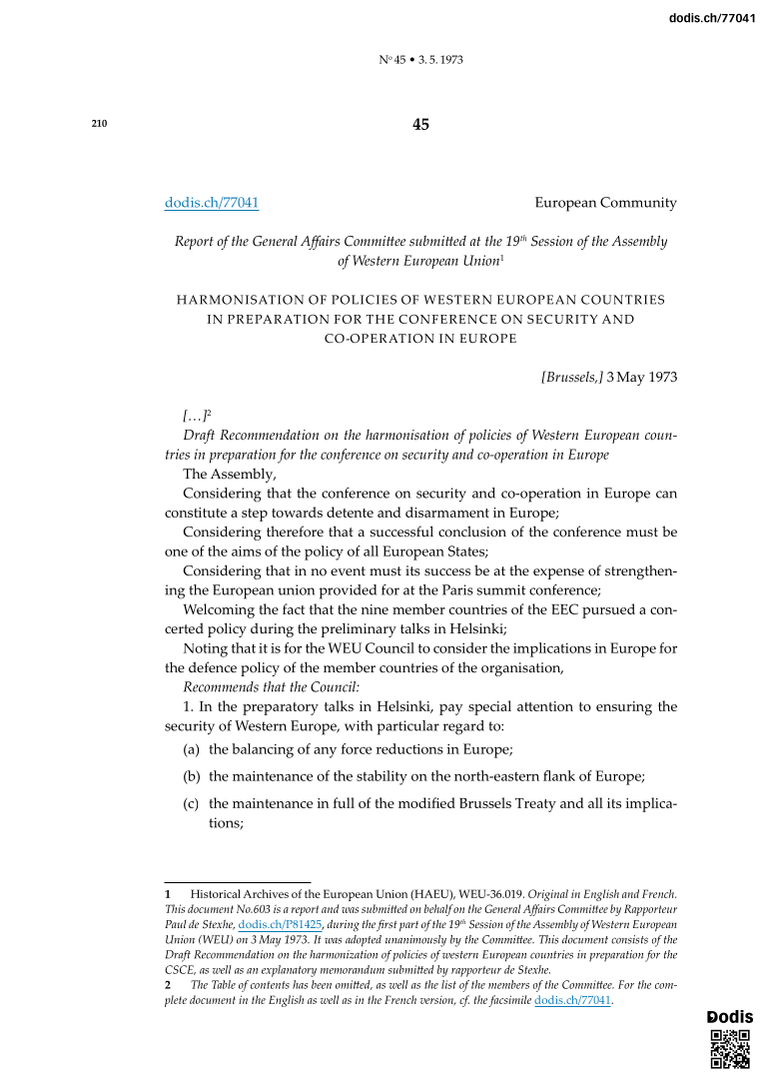
Report of the General Affairs Committee submitted at the 19th Session of the Assembly of Western European Union1
Harmonisation of Policies of Western European Countries in Preparation for the Conference on Security and Co-operation in Europe
[…] 2
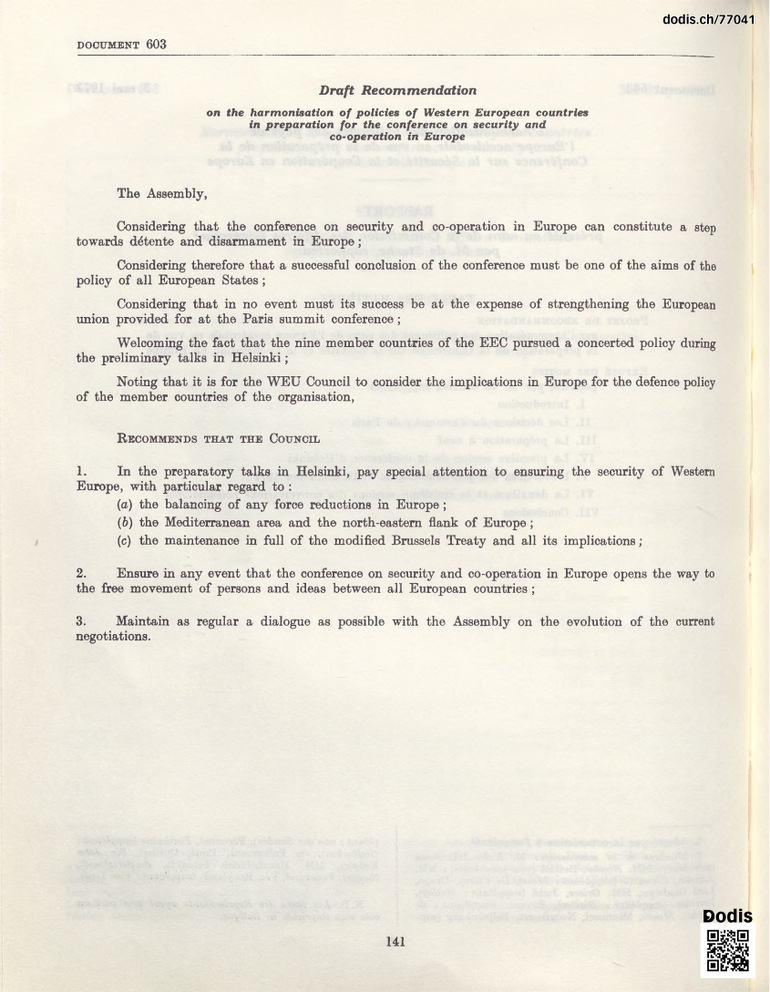
Draft Recommendation on the harmonisation of policies of Western European countries in preparation for the conference on security and co-operation in Europe
The Assembly,
Considering that the conference on security and co-operation in Europe can constitute a step towards detente and disarmament in Europe;
Considering therefore that a successful conclusion of the conference must be one of the aims of the policy of all European States;
Considering that in no event must its success be at the expense of strengthening the European union provided for at the Paris summit conference;
Welcoming the fact that the nine member countries of the EEC pursued a concerted policy during the preliminary talks in Helsinki;
Noting that it is for the WEU Council to consider the implications in Europe for the defence policy of the member countries of the organisation,
Recommends that the Council:
1. In the preparatory talks in Helsinki, pay special attention to ensuring the security of Western Europe, with particular regard to:
– the balancing of any force reductions in Europe;
– the maintenance of the stability on the north-eastern flank of Europe;
– the maintenance in full of the modified Brussels Treaty and all its implications;
2. Ensure in any event that the conference on security and co-operation in Europe opens the way to the free movement of persons and ideas between all European countries;
3. Maintain as regular a dialogue as possible with the Assembly on the evolution of the current negotiations.
1. The Assembly of Western European Union has already had several opportunities of considering the prospects of a conference on security and co-operation in Europe and in particular when it examined the reports by Mr. Sieglerschmidt and Mr. Nessler.3 The last occasion was in December 1972 when it adopted a recommendation on Europe and the evolution of East–West relations urging, inter alia, that the Council:
“Invite member States to make an effective contribution to preparatory work on the conference on security and co-operation in Europe so that the participation of the EEC countries is concerted and constructive in application of the decision of the Heads of State and of Government.”
2. Since then, the situation has developed quickly in three respects:
– Obstacles preventing an agreement between the Federal Republic and the GDR have been removed and a treaty on relations between the two German States has been concluded. Although the application of the treaty still presents certain difficulties, most of the Western European countries are preparing to establish diplomatic relations with the GDR.
– Negotiations between Ambassadors in Helsinki in preparation for the conference on security and co-operation in Europe started on 22nd November 1972. Preparatory talks have also been held in Vienna since January 1973 with a view to negotiations on mutual and balanced force reductions by the two alliances.
– The nine-power consultations on the conference on security and co-operation in Europe have proved effective, and the results achieved will be analysed in this report.
3. Your Rapporteur will not therefore revert to matters covered in earlier reports but will confine himself to the most recent developments.
4. In view of the nature of these developments, this report has been written in the light of the decisions taken at the Paris summit conference, attention being concentrated on the nine-power consultations. It is evident that the questions to be dealt with at the conference on security and co-operation in Europe come within the field of responsibility of several organisations, none of which, by membership or terms of reference, is in a position to consider all the problems raised by the Helsinki negotiations. Nor is there any reason why the EEC countries should keep other European countries, neutral or not, members of the Council of Europe or not, out of the preparatory talks in Helsinki if they wish to take part, at least in certain fields.
5. Thus, the Political Committee of the Council of Europe recently adopted a report on East West relations in Europe submitted by Sir John Rodgers4 (Document 3230) recommending inter alia that the Committee of Ministers:
“Seek and promote the co-ordination of the policies of member States in the preparation of the conference on security and co-operation in Europe.”
6. Your Rapporteur fully endorses this recommendation and believes such co-ordination should be extended to countries which have hitherto been kept out of the Council of Europe because of their political régimes but which are directly concerned by security and co-operation in Europe. This is the case in particular of Mediterranean countries such as Spain and Portugal.
7. However, to avoid all the European organisations considering the same matters at the same time and in the same way, each must keep to its own specific field at both intergovernmental and parliamentary assembly level. Thus the Council of Europe’s field covers cultural, technical and juridical matters, whereas the Ministers of the Nine are responsible for everything connected with the Rome Treaty. The North Atlantic Council handles the truly military aspects of European security where military co-operation between Europe and the Uniting States is concerned and WEU the policy of defence and general political matters involving the application of the modified Brussels Treaty.5
8. Governments may be expected to hold their consultations in the most convenient manner at any given moment. Parliamentary assemblies are not tied to these particular arrangements, their task being to consider the conference on security and co-operation in Europe as it affects the application of the treaty for which they are responsible. It is on these grounds that your Rapporteur is able to devote the closest attention to nine-power cooperation in the political field since this involves the implementation of the political provisions of the modified Brussels Treaty, just as the principal military provisions are implemented in the framework of NATO.6
9. Finally, it must be remembered that the present report has had to be drafted immediately after the close of the third round of preliminary talks in Helsinki, which ended on 6th April. The fourth round will be held at the end of April and the beginning of May and it is planned that the conference proper should start during the second half of June 1973. The essence of the Helsinki talks is moreover being kept secret, as is necessary in the course of negotiations. For these various reasons the information your Rapporteur is able to present here is necessarily fragmentary and his conclusions therefore provisional.
10. Although the idea of a conference on European security was first broached eighteen years ago, it was not until 10th December 1971 that the North Atlantic Council, meeting in Brussels, announced its willingness to hold multilateral talks as soon as possible in preparation for such a conference.
11. In Bonn on 31st May 1972, the Atlantic Pact countries proposed that exploratory multilateral talks be held as soon as possible on balanced force reductions by the two blocs. These talks were to be held parallel with the preparatory multilateral talks on the conference on security and co-operation in Europe.
12. When Mr. Kissinger8 visited Moscow on 12th September 1972, the Soviet Union agreed to the principle of starting exploratory talks on force reductions in January 1973, and the United States consequently agreed that the multilateral talks on the conference on security and co-operation in Europe should start in Helsinki on 22nd November 1972. The NATO Permanent Council agreed to this date on 23rd October 1972, and on 9th November the Finnish Government invited 32 European countries, the United States and Canada to meet for this purpose in Helsinki as from 22nd November.
13. The West had always handled the question of a conference on security and co-operation in Europe in the framework of NATO since the western powers considered that all matters concerning force reductions should be considered side by side with problems connected with the European States’ frontiers or economic and cultural relations.
14. It became apparent, however, that although NATO was a suitable framework for co-ordinating all matters affecting defence policy it was unsuitable for the preparation of a conference whose agenda included a large number of questions outside the terms of reference of the Atlantic organisation. Also, if western positions had been worked out solely in the framework of NATO it would inevitably have led to a confrontation between two military blocs, which would probably not have contributed to the success of the conference on security and co-operation in Europe.
15. For these reasons, once they had agreed to co-ordinate their foreign policies on a permanent basis, the nine countries which are now members of the European Economic Community9 included in their agenda preparatory discussions on the conference on security and co-operation in Europe.
16. At the summit conference in Paris on 19th and 20th October 1972, the Heads of State or Government took two decisions concerning co-operation in the field of foreign policy and, consequently, the preparation of the conference on security and co-operation in Europe.
17. First, in paragraph 14 of their communiqué, they set out the following guidelines for their co-operation:
“The Heads of State or of Government agreed that political co-operation between the member States of the Community on foreign policy matters had begun well and should be still further improved. They agreed that consultations should be intensified at all levels and that the Foreign Ministers should in future meet four times a year instead of twice for this purpose. They considered that the aim of their cooperation was to deal with problems of current interest and, where possible, to formulate common medium- and long-term positions, keeping in mind, inter alia, the international political implications for and effects of Community policies under construction. On matters which have a direct bearing on Community activities, close contact will be maintained with the institutions of the Community. They agreed that the Foreign Ministers should produce, not later than 30th June 1973, a second report on methods of improving political co-operation in accordance with the Luxembourg report.”
18. Second, in paragraph (vi) of the communiqué, they set out the aims which they would pursue in their relations with the Eastern European countries:
“The member States of the Community, in the interests of good neighbourly relations which should exist among all European countries whatever their régime, affirm their determination to pursue their policy of détente and of peace with the countries of Eastern Europe, notably on the occasion of the conference on security and co-operation in Europe, and the establishment on a sound basis of a wider economic and human co-operation.”
19. No time was lost in applying these decisions since the nine Foreign Ministers met on 20th November 1972 to discuss political co-operation and particularly preparations for the talks which were to start in Helsinki on 22nd November. For all the economic aspects of the conference on security and co-operation in Europe, they were assisted by members of the European Commission.11
20. In reality, the meeting on 20th November was merely a culmination of two years’ consultations in the framework of the Political Committee, the ad hoc committee dealing with questions of economic co-operation and NATO. However, by 20th November it was time for the Community to take certain fundamental decisions and also to decide on procedure for the preparatory multilateral talks. All the member countries had accepted the principle that the conference on security and co-operation in Europe was not to be a confrontation between blocs, but opinions varied as to the effect the application of this principle would have on the policy to be pursued. Although the Community is in no way a military bloc since it has no defence organisation of its own, it is economically at least, a homogeneous body and its members must not forget this fact, even when one of them acts individually in negotiations outside the Community.
21. The Commission had submitted two documents to the Council, one of which dealt with the rôle which the Community should play in the forthcoming conference on security and co-operation in Europe. The Commission asked to be allowed to take part in the conference and in particular in the work of the committees set up to consider questions of economic co-operation. The other document set out the aims of Community policy in the framework of co-operation with the Eastern European countries.
22. So far, these documents have had only one reading by the Committee of Permanent Representatives12 and no decision has been taken. The real question for the Ministers was whether, by following the guidelines laid down at the Paris summit conference, they would admit that the rôle of the Community as such went beyond the strictly commercial aspects of co-operation between the various European countries and, if so, how far Community responsibilities might extend in economic or even political fields.
23. The fact that the Community is to move rapidly towards an economic and monetary union will inevitably have repercussions on Community policy in the field of foreign policy. For instance, who has authority to speak for the Community and who will be the representative of the country which has the Chairmanship of the Council fulfil this rôle satisfactorily? Are there not grounds for making the Commission responsible for representing the Community as a whole in certain fields? This would imply some form of official recognition of the Community by all those taking part in the conference. A moot point is whether such formal recognition is worth the cost of concessions which otherwise might not be essential. It is now evident that the Soviet Union recognises the existence of Community Europe and the EEC has no need of more formal recognition.
24. At the meeting on 20th November, the Political Committee submitted a document proposing a harmonised nine-power approach in the various eventualities that might arise in the course of the multilateral preparatory talks with due regard to the items likely to be included in the agenda of the conference.
25. The nine Ministers agreed on most aspects of the agenda of the conference at which the following suggested questions might be considered:
(i) security, i.e. principles governing relations between States and matters affecting the balance of forces;
(ii) economic, scientific and technical cooperation;
(iii) human and cultural relations.
26. With regard to the conference proper, the proposal that it should be held in three stages was adopted:
a) an opening session attended by the Foreign Ministers;
b) a period that might be quite long during which study committees would work out the final act;
c) a second ministerial session for adopting the final act.
27. The Nine agreed to turn down the Soviet proposal that the conference on security and co-operation in Europe should only be a summit meeting. Nor did they agree that a permanent body should be set up after the conference. However, they agreed on proposed terms of reference for the various study committees. The Ministers decided to uphold these proposals at the December meeting of the North Atlantic Council.13
28. At the same meeting, the nine Ministers considered two other documents prepared by the Political Committee in co-operation with the Commission concerning harmonisation of the positions of the Nine in respect of economic and technical co-operation and the environment. When submitting these documents, Mr. Sicco Mansholt,14 President of the Commission, emphasised that action taken by the Nine in this field should be not only harmonised but of a strictly Community nature, even if it extended beyond questions concerned with trade.
29. Although no official details have been given of the nine-power talks, it is an open secret that there were differences of opinion over these proposals.
30. (i) As regards security, France has always refused to recognise the need for a parallel approach to balanced force reductions and European security and, a fortiori, refuses to give priority to the question of balanced force reductions. It is not taking part in the Vienna negotiations on this question. Subsequent stands adopted by the French Government indicate that France’s position is unchanged and whatever progress may have been made on 20th November, a settlement cannot yet be seen. In all probability, however, being primarily concerned with the military aspects of the talks with Eastern Europe, this matter can best be tackled in the framework of NATO rather than that of the Nine.
31. (ii) In the economic field, opinions also differ as to how Community cohesion can and should be expressed in regard to the outside world. No one challenges the need for the Nine to harmonise their positions but it is feared that if there is too much cohesion the Nine might give the impression that they are forming a bloc. Admittedly within their own sphere of responsibilities the European Communities do form a bloc, but it is to be feared that if the Community’s interests are represented by a single body the Soviet Union might take this as an excuse for claiming to represent the interests of all the Eastern European countries and consequently not allowing the people’s democracies to have a say at the conference, thus further strengthening Soviet positions in Eastern Europe.
32. (iii) Human and cultural relations are not the direct responsibility of NATO nor of the Nine. To study such relations in the framework of an economic or, a fortiori, military bloc might jeopardise co-operation which should be considered in the widest possible framework. Many consider the Council of Europe15 to be the most appropriate framework at the present time.
33. In this connection, your Rapporteur wishes to recall the views expressed by Mr. Reverdin16 in Document 3243 of the Consultative Assembly of the Council of Europe:
“Politically, the conference on security and co-operation in Europe seems likely to be the major political event in Europe in 1973. One of our priority tasks should be to establish the Council of Europe’s political approach and the rôle it might play in East–West relations.
Opinions on this subject differ. Some believe that the Helsinki conference, which is likely to be held in June this year, may bring about considerable changes in the European situation. We should take care to ensure that the Council of Europe is not left out of any such development in pan-European co-operation, particularly in certain technical and cultural fields where the Council has made considerable contributions. Some firmly believe that this can be done, whilst pointing out that a certain image dating from the cold war devalues the Council in the eyes of the East European countries. The absence of communist representatives in the Assembly, debates such as those on the “Free Europe” and “Freedom” radio stations, and the continuing existence of a committee on European non-member countries are mentioned as obstacles in this regard.
[…]
So far, member States have not wanted to use the Council of Europe as a framework for consultations in preparation for the conference on security and co-operation in Europe, nor do they seem to intend to do so. However, the Working Party will need to consider the possibility – as referred to in the Committee of Ministers’ communiqué – of East European countries participating in certain Council of Europe activities as well as the possibility of the Council’s providing a framework for pan-European co-operation in the implementation of some of the results of the conference on security and co-operation in Europe.
With the conference on security and co-operation in the offing, it is also important that our governments should not agree to a new international body being set up in Europe as a result of the conference with responsibilities that more or less overlapped with those of the Council of Europe.”
34. The Nine seem to have agreed that:
(a) all proposals, whatever their origin, made during the conference concerning matters within the competence of the Community must be considered by the Community bodies concerned;
(b) the EEC countries must not make any offers or proposals on such matters at the conference without prior discussion by the Community;
(c) the Commission must be represented as from the start of the preparatory talks in order to apply this procedure and intervene as and when necessary.
35. This means that the Commission’s role will not be to give the Community’s point of view at the conference. This will be the task of the representative of the country chairing the Council. But at the same time it has been stipulated that for matters within the competence of the Community no proposals may be made other than on behalf of the Community as a whole, which means that the Community bodies must discuss each case as it arises and take appropriate decisions.
36. The Commission will therefore be in Helsinki but only to take part in internal Community consultations and not to represent it outside.
37. Conversely, no firm agreement seems to have been reached on the Community responsibilities which demand concertation. There is no problem where trade is concerned, but if the guidelines laid down at the Paris summit conference are interpreted in their broadest sense all matters relating to economic, technological or financial co-operation will have to be considered within the competence of the Community. The Nine will have to take a decision on this point without delay.
38. During the preliminary talks in Helsinki, the Nine were able to meet to consider jointly the questions arising from the talks, for instance at the ministerial meeting held in Brussels on 16th March when they welcomed the results achieved by nine-power co-operation and decided to improve their co-operation by holding regular meetings of their delegations in Helsinki and maintaining closer liaison between them and Brussels. They also agreed that in order not to avoid a fundamental distinction being drawn between “all-European” rights whereby the Soviet Union might have a say in the evolution of the EEC and international rights, as defined inter alia in the United Nations Charter.
39. It should be underlined that although nine-power consultations seem to have produced excellent results in Helsinki, talks between Europeans and Americans have fallen short of any such co-ordination of aims and hence approach. Everything indicates that the Americans no longer consider the success of the negotiations on mutual and balanced force reductions in Vienna to be a prior-condition for the conference on security and co-operation in Europe. On the contrary, they believe the conference on security and co-operation in Europe should clear the way for the talks on mutual and balanced force reductions which are marking time due to the ill will of the Soviet Union and its allies and disagreement between the western countries. The United States Government is making it increasingly evident that its principal aim is the reduction of American forces stationed in Europe and it seems prepared to make any concessions necessary in Helsinki to break the deadlock in the Vienna negotiations. Moreover, it seems to grant greater importance to its bilateral relations with the Soviet Union than to collective talks such as those in Helsinki.
40. Distrust of American intentions referred to in no uncertain terms and with increasing frequency in the European press can but encourage the Nine to strengthen their solidarity, failing which they may one day find themselves faced with an American-Soviet agreement about which they have had no say. The need to continue the Helsinki talks is now greater than ever but so is the need for the Nine to proceed with the utmost caution and to co-ordinate their positions and approach to the greatest possible extent.
41. The first session of the conference of Ambassadors was held in Helsinki from 22nd November to 15th December 1972. It was primarily concerned with organisational matters but it is evident that some of the principles agreed to already commit the conference proper.
42. On 24th November, Mr. Toetterman,18 Chairman of the conference, read out eight points on which all member countries had agreed:
– all States will take part in the consultations on a basis of complete equality and independence;
– each country has one representative, but he can delegate his power to speak;
– the secretariat and technical services will be provided by the Finnish Government;
– decisions shall be taken by consensus, this being defined as there being no opposition;
– working groups will be set up only by consensus;
– no official minutes will be kept but decisions taken and final texts will be published;
meetings will be held in camera unless otherwise decided by consensus;
the seven preceding points may be modified only by consensus.
43. It was apparent however that there had been insufficient co-ordination of the positions of the Community countries and it was not possible to avoid disagreement between them on a number of points. In general, the French Delegation wanted the talks between Ambassadors to be as flexible as possible and on no account to resemble an official conference. The French Delegation was therefore not in favour of a very detailed agenda being drawn up for the conference on security and co-operation in Europe. It wished agreement to be confined to the broad lines of the agenda. Conversely, delegations from other EEC countries and the United States wanted a very detailed agenda to be drawn up and even wished the Ambassadors to reach preliminary agreement on each item.
44. Finally, in response to the Soviet proposal for an agenda including:
– security, particularly the political aspects;
– economic and cultural co-operation;
– the creation of a permanent organisation, the West proposed the following agenda:
– security;
– economic co-operation;
– cultural exchanges and the free circulation of ideas and persons.
45. However, there is no indication that the West has rejected the idea of setting up a permanent organisation and it is therefore probable that the matter will be considered at the conference. Distrust of such an organisation was not specific to the Nine since the United States adopted a similar position.
46. Finally, on one essential point no conclusion was reached during the first round of preparatory talks in Helsinki, i.e. the terms of reference of the committees which will meet during the second stage of the conference on security and co-operation in Europe. This was a fundamental difference between the western countries as a whole, which were anxious that a conference on security and co-operation in Europe should be held only if a detailed agenda is drawn up beforehand, and the Soviet Union and its allies.
47. There seem therefore to have been fundamental differences from the outset.
48. The Soviet Union considered the aim of the conference on security and co-operation in Europe was to make solemn declarations of a general nature on a political status quo in Europe, the creation of a nucleus of a permanent organisation and accessorily the promotion of economic co-operation.
49. In the West’s view, the conference should go beyond general declarations which would in fact merely confirm declarations already adopted in the United Nations for instance. It should seek agreement on the interpretation of general principles governing specific problems, particularly with regard to improving security by emphasising noninterference, military measures, wider movement of persons, ideas and information and true economic co-operation.
50. To this end, methods of work would be quite different: rather than holding general assemblies where participants unilaterally state their views and which are not very suitable for real negotiations, all concrete problems should be entrusted to committees or working groups with detailed terms of reference.
51. Meeting in Brussels on 7th and 8th December 1972, the North Atlantic Council agreed on the following text to which France has therefore subscribed:
“Ministers affirmed that their governments would work constructively to establish necessary agreements in the multilateral preparatory talks, which have just started in Helsinki. They recalled that the aim of their governments at these talks would be to ensure that their proposals were fully considered at a conference and to establish that enough common ground existed among the participants to warrant reasonable expectations that a conference would produce satisfactory results. They considered that there should be agreement at these talks on the arrangements and guidelines necessary to enable such a conference to produce constructive and specific results. They noted that such results could be achieved only through the process of detailed and serious negotiation, without artificial time limits.
Ministers confirmed that it is the goal of their governments to increase the security of all Europe through negotiations concerning such questions as principles guiding relations between the participants and through appropriate measures, including military ones, aimed at strengthening confidence and increasing stability so as to contribute to the process of reducing the dangers of military confrontation; to improve co-operation in all fields; to bring about greater, more open and freer relationships between all people in Europe; to stimulate a wider flow of information and of ideas.”
52. Events between the first and second rounds of negotiations in Helsinki, particularly the meeting of the North Atlantic Council in December 1972 and President Pompidou’s19 visit to the Soviet Union in January 1973, showed that views were converging and facilitated the resumption of negotiations in Helsinki on 5th January.
53. In the quarrel over terms of reference in Helsinki, France adopted a less rigorous position than its partners but, conversely, during his talks with Mr. Pompidou, Mr. Brezhnev20 seems to have come round to the idea that the conference on security and co-operation in Europe could be delayed in order to reach sufficiently definite agreement on the terms of reference of the committees.
54. This may be deduced from the communiqué issued after the talks:
“Emphasising once again the great importance which the USSR and France attach to an all-European conference on security and co-operation, the two sides proclaim their determination to do all they can to ensure that the multilateral preparatory consultations in Helsinki bring about an early mutual agreement and to ensure that the conference itself is convened as soon as possible in the coming months. Taking into account the fact that their views as formulated in the Soviet-French declaration on 30th October 1971 broadly coincide, and the profound character of the consultations between them, the Soviet Union and France will exert every effort in order to make an effective contribution to the holding of the conference.”
55. The communiqué continues:
“The Soviet Union and France proceed on the basis of the fact that an all-European conference should not be made dependent on any other negotiations and that it is a major independent action of European and world politics.”
56. This confirmed what had been inferred from France’s refusal to agree to the paragraphs of the communiqué issued after the North Atlantic Council meeting on 8th December concerning exploratory talks on mutual and balanced force reductions in Central Europe, which stated:
“Ministers hoped that these talks would make it possible to commence negotiations on this subject in the autumn of 1973. They noted that such a programme implied that talks on both mutual and balanced force reductions and on a conference on security and co-operation in Europe would be going on in the same general period of time.”
57. However, from what President Pompidou told the press it could be understood that France’s position with regard to the talks on mutual and balanced force reductions is perhaps not inflexible:
“Mr. Brezhnev and I had a long discussion on mutual and balanced force reductions. I recalled the position which I had explained in great detail in Paris. The Secretary General of the Communist Party of the Soviet Union also set out his ideas on this conference, which led him to hope that France would take part. There was no question of France changing its position overnight, of course. But I noted the interest on the one hand the detailed information which I obtained from the Soviet Union on this occasion regarding its views on the conference, its procedure and aims, and on the other the Soviet Union’s reasons for wishing France to take part, and we agreed to discuss the matter further. Do not draw over-hasty conclusions from this.”
58. Finally, the Soviet Union agreed to the West’s proposal to call the preparatory conference for the negotiations on mutual and balanced force reductions on 22nd January, although it insisted that the meeting be held in Vienna and not in Geneva as planned and that all the European countries be invited to take part. The NATO countries agreed to the first condition but the second is still the subject of heated discussion since this would imply a complete change of course for the conference and also the extension of future force reductions to Southern Europe. These discussions did not prevent the Vienna meeting from being held but the negotiations seem to be marking time pending agreement on this point.”
59. It is questionable whether, having been caught off-foot by the Soviet request, the NATO countries concerted their positions sufficiently prior to the Vienna negotiations. Again, does the Soviet Union really intend the negotiations to succeed?
60. Is it therefore essential from the very outset to establish close ties between the conference on security and co-operation in Europe and the negotiations on mutual and balanced force reductions?
61. However, your Rapporteur feels that the minimum degree of confidence which is necessary between participants if the conference on security and co-operation in Europe is to succeed would be seriously jeopardised if it did not find an echo in Vienna.
62. Although there may have been some doubt after the first round of meetings in Helsinki from 22nd November to 15th December 1972 as to the depth of the nine-power consultations, the second round, which started on 15th January 1973, shows that the Nine are effectively applying the decisions taken at the Paris summit conference and have co-ordinated their positions in Helsinki, as most observers have noted, since it has been clearly demonstrated either that the representative of one EEC member country was speaking on behalf of the whole Community or that statements made by representatives converged, and this is not just a question of chance. The very nature of present nine-power political co-operation, apart from ministerial meetings or other outward manifestations, allows governments to collaborate closely when implementing policies, the broad lines of which have been agreed. Everything indicates that this was the case in Helsinki, thanks in particular to the regular meetings of delegates from the nine countries in preparation for the Ambassadors’ meetings. These meetings seem to have been far more fruitful than those in the framework of NATO, especially since France did not attend the latter meetings regularly. However, the second round of preliminary negotiations has not brought out any major differences between the west countries, or even between them and most of the neutral European countries, on matters related to the conference on security and co-operation in Europe.
63. From the very start, the Nine demonstrated their cohesion by presenting a joint proposal for an agenda for the conference on security and co-operation in Europe. Within the three main heads already suggested by the western countries, this draft agenda sets out a number of important points and particularly the creation of ten sub-committees to study specific problems linked with the three main heads:
– with regard to security matters a definition would have to be made of the principles governing relations between States, due account being taken of the United Nations Charter,21 the principle of the sovereignty of States, human rights and international law;
– with regard to economic co-operation, this proposal would imply increasing trade and industrial co-operation, seeking better use of natural resources and consideration of environmental problems;
– finally, with regard to the free circulation of persons and ideas, the nine-power proposal provides for a general liberalisation of exchanges between persons and in particular for co-operation between States in the field of education.
64. Although this proposal was not put forward in the name of the EEC but by the Ambassadors of Belgium, Italy and Denmark, there can be no doubt that the Nine – in this first joint statement on foreign policy – have taken advantage of the suspension of the Helsinki talks to confirm a degree of cohesion in their foreign policy which was not so clear in December.
65. It is to be noted that the firm well-thought-out proposals were supported not only by the Nine and the Fifteen; they were also received with great interest by the neutral countries.
66. Yet no decisive progress was made during the second round of the Helsinki negotiations although the four main items on the agenda have been agreed to – security; economic co-operation; human contacts, cultural exchanges and information; institutional matters.
67. But the Soviet Delegation found the Belgian proposal too detailed and, while agreeing to the terms of reference of the main committees, it rejected those proposed for the sub-committees, although they are essential if sufficiently detailed and concrete results are to be achieved within a reasonable time.
68. With regard to security, the Soviet Union wished the terms of reference of the committee to include only the bases of sovereignty, equality of States, renunciation of force and nonintervention in the internal affairs of States, whereas the western powers endorsed the Swiss proposal to include human rights and selfdetermination as well. The principles of international law are contained in the United Nations Charter and the General Assembly resolution of 1970 on friendly relations between States. The conference cannot claim to elaborate new international law on different bases to those of the United Nations, thus opening the door to all kinds of contestation. Nor can it “pick” and choose among the principles defined by the United Nations for this would infer that Europe rejected any principles it did not retain. But Europe could form a permanent body to arbitrate in the event of disputes and thus, instead of being based solely on principles, as the Soviet Union proposes, European security would be given tangible, dynamic meaning as underlined by the Swiss and Austrian Delegates.
69. Conversely, the Soviet Union and some of the western countries do not wish the concept of European security to be extended to the whole Mediterranean area, nor do they consider that the military aspects of security should be examined in the framework of the Helsinki negotiations in view of the parallel negotiations in Vienna.
70. Your Rapporteur wonders whether this attitude towards the Mediterranean countries is in Europe’s general interests: Europe’s security is linked with the Mediterranean area and it would be appropriate for the countries concerned to examine the problems of security and co-ordination in that area in an appropriate framework.
71. There was the least difference on the question of co-operation, although the GDR, Poland and Czechoslovakia asked that restrictions on trade between European States be abolished and that all discrimination be stopped, and Czechoslovakia called for an improvement in relations between the EEC and COMECON.22 In fact, the EEC’s right to exist as a trade partner was questioned neither by the eastern countries nor by the neutrals and the British proposals for dealing concretely and pragmatically with economic problems and increasing joint industrial projects, and the Finnish proposal for dealing with economic matters on a regional basis seem to have raised no serious objections.
72. This was not the case for human contacts. The terms of reference of the committee concerned raised the greatest difficulties and the negotiators discussed this matter right up to the last minute without finding a satisfactory solution. Here the problem of State control over mass communication media in the eastern countries arises, and the Soviet Union and its allies – while expressing their support for any proposal for wider co-operation in the cultural field – asserted that, in the field of information, exchanges should “respect each country’s laws and customs”. In fact, cultural relations could be considered only through the intermediary of the State authorities.
73. The eastern countries denounced such institutions as Radio Free Europe23 or “anti-culture, hatred between nations and pornography” in order to ensure the maintenance of strict State control over mass communication media.
74. Yet this is a question of cardinal importance, for détente cannot be effective unless it helps to free mankind. As the Irish Delegate24 emphasised at the last sitting of the second session, the denial of human contacts and the free exchange of information undermined the West’s confidence in the Helsinki conference as a whole.
75. As the French Delegate25 underlined at the same sitting, the Nine’s position with regard to institutional matters, i.e. the creation of a permanent body to implement decisions taken at the conference and follow up its work, is meaningful only insofar as the conference achieves results.
76. The third round of preliminary talks ended on 6th April 1973 without any decisive progress having been made. A fourth round is now to be held at the end of April and the beginning of May and some observers openly speak of a fifth round. There is even some doubt as to whether it will be possible to hold the conference in June or July as initially planned.
77. Most questions relating to the material organisation of the conference seem to have been settled. In particular, it seems to be agreed that the conference should meet in Helsinki, but there are still serious differences over the drafting of the various items of the agenda for which a special working group exists. Its work seems fairly advanced where economic co-operation and security are concerned and the discussion on measures to improve confidence
78. But little progress has been made with consideration of item 3 on cultural co-operation and movements of ideas and persons and item 4 regarding post-conference measures has remained practically untouched.
79. In face of the most unreceptive attitude of the Soviet Delegation to item 3 the western countries have by no means reached a common position. The Soviet Union appears to consider that exchanges of official delegations and government statistics would be sufficient to comply with this item on the agenda whereas the West has always considered that the development of human contacts, exchanges of information and cultural relations should assume far greater importance and in any event extend beyond intergovernmental exchanges.
80. For the forthcoming rounds of preparatory talks, it will therefore be essential for the delegations of the western countries to receive detailed instructions from their governments on the positions they should adopt with regard to such exchanges. In this respect there should be active concertation, at least between the governments of the nine EEC member countries.
81. Similarly, the negotiations on mutual and balanced force reductions in Vienna have so far come to naught and there is every reason to fear that the West’s principle of parallelism between the Vienna and Helsinki negotiations is not being respected.
82. In this connection, too, it is evident that there are still major differences between the western countries calling for close concertation as a matter of urgency, failing which the Soviet Union will be able to approach the conference on security and co-operation in Europe in the knowledge that it has already attained all its objectives without having made the slightest concession.
83. At the present juncture it cannot be said that anything very positive has been achieved at the Helsinki talks. Whatever their claims, it is difficult to say exactly how far each country wishes to pursue the negotiations to a successful conclusion, particularly in the case of the Soviet Union. Some observers feel that, with the agreements between the Federal Republic and its eastern neighbours and the strategic arms limitation talks, the Soviet Union has already obtained all the benefits it could have expected of a conference on security and co-operation in Europe and that it now considers the negotiations on mutual and balanced force reductions and security and co-operation in Europe as of but secondary importance.
84. There is no need for the Western European countries to adopt a very different position. Although anxious to consolidate détente, they have even less reason to seek to obtain it at any cost now that they have managed for the first time to co-ordinate their foreign policies in this regard and can consequently hope to exercise a greater influence than in the past.
85. Finally, some observers fear that in their haste to see the negotiations on mutual and balanced force reductions concluded without delay, the Americans may step down from their positions on security and co-operation in Europe without sufficient concessions in return. It is therefore felt that the Europeans should be a little more exacting, particularly with regard to the capital question of the free movement of persons, ideas and information.
86. Your Rapporteur considers that at the preliminary talks agreement must be reached on a detailed agenda for the conference on security and co-operation in Europe which must not be confined to general declarations which each State subsequently interprets unilaterally; the means of applying these principles in practice must be spelled out. This leads to the need for agreement on working methods, i.e. consideration of specific problems, in committees capable of initiating genuine negotiations.
87. Here, mention may be made of the suggestions put forward by Mr. Michael Stewart,26 Council of Europe Delegate to the Inter-parliamentary Union Conference in Helsinki on 27th January 1973, which might be summarised as follows:
– The conference should reaffirm generally-accepted norms of international law, and should reject ideologically-grounded versions.
– There should be a renunciation of force and the threat of force in all relations among European States, particularly with regard to any territorial changes.
– The conference should afford the occasion for recognition not only of all European States but also of all multilateral, supranational organisations functioning in Europe which share the purpose of furthering international co-operation.
– The conference should affirm the right of self-determination of all European peoples and the right of all European States freely to choose the unique paths of their own development, foreign policy and alliance affiliation, as long as such choice does not contradict the basic principle of force renunciation.
– The conference should affirm norms aimed at liberalising the movement of persons, ideas and information among all parts of Europe.
– The conference should affirm the close relationship between security and the twin goal of reduction of military forces without either of these elements being substituted for the other.
– Security in Europe cannot be separated from the question of détente which necessarily encompasses the United States and the Soviet Union.
The conference should make arbitration compulsory in the event of disputes between European countries, with recourse to the International Court of Justice in the event of such disputes being within its competence.
– The conference should concentrate on those things which really are the common interests of mankind, particularly arms reductions, although the results to be achieved in this field must not be a prior condition for progress in other fields.
– Mr. Stewart further stated that it is also in the common interest of mankind for there to be as wide as possible an exchange of knowledge. We live now in an age of very highly advanced scientific knowledge, whether it is for the conquest of disease or the conquest of space. We come to realise it is to the common interest of mankind, irrespective of ideologies, that that knowledge should be increased, and that is most likely to happen if we are ready to pool and exchange what knowledge we have in all those fields.
– It is to the common interest of mankind to prevent economic progress from being of a kind which destroys and pollutes the human environment, and that is a task which by its nature cannot be successfully performed by one nation, or even by a group of nations. Certainly, if it is to be done on the European continent, all the nations living on that continent must take part in that task.
88. He believes therefore that it is not vain for groups of countries with profoundly different philosophies to come together to identify where their common interest lies and what practical steps they can take to promote it.
89. In this respect your Rapporteur considers that the West should decide who should do what. The Nine of the EEC should deal principally with the economic aspects and the Fifteen of the Atlantic Alliance with the military and security aspects. The Council of Europe should play its statutory rôle in the human, cultural and juridical fields.27
- 1
- Historical Archives of the European Union (HAEU), WEU-36.019. Original in English and French. This document No.603 is a report and was submitted on behalf on the General Affairs Committee by Rapporteur Paul de Stexhe, dodis.ch/P81425, during the first part of the 19th Session of the Assembly of Western European Union (WEU) on 3 May 1973. It was adopted unanimously by the Committee. This document consists of the Draft Recommendation on the harmonization of policies of western European countries in preparation for the CSCE, as well as an explanatory memorandum submitted by rapporteur de Stexhe.↩
- 2
- The Table of contents has been omitted, as well as the list of the members of the Committee. For the complete document in the English as well as in the French version, cf. the facsimile dodis.ch/77041.↩
- 3
- Parliamentarian of the Federal Republic of Germany Hellmut Sieglerschmidt, dodis.ch/P81426, and French politician Edmond Nessler, dodis.ch/P45515.↩
- 4
- British Parliamentarian John Rodgers, dodis.ch/P81427.↩
- 5
- The Treaty of Brussels, also referred to as the Brussels Pact, was the founding treaty of the Western Union between 1948 and 1954, when it was amended as the Modified Brussels Treaty and served as the founding treaty of the WEU until its termination in 2010.↩
- 6
- The NATO, dodis.ch/R2837, is an intergovernmental military alliance between 32 member states – 30 in Europe and 2 in North America.↩
- 7
- Held in 19–20 October 1972 in Paris where heads of state and government decisions on cooperation in the field of foreign policy and security.↩
- 8
- US Security Advisor Henry Kissinger, dodis.ch/P31846.↩
- 9
- The European Community (EC) was an economic and political association formed in 1957 (as the European Economic Community), dodis.ch/R9899, to foster integration among Belgium, Germany, France, Italy, Luxembourg, and the Netherlands.↩
- 10
- Refers to the nine members of the EC as of 1972.↩
- 11
- The European Commission is the executive cabinet of the European Communities.↩
- 12
- COREPER is the Committee of Permanent Representatives in the European Union, dodis.ch/R27374, made up of the Head or Deputy head of mission from the EU member states in Brussels.↩
- 13
- The North Atlantic Council, dodis.ch/R24629, is the principal political decision-making body within NATO. It oversees the political and military process relating to security issues affecting the whole Alliance.↩
- 14
- The Dutch President of the European Commission Sicco Mansholt, dodis.ch/P15891.↩
- 15
- The Council of Europe (CoE), dodis.ch/R2382, is an international organisation that aims to uphold human rights, democracy and the rule of law in Europe. It is Europe’s oldest intergovernmental organisation, representing 46 European member States.↩
- 16
- The President of the Parliamentary Assembly of the CoE Olivier Reverdin, dodis.ch/P11967.↩
- 17
- The 1972 Helsinki Conference initiated the CSCE; it led to the signature of the Helsinki Final Act on 1 August 1975. For the Final Act in all CSCE languages, cf. dodis.ch/58821.↩
- 18
- Secretary-General of the Finnish Ministery of Foreign Affairs Richard Tötterman, dodis.ch/P46542.↩
- 19
- French President Georges Pompidou, dodis.ch/P15264.↩
- 20
- General Secretary of the Communist Party of the Soviet Union Leonid Brezhnev, dodis.ch/P15543.↩
- 21
- The Charter of the United Nations is the founding document of the UN. It was signed on 26 June 1945, in San Francisco, at the conclusion of the United Nations Conference on International Organization, and came into force on 24 October 1945.↩
- 22
- The Council for Mutual Economic Assistance, dodis.ch/R11549, was an economic organisation from 1949 to 1991 under the leadership of the Soviet Union that comprised the countries of the Eastern Bloc along with a number of communist states elsewhere in the world.↩
- 23
- Cf. dodis.ch/R27967.↩
- 24
- Not identified.↩
- 25
- Not identified.↩
- 26
- British Parliamentarian Michael Stewart, dodis.ch/P15449.↩
- 27
- For all documents of the EC in this volume, cf. the compilation dodis.ch/C2912.↩
Relations to other documents
| http://dodis.ch/58821 | is quoted in | http://dodis.ch/77041 |
Tags
Organization for Security and Co-operation in Europe (OSCE) CSCE negotiations in Helsinki and Geneva (1972–1975)