
Printed in
Geneva, Helsinki, and the Making of the CSCE. International Diplomatic Documents on the Conference on Security and Cooperation in Europe, 1969–1975, vol. 30, doc. 30
volume linkBern 2026
more… |
▼▶Repository
| Archive | Historical Archives of the European Union, Florence |
▼ ▶ Archival classification | HAEU CEUE_SEGE-SEC(1972)3304 |
| Archival classification | HAEU Communautés européennes (CE), Secrétariat général de la Commission 1972/9002 |
| (9.10.1972–9.10.1972) |
 Transcription
 QdD
QdD
 Facsimile
dodis.ch/77040
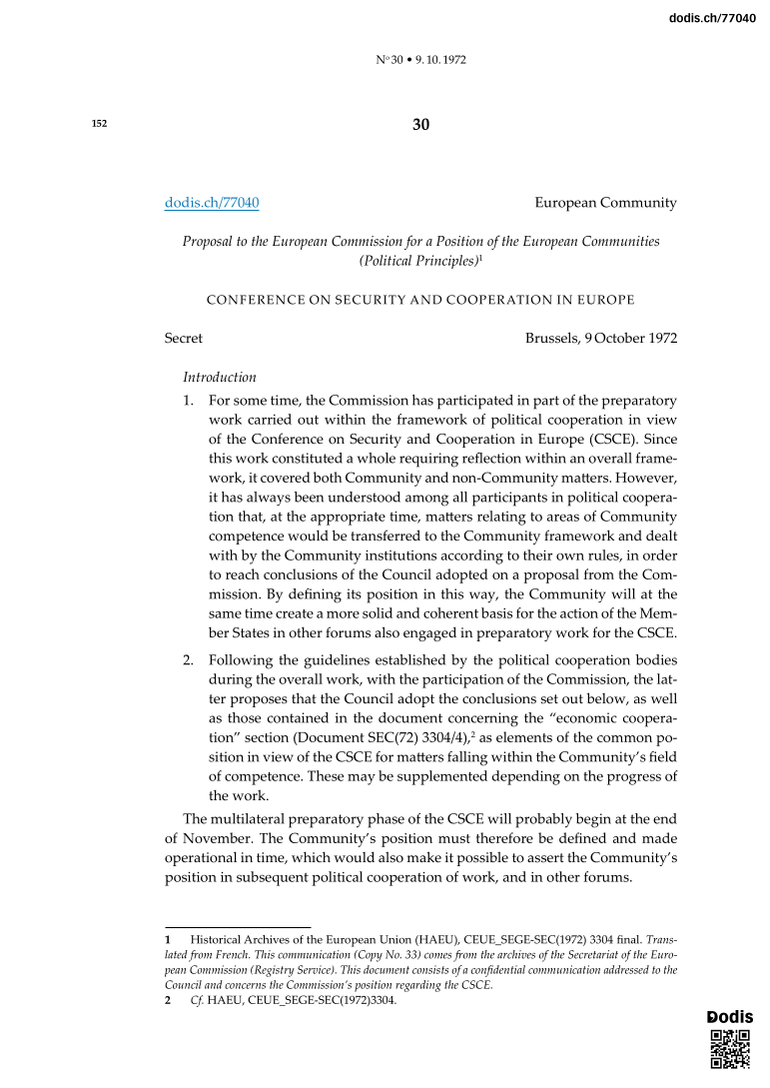
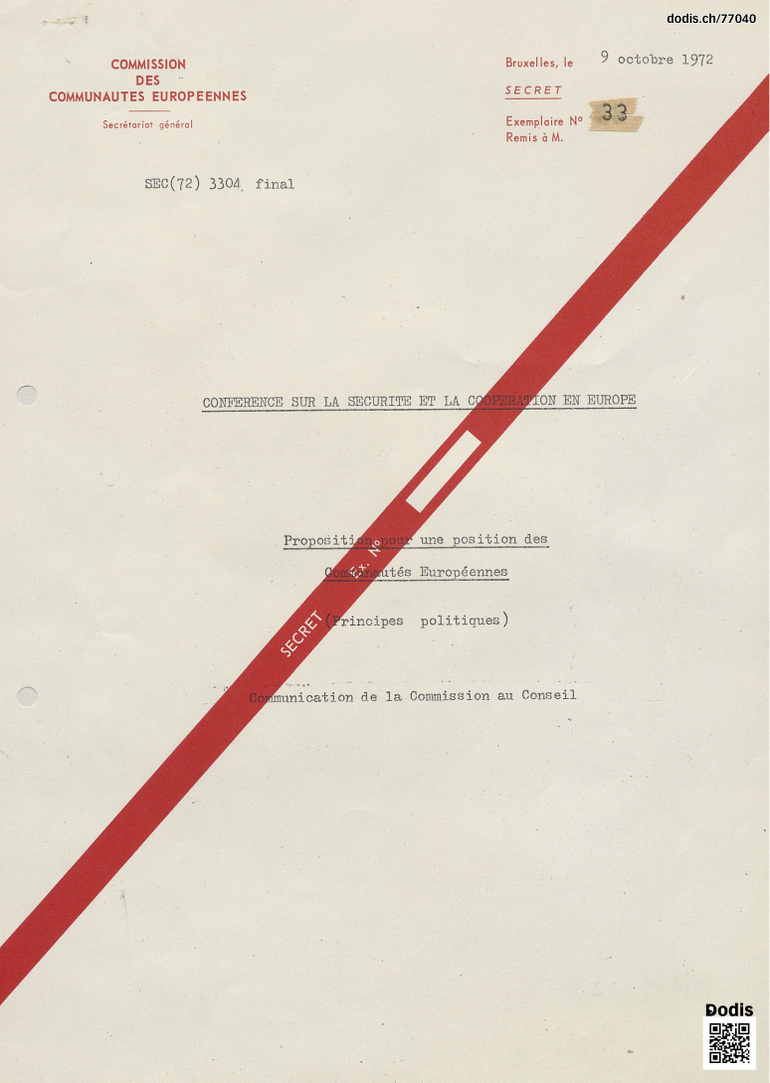
Proposal to the European Commission for a Position of the European Communities (Political Principles)1
Conference on Security and Cooperation in Europe
– For some time, the Commission has participated in part of the preparatory work carried out within the framework of political cooperation in view of the Conference on Security and Cooperation in Europe (CSCE). Since this work constituted a whole requiring reflection within an overall framework, it covered both Community and non-Community matters. However, it has always been understood among all participants in political cooperation that, at the appropriate time, matters relating to areas of Community competence would be transferred to the Community framework and dealt with by the Community institutions according to their own rules, in order to reach conclusions of the Council adopted on a proposal from the Commission. By defining its position in this way, the Community will at the same time create a more solid and coherent basis for the action of the Member States in other forums also engaged in preparatory work for the CSCE.
– Following the guidelines established by the political cooperation bodies during the overall work, with the participation of the Commission, the latter proposes that the Council adopt the conclusions set out below, as well as those contained in the document concerning the “economic cooperation” section (Document SEC(72) 3304/4),2 as elements of the common position in view of the CSCE for matters falling within the Community’s field of competence. These may be supplemented depending on the progress of the work.
The multilateral preparatory phase of the CSCE will probably begin at the end of November. The Community’s position must therefore be defined and made operational in time, which would also make it possible to assert the Community’s position in subsequent political cooperation of work, and in other forums.
II. Principles that must Guide the Community’s attitude
– The Community, in its current reality and in its future development, represents a politically and economically essential entity for European cooperation and security. It can therefore play a constructive role in the effort to organize closer cooperation between countries with different social systems, which is the objective of the CSCE. The positions to be adopted by the Community in preparation for the CSCE and at the Conference itself must therefore be open positions, based on mutual advantage, which implies the need for appropriate reciprocity.
– This general approach, which underpins the proposals contained in the document on the cooperation aspect, may encounter resistance from the Soviet Union and its allies. Despite some easing this year of its traditionally negative position, the Soviet Union continues to ignore the Community.
Considering the various possibilities, it is already possible to establish principles that must guide the attitude of the Community and the Member States towards this policy. The utmost clarity is required in this respect, so that there can be no ambiguity about the determination of the Member States to defend, in their relations with Eastern countries and at the CSCE, the policies implemented by the Community and to uphold the political and legal commitments they have undertaken in favour of European integration. As regards the common commercial policy, the Council already adopted in 1969 the rules that will apply, from 1 January 1973.
– The normalization of relations between the Community and the Eastern countries must be one of the outcomes of the CSCE. This means that bilateral relations should develop between the Community and the Eastern countries on the same basis as those that have long existed between the Community and other third countries. The development of such relations is an essential element of the normalisation in Europe sought by the Conference. The Community and the Member States must adopt an attitude capable of encouraging, as far as possible, such development.
However, it is excluded that the Member States should pay any economic or political price for this. In any case, acceptance of the Community cannot be a subject of negotiation, and even less a form of compensation. The Community exists independently of this “non-recognition,” and it neither requests nor needs to request recognition from the Warsaw Pact countries.3
– The Community must participate in the work of the CSCE for all matters falling within its field of competence. This is required not only because of the legal obligations arising from the Treaty of Rome,4 but also to make the integration policy of the Member States convincing and credible. If the Soviet Union and its allies were to show reluctance in this regard, a firm stance must be maintained. Should Eastern countries refuse to deal with the Community, the Member States must exclude from the CSCE agenda all subjects falling within the Community’s competence.
The modalities of this participation by the Community will be decided at the appropriate time.
– The differences in conception, structure, and competences between the Community and COMECON5 are such that it hardly seems possible at present to establish any analogy between the two institutions. The issue at stake is therefore that of relations between the Community and the Eastern countries, and this issue cannot be resolved by establishing relations between the EEC and COMECON. As long as this problem remains unresolved, the Community must neither take the initiative nor accept any suggestions from the Soviet Union aimed at opening relations with COMECON.
– The Community and the Member States must ensure that they do not encourage deeper integration within the Eastern bloc that would strengthen the Soviet Union’s hold over the other people’s democracies. To this end and given that Western countries have limited ability to influence processes within the socialist system, the policy outlined above towards COMECON appears the most appropriate. This is particularly so if it is combined with a constructive position, based on mutual advantage, regarding the economic cooperation aspect of the CSCE – one that is likely to encourage the various people’s democracies to diversify their current external economic relations.
– It cannot be ruled out that the Soviet Union and its allies may attempt, during the CSCE or in their bilateral relations with Member States, to organize cooperation in such a way as to hinder the Community – either by imposing narrow limits on the Community competences they are prepared to accept, by emphasizing the supposed advantages of pan-European cooperation between states, or by seeking to obtain indirectly a right of oversight over Community affairs. Any such initiative must be rejected by the Member States.
This applies to the question of creating permanent bodies following the CSCE. Since the Conference itself will not be able to organize concrete cooperation or to begin negotiations as such, the question of follow-up to the Conference will certainly arise. The Member States will need to exercise great caution regarding the role and mandate of such possible bodies.
The Community’s freedom of action and autonomy must be fully safeguarded. Preference should be given to existing institutions, notably the ECE.6 Beyond this, Member States should only indicate their willingness to consider, on a case-by-case basis, the possibility of creating bodies with a purely technical purpose and a clearly defined mandate.7
- 1
- Historical Archives of the European Union (HAEU), CEUE_SEGE-SEC(1972) 3304 final. Translated from French. This communication (Copy No. 33) comes from the archives of the Secretariat of the European Commission (Registry Service). This document consists of a confidential communication addressed to the Council and concerns the Commission’s position regarding the CSCE.↩
- 2
- Cf.HAEU, CEUE_SEGE-SEC(1972)3304. ↩
- 3
- Warsaw Pact, (May 14, 1955–July 1, 1991) treaty establishing a mutual-defence organisation (Warsaw Treaty Organisation, dodis.ch/R14957) composed originally of the Soviet Union and Albania, Bulgaria, Czechoslovakia, German Democratic Republic, Hungary, Poland, and Romania (Albania withdrew in 1968, and East Germany did so in 1990).↩
- 4
- Two treaties were signed on 25 March 1957 – the Treaty establishing the European Economic Community, dodis.ch/R9899, and the Treaty establishing the European Atomic Energy Community, dodis.ch/R9898.↩
- 5
- The Council for Mutual Economic Assistance, often abbreviated as COMECON dodis.ch/R11549, was an economic organisation from 1949 to 1991 under the leadership of the Soviet Union that comprised the countries of the Eastern Bloc along with a number of communist states elsewhere in the world.↩
- 6
- The United Nations Economic Commission for Europe, dodis.ch/R1871, is one of the five regional economic commissions reporting to the UN Economic and Social Council, dodis.ch/R218.↩
- 7
- For all documents of the European Community in this volume, cf. the compilation dodis.ch/C2912.↩
Tags
Organization for Security and Co-operation in Europe (OSCE) CSCE negotiations in Helsinki and Geneva (1972–1975)