
Printed in
Geneva, Helsinki, and the Making of the CSCE. International Diplomatic Documents on the Conference on Security and Cooperation in Europe, 1969–1975, vol. 30, doc. 103
volume linkBern 2026
more… |
▼▶Repository
| Archive | The National Archives, Kew |
| Archival classification | UK-NA FCO 160/174/11 |
| Dossier title | 'The CSCE [Conference on Security and Cooperation in Europe] Summit: Finland's Place in the Sun', despatch from Thomas Anthony Keith Elliott, HM Ambassador, Helsinki; DR 356/75 |
 Transcription
 QdD
QdD
 Facsimile
dodis.ch/76777
The British Ambassador in Helsinki, Elliott, to Foreign Secretary Callaghan1
The CSCE Summit: Finland’s Place in the Sun
[…] 2
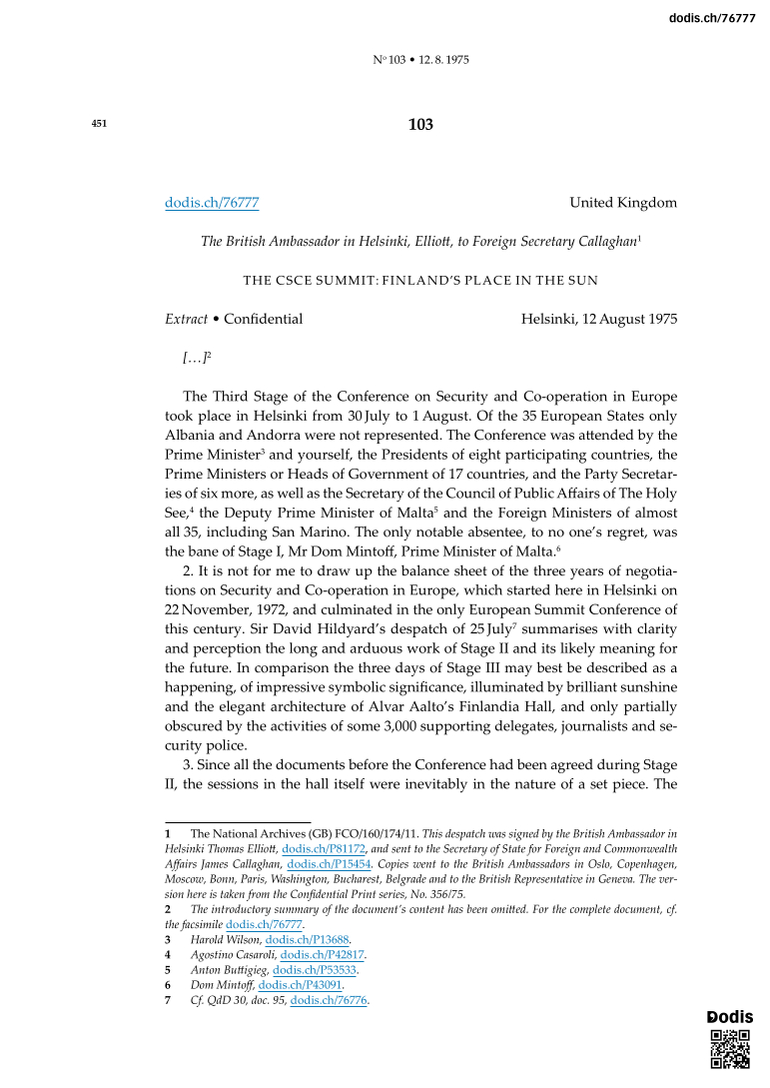
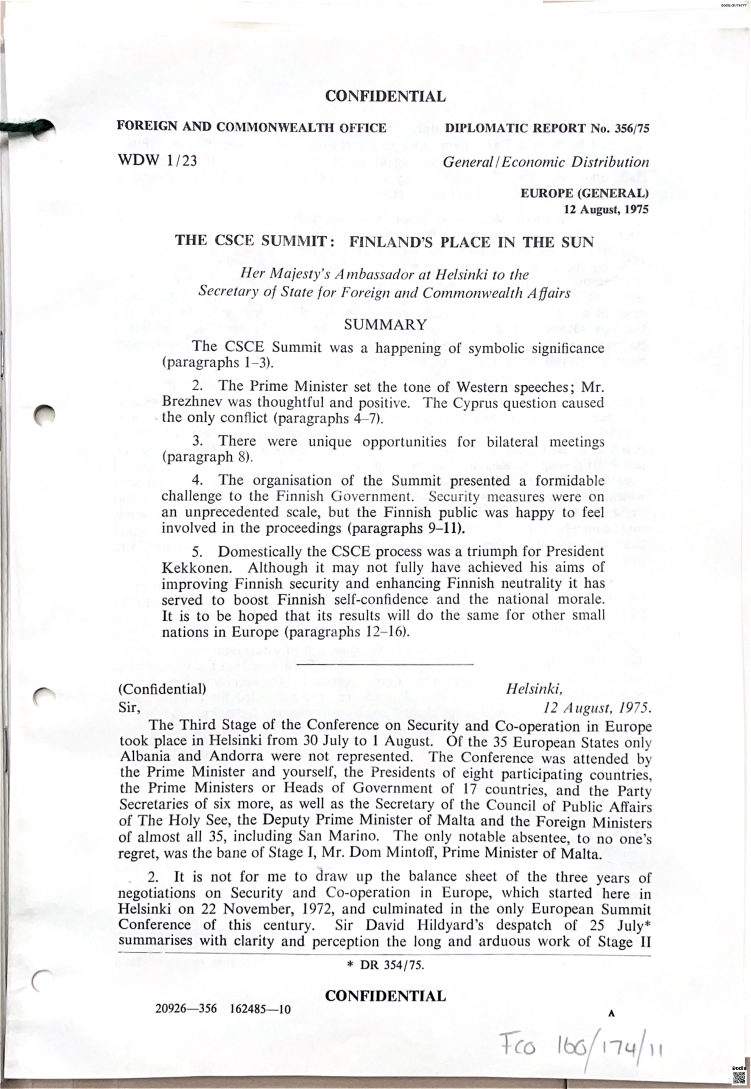
The Third Stage of the Conference on Security and Co-operation in Europe took place in Helsinki from 30 July to 1 August. Of the 35 European States only Albania and Andorra were not represented. The Conference was attended by the Prime Minister3 and yourself, the Presidents of eight participating countries, the Prime Ministers or Heads of Government of 17 countries, and the Party Secretaries of six more, as well as the Secretary of the Council of Public Affairs of The Holy See,4 the Deputy Prime Minister of Malta5 and the Foreign Ministers of almost all 35, including San Marino. The only notable absentee, to no one’s regret, was the bane of Stage I, Mr Dom Mintoff, Prime Minister of Malta.6
2. It is not for me to draw up the balance sheet of the three years of negotiations on Security and Co-operation in Europe, which started here in Helsinki on 22 November, 1972, and culminated in the only European Summit Conference of this century. Sir David Hildyard’s despatch of 25 July7 summarises with clarity and perception the long and arduous work of Stage II and its likely meaning for the future. In comparison the three days of Stage III may best be described as a happening, of impressive symbolic significance, illuminated by brilliant sunshine and the elegant architecture of Alvar Aalto’s Finlandia Hall, and only partially obscured by the activities of some 3,000 supporting delegates, journalists and security police.
3. Since all the documents before the Conference had been agreed during Stage II, the sessions in the hall itself were inevitably in the nature of a set piece. The opening address of President Kekkonen8 was followed, as during Stage I in 1973, by speeches from the representatives of each of the 34 other countries, this time at the level of Heads of Government rather than Foreign Ministers. On both occasions the proceedings (appropriately enough in Finland) bore some resemblance to a marathon. But there was a difference this year. In 1973 the Foreign Ministers had been obliged to talk about the immediate and often pedestrian problems before the Conference. In 1975 the Heads of Government were free to talk about the future.
4. The tone was set by the Prime Minister9 who (as the fortune of the ballot decreed) made the first speech and also took the chair at the last working session. His speech brought home the basic point that the success of the Conference would depend upon the extent to which its moral commitments were carried out in practice, in particular in relation to such sensitive issues as the status of Berlin, the MBFR negotiations in Vienna, and the possibility of future multilateral negotiations in the field of nuclear disarmament. He emphasised too, in a passage which has already been widely quoted, the extent to which the Conference would be judged by the effect it had on the lives of ordinary people in Europe; “there is no reason why in 1975 Europeans should not be allowed to marry whom they want; hear and read what they want, travel abroad where and when they want, and meet whom they want”.
5. Inevitably succeeding speeches by other Western leaders were variations on the same basic themes. Herr Schmidt10 spoke of the significance of détente to the Federal Republic and again underlined the significance of Berlin and the negotiations in Vienna. President Giscard d’Estaing,11 in a speech of great elegance, also spoke of Berlin, though his approach to the question of disarmament was notably distinct from that of his two colleagues. President Ford12 urged on the Conference, with notable firmness and force, the “decent respect for the opinions of mankind” prescribed in the Declaration of Independence, and reminded his audience succinctly that history would judge them “not by what we say today but what we do tomorrow; not by the promises we make but by the promises we keep”.
6. On the Eastern side there were (possibly orchestrated) indications of a rather wider range of views. Mr Honecker13 of the German Democratic Republic and Dr Husak14 of Czechoslovakia both took a hard line, emphasising the basic importance of the Declaration of Principles and in particular the inviolability of frontiers; while referring only perfunctorily (and in the context of official initiatives) to the need for the development of human contacts. Mr Brezhnev,15 however, in marked contrast to them (as well as to Mr Gromyko16 during Stage I two years ago) made a thoughtful and positive speech. He stressed the need for “a further development of military détente”, and called for “further headway along the lines mapped out by the Conference”, making none of the reservations that might have been expected about further work on confidence-building measures or in Basket III. He also attempted a redefinition of the idea of non-interference in the internal affairs of other States. Controversy will continue about his precise meaning; but the Prime Minister at his Press conference the same day was able neatly to turn the Soviet leader’s words to suggest that if he had made that pronouncement in 1967 the fate of Czechoslovakia might have been different.
7. Since the total time available for the meeting was limited, its prospects of success depended on there being no major dispute in the Conference Hall. In Mr Mintoff’s absence the most likely cause of conflict was the Cyprus question. The Turkish delegation (clumsily) walked out during Archbishop Makarios’17 speech, and subsequently circulated a formal reservation denying the applicability of the Final Act to Turkish relations with a Cyprus Government headed by the Archbishop. The move, which was not unexpected, at least diminished the likelihood of the Turks’ refusing to sign the documents or of any requests for rights of reply, for which the agreed arrangements for Stage III had made no provision. It also unwarily provided the Cyprus Delegation with the opportunity to circulate, 10 minutes before the close of the final working session, a consummately timed and thus devastating reply to the Turkish note which gave Cyprus a victory on points and prevented any disruption of the arrangements for the signature of the Final Act immediately afterwards. The prospect of protracted argument on the issue was averted to the vast relief of most Delegations; and no one chose further to comment on the fact that reservations were being made to the Final Act even before its formal signature.18
8. The formal proceedings of the Conference thus concluded without a hitch in the time allotted for them. The speeches of Heads of Delegations will of course provide those who are fully versed in the intricacies of Stage II – as well as the historians of the future – with a great quarry of material for study and analysis. On the face of it, what went on in the corridors outside the hall may have been of as much immediate significance. The Conference provided unique opportunities for bilateral meetings. In addition to acting as host at a luncheon in the Embassy for his American, West German and French colleagues, the Prime Minister took part in a Community lunch given by the Italian Prime Minister,19 had breakfast with President Ford, and other bilateral meetings with Secretary Brezhnev, President Kekkonen, Marshal Tito20 of Yugoslavia, and Messrs Demirel21 of Turkey, Karamanlis22 of Greece, Gierek23 of Poland, Husak of Czechoslovakia, Cosgrave24 of Ireland and Costa Gomes25 of Portugal. You yourself, Sir, in addition to accompanying the Prime Minister at his meetings, held bilateral talks with Foreign Ministers of Cyprus and Bulgaria.26
9. It was obvious to those who were present in Helsinki, as well as to the millions who watched the proceedings on television, that this was by any standard a remarkable gathering. Its organisation presented a formidable challenge for which the Finnish Government had long been preparing. Even their high level of organising skill was taxed by the fact that they received from Geneva less than three weeks’ notice of the final date; while their difficulties were compounded by what they judged to be the need to take security measures on a scale unprecedented in Finland. The Government brought rather more than half of the whole police force of the country to Helsinki (at some risk to international understanding, since most of the rural police spoke only Finnish); and acquiesced in suggestions that helicopters and MiG aircraft should circle the city whenever President Ford and Mr Brezhnev were at large outside their respective Embassy premises. Yet (although there was one fatal accident involving a Finnish boatman who approached too near to a cocktail party attended by Heads of Delegations) there were no untoward incidents directly affecting delegates or the Press; and the lavish nature of the facilities provided for the latter did something to correct the cynicism with which many of them had at first approached the Conference.
10. All this could hardly have happened in any other Western European capital. Helsinki is still a small town by European standards, and its life was disrupted by the CSCE. All hotels were commandeered by the Government, all traffic diverted or brought to a standstill simply to allow delegates to move between hotels and the Conference Hall; and all this occurred without a murmur of protest from the population. On the contrary, they lined the streets for three days, applauding the Heads of Government (especially the Western ones) in their restrained Finnish manner; and showing every sign of realising that this was the most remarkable political event in their country during their 60 years of independence.
11. The fact is that the ordinary Finns have been and have felt more involved in the CSCE than the citizens of other participating states. For, as the Finnish public have come to understand, Finland stood to gain from the process of the Conference almost irrespective of its results. In promoting it the Finnish Government acted not (as some impercipient Western critics have suggested) as advocates of a stock Soviet cause; but out of pure self-interest. It is hardly true that, as has rather too often been said (by Mr Brezhnev among others), there have been no winners or losers in this Conference. The main Helsinki newspaper was nearer the mark when on 27 July it carried the headline “Finland the only winner of the CSCE”.
12. The six-year process that ended here last week was thus a triumph for President Kekkonen. It was in May 1969, in the aftermath of the invasion of Czechoslovakia, (an event that had both alarmed and angered the Finns), that he had had the prescience to offer Helsinki as the site for the Conference. Even at that time he had realised how it could serve his twin aims of improving Finnish security and enhancing Finnish neutrality. A country like Finland in an exposed position on the Soviet borders has most to fear from tension between the great powers; and little to lose from the sort of understanding between Super-Powers that is criticised by many as Great-Power hegemony. Its interest is quite simply to reduce the risk of the sort of power game in which it itself can be used as a pawn by one side against the other. So Finland is bound to work for détente and to welcome any manifestations that will serve to persuade its Eastern neighbour that détente is becoming a reality.
13. President Kekkonen also had a more elaborate aim in mind; to try to use the development of détente to gain international recognition of the genuine “neutrality” of Finnish policy (a concept that the Soviet Union declines explicitly to acknowledge) and to increase Finland’s freedom of manoeuvre in the international field. He was involved at the time in attempts (not all of which were successful) to gain for Finland membership of the Security Council, as well as the Secretary-Generalship of the UN, and to make Helsinki a centre for major international conferences, starting with SALT. But it was from the CSCE that in his calculation there was most to gain. Not only would the Conference itself deepen the process of détente; but the fact that it was held in Helsinki would serve as proof of the confidence of the participating countries in the reality of Finnish neutrality; while the presence of 35 Heads of Government on Finnish soil might serve to create a new interest in their part in the preservation of Finnish independence.
14. These arguments were always more enthusiastic than logical, and it seems doubtful if all the President’s aims will be achieved. They always contained an element of contradiction. The Finnish Delegation played their hand with skill throughout the Conference; and succeeded often enough in acting as “honest broker” while contriving to conceal their anxiety lest Western insistence on getting “results” from the negotiations should jeopardise their outcome and perhaps also European hopes for détente. But Finnish enthusiasm for the idea of the Conference was sometimes misunderstood in the West as eagerness to play the Soviet game; and the misunderstanding did not help to promote belief in the genuineness of Finnish neutrality. Again, Finland’s freedom of manoeuvre in international policy has not perceptibly increased during the three years of negotiation; Finnish Governments look over their shoulders to study Soviet reactions to their policies as anxiously today as they did during the opening year of the Conference when they were obliged by Soviet pressure to defer for many months the signature of their trade agreement with the EEC. And although Helsinki is now firmly on the map as an international meeting point, its geographical position is always likely to militate against its becoming a second Geneva or Vienna.
15. President Kekkonen, however, would be justified in claiming the success of the Conference as a success for Finland. The people of his country, who have long felt themselves an almost forgotten nation in an isolated corner of Europe, have for a short time had the sensation that they had been in the centre of the world. They have profited from the promotion of something which may become known as the “Helsinki spirit” – to be defined as the readiness to argue and negotiate over issues which in the past were considered too dangerous for discussion in international conferences in Europe. President Kekkonen has some cause for self-satisfaction when he recalls his words of 1967: “Today we can say we have been on the right road. We have taken upon ourselves the often thankless task… of a bridge-builder. Our example has been followed.”
16. I have written at length about Finland’s attitude to the Conference because I am bound to approach the remarkable events of the last week in Helsinki from that angle. But there is perhaps a general point to remember. Many of those in the West who have criticised the Conference have done so because of their calculations about its supposed effect on the relationship between the big Powers. What seems certain is only that that effect will be very difficult to estimate; and that no complete assessment can be reached before years have passed. There are points that the East can exploit in the Declaration of Principles; and points in Basket III which the West would be foolish to fail to exploit. But it must also be remembered that, not least because of the rule of consensus, the CSCE was a small nations’ Conference. It obliged the big Powers to argue out and to justify their policies in front of the representatives of smaller Powers – in the case of the Soviet Union in front of the representatives of countries who have long unhappily considered themselves as its satellites. And it is precisely those nations who think themselves most threatened by the Soviet Union – besides Finland, Yugoslavia and Romania are the obvious examples – who have been most enthusiastic about the Conference, and most anxious that there should be some real follow-up to it in 1977. If the Conference has indeed contributed anything towards building up the self-respect and the security of the smaller European States, it will truly, to quote the words of the Prime Minister, Mr Wilson, when he closed the last working session, have been an historic event.27
- 1
- The National Archives (GB) FCO/160/174/11. This despatch was signed by the British Ambassador in Helsinki Thomas Elliott, dodis.ch/P81172, and sent to the Secretary of State for Foreign and Commonwealth Affairs James Callaghan, dodis.ch/P15454. Copies went to the British Ambassadors in Oslo, Copenhagen, Moscow, Bonn, Paris, Washington, Bucharest, Belgrade and to the British Representative in Geneva. The version here is taken from the Confidential Print series, No. 356/75.↩
- 2
- The introductory summary of the document’s content has been omitted. For the complete document, cf. the facsimile dodis.ch/76777.↩
- 3
- Harold Wilson, dodis.ch/P13688.↩
- 4
- Agostino Casaroli, dodis.ch/P42817.↩
- 5
- Anton Buttigieg, dodis.ch/P53533.↩
- 6
- Dom Mintoff, dodis.ch/P43091.↩
- 7
- Cf. QdD 30, doc. 95, dodis.ch/76776.↩
- 8
- Finnish President Urho Kekkonen, dodis.ch/P15249.↩
- 9
- British Prime Minister Harold Wilson, dodis.ch/P13688.↩
- 10
- Chancellor of the Federal Republic of Germany Helmut Schmidt, dodis.ch/P15416.↩
- 11
- French President Valéry Giscard d’Estaing, dodis.ch/P13791.↩
- 12
- United States President Gerald Ford, dodis.ch/P47012.↩
- 13
- First Secretary of the Socialist Unity Party of the German Democratic Republic Erich Honecker, dodis.ch/P46563.↩
- 14
- President of Czechoslovakia Gustáv Husák, dodis.ch/P48694.↩
- 15
- General Secretary of the Communist Party of the Soviet Union Leonid Brezhnev, dodis.ch/P15543.↩
- 16
- Soviet Minister of Foreign Affairs Andrei Gromyko, dodis.ch/P489.↩
- 17
- Cypriot President Archbishop Myriarthes Makarios III, dodis.ch/P16540.↩
- 18
- For the Final Act in all CSCE languages, cf. dodis.ch/58821.↩
- 19
- Aldo Moro, dodis.ch/P13878.↩
- 20
- Yugoslav President Josip Broz Tito, dodis.ch/P1002.↩
- 21
- Turkish Prime Minister Süleyman Demirel, dodis.ch/P44321.↩
- 22
- Greek Prime Minister Konstantinos Karamanlis, dodis.ch/P15271.↩
- 23
- First Secretary of the Polish United Workers’ Party Edward Gierek, dodis.ch/P46565.↩
- 24
- Irish Prime Minister Liam Cosgrave, dodis.ch/P15295.↩
- 25
- Portuguese President Francisco da Costa Gomes, dodis.ch/P47036.↩
- 26
- Ioannis Christophides, dodis.ch/P53305, and Petar Mladenov, dodis.ch/P46731.↩
- 27
- For full details of British involvement in the CSCE, cf. Documents on British Policy Overseas (DBPO): Series III, vol. II: The Conference on Security and Cooperation in Europe, 1972–1975. For all British documents in this volume, cf. the compilation dodis.ch/C2898.↩
Relations to other documents
| http://dodis.ch/76776 | is quoted in | http://dodis.ch/76777 |
| http://dodis.ch/58821 | is quoted in | http://dodis.ch/76777 |
Tags
Organization for Security and Co-operation in Europe (OSCE) Final CSCE conference in Helsinki (30.7.1975–2.8.1975)