
Printed in
Geneva, Helsinki, and the Making of the CSCE. International Diplomatic Documents on the Conference on Security and Cooperation in Europe, 1969–1975, vol. 30, doc. 95
volume linkBern 2026
more… |
▼▶Repository
| Archive | The National Archives, Kew |
| Archival classification | UK-NA FCO 160/174/9 |
| Dossier title | 'CSCE [Conference on Security and Cooperation in Europe]: The Conclusion of Stage II', despatch from Sir David Henry Thoroton Hildyard, HM Ambassador and UK Permanent Representative to United Nations and other International Organisations, Geneva; DR 354/75 |
 Transcription
 QdD
QdD
 Facsimile
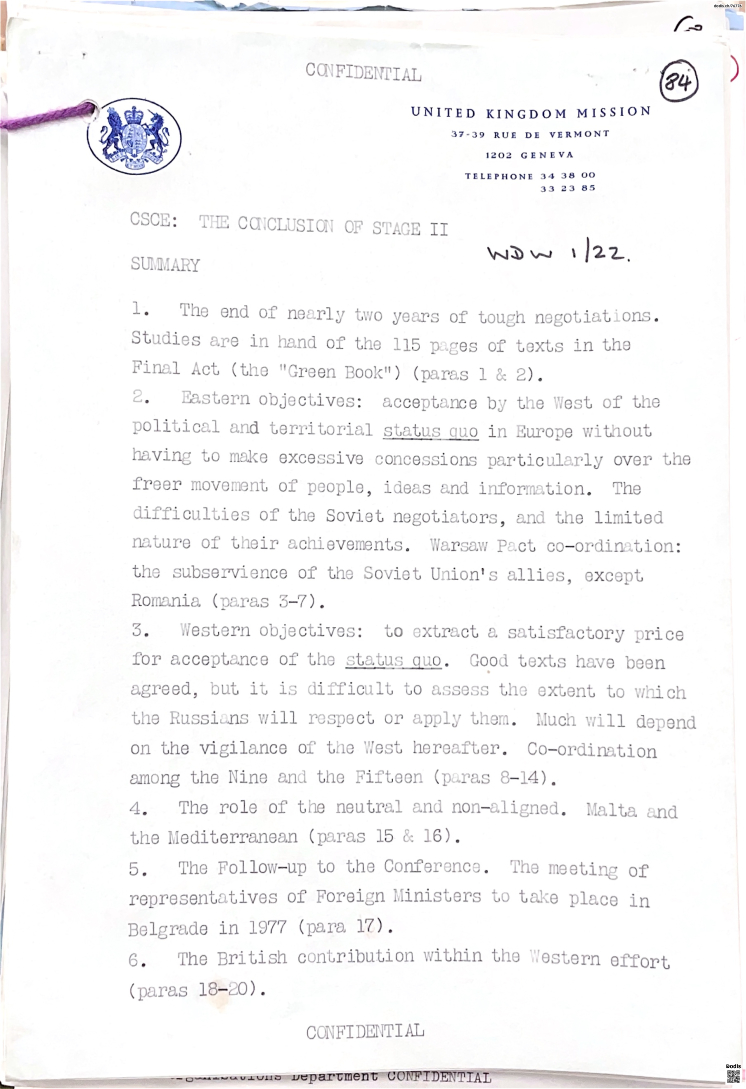
dodis.ch/76776
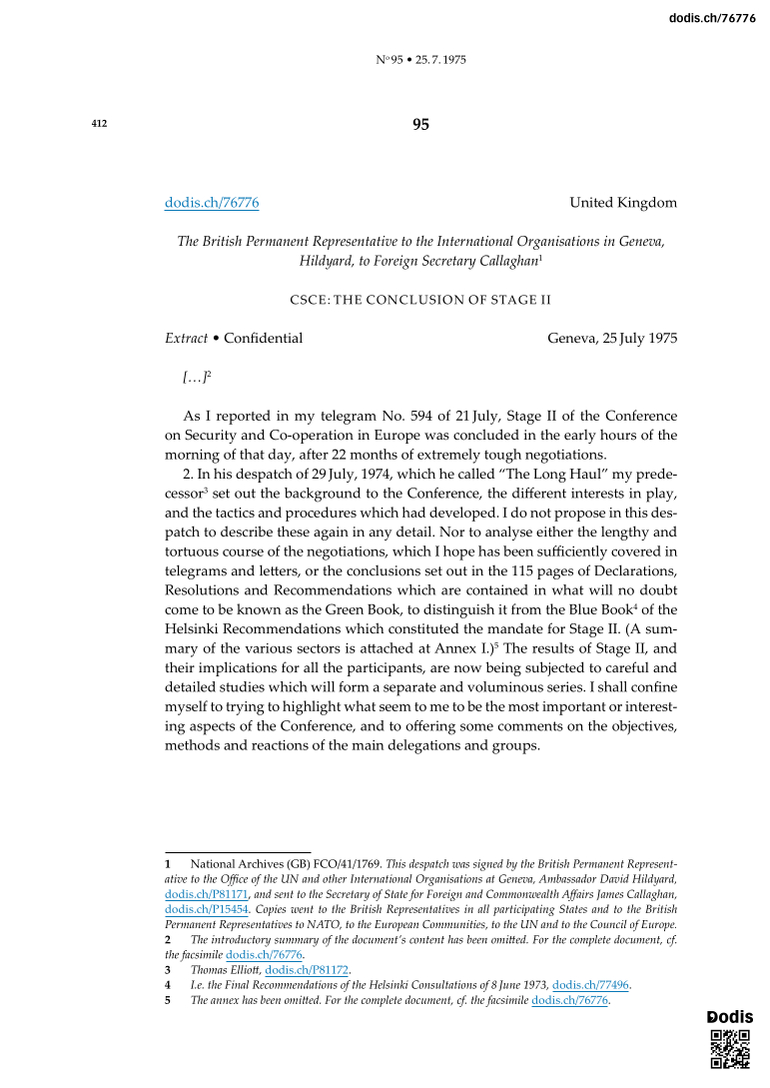
The British Permanent Representative to the International Organisations in Geneva, Hildyard, to Foreign Secretary Callaghan1
CSCE: The Conclusion of Stage II
[…] 2
As I reported in my telegram No. 594 of 21 July, Stage II of the Conference on Security and Co-operation in Europe was concluded in the early hours of the morning of that day, after 22 months of extremely tough negotiations.
2. In his despatch of 29 July, 1974, which he called “The Long Haul” my predecessor3 set out the background to the Conference, the different interests in play, and the tactics and procedures which had developed. I do not propose in this despatch to describe these again in any detail. Nor to analyse either the lengthy and tortuous course of the negotiations, which I hope has been sufficiently covered in telegrams and letters, or the conclusions set out in the 115 pages of Declarations, Resolutions and Recommendations which are contained in what will no doubt come to be known as the Green Book, to distinguish it from the Blue Book4 of the Helsinki Recommendations which constituted the mandate for Stage II. (A summary of the various sectors is attached at Annex I.)5 The results of Stage II, and their implications for all the participants, are now being subjected to careful and detailed studies which will form a separate and voluminous series. I shall confine myself to trying to highlight what seem to me to be the most important or interesting aspects of the Conference, and to offering some comments on the objectives, methods and reactions of the main delegations and groups.
3. For many years the Soviet Union had wanted the West formally to accept, in Mr Gromyko’s6 words, “the political and territorial realities” resulting from the Second World War, and at the same time to subscribe to East–West détente in the limited sense which the Russians conceived of it. The Helsinki preparatory talks showed that the price of the West’s agreement would be the broadening of the concept of détente to include a gradual liberalisation of contacts between people and in the fields of information and ideas. The Soviet Union was clearly anxious to limit this price as much as possible when the concrete details came to be worked out during Stage II.
4. The Soviet delegation was large (almost 100), very active and well briefed, and quick to use any bargaining weapon or to exploit any opening whether in bilateral or multilateral relations. I attach at Annex II7 some notes on their personalities and tactics together with those of other main delegations, which may be of some interest in the context of future discussions. The Soviet delegation’s difficulty was that in the Conference as a whole they were the demandeurs, and that after negotiating extremely toughly for a long period they were put by the Soviet leadership under a time pressure which became intense in the latter stages. Strategically they would have done better to have shown more flexibility much earlier, rather than stand firm for so long only to have to make very substantial concessions towards the end in order to ensure that Stage III could be held at the end of July. Tactically also the rigidity of their system created problems for them; they wasted a good deal of time and bargaining strength on points which realistically they could not hope to obtain, or which were of only secondary importance, apparently because they had high-level instructions, issued some time ago in very different circumstances, which were very difficult for them to change.
5. The Soviet leadership have achieved political, though not legal, recognition of the status quo; the results of the Conference are not legally binding. Also a summit meeting in July from which they will try to extract every possible propaganda advantage. No doubt Mr Brezhnev8 needed this badly for his own time-table. I believe, however, that they have paid quite a high price, particularly in Basket III. It may be that they intend to take advantage of all the escape clauses which they succeeded in having included, and to pay little more than lip-service to the agreements reached. In this case they will, if the West remains determined, come under great and increasing pressure in the years to come, and may be put almost permanently on the defensive. Alternatively they may calculate that movement in the direction of greater liberalisation is inevitable, and that the conclusions of the Conference will still permit them to control the rate of evolution in order to ensure that it constitutes no serious threat in the foreseeable future. This is the official line of the professional diplomats in the Soviet delegation. Speculations in these fields are more for Her Majesty’s Ambassador at Moscow9 than for the delegation in Geneva, but it is clear that the Conference took a very different course from that which the Soviet Union had originally expected, and that the Soviet authorities were thankful when at last they could extricate themselves from it.
6. The Warsaw Pact delegations co-ordinated as a group in the same way as did those of the Nine and Fifteen (NATO). I have already reported on various occasions about the divergencies within the Warsaw Pact. The Romanian delegation, who were both able and highly articulate, pursued very much their own policies and interests, to the great irritation of the Russians (and of the West in Basket III), until near the end of the negotiations. They then became far more moderate and co-operative over a wide range of issues on which they had previously been very tough; apparently as the result of Soviet pressure and Romania’s growing economic difficulties. Even so the Romanians obtained a satisfactory document on the non-use of force which they regard as strengthening still further their hand against the Russians.
7. The other Warsaw Pact members all toed the line obediently, at least on major issues. Several times the Russians negotiated away points which one or other considered of great importance without informing let alone consulting them. This was particularly the case with the East Germans (Peaceful Change of Frontiers, Irreversibility of Détente, etc.) who may, however, have played up to the West Germans their resentment at the way in which they had been treated. On a few occasions one or more of the East Europeans differed from the Russians on a not very significant issue, almost always in the direction of greater inflexibility, and on minor matters such as the Easter break (which the Russians none the less made into a major political question) several were prepared to come out publicly against them. At this stage the conclusion can only be that the Russians can still crack the whip on any matter of importance and do not hesitate to do so. The Conference together with its follow-up, however, and above all the consensus rule, should gradually have an influence on relationships. And even if the Russians themselves only pay lip-service to the results in Basket III, they will find it very difficult to oppose movement towards greater liberalisation in any other Warsaw Pact country which is prepared to allow it.
8. The main Western interests were on the one hand to avoid any commitments which could imply eventual acceptance of a pan-European security system or condonation of the Brezhnev Doctrine, or which could prejudice the reunification of Germany, the development of the European Communities, or the complicated position in Berlin; on the other to reduce to the maximum extent possible the barriers of suspicion and mistrust between East and West (paragraph 3 above). Their view on the latter issue was well summarised by President Kekkonen10 at the opening of Stage I when he described security as a matter of opening gates rather than erecting fences. Certain US journalists like to talk in terms of winners and losers in the protracted negotiations, but in practice it was clear from the early stages that the result would be a series of compromises. The West protected its position in the political sector, with the references in the Principles to Self-Determination and to the possibility of Peaceful Change balancing that to the Inviolability of Frontiers to which the Russians attach such importance. And the references to Human Rights together with the conclusions of Basket III have ensured that these questions are now accepted as legitimate matters for international concern; a whole series of agreements have been reached and commitments, even if very often qualified, accepted.
9. It is difficult to assess from Geneva the importance of the Confidence Building Measures for which the UK delegation in particular worked so hard. Their value was always political, in reducing the huge barriers of secrecy within which the Russians, and above all the Soviet State, have always operated. I believe the Soviet negotiators when they say that although the commitment is on a voluntary basis, it will not be possible for the Soviet Union not to comply with it. There are indeed many pointers to Soviet desire to complement political with military détente in due course in order to reduce their crippling armaments bill. The results of the Conference could be a very useful first step, and an encouragement to progress in the talks in Vienna.
10. Nor is it easy to evaluate here the result of the second (Economic) Basket. The conclusions on Business Contacts and Facilities and on Economic and Commercial Information should be useful. The great battles on Most-Favoured-Nation treatment and Reciprocity ended in a draw but slightly to the advantage of the West. Possibly the most important result of all was the de facto recognition of the European Economic Community by the Warsaw Pact countries (see also paragraph 12 below).
11. The Conference could only be a stage in the process of détente, and a great deal will depend on the way in which the implementation of its results can be assessed and reviewed; thus on the continuing cohesion and determination of the West. Nevertheless, starting from the premise that the West had no practical alternative to the recognition of the status quo and that the Ost-Verträge had already taken a large step in this direction, I believe that we can conclude that a satisfactory price was extracted for this recognition, while the potentially awkward consequences were avoided.
12. Co-ordination among the Nine was both one of the major successes of the Conference, and a major contribution to the achievement of satisfactory results. Some heads of delegation of the Nine while intelligent and good negotiators in their own right, could be extraordinarily verbose and finicky. Both the French and the Germans in their different ways caused complications. So on a much lesser scale did at times the Dutch (see also Annex II).11 Co-ordination consequently absorbed an immense amount of time which many delegations hoped to devote to other work. Nevertheless the repeated failures of those who tried to go it alone, and the effectiveness of the Nine when acting together, must, I believe, have had their effect, including on many, although alas not all, of the French. There was a general feeling that the success of our co-ordination had given a considerable fillip to the development of political co-operation in the future. At the same time the European Commission considered that it had emerged with increased status and influence vis-à-vis the State trading countries.
13. Co-ordination among the Fifteen NATO members was very good on the whole although there were moments when the Nine took so long to reach a common position that they appeared to be giving the others far too little time for adequate consideration and consultations. There were also moments when the Scandinavians felt that they had special interests, e.g. where Finland was concerned. Fortunately the Cyprus question caused very little trouble within the Alliance or indeed within the Conference at large; even the last-minute flurries over the Confidence Building Measures and representation at Stage III did not hold us up long.
14. The United States deserve a special mention. Dr Kissinger12 had given instructions that the US delegation should keep in line with the Nine, indeed “half a step behind” if this were logically possible. On certain issues the US negotiated directly and effectively with the Soviet Union, e.g. at the behest of the Federal Republic of Germany over Peaceful Change of Frontiers. On others their influence and support was extremely helpful, for instance over the package deal in Basket III, and in particular on Working Conditions for Journalists. As against this Dr Kissinger’s discussions on Confidence Building Measures were widely considered unhelpful, and may indeed have led to the West obtaining rather less than they could have expected on Prior Notification of Military Manoeuvres. In most sectors, however, the Americans were faithful but lack-lustre allies, determined not to allow themselves to be inveigled by the Russians into Super Power negotiations which could have been very unpopular with all the other Europeans.
15. The neutral and non-aligned delegations stood together on many issues as the best way to ensure that their interests were taken into account. They had, of course, only a certain amount in common. They all felt to some extent out in the cold outside the main military alliances, and welcomed a conference in which they could participate as equals. They all attached crucial importance to the consensus rule. They all wanted definite arrangements for continuing the multilateral dialogue, and indeed most would have liked to see some form of institutionalisation. On this as on many questions the Romanians behaved more as a non-aligned country than as a member of the Warsaw Pact. On other issues some of the neutrals, particularly the Swedes and the Swiss, were clearly Western in outlook. And in Basket III the Russians said quite rightly that there were no neutrals. Unfortunately at times personalities counted more than policies with usually unhelpful results. In general, however, both neutrals and non-aligned were of considerable assistance to the West, and it remained a cardinal point of Western policy to ensure close and continued consultations with them.
16. I shall not recount again in this despatch Malta’s efforts to extend the scope of the Conference to include the non-participating Mediterranean States, and her success in extracting general agreement at the last moment, both to the continuation and amplification of the dialogue with these States, and to the inclusion in the document on the Mediterranean of a reference to lessening tension and to reducing armed forces in the region. This operation was certainly important as an illustration of the use or misuse which can be made of the consensus rule. It remains to be seen how successful it will prove in practice. Also, what effect Malta’s behaviour will have on the other participating States and their attitude to future meetings.
17. After a battle in the corridors it was decided that both the preparatory meeting and the meeting of the representatives of Foreign Ministers in 1977 should take place in Belgrade rather than in Helsinki as the Russians wished, or one meeting in each capital as was suggested at one time. Politically this could be a very interesting and important time for Yugoslavia. If there is to be a satisfactory review of the implementation of the results of the Conference, preparatory work will have to be well co-ordinated and begun in good time. Consideration is now being given both by delegations and in capitals to the most effective procedures.
18. I have left until last the contribution which the UK delegation was able to make. In recent years at least we have been apt to be more modest than other countries about our achievements. There is no doubt, however, that particularly in the later phases of the Conference, the delegation played a considerable role in almost every sector.
19. We played a major role in the drafting of the Final Act proper.13 In Basket I we were tough on Principles but ready with helpful suggestions and compromises, while on Confidence Building Measures we had the leading part throughout. In Basket II (Economic) we were prominent in paving the way for agreement, and were specially thanked by the representatives of the European Commission for the support and assistance which we had given them. In Basket IV (Follow-up) we also helped considerably towards the achievement of a compromise solution. It was in Basket III, however, that we made the biggest impact with our initiative for a package deal which led to a breakthrough after many months of impasse. Our concept of exploiting the time pressure on the Russians to confront them with a choice between making rapid and substantial concessions, but with an assurance that these represented the outer limit of the commitments which they would be called on to accept, or indefinite delay with no assurance that better terms would eventually be forthcoming, proved highly successful, and had a significant influence on the negotiations in all other sectors.
20. One should not exaggerate the part which any Western delegation could play either in achieving results or in speeding up the work of the Conference. As I have emphasised in paragraph 12 above, by far the most important factors were the unity and determination of the Nine and the Fifteen. Nevertheless I am sure that the relatively satisfactory results of the Conference, and the fact that it was terminated in time for Stage III to take place in July, were due at least as much to us as to any other Western participant. I should like to pay warm tribute to all who participated in the work of the delegation in the course of the three long years since the early days at Dipoli, and particularly to the skill, imagination and endurance of those who formed part of it during the last gruelling months.14
- 1
- National Archives (GB) FCO/41/1769. This despatch was signed by the British Permanent Representative to the Office of the UN and other International Organisations at Geneva, Ambassador David Hildyard, dodis.ch/P81171, and sent to the Secretary of State for Foreign and Commonwealth Affairs James Callaghan, dodis.ch/P15454. Copies went to the British Representatives in all participating States and to the British Permanent Representatives to NATO, to the European Communities, to the UN and to the Council of Europe.↩
- 2
- The introductory summary of the document’s content has been omitted. For the complete document, cf. the facsimile dodis.ch/76776.↩
- 3
- Thomas Elliott, dodis.ch/P81172.↩
- 4
- I.e. the Final Recommendations of the Helsinki Consultations of 8 June 1973, dodis.ch/77496.↩
- 5
- The annex has been omitted. For the complete document, cf. the facsimile dodis.ch/76776.↩
- 6
- Soviet Minister of Foreign Affairs Andrei Gromyko, dodis.ch/P489.↩
- 7
- The annex has been omitted. For the complete document, cf. the facsimile dodis.ch/76776.↩
- 8
- General Secretary of the Communist Party of the Soviet Union Leonid Brezhnev, dodis.ch/P15543.↩
- 9
- British Ambassador in Moscow Terence Garvey, dodis.ch/P37436.↩
- 10
- Finnish President Urho Kekkonen, dodis.ch/P15249.↩
- 11
- The annex has been omitted. For the complete document, cf. the facsimile dodis.ch/76776.↩
- 12
- US Secretary of State Henri Kissinger, dodis.ch/P31846.↩
- 13
- For the Final Act in all CSCE languages, cf. dodis.ch/58821.↩
- 14
- For full details of British involvement in the CSCE, cf. Documents on British Policy Overseas (DBPO): Series III, vol. II: The Conference on Security and Cooperation in Europe, 1972–1975. For all British documents in this volume, cf. the compilation dodis.ch/C2898.↩
Relations to other documents
| http://dodis.ch/77496 | is quoted in | http://dodis.ch/76776 |
| http://dodis.ch/76776 | is quoted in | http://dodis.ch/76777 |
| http://dodis.ch/58821 | is quoted in | http://dodis.ch/76776 |
Tags
Organization for Security and Co-operation in Europe (OSCE) Final CSCE conference in Helsinki (30.7.1975–2.8.1975)