
Printed in
Geneva, Helsinki, and the Making of the CSCE. International Diplomatic Documents on the Conference on Security and Cooperation in Europe, 1969–1975, vol. 30, doc. 53
volume linkBern 2026
more… |
▼▶Repository
| Archive | The National Archives, Kew |
| Archival classification | UK-NA FCO 160/152/18 |
| Dossier title | 'CSCE [Conference on Security and Cooperation in Europe]: Stage I', despatch from Thomas Anthony Keith Elliott, HM Ambassador, Helsinki; DR 359/73 |
 Transcription
 QdD
QdD
 Facsimile
dodis.ch/76775
The British Ambassador in Helsinki, Elliott, to Foreign Secretary Douglas-Home1
CSCE: Stage I
[…] 2
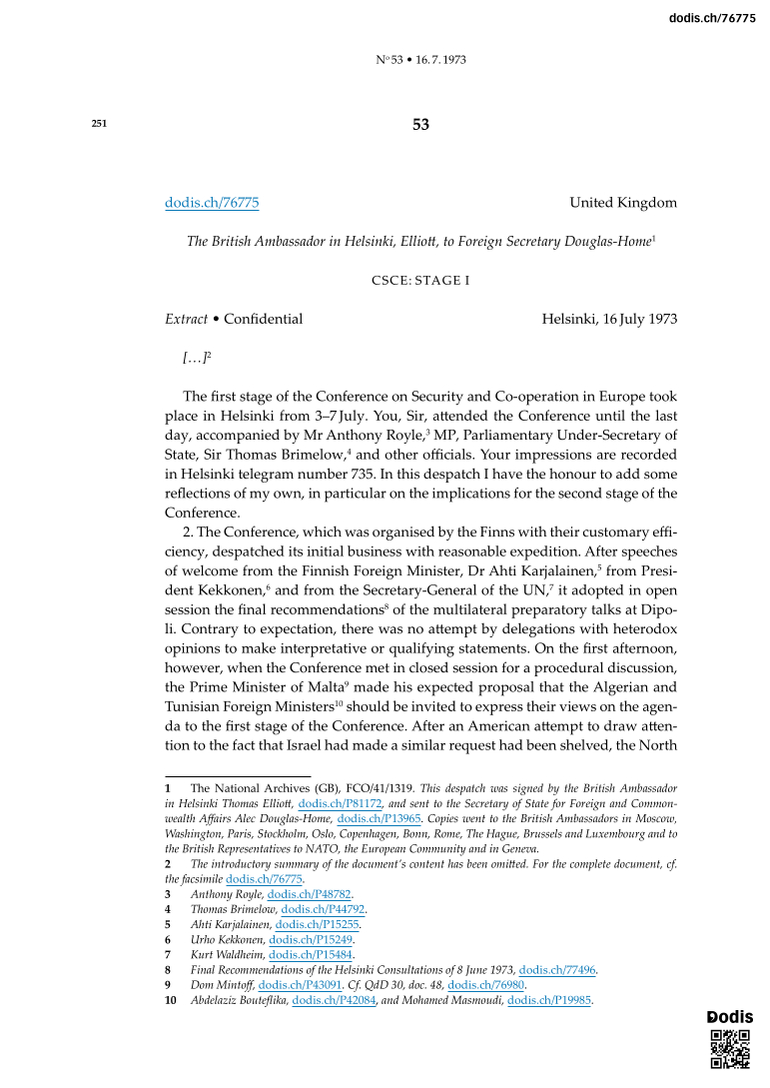
The first stage of the Conference on Security and Co-operation in Europe took place in Helsinki from 3–7 July. You, Sir, attended the Conference until the last day, accompanied by Mr Anthony Royle,3 MP, Parliamentary Under-Secretary of State, Sir Thomas Brimelow,4 and other officials. Your impressions are recorded in Helsinki telegram number 735. In this despatch I have the honour to add some reflections of my own, in particular on the implications for the second stage of the Conference.
2. The Conference, which was organised by the Finns with their customary efficiency, despatched its initial business with reasonable expedition. After speeches of welcome from the Finnish Foreign Minister, Dr Ahti Karjalainen,5 from President Kekkonen,6 and from the Secretary-General of the UN,7 it adopted in open session the final recommendations8 of the multilateral preparatory talks at Dipoli. Contrary to expectation, there was no attempt by delegations with heterodox opinions to make interpretative or qualifying statements. On the first afternoon, however, when the Conference met in closed session for a procedural discussion, the Prime Minister of Malta9 made his expected proposal that the Algerian and Tunisian Foreign Ministers10 should be invited to express their views on the agenda to the first stage of the Conference. After an American attempt to draw attention to the fact that Israel had made a similar request had been shelved, the North African issue was smartly referred to a working group; and the 35 Ministers settled down again in plenary to the business of making their general statements, which were not completed until the morning of 8 July. There followed a day’s procedural wrangle, which reflected the failure of the working group to reach consensus either on the Maltese proposal or on language to describe that lack of consensus in a communiqué; but the points in dispute were papered over at the last minute, and the first stage finally ended only a little later than the time originally envisaged by the majority of non-Communist delegations.
3. On the face of it, then, the proceedings went relatively smoothly. Your own speech was widely praised, both by the Press and by delegates from all parts of Europe; (even a middle-ranking member of the Soviet delegation remarked to my Head of Chancery11 that his “evaluation of the speech was positive”). Other interesting contributions were made by Herr Scheel12 and M. Jobert13 (who spoke in terms of undoubted elegance but rather more doubtful meaning); while Mr. FitzGerald,14 in speaking of the future of Ireland and of the tasks of the Conference, displayed a tact and statesmanship missing from the references of the Foreign Ministers of Spain and Iceland15 to the issues respectively of Gibraltar and the fishing dispute.16 The fact remains, however, that even to those who knew that the first stage of the Conference was likely to be largely a formality, the proceedings were something of a disappointment. Few of the speeches other than those I have mentioned measured up to the occasion. A number of Western Ministers said little that was new, while the Ministers from the Warsaw Pact countries said far too much that was old. Mr Gromyko’s17 speech was written as if nothing had happened in the last nine months, and certainly seemed designed to ensure that nothing happened in the next. Again, too much time had to be spent inside and outside the plenary meetings on dealings with the irrelevant Maltese proposal. To make matters worse, it at length became plain when San Marino took the chair that the combination of a rotating Chairmanship (chosen by lot) with the complicated system of agreement by consensus was a recipe for the inefficient conduct of proceedings. The Conference ultimately, and after your departure, Sir, degenerated into an unseemly argument about a communiqué which appeared the more unnecessary and irrelevant the longer the process of its drafting extended.
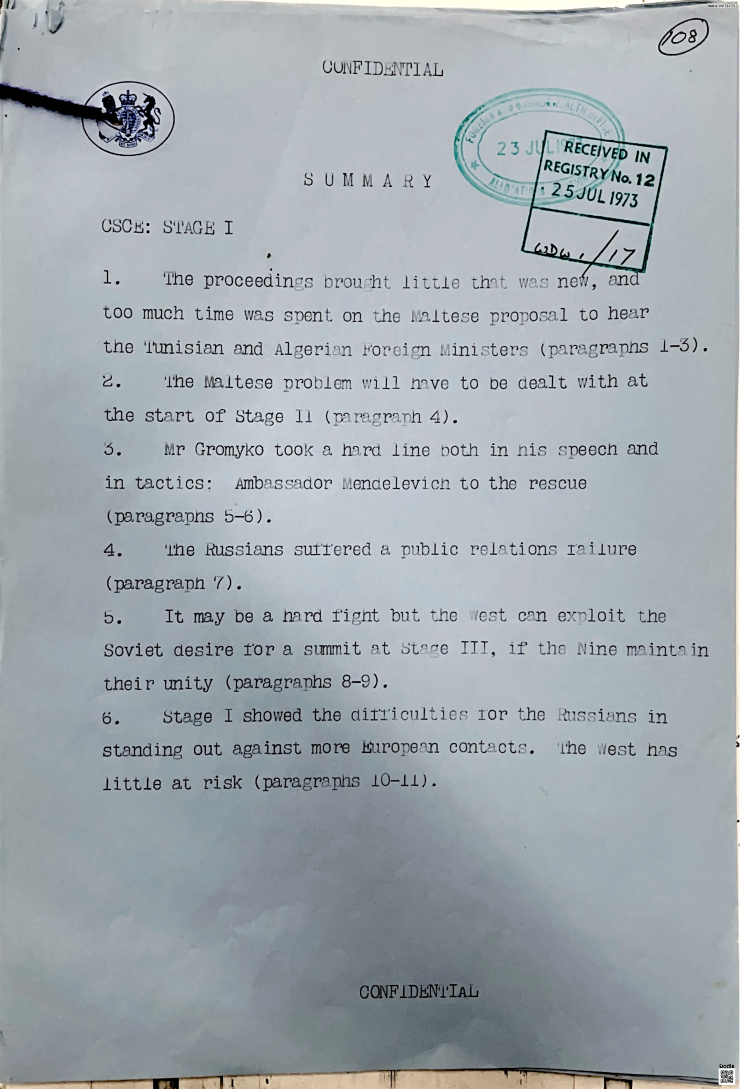
4. What are the implications of all this for Stage II? I will take the Maltese proposal first. It fortunately proved possible to prevent any of the non-participants from being heard during Stage I; but the wording of the communiqué effectively exports the problem to the beginning of the second stage. The Maltese have put us all on notice that they will pursue their case with equal vigour in September in Geneva. There will be no hope then of simply setting the matter aside. It has to be remembered that in the interval between the end of the preparatory talks and the start of Stage I the Maltese succeeded in mustering new and significant support for their case, notably from Spain, France and Italy. Again, although the Russians tried in the final procedural debates in the plenary to give the impression that the Maltese were in a minority of one, they were themselves most careful throughout the week to say nothing that could offend the Arabs, while arguing with consistent disingenuousness against the appearance of the Israelis. All this, however, may look rather worse from Helsinki than from Geneva. The absence of Mr Mintoff himself from Stage II, and the fact that publicity for that stage will be less glaring than for Stage I, may help in getting the matter settled. Provided that we can restore the unity of the Nine, there may be a case for agreeing promptly to hear the Mediterranean non-participants in the relevant Committees at the outset of the second stage, and thus defusing the problem from the beginning.
5. The implications of the stiff line taken in the East European speeches during Stage I are more serious. We had expected, as I suggested in my despatch of 13 June,18 on the preparatory talks, to have in Stage II to refight many of the battles of Dipoli. I do not think, however, that we expected the Russians to try quite so firmly to put the clock back to 1972. In his speech Mr Gromyko indicated that he wishes to keep its hands stuck. Hardline speeches and tactics were de rigueur. One of the most instructive experiences of the week was to see how Mr Gromyko and Mr Kovaliev,19 one of the two Soviet Deputy Foreign Ministers, instinctively turned to bullying tactics when they failed to get their way round the negotiating table. Half an hour of final debate on the Maltese proposal in plenary was too much for Mr Gromyko; and he promptly proposed the suspension of the principle of consensus.
6. It was ironical that when this drastic move met, as anyone might have calculated, with opposition from the smaller delegations, and there seemed small prospect of consensus on the wording of their precious communiqué, the Russians turned as if in desperation to Ambassador Mendelevich,20 whose flexible negotiating style had probably achieved more at Dipoli than all the other Communist participants put together. He quickly reached a compromise with the Maltese. It was easy enough for other delegations to read the moral; but what will be interesting is whether the Russians will do so. It will be a test of Soviet intentions for Stage II whether M. Mendelevich is given an important negotiating task in Geneva.
7. Yet, though the Soviet line in Stage I was depressingly tough, it was unmarked by imagination or political insight, and it did not achieve any particular success. Mr Gromyko, for example, showed no more sign than the Soviet negotiators at Dipoli of realising that this was not just a routine East–West Conference and that the non-aligned countries (whom he did not mention in his speech) are also involved in the process of détente. His attack on the principle of consensus could hardly have been better designed to arouse neutral countries’ suspicions and fears. In the wider field of public relations the Eastern failure was just as obvious. There was some reason to fear that, having given some ground to the West at the preparatory talks, they would at least seek a major propaganda victory in Stage I. But their reactionary speeches, and the repetitive thinness of the proposals they actually tabled, gave the West much the better of the propaganda exchange. Again, the East made no attempt to invest the Conference with any special atmosphere of urgency or significance. In spite of their protestations before arriving in Helsinki, they quickly came to acquiesce in the Western view that Stage I should be a relatively short and formal affair. Although Mr Gromyko made a half-hearted attempt to prolong the first stage (in the name of “dignity”) by suspending plenary meetings on the third and fourth days, he soon dropped the proposal in the face of a remarkable, and totally spontaneous display of united opposition by the West; and the Russians agreed with little discussion to the Western proposal that Stage II should not start until mid-September.
8. It may be optimistic to comment that, although the Russians publicly adopted rigid attitudes, they did not defend them very hard when it came to the crunch. It was no doubt inevitable that during the first stage they should give the impression of caring less about the substance of what the Conference decided than that the proceedings should be completed without a hitch. We can expect them to fight a good deal harder in Stage II, and to repeat many of the skirmishes that we hoped had been concluded on the Dipoli terrain. But I do not think we need be too apprehensive about the prospect. So long as Mr Brezhnev21 is set on having his European summit meeting, he can be expected to pay a price to achieve it. Just as we were able to exploit the Soviet desire for a Conference to ensure that the MPT’s final recommendations basically reflected Western plans, we should be able to exploit the Soviet wish for a summit at the third stage to ensure that Stage II concludes in a form that is favourable to us. What is essential is that the Nine should continue their cohesive approach, and maintain as close harmony with the other NATO countries and the non-aligned as they did at Dipoli.
9. It must be admitted that the handling of the Maltese proposal in Stage I created the impression that the Nine may find united action hard to preserve. The French and Italians certainly made little effort during the first stage to be faithful to what elements of unity there were in the Community position on the Mediterranean. But we must hope that they will draw the appropriate moral from the fact that they were roundly defeated, having failed to secure not only an invitation to Algeria and Tunisia, but also the formula for which they were fighting in the communiqué. We must hope too that the North African issue will prove to have been a very special case; and that if at the beginning of Stage II the Community can reach agreement on how to handle it, the advantages of united action will again become obvious to all the Nine.
10. The lesson is clear, as was the lesson of Dipoli, and I do not believe that anything that happened during Stage I need change it. In this forum of 35 European countries a Community united in policy can achieve the greater part of what it sets out to obtain. It is true, of course, that the Russians, if they wish, can bring the process of discussion to a halt by denying final consensus; but (to repeat a point in my despatch of 13 June)22 they can hardly do so, provided that the West maintain a reasonable line, without exposing the hollowness of their own professions of détente. They can hardly do so either without putting themselves in the position of obstructing the development of the European idea. No one who has sat through the apparently interminable debates of the last eight months in Helsinki would deny that there was a great deal of cynicism round the table. But no one could fail to notice, either, that there was a vague but genuine sentiment, not only on the part of Western delegates, that the barriers between European countries ought ultimately to become less significant than the links of their common civilisation. Stage I of the CSCE may not have achieved many tangible results; it may have been a demonstration rather than a discussion; but at least it showed that none of the Foreign Ministers of Europe (always excepting Albania) were ready to stand out against the idea of more regular and more orderly contacts between the Governments of Europe.
11. Mr Brezhnev, like other Heads of Government, is still free to prevent the development of this idea if he wishes. But each stage of the Conference is likely to make it increasingly difficult for him to contemplate (or indeed calculate) the consequences of withdrawal from the process. We in the West, on the other hand, may find it a difficult task to push the East into adopting a more civilised attitude towards the development of closer human and cultural contacts between the peoples of Europe. If the pessimists are right about the basic Soviet attitude, we may achieve little or nothing. But if we continue to follow the admirably clear lines of your speech to the Conference, we shall have little at risk if we press on with this task at Geneva.23
- 1
- The National Archives (GB), FCO/41/1319. This despatch was signed by the British Ambassador in Helsinki Thomas Elliott, dodis.ch/P81172, and sent to the Secretary of State for Foreign and Commonwealth Affairs Alec Douglas-Home, dodis.ch/P13965. Copies went to the British Ambassadors in Moscow, Washington, Paris, Stockholm, Oslo, Copenhagen, Bonn, Rome, The Hague, Brussels and Luxembourg and to the British Representatives to NATO, the European Community and in Geneva.↩
- 2
- The introductory summary of the document’s content has been omitted. For the complete document, cf. the facsimile dodis.ch/76775.↩
- 3
- Anthony Royle, dodis.ch/P48782.↩
- 4
- Thomas Brimelow, dodis.ch/P44792.↩
- 5
- Ahti Karjalainen, dodis.ch/P15255.↩
- 6
- Urho Kekkonen, dodis.ch/P15249.↩
- 7
- Kurt Waldheim, dodis.ch/P15484.↩
- 8
- Final Recommendations of the Helsinki Consultations of 8 June 1973, dodis.ch/77496.↩
- 9
- Dom Mintoff, dodis.ch/P43091. Cf. QdD 30, doc. 48, dodis.ch/76980.↩
- 10
- Abdelaziz Bouteflika, dodis.ch/P42084, and Mohamed Masmoudi, dodis.ch/P19985.↩
- 11
- Roger Beetham, dodis.ch/P56350.↩
- 12
- Foreign Minister of the Federal Republic of Germany Walter Scheel, dodis.ch/P15413.↩
- 13
- French Foreign Minister Michel Jobert, dodis.ch/P47096.↩
- 14
- Irish Foreign Minister Garret FitzGerald, dodis.ch/P50840.↩
- 15
- Laureano López Rodó, dodis.ch/P43295, and Einar Ágústsson, dodis.ch/P50148.↩
- 16
- In July 1971 the Icelandic Government had unilaterally extended its fisheries limit to 50 miles, an action that had been referred to the International Court of Justice.↩
- 17
- Soviet Minister of Foreign Affairs Andrei Gromyko, dodis.ch/P489.↩
- 18
- Cf. QdD 30, doc. 49, dodis.ch/76770.↩
- 19
- Soviet Deputy Foreign Minister Anatoly Kovalev, dodis.ch/P45912, was appointed Soviet Head of Delegation to Stage II.↩
- 20
- Lev Mendelevich, dodis.ch/P54642, a leading member of the Soviet Delegation.↩
- 21
- General Secretary of the Communist Party of the Soviet Union Leonid Brezhnev, dodis.ch/P15543.↩
- 22
- Cf. QdD 30, doc. 49, dodis.ch/76770.↩
- 23
- For full details of British involvement in the CSCE, cf. Documents on British Policy Overseas (DBPO): Series III, vol. II: The Conference on Security and Cooperation in Europe, 1972–1975. For all British documents in this volume, cf. the compilation dodis.ch/C2898.↩
Relations to other documents
| http://dodis.ch/77496 | is quoted in | http://dodis.ch/76775 |
| http://dodis.ch/76980 | is quoted in | http://dodis.ch/76775 |
| http://dodis.ch/76770 | is quoted in | http://dodis.ch/76775 |
Tags
Organization for Security and Co-operation in Europe (OSCE) CSCE negotiations in Helsinki and Geneva (1972–1975)