
Printed in
Geneva, Helsinki, and the Making of the CSCE. International Diplomatic Documents on the Conference on Security and Cooperation in Europe, 1969–1975, vol. 30, doc. 49
volume linkBern 2026
more… |
▼▶Repository
| Archive | The National Archives, Kew |
| Archival classification | UK-NA FCO 160/151/15 |
| Dossier title | 'CSCE [Conference on Security and Cooperation in Europe]: The First 200 Days', despatch from Thomas Anthony Keith Elliott, HM Ambassador, Helsinki: DR 305/73 |
 Transcription
 QdD
QdD
 Facsimile
dodis.ch/76770
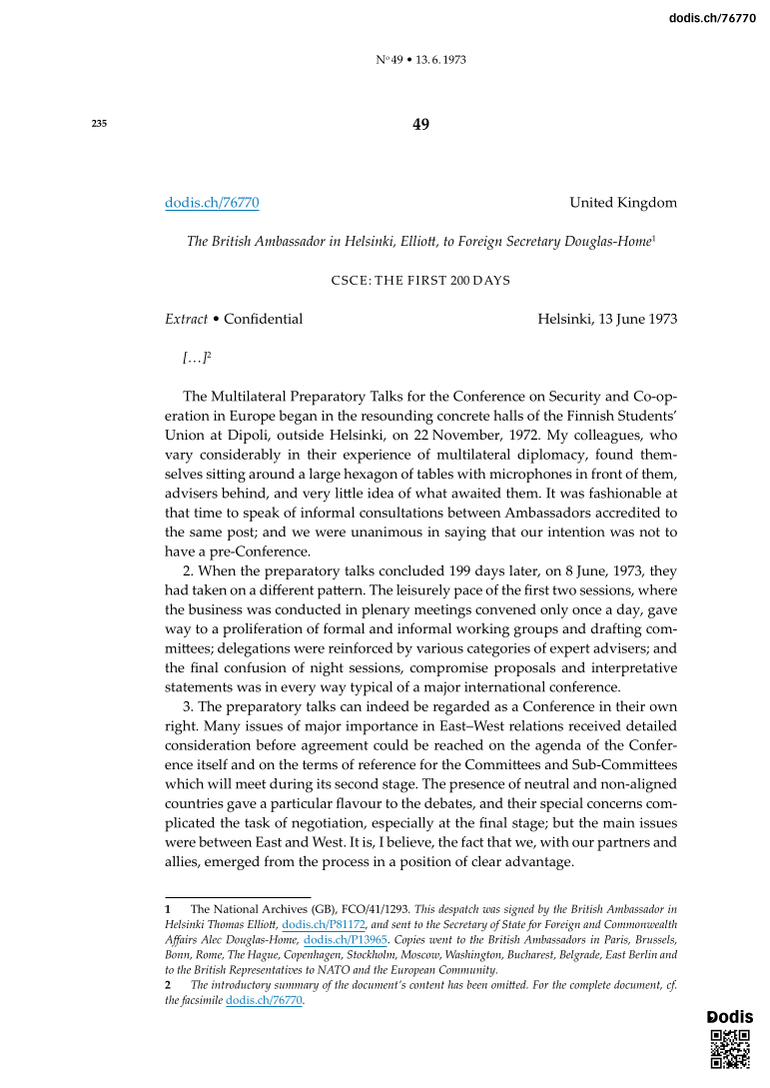
The British Ambassador in Helsinki, Elliott, to Foreign Secretary Douglas-Home1
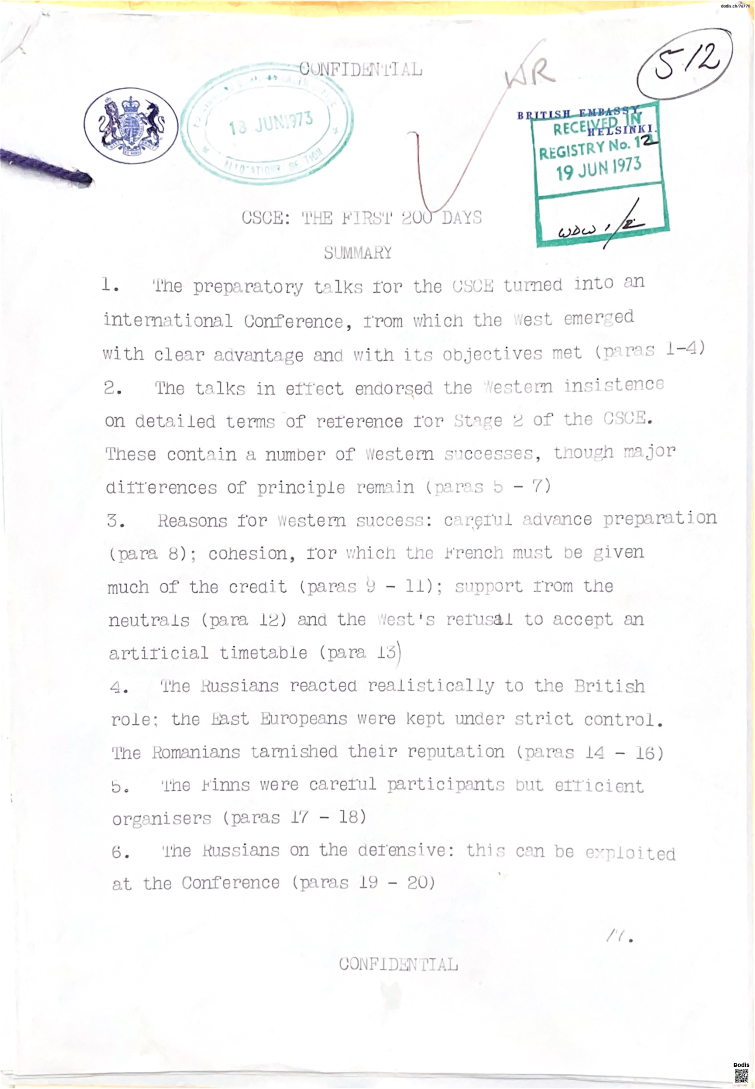
CSCE: The First 200 Days
[…] 2
The Multilateral Preparatory Talks for the Conference on Security and Co-operation in Europe began in the resounding concrete halls of the Finnish Students’ Union at Dipoli, outside Helsinki, on 22 November, 1972. My colleagues, who vary considerably in their experience of multilateral diplomacy, found themselves sitting around a large hexagon of tables with microphones in front of them, advisers behind, and very little idea of what awaited them. It was fashionable at that time to speak of informal consultations between Ambassadors accredited to the same post; and we were unanimous in saying that our intention was not to have a pre-Conference.
2. When the preparatory talks concluded 199 days later, on 8 June, 1973, they had taken on a different pattern. The leisurely pace of the first two sessions, where the business was conducted in plenary meetings convened only once a day, gave way to a proliferation of formal and informal working groups and drafting committees; delegations were reinforced by various categories of expert advisers; and the final confusion of night sessions, compromise proposals and interpretative statements was in every way typical of a major international conference.
3. The preparatory talks can indeed be regarded as a Conference in their own right. Many issues of major importance in East–West relations received detailed consideration before agreement could be reached on the agenda of the Conference itself and on the terms of reference for the Committees and Sub-Committees which will meet during its second stage. The presence of neutral and non-aligned countries gave a particular flavour to the debates, and their special concerns complicated the task of negotiation, especially at the final stage; but the main issues were between East and West. It is, I believe, the fact that we, with our partners and allies, emerged from the process in a position of clear advantage.
4. The brief for the UK delegation at the outset of the preparatory talks restated the objectives agreed by NATO Ministers: to ensure that the proposals in which they were interested would be fully considered at the Conference, and to establish that enough common ground existed among the participants to justify the reasonable expectation that a Conference would produce satisfactory results. Hence, our aim was to seek agreement at the preparatory talks on:
(i) an agenda which would allow Ministers to raise at the Conference proper the points to which they attached importance, and
(ii) an organisational structure for the Conference which would ensure that the various items on the agenda received detailed examination before any decisions were taken.
In my view these objectives have been met.
5. A major difficulty in the early part of the discussions lay in convincing the Russians that an agenda drawn up in general terms, even with a separate agenda item covering human contacts and information (a point in effect conceded by Brezhnev3 in his speech to the 50th Anniversary Congress in Moscow in December), would not be sufficiently detailed to meet the requirements of Western delegations. We insisted that the preparatory talks should also specifically agree terms of reference for the Committees and Sub-Committees which would undertake the detailed work of the Conference at its second stage. The Belgians, Italians and Danes tabled on 15 January draft proposals (previously agreed among the Nine and in NATO) for the agenda and terms of reference. The recommendations that finally emerged from the talks are naturally less satisfactory to us than those original drafts. But it is remarkable how little has been given away.
6. The preparatory talks have in effect endorsed the essential features of the Western approach to the Conference. It will take place in three stages; and it will not produce results until the Committees and Sub-Committees at the second stage have undertaken a thorough examination of the subjects covered in their terms of reference. I have reported on their contents in telegrams to the Department, and the delegation has produced separately a fuller record of the main points of interest. But the following points are worth noting here as successes for the West.
(i) The list of “principles of primary significance guiding the mutual relations of the participating States” includes:
(a) respect for human rights and fundamental freedoms, including the freedom of thought, conscience, religion or belief; and,
(b) equal rights and self-determination of peoples.
(ii) The terms of reference on principles contain two important sentences which are clearly incompatible with the Brezhnev doctrine. One refers to “those basic principles which each participating State is to respect and apply in its relations with all other participating States irrespective of their political, economic and social systems”; and the other provides that the document to be submitted for adoption by the Conference “shall express the determination of the participating States to respect and apply the principles equally and unreservedly in all aspects of their mutual relations and co-operation in order to ensure to all participating States the benefits resulting from the application of these principles by all. ”
(iii) The terms of reference for the Committee dealing with economic and related forms of co-operation provide the basis for a business-like examination of economic questions at the second stage of the Conference, and they place useful emphasis on reciprocity, and on information and contacts.
(iv) The section of the terms of reference corresponding to the original Western ideas on “freer movement” contains a preamble which contradicts the traditional Communist line that progress in this field is limited by differences in political, economic and social systems; and which states that the Committee “shall not only draw upon existing forms of co-operation but shall also work out new ways and means appropriate to these aims”.
(v) In addition, there are agreed references to facilitating freer movement and contacts between persons, as well as institutions and organisations, of the participating States; to marriages between nationals of different States and the re-unification of families; to the freer and wider dissemination of information of all kinds, and to improving conditions for journalists working outside their own countries.
7. There can admittedly be no guarantee that the results of the Conference proper will justify the expectations raised by a reading of the terms of reference. Some of the formulae that were evolved did little more than paper over major differences of principle. Thus, the dispute between the French on one side and the Dutch and Yugoslavs on the other about the relationship between the military and political aspects of security (and so inter alia the possibility of a link between the CSCE and the MBFR) was composed by means of a neutral formula that in effect exports the dispute to a later stage of the Conference. Again, the Maltese demand that the Mediterranean Arab States should be permitted to participate in the Conference was deflected on the final day (after it had appeared likely to block a general consensus) by the adoption of wording which keeps open the possibility that these States might present their case to the Conference, and which may be so vague as to give Mr Mintoff4 scope for lengthy argument at the first stage. More important, there is still room for months of discussion at the second stage on the precise decisions to be taken by Governments on the issues covered by the first three major sections of the terms of reference. The Russians fought hard for more restrictive texts, and gave ground only when they realised that they must pay the price of accepting them in order to get any Conference at all. If we are to build effectively on the foundations laid by the preparatory talks we shall have to exert and maintain similar pressure on them during the first and second stages of the Conference. I think it important, therefore, to consider in some detail what have been the main reasons for the relative success of the West so far.
8. The primary reason, I believe, was the careful advance preparation carried out in NATO and in the Political Consultations of the Nine. As a result we were able from the outset to adopt a business-like attitude to the Conference, and thus to win the sympathy of the neutrals and non-aligned. In sharp contrast the Warsaw Pact countries proved unable to produce any evidence of detailed planning for the Conference which they had so long promoted. Our advantage was confirmed when the Western proposals were tabled on 15 January. The East never explicitly accepted them as the basis for negotiation, but as the talks proceeded it proved as a matter of practice that the discussion tended to be based on them rather than on their own much more sketchy drafts. The West were thus able to maintain their ground until acceptable compromises were in sight.
9. The second reason was the success of the West in maintaining its cohesion throughout the long negotiations. Our advance preparations would hardly have been effective if our partners and allies had not been willing and able to put up a persistent defence of their joint proposals. They did so with varying degrees of commitment, and there were inevitably occasions when a delegation departed from the agreed line. But on the whole the West stuck together well, and the fact that they created an impression of harmony rather than of unison contrasted favourably with the rigid discipline of the East. Confusion could have resulted from the evident decision of the US delegation to maintain a low posture with the object of reconciling the two aims of avoiding public confrontations with the Russians and accusations of collusion between the super Powers. But that thrust the main burden of defending Western positions upon the Nine, and they passed the first real test of their ability to develop and execute a common policy with flying colours.
10. The idea that the preparatory talks should take the form of a salon des ambassadeurs soon evaporated, as far as the Nine were concerned. Even before the substitution of working groups for the plenary sessions, many of the Ambassadors had dropped out of the picture, lacking either the time or the inclination to acquire the volume of detailed knowledge needed for negotiations whose subject matter ranged from divided countries to divided families, from the social conditions of migrant workers to East/West industrial co-operation. Co-ordination between the Nine in Helsinki thus devolved on a number of deputy heads of delegation who had been involved from an early stage in working out the common positions of the Nine in the Sub-Committee and Ad Hoc Group reporting to the Political Directors. They were used to working together, and felt jointly involved in the papers they were defending. They were as a result able to form a cohesive nucleus which proved resilient to the strains of the negotiations, and to the unpredictable behaviour of the Belgian Presidency, which alternated in Helsinki between King Log and King Stork.5 Their efforts were co-ordinated by meetings of the Nine in Brussels during the break between the various stages of the preparatory talks; and by detailed discussion of CSCE questions in the regular meetings of Political Directors. The latter were occasionally tempted to think too little about strategy and too much about tactical details which could have been left to delegations on the spot; and the timing of their meetings (perhaps unavoidably) appeared eccentric to those engaged in the day-to-day struggle at Helsinki. Yet without the discipline provided by common instructions from senior officials who were free to concentrate on the broader picture the Nine would have proved far less effective.
11. Much of the credit for the achievements of the Nine must go to the French delegation. Despite occasional lapses, they remained loyal to the positions worked out with their partners and defended them actively not only in debate but in private conversations with the Russians. If they had chosen to act as mavericks they could have confronted their EEC partners with an uncomfortable choice between an appearance of solidarity around the French flag and the maintenance of agreed positions. In the event, the French were especially effective in their deployment of the Western case on principles guiding relations between States and on most of the major issues relating to freer movement. Their attitude contrasted with that of the Dutch and Belgians who, for all their tough noises in meetings of the Nine and the Fifteen, were for the most part unwilling to expose their views in discussions with the East.
12. A third reason for the favourable development of the talks was the extent to which the neutrals gave sympathy and support to Western positions. The Austrians, Swedes and Swiss worked closely together, but without trying to establish a “neutral bloc” that might have made a virtue of taking decisions half-way between East and West. Instead they defended their own conception of a business-like Conference, and made it plain that on most issues, their values were those of the West. (Indeed, the Swiss, and sometimes the Austrians, found themselves often to the right of the NATO centre.) The support of these delegations was especially valuable to us in so far as it formed a focus for other neutral and non-aligned delegations; and we shall no doubt need to retain their confidence during the Conference itself. Bilateral consultations are time-consuming, but it would patently be useful to arrange an exchange of views with each of these three countries (and if possible also with the Yugoslavs) before the second stage of the Conference begins.
13. One final reason for the success of the Western tactics remains to be mentioned. The Nine refused to accept an opening date for the Conference until it was clear that the preparatory talks had produced satisfactory results. Before the beginning of the crucial fourth session, the Political Directors reaffirmed their determination not to accept an artificial timetable, and we were able to maintain to the end that the preparatory talks would conclude only when the results justified it. Hence, the West continued to exploit the Soviet anxiety to hold the Conference in the middle of the summer without themselves coming under time pressure on points of major importance. The implications for our strategy at the second stage of the Conference itself are obvious.
14. I turn now to the general shape of our dealings with the East during these negotiations. British relations with the Russians were still in an icy stage when the talks began, and this was reflected in our contacts with the Soviet delegation here. During the first and second stages the Russians reacted to most of our interventions as if they were deliberate attempts to obstruct progress towards a Conference, and they concentrated their bilateral attentions on the Americans, French and West Germans, trying to settle as much business as possible with them in the corridors. That they failed is due to the loyalty shown by those three delegations to their partners and allies; and also to the fact that the neutral and non-aligned countries made it crystal clear that they (like the French) would not accept solutions privately concocted by the big Powers. (There is a moral here that might well repay thought in Washington as well as Moscow.) Meanwhile, we did our best to establish in the minds of the Russians the idea that, although we would fight hard in defence of our positions, our underlying attitude to the talks was a constructive one; and that we were in as good a position to influence the opinions of the Nine and the Fifteen as any other delegation. They reacted realistically; and during the third and fourth session of the talks, we were fully accepted as a delegation with whom the Russians thought it necessary and profitable to do business.
15. The other East European countries as a whole failed to make the most of the opportunities the Conference gave them. The Russians kept their allies under strict control and allowed them small discretion on points of importance. The Bulgarians, Czechs and Hungarians neither made, nor tried to make, an individual impact; while the Poles, although better equipped in diplomatic skills, disastrously allowed themselves to be manoeuvred by the Russians into defending an absurdly illiberal (and soon discarded) thesis on human and cultural contacts, and ceased thereafter to play a prominent role. The East Germans deserve a special word. Their main representative, Dr Siegfried Bock,6 displayed an irrepressible intelligence and sophistication of manner which one may hope will be repeated at other conferences as the GDR gains in international experience. He was the only East European representative to take an active part in negotiations on questions of substance, and his relationship to the Russians was that of a member of a team rather than that of a subordinate. But often enough, when the Russians decided that the time had come to make another move towards the Western position, they left him stranded.
16. The Romanians were a case apart. They began the preparatory talks with a loud (and to the Russians no doubt embarrassing) advertisement of their independence and sovereignty. Yet as the talks proceeded it became clear that they had done no more than give premature indications of fall-back positions acceptable to the other Warsaw Pact countries; and that they were among the most rigid of the East Europeans on questions of freer movement and human contacts. Their reputation became tarnished, and in the closing stages of the talks their elegant prevarications (expressed in impeccable French) produced apoplectic reactions among both Eastern and Western delegations. They finally achieved a coup of a sort by persuading Mr Mintoff, on the basis of a formula proposed by the French weeks previously, not to block a final consensus; but they had by then lost much of the general sympathy they had won at the outset of the talks. The Yugoslavs, on the other hand, by maintaining a consistent line and pursuing their major interests with a balance of firmness and flexibility, emerged from the process with a high reputation. The contrast is instructive.
17. I should say a word finally about the Finnish record at the Conference. The vigorous pro-Western performance of their fellow neutrals, the Austrians, the Swedes and the Swiss, placed them in a position of some embarrassment. Finnish neutrality, which has yet to be recognised by the Soviet Union, by definition cannot be pro-Western; and the Finns were careful not to associate themselves with these three delegations. On the other hand, they did not allow themselves to be used as “Eastern neutrals” to provide a counter-weight. They may well have come under bilateral pressure to do so, as an intervention they made at the outset of the detailed discussions on human contacts and information suggested; but this was a solitary lapse and otherwise they kept resolutely silent. The Chairman of the preparatory talks, Richard Totterman (Secretary-General of the Finnish MFA),7 and the Executive Secretary, Ambassador Joel Pekuri,8 performed their difficult tasks impartially and well, and the general organisation of the long and (for the Finns immensely expensive) talks was seldom faulty. I think it a reasonable reward for these efforts that the first and third stages of the Conference should take place in Helsinki. There was a risk that the decision of many of the Nine to support Geneva as the site of the second stage would cause the Finns offence; but the negotiations that achieved this result were handled with great skill by the Irish chairman,9 and I was eventually assured by Mr Sorsa, the Finnish Prime Minister,10 that the Helsinki– Geneva–Helsinki formula was the “best possible solution” to the problem.
18. It is to the Conference itself that the West have now to turn their attention. We entered the preparatory talks believing that the Conference was inevitable; that the dangers it comprised could probably be avoided; and that it might provide us with some modest benefits. In the light of the preparatory talks I would take a more optimistic view.
19. The Russians have pressed for the Conference for their own purposes. They hoped no doubt to get its blessing for the Brezhnev doctrine; and to exploit it in other directions as a means of dividing the West. The preparatory talks suggest that they did not judge the situation very accurately. From the first they found themselves in a forum where they could expect the regular support of only six out of thirty-four delegations; and where the neutral countries, because of the consensus rule, had much more incentive to express, and persist in expressing, their individual points of view than is the case in international meetings operating under majority voting procedures. In the early days of the talks I sometimes had the impression that the Soviet spokesmen were in a state bordering on panic as they found themselves in a negotiating position rather less strong than they had enjoyed in the UN in the early 1950s. As time went by they adapted themselves to the new situation, abandoned bullying tactics (which succeeded only in alienating the Swiss, the Maltese, and many other neutrals), and began to deploy their real diplomatic skills and experience. But they still remained in a defensive position; and one where their only hope of making their point was by rational argument rather than by the exercise of pressure. It was a stimulating experience for Western delegations to find the Russians, in the hearing of representatives of all their satellites, obliged to give a detailed defence of their domestic policies on, for example, the increase of human and cultural contacts, in order to answer criticism by Liechtenstein. For the Soviet spokesmen themselves the experience cannot have been so refreshing. It is no wonder that the Soviet leadership are still pressing for an early end to the Conference.
20. It should nevertheless be possible for the West at the Conference to exploit the psychological advantage gained at the multilateral preparatory talks. I know that we have never set much store by a declaration on principles guiding relations between States; and public opinion in the UK is rightly suspicious of elevated legalistic phrases with little practical content. But the relevant section of the terms of reference provides some encouragement for the view that we should be able to produce a document of political value if we are prepared to make a major effort to elaborate the principles. Perhaps more important, we can work for some improvement in Soviet behaviour in the area covered by the terms of reference on human contacts and information. In this field, which they have always hitherto insisted is appropriate only to bilateral discussion, we now have a means of exerting multilateral pressure on the Russians and their satellites; and we have never had anything of the sort before. At the least, we ought now to be in the position to oblige the Russians either to make some concrete (if modest) advances in this area or to expose the hollowness in practical terms of their professed desire for détente.
21. The importance of the Conference is not limited, however, to what it achieves in the field of East/West relations. It has become, as a result of the work done both before and during the preparatory talks, something of a test case for developing the co-ordination of foreign policy among the Nine. Many of our partners have reasons for wanting to go their own way in important aspects of their relations with the East. But they have shown during the preparatory talks a willingness to work as a group and an awareness of the negotiating advantages this provides. It should surely be a major objective of our policy to ensure that this lesson is reinforced in the course of the Conference itself. We shall not get our own way during the second stage without full preparation.
22. There is one final point. As the MPT showed, the Nine cannot be led from behind. In the early days of the talks the still uncertain state of our bilateral relations with the Russians, as well as tactical considerations relating to our position as a newcomer to the EEC, led the British delegation to play a cautious role. But the detached position of the French, the special preoccupations of the Germans, the eccentricity of the Italians and the public silences of Benelux increasingly made it necessary for us to give a lead, if the Nine were to continue to follow a positive line and enjoy the initiative in the talks. I believe that we shall find ourselves in a similar position in the second stage of the Conference itself; we shall have little choice but to act as one of the leaders of the West. And it is reasonable enough that we should do so. We can, evidently, make a greater contribution to the collective self-confidence of EEC and the more effective safeguarding and prominence of the Community countries’ interests if we take a lead in urging and directing the full preparation of the position of the Nine than if we take a back seat. If Britain is not to act as a major European Power in the context of the CSCE she can hardly hope to be a Power anywhere.
23. I cannot conclude this despatch without expressing my gratitude and admiration for the work of the First Secretaries (including my own Head of Chancery, Mr Beetham)11 who bore the whole burden of the detailed work of negotiation on our side. They were younger than any other delegation and more lively, led by Mr Brian Fall,12 who played a significant role in shaping the course of the talks, they took a prominent part in working out the agreed terms of reference and the arrangements for the procedure and finances of the Conference. Their ingenuity, drafting ability and resilience during these protracted discussions were alike remarkable. I found it both a piece of good fortune and a pleasure to work with them.13
- 1
- The National Archives (GB), FCO/41/1293. This despatch was signed by the British Ambassador in Helsinki Thomas Elliott, dodis.ch/P81172, and sent to the Secretary of State for Foreign and Commonwealth Affairs Alec Douglas-Home, dodis.ch/P13965. Copies went to the British Ambassadors in Paris, Brussels, Bonn, Rome, The Hague, Copenhagen, Stockholm, Moscow, Washington, Bucharest, Belgrade, East Berlin and to the British Representatives to NATO and the European Community.↩
- 2
- The introductory summary of the document’s content has been omitted. For the complete document, cf. the facsimile dodis.ch/76770.↩
- 3
- General Secretary of the Communist Party of the Soviet Union Leonid Brezhnev, dodis.ch/P15543.↩
- 4
- Maltese Prime Minister Dom Mintoff, dodis.ch/P43091. Cf. QdD 30, doc. 48, dodis.ch/76980.↩
- 5
- King Log and King Stork refers to a famous Aesop’s Fable where frogs, bored with their peaceful lives, ask the gods for a king, first receiving a harmless log (King Log) which they find useless, then a predatory stork (King Stork) who eats them.↩
- 6
- Head of the Policy and Planning Department of the Foreign Ministry of the German Democratic Republic Siegfried Bock, dodis.ch/P27632.↩
- 7
- Richard Tötterman, dodis.ch/P46542.↩
- 8
- Joel Pekuri, dodis.ch/P46545.↩
- 9
- Irish Ambassador in Stockholm to Sweden and concurrently to Finland Timothy Horan, dodis.ch/P14087.↩
- 10
- Kalevi Sorsa, dodis.ch/P46536.↩
- 11
- Roger Beetham, dodis.ch/P56350.↩
- 12
- Brian Fall, dodis.ch/P57474, Deputy Head of the British Delegation. His full report on proceedings is reproduced in Richard Smith (ed.): Preparing for Helsinki. The CSCE Multilateral Preparatory Talks, London 2020.↩
- 13
- For full details of British involvement in the CSCE, cf. Documents on British Policy Overseas (DBPO): Series III, vol. II: The Conference on Security and Cooperation in Europe, 1972–1975. For all British documents in this volume, cf. the compilation dodis.ch/C2898.↩
Relations to other documents
| http://dodis.ch/76980 | is quoted in | http://dodis.ch/76770 |
| http://dodis.ch/76770 | is quoted in | http://dodis.ch/76775 |
Tags
Organization for Security and Co-operation in Europe (OSCE) CSCE negotiations in Helsinki and Geneva (1972–1975)