
Jonathan and I are going to see West Side Story at the Film Forum tonight so I begin this post by saying I have not yet watched the movie, but I probably will. Still deciding on whether to wait for it to be on streaming so I don’t have to pay movie theater prices for something I’m sure to completely hate. I am trying to leave my expectations open, even though I found Saltburn to be an absolutely ridiculous excuse for a movie (beautifully shot! rosamund pike was fantastic!) and every time I see the trailer for Wuthering Heights I cringe when I see it described as “the best love story ever told.”
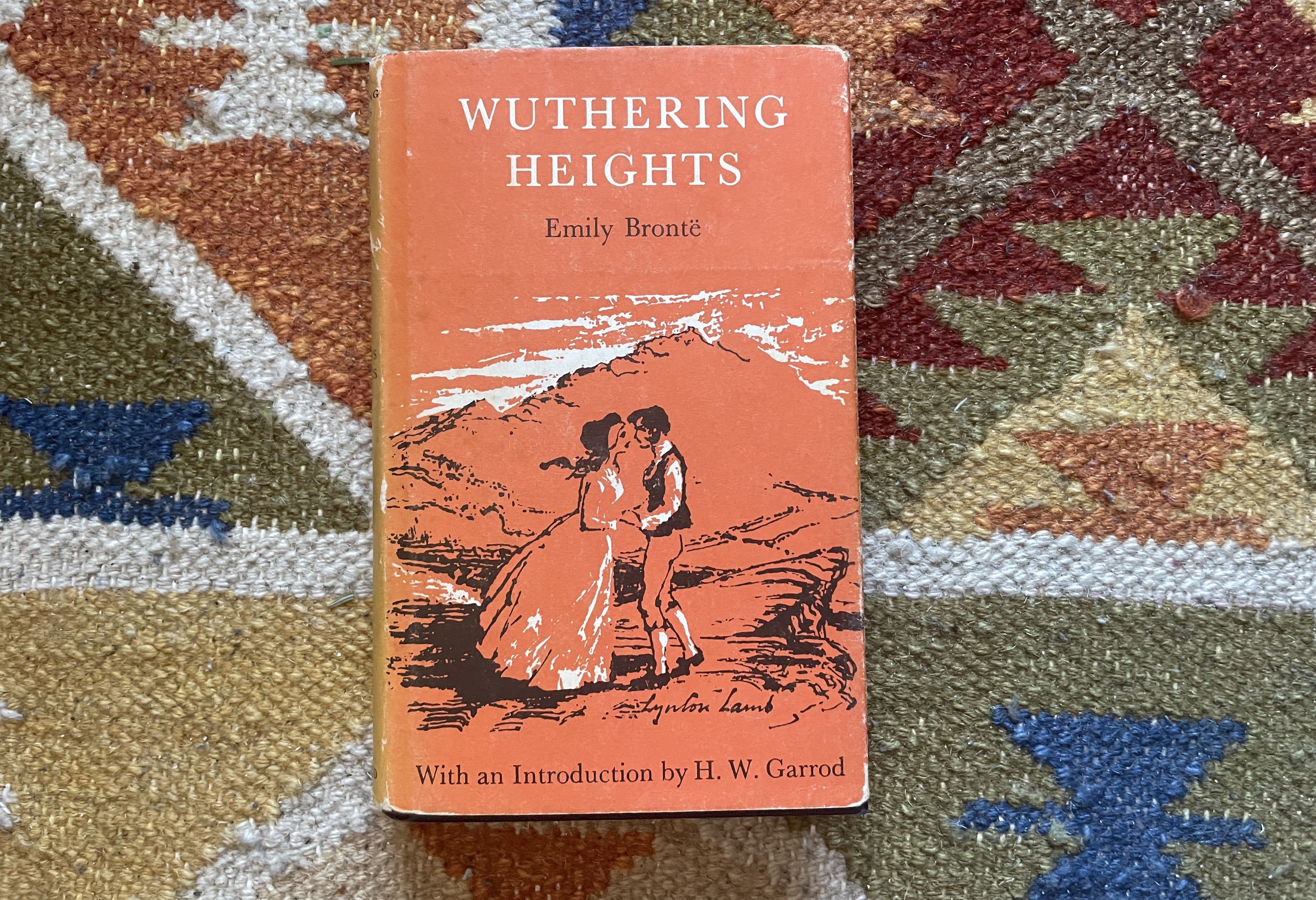
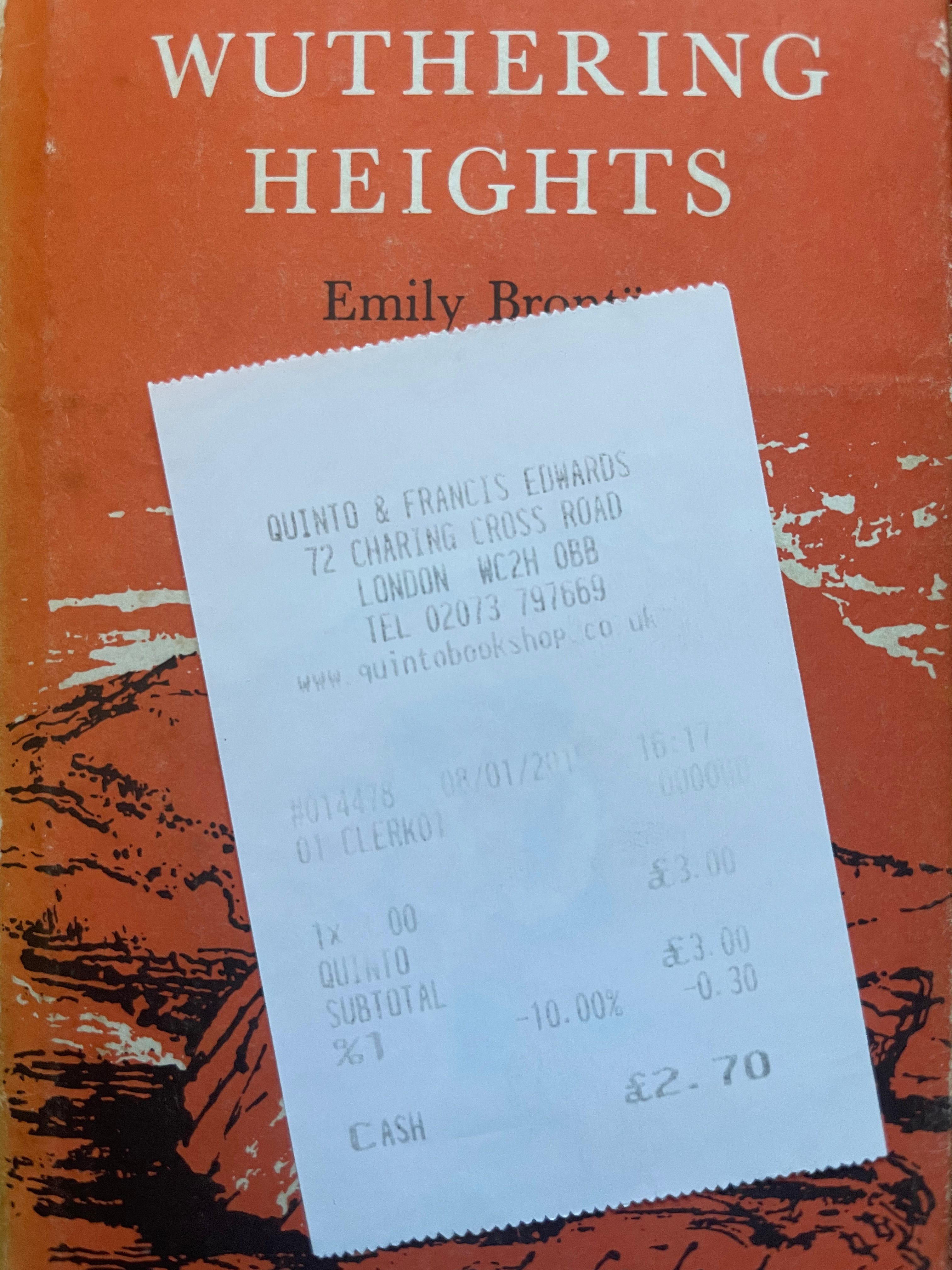
I first read Wuthering Heights in college, over spring break at my parents house. I had gone to London that winter break for a theater course, it was very cool. While there, I had come across a small and dank used bookstore right in the heart of London, where in the basement level I’d found this fantastic old copy of Wuthering Heights. I was familiar with the title and loved the cover so I bought it. When I picked it up again a few months ago after seeing the trailer for the movie, I discovered that the receipt was still in it, look at this.
Anyway, I didn’t remember much about reading it at 21 years old, except how I kept exclaiming (mostly to my mom, who wasn’t interested) “they said this is a love story but it’s all about DEATH. It’s all about GHOSTS and DEATH.”
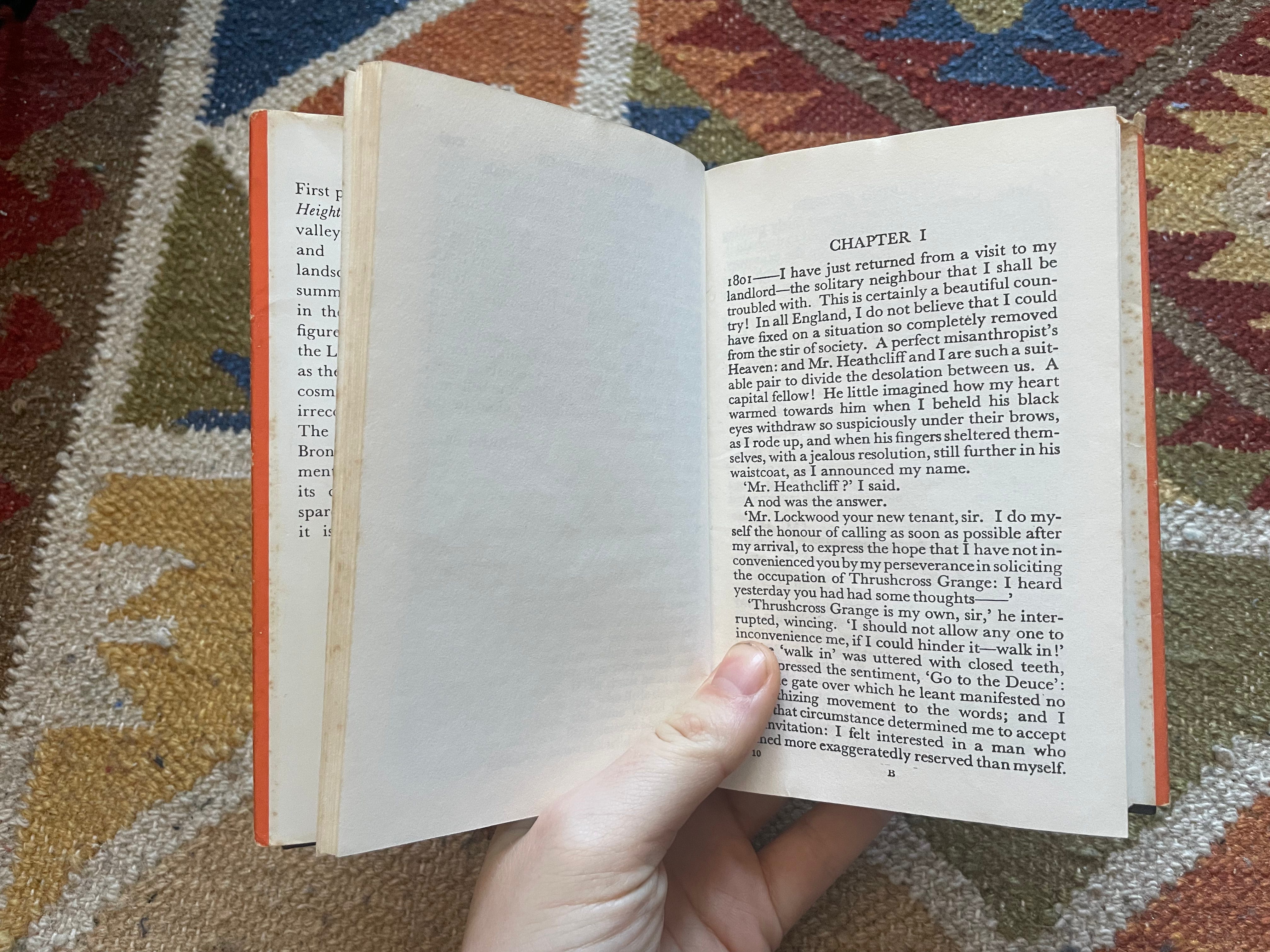
I had been wanting to reread it for years anyway and used the movie release as a good push and excuse to do so. So many people have been talking about it, and honestly I’ve really been enjoying all of the discussions both that I’ve read online and that I’ve had in person about Wuthering Heights recently, and I’m happy the movie’s coming out for that reason alone. But that being said, I’m not going to focus on any of the movie drama and just talk about my reading of the book.
Do I agree with my younger self that it’s all about GHOSTS and DEATH? Yeah, as well as race and class and isolation and, Emily wouldn’t have used this phrase but it’s absolutely what it is, generational trauma and inheritance.
The structure is so good. It’s so cool, and it is one of the reasons I can’t really think of this as a love story. The narrator, Mr. Lockwood, visiting the moors and renting a house, Thrushcross Grange, for a while. He meets his landlord, Heathcliff, who lives in the house over, the titular Wuthering Heights, and lives with a young man and woman whose relation Mr. Lockwood can’t immediately parse. But what is clear is that the situation is extremely bleak, and no one is happy. Here’s how he describes the house:
Wuthering Heights is the name of Mr. Heathcliff’s dwelling. “Wuthering’ being a significant provincial adjective, descriptive of the atmospheric tumult to which its station is exposed in stormy weather. Pure, bracing ventilation they must have up there at all times, indeed: one may guess the power of the north wind blowing over the edge, by the excessive slant of a few stunted firs at the end of the house; and by a range of gaunt thorns all stretching their limbs one way, as if craving alms of the sun. Happily, the architect had foresight to build it strong: the narrow. windows are deeply set in the wall, and the corners defended with large jutting stones.
Mr. Lockwood gets sick and asks his housekeeper what’s the deal with the landlord. And his housekeeper, Ellen, proceeds to tell him the greatest love story of all time. Just kidding! But it is her perspective and voice that we get throughout the majority of the novel, as reported by our narrator Lockwood. Ellen had grown up with Catherine and Heathcliff at Wuthering Heights, so it is a pretty complete image of their and their family’s story since they were all children. But, all we know about their relationship and feelings comes from what Ellen remembers and reports to Mr. Lockwood and then to us. It’s essentially all gossip!
She is not only recalling from old memories, but she herself is biased and an active participant in the story. And she’s not always the heroine. Oftentimes I found myself rooting against the person who was telling the story, which I think is such a delicate balance to strike. That being said, I wasn’t much rooting for anyone here, everyone is their own kind of horrible.
There’s no question in my mind that Brontë is playing with the gossipy nature, and leaning into the gaps that, more or less, outside observer would have when telling this story of two isolated families on the famously bleak moor. We’ll never really know what went on in Heathcliff or Catherine’s mind, or what they said to each other when they were truly alone. But here’s how Ellen describes Catherine:
I’ve had many a laugh at her perplexities and untold troubles, which she vainly strove to hide from my mockery. That sounds ill-natured: but she was so proud, it became really impossible to pity her distresses, till she should be chastened into more humility. She did bring herself, finally, to confess, and confide in me: there was not a soul else that she might fashion into an adviser.
Just including that to hammer home that everyone in this book is deeply flawed. And that’s the point! “I wasn’t rooting for anyone :(” Grow up!! I went to a Mets vs Marlins game this summer as a Yankee fan and I had a great time without rooting for anyone! Read for the love of the game, goddamnit.
The story does start out with a bit of a love triangle, and the lingering feeling of one character is the propulsion for most of the conflict for the rest of the book, but that initial love triangle is basically a few pages. Still, here’s how Ellen tells it.
Doubtless Catherine marked the difference between her friends, as one came in and the other went out. The contrast resembled what you see in exchanging a bleak, hilly, coal country for a beautiful fertile valley; and his voice and greeting were as opposite as his aspect. He had a sweet, low manner of speaking, and pronounced his words as you do: that’s less gruff than we talk here, and softer.
I have to reiterate that it baffles me that anyone can interpret this book as a love story. There is love in it, to be sure, and a lot of great lines about that all consuming, know-you-on-a-deeper-level type of obsession, but the scope and plot of the novel expand much wider than that. The “love story” in question soon gives way to a completely different characters. The “love” is definitely still a part of the story, but it’s the echoes and result of it that show up in terms of inheritance and generational trauma. Also, the love is only observed by the housekeeper Ellen, which really distances us from any emotion. It is really focused on the facts and the history, and Ellen’s perspective.
I am really struck by the positioning of Ellen, a lower class person and a servant, as the main voice of the narrative. This book was published about 40 years after Jane Austen, who I was mostly comparing this to while reading it. Stories concerned with the upperclass inhabitants of these great houses. But then I realized that Dickens published Oliver Twist in 1837, so my theory is not really quite right, just think about what the word ‘dickensien’ evokes! But it still feels novel the way Brontë uses the unique position of a servant, as someone who has a spot in this upper class life but is not quite a part of it, is someone in the unique position to hear things other people within the same class wouldn’t. I don’t feel like I'm articulating myself well, but I feel like, short of writing a whole research-based academic essay here, I’m not going to be happy with this paragraph so I’m just going to hope you understand me and move on.
Heathcliff is completely positioned as the antagonist, even though at some points Ellen reveals sympathy for him because of the way he was treated. His “origin story” as the kids say, is absolutely impacted by the extremely negative and frankly racist treatment he receives as a child. If you’ve seen any discourse about Jacob Elordi being cast as Heathcliff, this is why. It’s not just that he was described as a person of color in the text and they ignored it (and not even in the “Hermione’s skin is described as ‘very brown’ at one point so we’ll run with it” way, he’s quite clearly a darker person and people continually remark on it) it’s that his race, and the abuse he receives because of it, is a core part of his character and is absolutely a theme that the novel explores.
Okay it looks like I did wind up talking about the movie, whoops. Let’s bring it back to the book. There are a few clunky parts, to be sure, and I especially struggled with one character’s dialogue which was written phonetically to highlight his lowclass-ness and probably mark him as very rural as well. I feel like I missed a lot of the stuff about religion because it was filtered through his drawl.
But the tension in this book is so interesting, and yeah it’s a little slow in parts towards the end, but the present day scene that Lockwood observes is given before Ellen tells us any of the backstory, so the reader already knows which characters are missing and who is currently married to whom. Watching the movement between the houses play out, almost a swapping nature throughout the generations, is changed and highlighted by knowing where people end up.
I could keep talking for quite a while about this book but I’ll wrap it up here. Happy Valentines Day! Let me know if you see “Wuthering Heights.” Do you love it or does it suck? Have you reread the book in preparation? Let me know! Give me some gossip!
Honestly, I think I may watch the Laurence Olivier version this weekend. I’ll leave you with this: Emily Brontë died a year after this was published, in 1848.

No posts
Comments
Nothing yet. Say the first thing.
Sign in to join the conversation.