
I didn’t even notice until I’d started reading that Helm has a blurb on the back from my love Sarah Moss - real fans of this newsletter know what I’m talking about! This book is most definitely in the same vein as Moss’s work, on the shorter side, concerned with rural England, and exploring the intersection of many different people’s stories. I even felt like the narrative voice was slightly similar - not in a derivative way, just in that they are similar writers.
Does that mean that I loved this book?
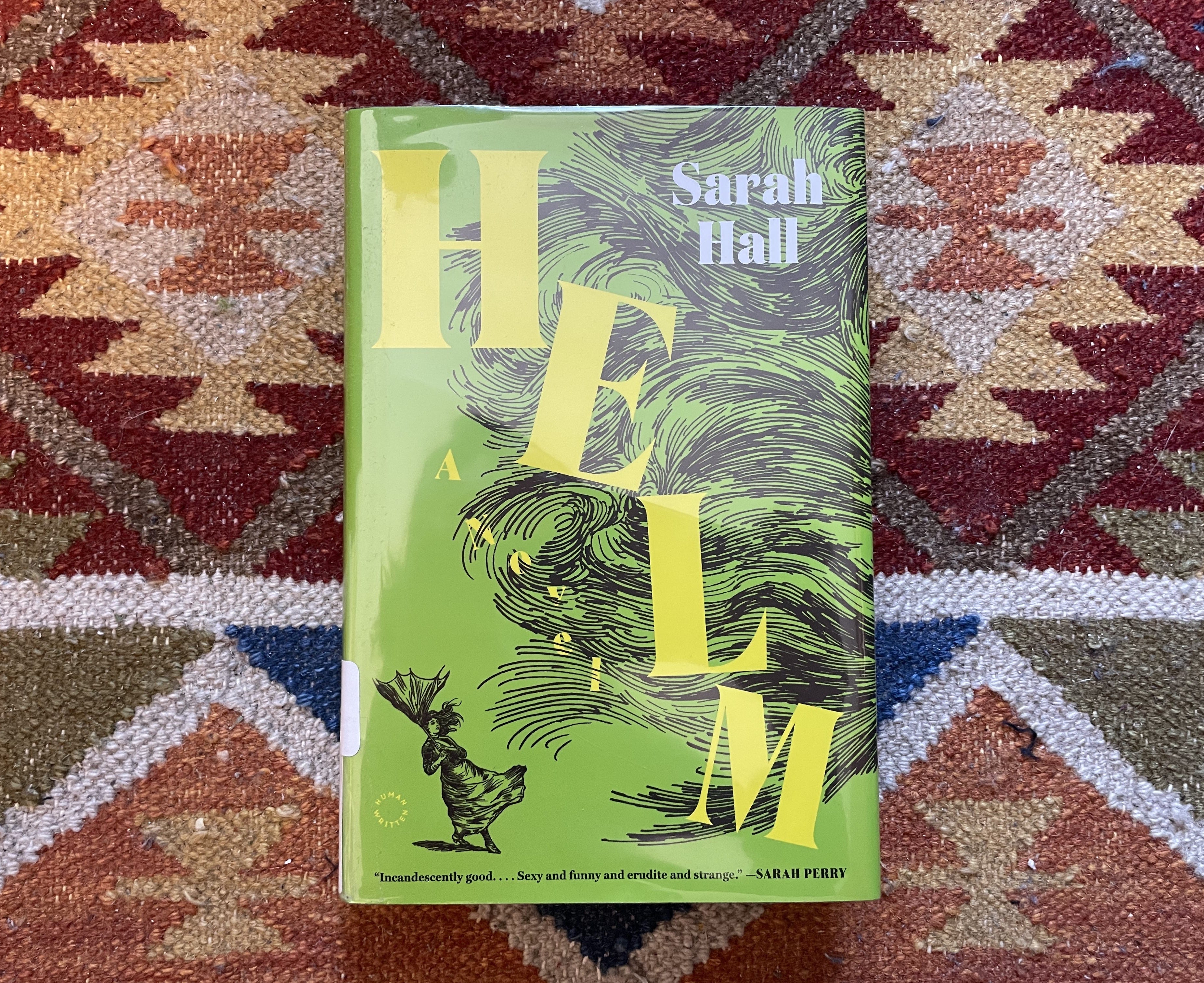
Basically, yeah. (with a few notes!!!)
Helm is the name of a wind somewhere in northern England (that I still don’t really know what exactly Helm is or the geography of it even after having read the book is one of my critiques) and this novel slightly anthropomorphizes the wind. The opening starts with the creation of everything, going on to narrate the creation of Helm, and how it was so bored until people started showing up. This first chapter was very voice-y, in a pleasant way, kind of a rye humor that I was slightly disappointed to find didn’t carry through for the whole book.
The rest of the book followed various different characters throughout the course of history, most memorably a neolithic woman who becomes important in the laying of the local standing stones in the area, a medieval guy who thinks Helm is demonic and wants to banish it, a victorian scientist intent on classifying and mapping it, and a modern scientist tracking microplastics in the vapor of clouds. There are a few other threads throughout, as well as a few one-off chapters, and here is where my criticism really begins.
First of all, the writing was consistently engaging, no matter what time period was being invoked (although, as I mentioned earlier, I sort of wish that irreverent and comedic tone was more present throughout) and in every storyline I was very invested in the characters and what was going to happen. The only exception to that, surprisingly based on my interests and personality, is the medieval guy. I don’t know why, but I think it had something to do with one of the problems with every thread, which is that when a new storyline started, it was very difficult to tell when in time we are, as well as where exactly we are geographically. I understood that Helm is present throughout one valley, essentially, but as someone who is not familiar with England’s geography at all I was very lost. There is a map at the front of the book, but most of the places mentioned in the storylines are not on the map so it was basically useless to me. If we have a lot of different storylines that only really overlap in their location and interaction with a geographical feature, I would like to be able to see echoes of each story in the other, even if it is just in location. Perhaps someone from England or this region wouldn’t have this complaint, but as someone who is unfamiliar it felt like a lost opportunity to me.
Similarly, since each story only got so much space, we are left with very little actually filling out the story. This was mostly fine, but it meant that things were being alluded to in the past that were not very well established, and I think this was mostly a fault of the narrative tone than anything else. I don’t mind things being difficult to parse out, but when I consistently had the same problem in four different storylines, it gets to be a bit more grating than gratifying.
One thing I liked about the structure was that it wasn’t linear. Another version of this book would have been essentially a collection of short stories, each person’s tale after the other. Instead she breaks up the stories and we float back and forth through time. A satisfying journey after being told in the opening that Helm doesn’t experience time the way humans do. However, I’m not sure that things are ordered and broken up in a way that makes it flow the best. I was left kind of not caring about some storylines or at least not being intrigued to see where they go, because somehow the later storylines kind of undercut the urgency. I’m not sure exactly how this could have been fixed, maybe with a simple restructuring of the chapters, but probably what I was looking for was more of a thread between the different stories. (Even if this had been geographical like I was talking about before, it would have been more satisfying.)
Also, I was surprised that actually, Helm really was in the background of some of the stories. This might play into what I’m describing above, as I was left kind of unsure of how exactly all of these different strings flow together.
There was also a trend of the main characters of various stories being from other places and considering this place (town? valley?) as very rural, and kind of looking down on it and its customs. I know there were also some local stories included, but I think there’s some kind of tension there that would have been interesting to explore more. The back of the book mentioned how many interviews the author did with people about Helm and, while its really clear that she’s passionate about the wind and this project, I wish that more of those local stories and voices were present here. There are a few really good passing anecdotes about what locals consider to be Helm’s fault that I was so interested in seeing fleshed out but weren’t.
Finally, I think I just wanted more from each of the stories! Classic me, wanting it to be longer! Although, I don’t really think it needed more length, just a slight shift in its focus if that makes sense. There was one character, who only got about three chapters if i’m remembering correctly, who I thought was tragically underused - it could have been all about him! A retired something or other (the vagueness comes from my issue with the narrative I mentioned above, I was slightly confused on his backstory?) who has started flying planes during his retirement is recruited by some agency who wants to track helm and suddenly there are the right conditions. The writing about him in the plane, being hoisted by Helm, was really incredible. I know I’ve been mostly pointing out negatives of the book but I really did enjoy reading it. However, even if I thought the rest of the book was awful, I think it would have been worth it for me for that one scene alone. It harkens back to something that had been established in his past and creates this really beautiful symmetry and to me just really felt like the core of the book. It was a shame that his story wasn’t more prevalent throughout. Also, I have no idea how contemporary his plot line is, whether he was flying around while the scientist (mentioned above) is going about her testing.
I also wish that there’d been more of a focus on older time periods, even though we start in Neolithic times, after that there’s nothing before the 1300’s, which I think is a modernity bias and I would have liked to see more earlier peoples interacting with such a powerful force, especially in regards to changing religion throughout time. (There was a really good passage in the medieval guy’s section about the beliefs of the local people, how they hedged their bets and didn’t truly believe things for the sake of faith, but rather in order to make sense of the brutality around them.)
I think that overall this book really frustrated me, as I was so close to loving it. I definitely enjoyed the framing and a lot of the ideas it explored, as well as the technical ways it chose to explore them. It just wasn’t perfect, at least for me, but hey, what is, when you think about it? I liked it enough that I’ve ordered another book by Sarah Hall from the library, and we’ll see what I make of that one.
No posts
Comments
Nothing yet. Say the first thing.
Sign in to join the conversation.