
I read Hild, a thick novel that follows the life of real historical figure St. Hilda of Whitby who lived in the 7th century England, last Sunday during the massive snowstorm that NY got. The author broke up Hild’s life story into two books, and the sequel, Merewood, is lurking on my shelves for the follow up storm this weekend. This time we’re prepared with marshmallows for our hot chocolate- we’ve learned from our mistakes.
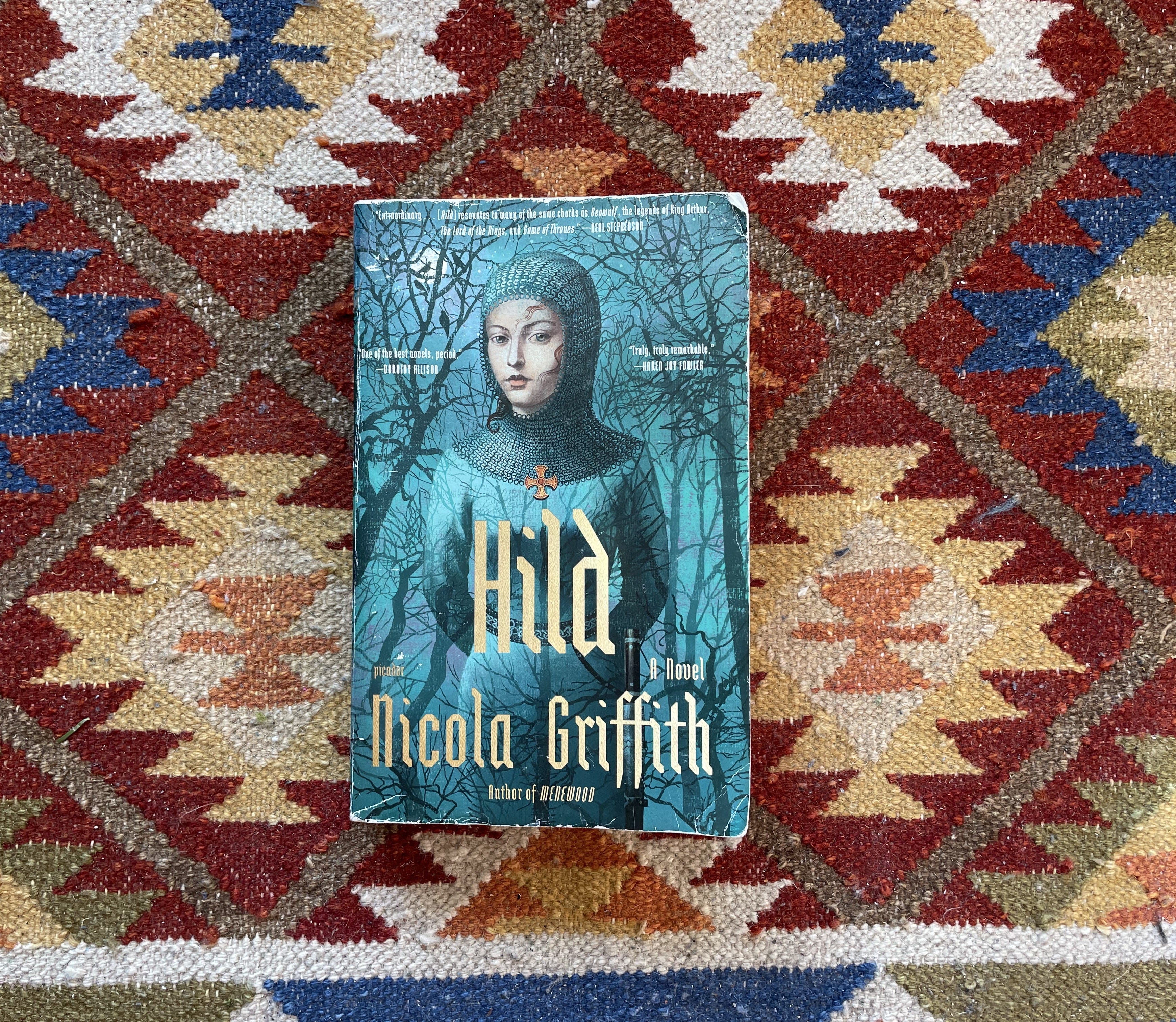
The real life Hild (or Hilda?) was the niece to king Edwin of Northumbria, one of the Anglo-Saxon kings during the time after the Romans and before William the Conquerer, well, conquered. Known as the “dark ages,” famously, not much is known about this time period, and understandably, very little is known about Hild. Griffith has clearly clearly done her research with this novel, but also has not been afraid to invent and infer, to create a character out of the very few historical details available to us.
Griffith’s research and knowledge are both a strength and a weakness. I was absolutely convinced by the world, and could understand the motivations and belief systems of these people who share so little with me. However, it was really annoying how much the author used the old English words for things. It didn’t make sense logically to me, since the narration and dialogue is in English, why cherry pick some words to show off and use the old English translation of it? She was definitely trying to build a tone and atmosphere, but she does this so well already with the detail of the narration, this was just not a needed touch. I can understand including a concept that isn’t quite the same as the modern translation, and there is a bit of that, but for the most part the words were not even introduced in a way that we understand their significance to the people using them. There was a glossary in the back, but not every word I didn’t recognize was in there.
There were also two very jarring instances of modern references. Hild’s mother says to her (I think verbatim, but I can’t find the page now) “Men are afraid that women will laugh at them. Women are afraid that men will kill them.” Which is absolutely an internet meme quote, that I’m sure most of you will have seen before, a bastardization of an excerpt from a Margaret Atwood speech. I was extremely taken aback by this, how the exact words were placed in the mouth of a woman from the 600s. I don’t think it’s wrong to assume that a woman in the 600’s would come to that conclusion, but to use the exact words feels lazy to me, or at least the way of inserting 20th century thought (the Atwood speech is from the 80’s) wholesale into the 7th century just totally took me out of the story. the second instance was using “Do your ears hang low” as a drinking song that the warriors sing. I looked it up and it’s from the 1800s, not the 600s. I don’t inherently hate the melding of modern speech or references in a historical story, but this book is so well researched and is actively trying to evoke a specific time that is very far from ours, that these choices felt baffling to me.
Other than that, I really enjoyed this book. It follows Hild from her early childhood until she’s about 18, and the passage of time, growth and development of her mind and worldview were really well done.
It also does a very good job of explaining the political scene of the 600’s Britain, and I feel like I have a better picture in my head of the time than I had before. I am interested in this time, not only in how the different kingdoms developed and interacted with each other, but how Christianity spread through the island at this time. I knew as a fact that in 597Æthelbert of Kent was the first Anglo-Saxon king to be converted to christianity, and the monks who converted him there founded Canterbury. But this story takes place just after this event, in the early 600’s, in another kingdom to the north. The dates on a timeline don’t account for the way that ideas and movements percolate slowly through populations and the culture changes slowly.
Through Hild’s eyes, it’s really interesting to watch her dismiss, be confronted with, and then accept the reality of Christianity throughout the years, not being totally converted, but accepting that belief is something that people hold and need to be accounted for and as a concept that can be manipulated. It was especially interesting how she grapples with the concept of sin, equating it with her culture’s understanding of an oath- which does not necessarily have religious connotations at all but is binding and perhaps spiritually significant.
The real Hild was a powerful figure in her time, and an advisor to kings and other political leaders. ( I’m assuming we’ll get there in the second book, so I’m not too solid on that stuff yet. check back soon for an update!!!) This book interprets and shows how a figure like that could come about, a smart person who can make inferences and come to conclusions other people miss that are then interpreted as prophesy, and she is thought of as a seer by her uncle the king.
The other thing I really didn’t like, along with the superfluous old-english words, was a certain plot line involving her (fictional, mind you. the author made this person up and she didn’t have to do that) half brother. The book spends so much time talking about how similar he and Hild look, and there is some tension there because he is the secret bastard of Hild’s deceased father who had been the older prince, so her half-brother now has some claim to the crown and if the current king knew, her brother would be in danger. All that is well and good, until at the end of the book when it becomes clear that they are very attracted to each other, and things just go in a direction that I really don’t think they needed to. Especially after all that weight about how they look so similar. Gross, if you ask me. And like I said, this was an invented character, not something from the historical record, so why did she have to do that! unnecessary, and also predictable. It almost felt like the book was almost completed and then the author realized that she needed a bit more of a love story in it, and picked up the closest loose thread.
Okay, how do I turn this around so I don’t end on a low note? I really enjoyed this book! I don’t think I really accurately described the plot, how sprawling it is. Things happen slowly, according to the seasons and with the constraints of geography, but the tension keeps you moving quickly. There is a great sense of life, how people had to interact with the natural world to survive, as well as the cultural and interpersonal calamities, and how both things interplayed with each other. I am looking forward to reading the second one this weekend!
No posts
Comments
Nothing yet. Say the first thing.
Sign in to join the conversation.