
How Cyrus the Great Ruled a Diverse Empire More Than 2,500 Years Ago
An early example of governing diversity through local autonomy
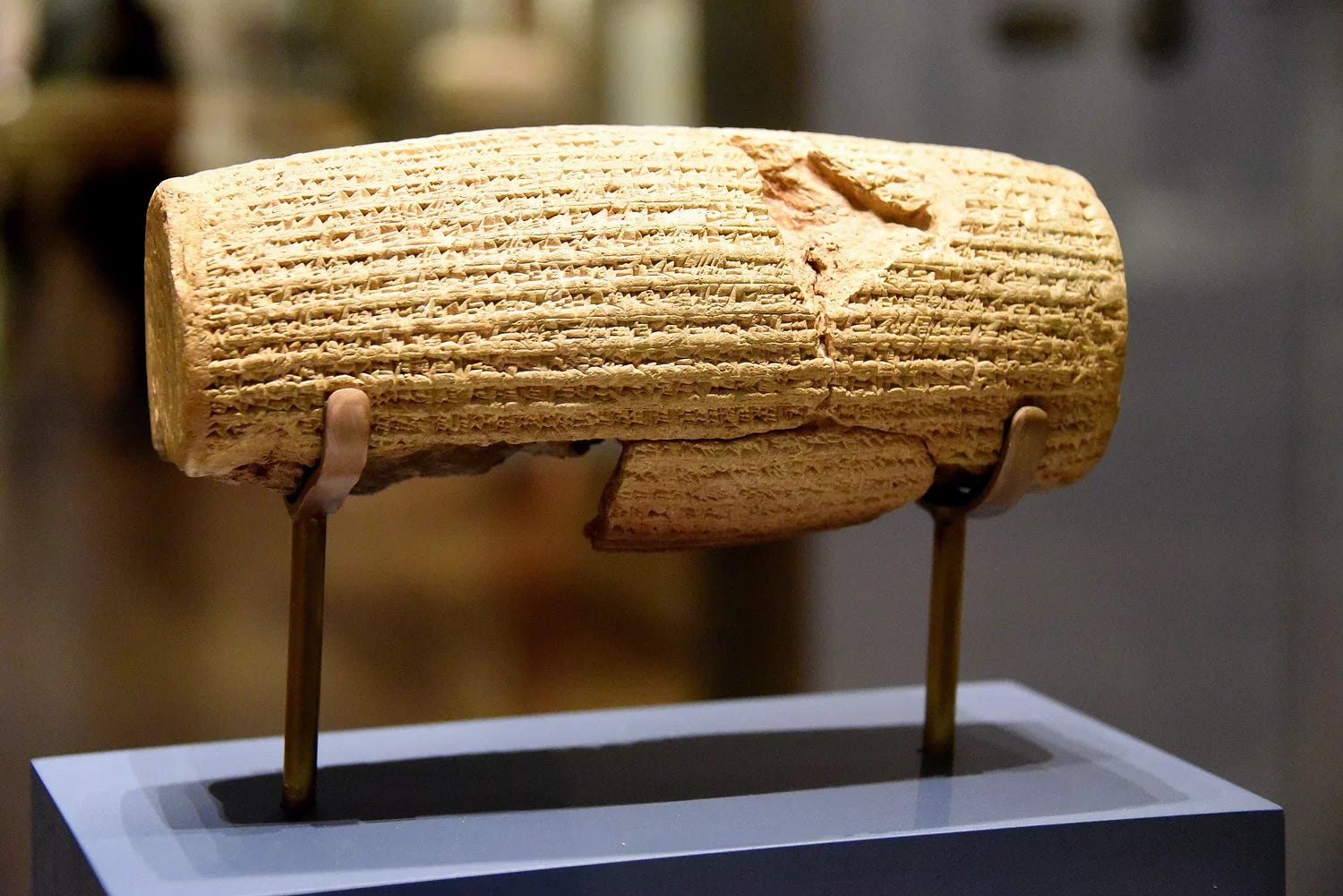
In 539 BCE, when Cyrus the Great conquered the city of Babylon, he inherited more than territory. His empire now encompassed a vast and diverse population—people of different languages, religions, and cultural traditions.
Rather than impose a single system of rule, Cyrus took a different approach. According to inscriptions on the Cyrus Cylinder, a clay artifact discovered in the 19th century and now housed in the British Museum in London, he allowed displaced communities to return to their homelands and restore their temples. Among them were Jewish populations exiled to Babylon.
The policies described on the cylinder have led some historians to view it as an early example of governance that recognized cultural and religious plurality. While interpretations vary, the artifact offers insight into how Cyrus sought to consolidate power across a heterogeneous empire.
Historians note that such policies were not simply ideological. Administering a vast empire required stability, and enforcing uniformity across regions with distinct traditions would likely have provoked resistance. By permitting local autonomy in matters of religion and culture, Cyrus maintained control while reducing the risk of unrest.
This approach helped sustain the Achaemenid Empire, which at its height stretched from parts of Eastern Europe to South Asia—one of the largest empires of the ancient world.
Today, the Cyrus Cylinder continues to draw attention from scholars and the public alike. Some have described it as an early charter of human rights, though others caution against applying modern frameworks to ancient texts. Still, it remains a rare and tangible record of how one ruler addressed the challenge of governing diversity more than two millennia ago.
In that sense, Cyrus’s rule offers a historical example of a question that remains relevant: how to build systems that accommodate difference while maintaining cohesion.
For a more reflective exploration of Cyrus the Great and the idea of enduring leadership, see my essay Ancient Ideas, Modern Questions: The Cyrus Cylinder.
How Rome Built an Empire by Borrowing From Others
Rome’s strength lay not in originality, but in adaptation at scale.

Rome built one of the most formidable empires in history—but many of the ideas that sustained it were not originally Roman.
From its earliest days, Rome grew not in isolation, but in conversation with the cultures around it. Many of the technologies and ideas that defined Roman power were borrowed, refined, and deployed at scale.
Among the most important of these was the arch. While closely associated with Roman engineering, the structural form was first developed by the Etruscans, a neighboring civilization in central Italy. The Romans adopted and expanded the use of arches, incorporating them into aqueducts, bridges, and monumental buildings that still stand today.
Greek influence was equally profound. Roman elites studied Greek philosophy, literature, and art, often translating and adapting them for Roman audiences. Latin literature, for instance, drew heavily on Greek models, while Roman sculpture frequently echoed Greek forms.
What distinguished Rome was not the originality of its ideas, but the consistency with which it absorbed and applied them. Roman engineers standardized construction techniques across vast territories, while administrators incorporated local customs into systems of governance that extended imperial control.
This ability to synthesize knowledge from multiple cultures helped sustain an empire that stretched across Europe, North Africa, and parts of the Middle East for centuries.
Historians today increasingly view Rome’s success through this lens—not simply as a story of conquest, but of integration. Its infrastructure, legal systems, and cultural practices were shaped by a wide range of influences, many of them external.
That legacy is still visible. Roman roads, legal principles, and architectural forms continue to influence modern societies, long after the empire itself collapsed.
In that sense, Rome’s enduring strength may have been less about what it created than how effectively it learned from others—and turned those lessons into systems that lasted.
The above pieces are shared as representative writing samples.
End of selected writing samples
Comments
Nothing yet. Say the first thing.
Sign in to join the conversation.