
Ancient history has always surprised me—for its moments of startling clarity, with ideas that feel, even now, ahead of their time.
Despite their age. And despite the bloodshed and power struggles that marked its empires, leaving deep scars on humanity.
In early Chinese history, kings like Yu the Great were chosen for their virtue, not their lineage—their authority grounded in their ability to bring order to chaos, as Yu did by taming the Yellow River’s floods, rather than in inherited power.
A striking idea, especially in a world still learning how to separate power from inheritance.
Perhaps there is something about beginnings—about systems not yet hardened into tradition—that allows for such experimentation. The first attempts at governance, at order, at coexistence carry a kind of openness that later eras often lose.
What emerges, then, is not a simple story of progress, but something more complex:
An ancient history that is at once brutal and unexpectedly wise.
If this resonates, you may enjoy subscribing for more reflections like this.
That paradox came alive for me when I found myself, quite unexpectedly, face-to-face with the Cyrus Cylinder at the British Museum in London—almost exactly two years ago, during spring break.
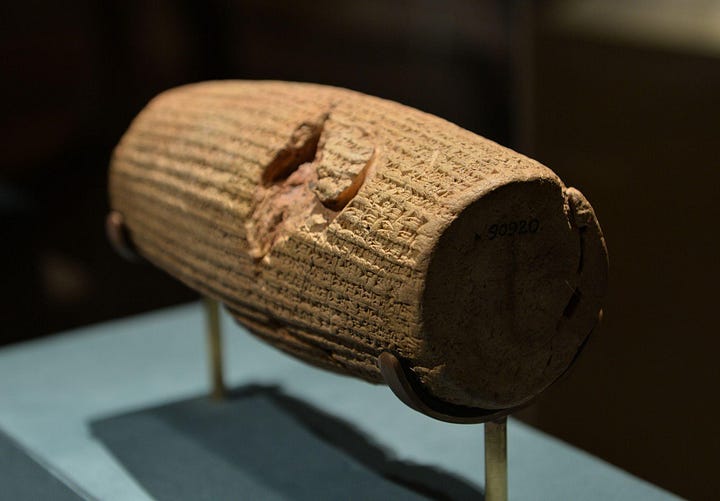
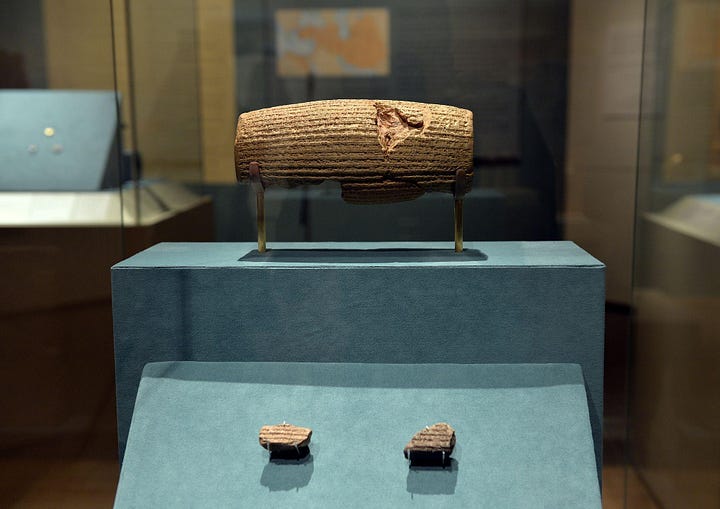
It was a surreal moment—one of those quiet encounters with history that feels both distant and deeply immediate.
The Cylinder itself is unassuming—neither towering Greek marble nor a gilded Baroque spectacle. Just a small clay object, inscribed in cuneiform, easy to miss amid the grandeur of the museum’s vast collections.
And yet, it carries the weight of an idea that has echoed across millennia:
An idea of power exercised not through domination, but through restraint.
The Cyrus Cylinder, a 6th century BCE relic, is often described as one of the earliest articulations of an approach to cultural and religious diversity. Biblical scholars have long seen it as evidence of Cyrus’s policy of repatriating the Jewish people following their Babylonian captivity—a remarkably forward-looking idea for its time.
But beyond the historical significance, what struck me was something quieter—its enduring relevance.
Cyrus the Great, the founder of the Achaemenid Empire, is often remembered not merely for conquest but for what followed.
Unlike many rules of his time, Cyrus allowed displaced communities to return to their homelands. He permitted them to rebuild their temples.
Cyrus chose, in effect, not to erase differences—but to accommodate them.
Standing there, I found myself wondering:
What does it mean that such an idea—acceptance of diversity—existed so long ago? And what does it mean that we still struggle with it today?
Some historians have even described the Cylinder as an early charter of human rights.
Granted, Cyrus was not simply being generous. He was being strategic.
His empire stretched across languages, religions, and cultures. Suppressing differences would have meant constant revolt. Accommodation, on the other hand, created stability.
Inclusion was not softness. It was part of his statecraft.
And yet, Cyrus deserves credit—not just for strategy, but for recognizing that differences need not be erased to sustain power.
More than two thousand years later, the lesson still resonates—quietly, insistently.
The most stable systems do not erase differences. They learn how to hold them.
And perhaps that is the deeper paradox the Cylinder leaves us with:
What we often call strength—control, uniformity, dominance—may in fact be its opposite. And what we dismiss as accommodation may be, in its own way, a more enduring form of power.
Meaningfully yours,
Anu Prabhala
If this made you pause, feel free to share it with someone who might enjoy the reflection.
No posts
Comments
Nothing yet. Say the first thing.
Sign in to join the conversation.