
So I think we have all got it by now (well, people in my Substackosphere anyway… the politicians still appear to be struggling):
Without oil, there is no economy. More specifically, without diesel, there is no economy.
Thanks for reading An Uncommon Land! This post is public so feel free to share it.
As petroleum geologist Art Berman puts it in his recent conversation with The Great Simplification’s Nate Hagens:
“Diesel … is the global economy. Diesel runs all the ships, all the trains. All the trucks, all the agricultural equipment, all the mining equipment. And those uses don’t have scalable substitutes, at least not in the near term. So if you don’t have diesel, you can’t move anything. You can’t mine anything. You can’t do very much of anything. So your economy comes to a screeching halt if you don’t have diesel.”
Sure, but we have been here before right – the 1978/9 oil crisis?
Well, yes and … no.
In terms of magnitude of impact, Berman calculates that this is about 100 times greater than the 1978/9 oil shock in terms of daily loss of oil to the economy (i.e., rate of loss). And as he points out, in previous crises, oil supply was lost gradually over a period of time – several months to years. In this case it literally happened overnight.
But if it is this bad, why aren’t we feeling any real shortages yet? As a number of commentators including Berman, the Honest Sorcerer and Richard Murphy have said, the full flow-through effects are yet to come. We are experiencing a Wiley E Coyote moment, where we are all suspended in mid-air, waiting for gravitational (or in this case, biophysical) forces to exert themselves. And when they do, it will not just be a shock that affects liquid fuels, but also fertiliser, food, and other supply chains.

The initial shock of lost supply has been dampened by the release of unprecedented volumes of reserve oil, particularly by the United States. But there will soon be no more to release, and that lost supply will be lost forever. In fact, Berman says that the impact of the shock will last until we stop using oil:
“We are going to be with constrained oil supply until we stop using oil.”
This cannot mean anything other than an economy that slows down, potentially entering an extended recession or even depression. Ultimately we can only hope that eventually we reach a new equilibrium; one that is much better aligned with planetary boundaries. But this is not planned degrowth. This is going be chaotic and messy and a lot of people will suffer. In the global South, they are already suffering.
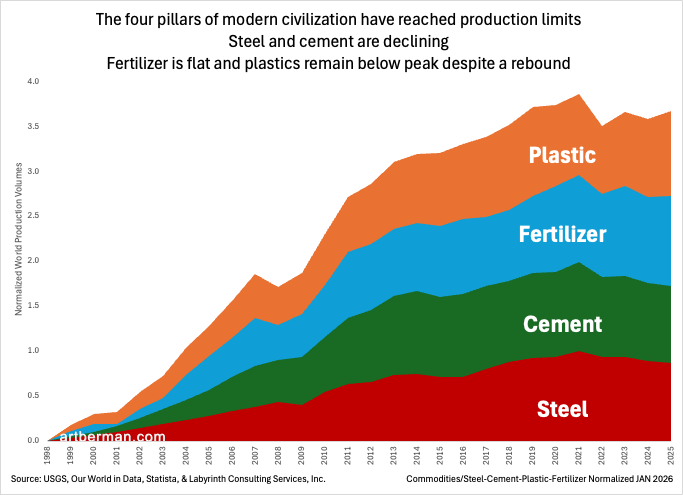
Intriguingly, this slow-down was occurring before the war on Iran (or as Berman put it, the ‘greatest military blunder since Napoleon decided to invade Russia in 1812’). Data on global production of plastic, fertiliser, cement and steel (the ‘four pillars of civilisation’ - all made using fossil fuels), are all in decline.
Clearly, in this situation, a little island nation at the bottom of the Earth, with minimal buying power and long supply chains, should be thinking about building resilience into our economy and into our social fabric. We will face critical supply issues in fuel, fertiliser, medical supplies, machinery, and many other things. We need to start planning for these and meanwhile become more self-sufficient in the things in which we have the capacity to do so. Food being a key example. We should not be shutting down local food manufacturing capacity; we should be encouraging more it. (Personally I think there is an urgent conversation to be had here about nationalisation or at the very least public investment.) And we need to be investing in the electrification of transport of the future (rail, trackless trams, buses) not squandering precious, scarce resources on four-lane motorways - bitumen monuments to the peak-oil past.1
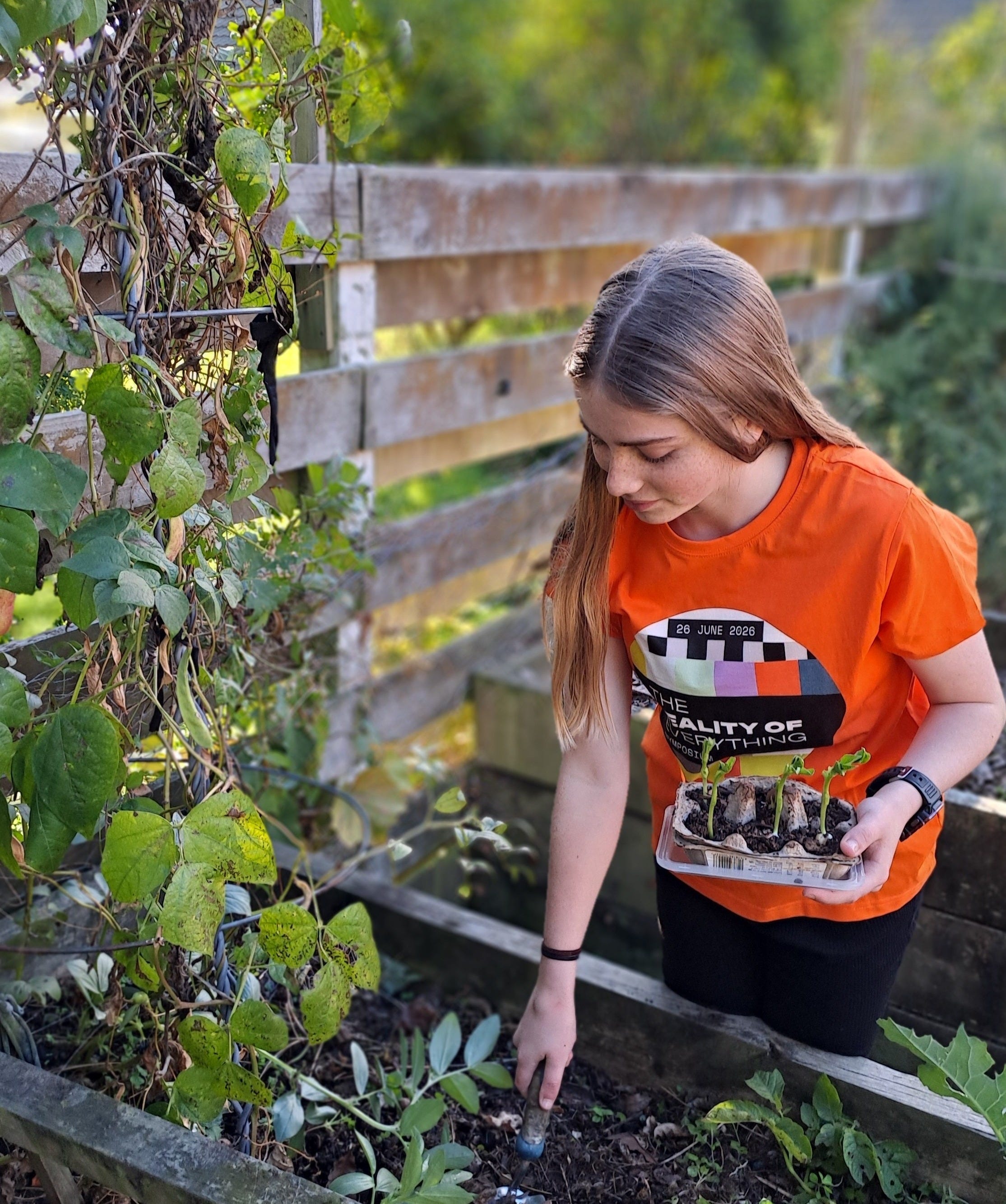
And what can you and I do? If you have a garden, plant some beans! If you don’t, see if you can support local community garden or food recovery initiatives. Or support your local repair café. (For other ideas, check out this guide developed by transition engineer Nathan Surendran /Wise Response.)
But what is the most important action of all? In my view, it is to be aware. And to amplify this awareness through our family, social and professional networks.
Talk about energy security. Talk about food security. Talk about diesel being the lifeblood of the economy. Talk about New Zealand being ‘the last bus stop on the planet’ - highly vulnerable to supply chain disruption. Talk about the urgent need for an economy centred on wellbeing and resilience, not growth.
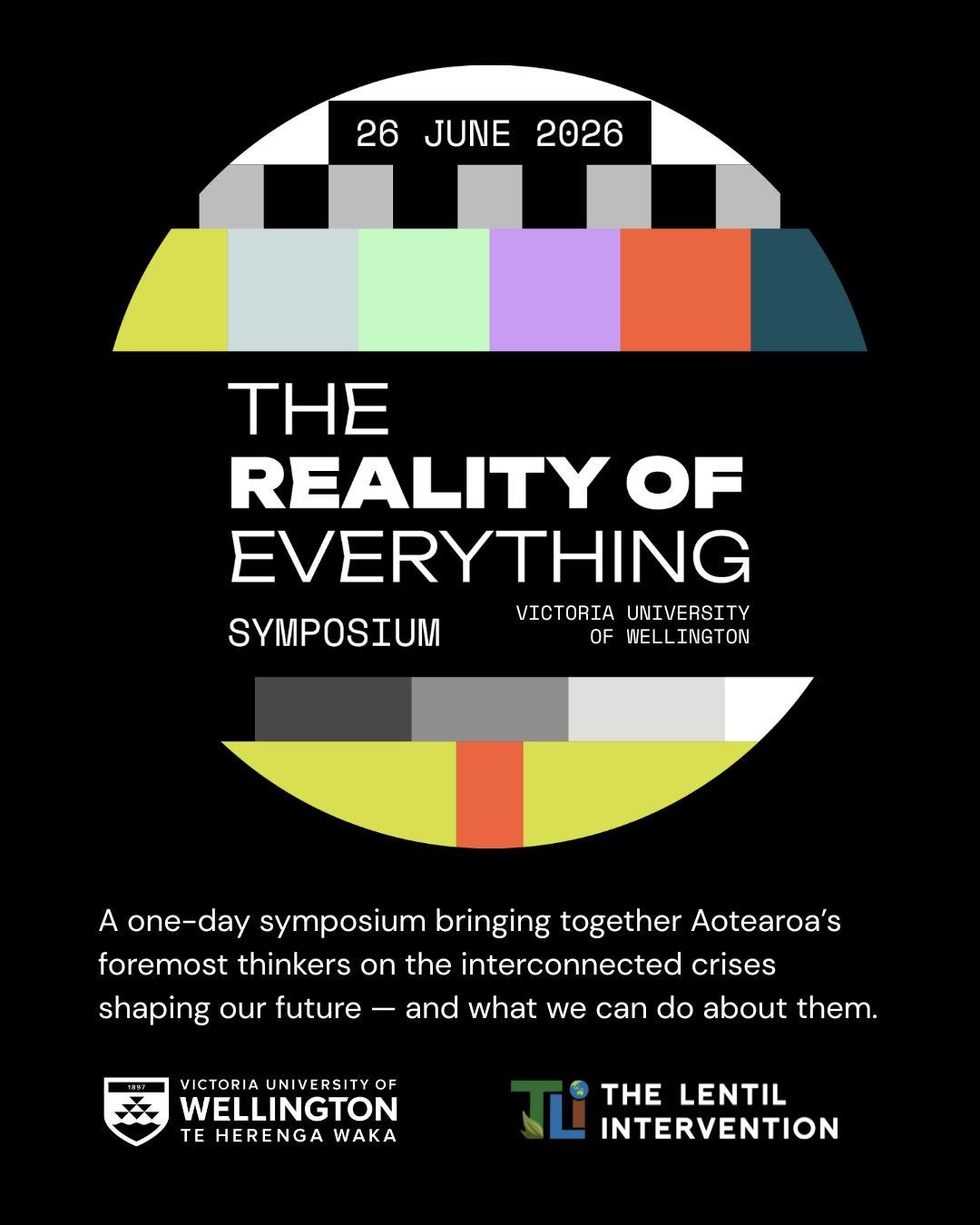
And of course, join us at The Reality of Everything Symposium, 26 June, where awareness will be theme of the day.
Help alert our political leaders to reality
·
Mar 4

As a follower of this Substack, you are probably already aware of the upcoming Reality of Everything Symposium and the intent behind it. You may have already secured your place at what could be 2026’s most important conference. But even if you can’t make it on the day, there are still important ways to you can
An analysis of pathways to greater social and economic resilience for the Wellington Region can be found here “Our Region 2050”.
No posts
Comments
Nothing yet. Say the first thing.
Sign in to join the conversation.