
Many of us make myriad choices in our lives - such as not to eat meat, to buy second-hand clothes and to use the bicycle rather than the car - with a sense that somehow, if enough people do the same, we will change how the economy works. That eventually the aggregate of all our green behaviours will “save the world”.
But it turns out we have been sold yet another myth. An all-pervasive version of the BP carbon footprint, which encouraged us to focus on reducing the greenhouse gas emissions generated by our own consumer choices, rather than trying to influence industry or government policy.
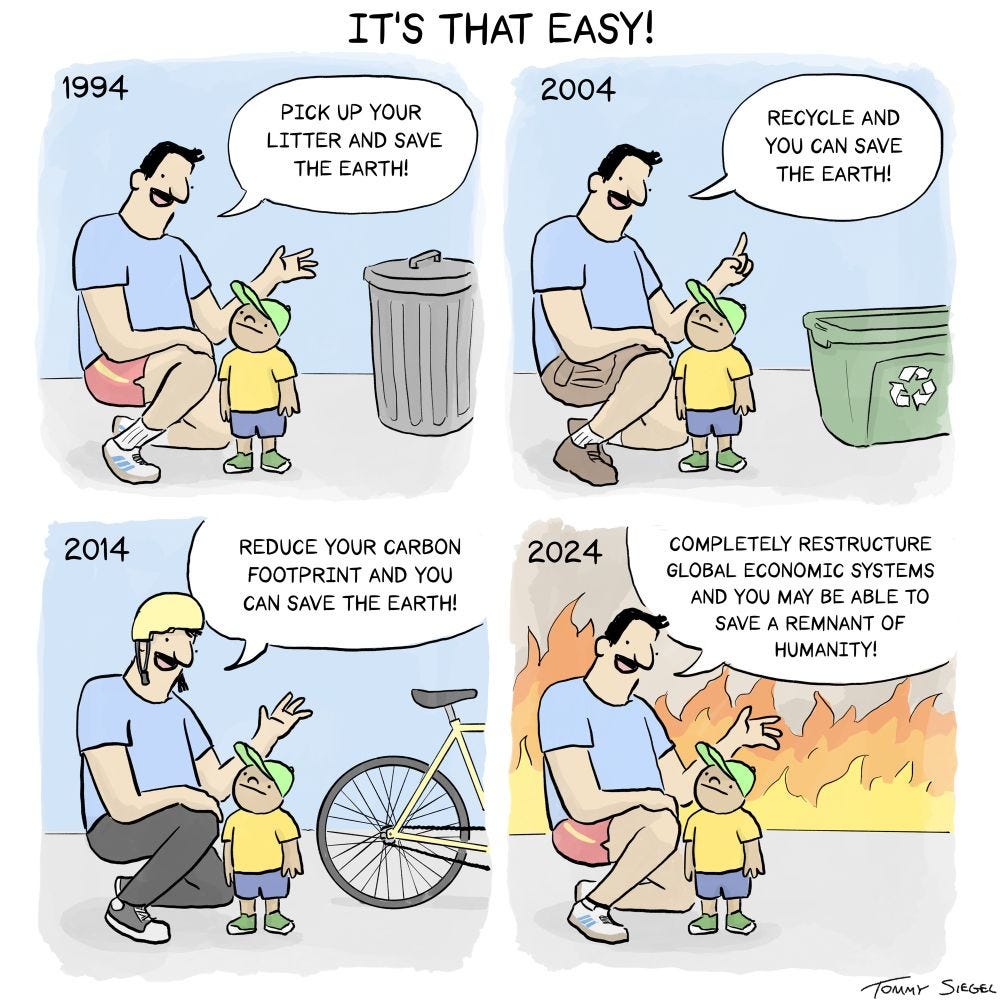
In fact, in his conversation with climate corruption journalist Rachel McDonald social scientist Michael Maniates goes further. He calls it a con. He also calls it corrosive, because individuals desperately wanting to effect change have been led to believe that it is not enough to make these choices individually; they must also persuade their friends, their family, their neighbours and their workmates do the same. And when that doesn’t happen, people become dejected and disillusioned.
But he is not saying that “going green and living lean” is not worthwhile. Far from it. Living in ways that reduce our impact on the biosphere make ethical sense and can enrich our lives and bring us into closer connection with our community and environment.
What he is saying is that we should not make these choices because we believe that somehow those behaviours are going to aggregate with those of others to lead to transformative political and social change. The social science on this is clear is no, he says: it is not going to happen.
Theoretically, Maniates says, behaviour change on a mass scale could provoke system change. “But I am hard-pressed to think of any instance of a successful challenge to dominant social, economic or political systems that has come from mass behaviour change as an initial driver.”
Those structural changes do not happen as a consequence of the aggregate of individual behaviours but rather concerted, direct efforts to transform the institutions we do have influence over. Not efforts mediated through the market.
“The Living Green Myth” as he calls it, emerged from a neoliberal economic system which has inculcated us with the belief that as consumers (not citizens, mind) operating in a “free market”, we have agency to change how the market works. But as Donald points out, there is nothing free about the market. Rather, it is labyrinthine system of regulatory support, incentives, subsidies and kickbacks, with every push towards greener consumption counteracted with even greater force by industry in its effort to maintain the status quo – or a version of the status quo. The example they discuss is the push to ban single-use plastic bags in some US states, which was initially stymied by industry touting recycling as the solution. And when plastic bags were eventually banned, the pulp and paper industry stepped in with their “solution” - single-use paper bags, whose production is arguably more energy-intensive and environmentally damaging than the plastic bags they replaced.
But he also warns against the argument that we just need a good crisis to get the behaviour change we need “to save the world”. “Crises rarely lead to progressive change,” he warns. In fact, as we saw with the rise of neoliberalism itself, crises are often used a justification for the stripping back of democratic institutions and public investment.
Thanks for reading An Uncommon Land! This post is public so feel free to share it.
But here is the crux of it. Maniates is not arguing that we don’t as individuals have power.
“We have power. We have individual agency. But we should not be frittering it away trying to decide between paper or plastic or getting the neighbour to hang their washing on the line.
We should be preaching to the converted rather than trying to convert those not in solidarity with us, and getting on with the business of organising for structural change.”
Hallelujah. Let’s do it, people!
Climate change is not a big issue for New Zealanders …
·
Feb 14

In our MMP political environment, all (it seems) politicians care about is public opinion. There are political polls every few weeks, the results breathlessly relayed to us by the media: which party has gained a point or two and which ones have slumped; which leader is most popular (or, perhaps more…
Myth or reality? The circular economy
·
December 26, 2025

As we sit contemplating the mountain of packaging and - dare I say it - unwanted or unneeded gifts left in the wake of the gift-giving frenzy of Christmas, not to mention the temptation of Boxing Day sales, it struck m…
No posts
Comments
Nothing yet. Say the first thing.
Sign in to join the conversation.