
Sounds
Joshua Bonnetta
The Pines
(Shelter Press & The Dim Coast)
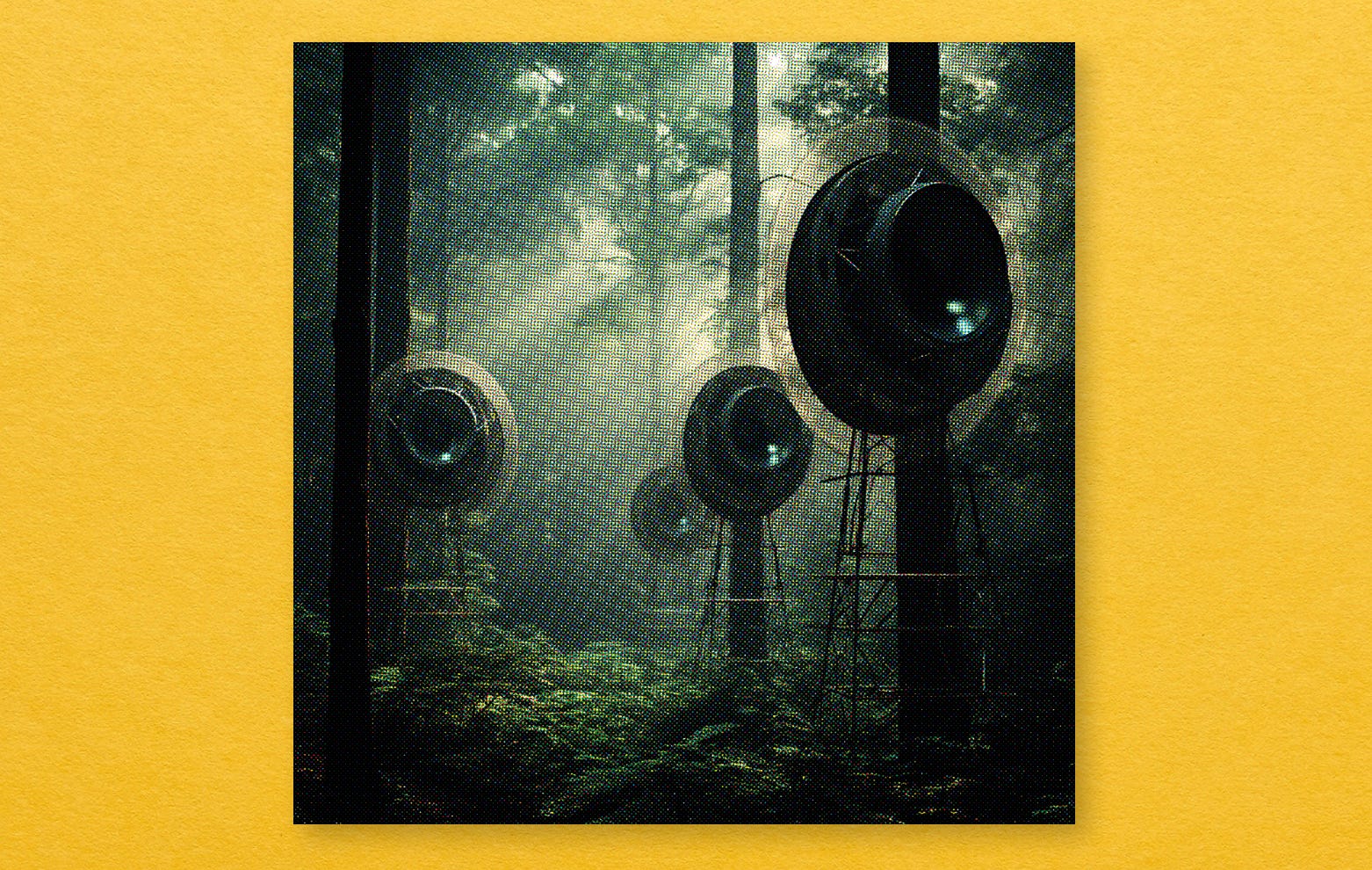
Thirty-eight minutes in and there is a rustling in the undergrowth. The muffled footsteps of a nondescript mammal rustle in the leaves. The pine wood creaks. A bird screeches. A rush and scuffle as the beast tumbles off into the distance. Edited from 8760 hours of audio recordings, sound artist and filmmaker Joshua Bonnetta’s latest project The Pines is an arboreal epic - a four-hour ecoacoustic suite capturing the year-long lifecycle of a pine tree in Tioga County, NY.
Using passive acoustic monitoring equipment strapped 10 metres up a tree trunk, the recordings are split into four hour-long seasons, stitched together to create a concentrated, continuous listening experience. Like many durational works, things really start to get interesting when you lose yourself in the recording and time begins to bend and stretch in unusual ways.
As much as The Pines points towards a slow and situated listening to the natural world without human interference, I found the cumulative experience almost psychedelic, as sounds, rhythms and moods drift in and out of focus, some impossibly close, others eerily distant as to almost be auditory hallucinations, impossible to pin to any single source. A simple idea, uniquely realised, The Pines is a beautifully open-ended work, realised at a scale few would be brave enough to undertake.
(Look out for an interview with Joshua about the work in the next few months here on Through Sounds.)
Being Strangers
Concrete Dreams of Sound
(Built Sound)
Concrete Dreams of Sound is rooted in a proposition: What could music be if it were made of architecture? Built from detailed spatial and acoustic recordings of the Barbican Centre in London, using instruments and sensors to capture airborne and structural vibrations that were then played back into the spaces they were recorded, Concrete Dreams of Sound exposes the sonic materiality inherent in the spaces and structures that surround us. Accompanied by Gascia Ouzounian’s textural violin playing, it offers a new aural perspective on a built environment that has long been an inspiration for artists, film-makers and photographers.
Various Artists
Afrosonica
(FLEE)
I’ve been aware of FLEE for several years now, and amid the great sea of reissues and archival projects, the Paris-based label have always stuck out for their attention to detail and ethnographic engagement with the music they release. Teaming up with the MEG (Museum of Ethnography) in Geneva, this latest project brings together the four artists commissioned for the exhibition Afrosonica - Soundscapes. Released alongside a hardback book exploring the ideas behind the project, KMRU, Midori Takada, Yara Mekawei, and Ntshepe Tsekere Bopape (Mo Laudi) begin to chip away at reframing the Western-centric notion of the archive, and the often racist anthropological research that underpinned it. KMRU’s piece in particular knits together a collage of sonic materials and trajectories that jar and provoke through juxtaposition.
Andrew Pekler
New Environments & Rhythm Studies
(Faitiche)
I’ve referred back to Andrew Pekler’s Phantom Islands over and over again since I came across it a few years ago, both as a piece of interactive design and series of speculative compositions, imagining the sounds of islands lost in the mapping and remapping of the world over several centuries. Sonically at least, New Environments & Rhythm Studies feels like it is drawing from the same well, full of equal parts unsettling and compelling atmospheres crafted from synthetic, looped or manipulated field recordings (such as crickets and other insects), that “attempt to re-describe past tropes which laid claims to authentically represent music and sound from beyond the Western world (exotica, ethnomusicology, field recording) as undertakings of the imaginary.”
Khaled Kurbeh
Likulli Fadāin Eqāéh لكلّّ فضاءٍٍ إيقاعه
(Research Records)
With a title that translates as ‘to each space its own rhythm’, Berlin-based Syrian musician Khaled Kurbeh’s new album is a striking electro-acoustic work with its own internal architecture - at times expansive and speculative, at others densely textured, and intricately detailed. Drawing on field recordings (swallows, sunflower seeds among others) and elements of musique concrete, each track feels like its own kind of mnemonic device, taking its place within the broader landscape hinted at in the album’s bold artwork.
Morgan Szymanski & Tommy Perman
Songs for the Mist Forest
(Blackford Hill Audio)
A record that extends guitarist Morgan Szymanski and artist Tommy Perman’s soundtrack to documentary film El Dragón de los Bosques de Niebla (The Dragon of the Mist Forest), which follows ongoing ecocide in the Valle de Bravo in Mexico where overdevelopment is threatening the survival of native Abronias reptiles. Weaving Szymanski’s acoustic guitar lines with field recordings from the Valle de Bravo, it offers an emotive response to a local environmental crisis that could speak for so many other conservation challenges around the world.
Various Artists
mɜː.məˈreɪ.ʃən #5 - transmit
(Murmurations)
Emerging from a listening and recording residency run by Jez Riley French in Glenshee, Scotland, last year’s iteration of Murmurations gathers around the idea of transmission, “ from remote streaming, to spoken scores in-situ, and to thinking about how sound history is communicated…or rather, how it has been and can be.” The subsequent release features 26 tracks made by the participants and spans a huge breadth of ideas and approaches. You can find out more about the 2025 Murmuration here.
Wampís of Guayabal & Aboutface
Los Bosquesinos
(Coordinates)
A sensitively produced collaboration between UK-based artist Aboutface and indigenous Wampís forest community living in the Peruvian Amazon. Based on collaborative recordings made during a month Aboutface spent living with the Wampís, the album’s four tracks are improvisations on Nampets - ancient songs sung from the perspective of animals living in their rainforest environment. All sales revenue from the project will go to the Wampís to support indigenous-led conservation initiatives against illegal deforestation and ecocide.
Qasim Naqvi
Endling
(Erased Tapes)
An endling is the final member of a species. On his new album for Erased Tapes, Pakistani-American composer Qasim Naqvi takes a modular journey into the future to narrate the story of the last living human. A piece of speculative world-building - or world dismantling - the album accompanies its protagonist “through the crumbling landscape of the future … now being overtaken and absorbed by the natural world.” Testing boundaries between organism and machine, Endling is a sophisticated and layered record, and an imaginative response to the spectres of extinction and species loss which haunt our present.
Asher Levitas
Peripheral Lands
Sound artist Asher Levitas draws inspiration from Nan Shepherd’s The Living Mountain for a four-track investigation of sonic ecologies, both above and below the water line. Threading each composition with field recordings that reject binaries of nature and culture, Levitas allows for the sounds of bat echolocation calls, fish respirations or static electrical charges to lead the mood and rhythm of each piece. Levitas also has a new album out now called I Wish We Could Tell You Everything, which you can find here.
to you they are birds, to me they are voices in the forest
June 7th Pt. 1 & 2
(Vibrant Matter)
A live release by newly formed Bergen-based duo Daiyen Jone Castro and Knut Jonas Sellevold, this short-run cassette release takes a subtle and meditative journey through a verdant, imaginary environment. This is improvised, visually evocative music that treads a fine line between critical field recordings and post-natural aesthetics. If you like flutes and ambient electronics, then this one is definitely for you.
Machine Listening
Environments 12
(Futura Resistenza)
Between 1969 and 1979 sound recordist Irv Tiebel oversaw the production of an 11-album series called Environments featuring field recordings and natural soundscapes that contributed to the creation of what is now a booming nature-based mood music economy. First created as an 8-channel sound installation, Environments 12 is a speculative twelfth edition in the series which “unfolds across a series of historical, contemporary, and speculative scenes, narrated by an ensemble of vocal performers and their generative voice clones.” Delivered from the vantage point of an altered nature, it’s a fascinating engagement with both the idea of sonic environments and human obsession with capturing and repackaging them.
Books & reading
Following their collection of feminist sound writing Bodies of Sound, Silver Press have recently republished Anna Carson’s 1995 essay The Gender of Sound, which is a fascinating and digestible exploration of the ways in which utterances are deemed either acceptable or hysterical, deviant or conformist within patriarchal Western society. It’s short and snappy and knitted together by Carson’s wonderful prose.
Other bits of reading to recommend include an essay by Shzr Ee Tan on the sonic regimes of domestic workers in southeast Asia; an interview on sound and power with artist and Earshot founder Lawrence Abu Hamdan in Frieze; a wide-ranging meditation on Aura Satz’s Preemptive Listening and the sonic politics of emergency published by Liquid Architecture; and, if you pick up a copy of this month’s Wire magazine, a short piece by me on contemporary bells.
Exhibitions
The Wellcome Collection currently has an exhibition called 1880 THAT, featuring works by Christine Sun Kim and Thomas Mader that explores sign language, the right to communicate and “the idea of language as a home - an essential place of belonging - and what it means to live with the threat of losing one's language.”
Given the relevance to this newsletter it’s worth also pointing to Barbican’s new show ‘Feel the Sound’, which makes the point that we listen with more than just our ears. A simple idea, it brings together work by lots of artists and practitioners I really admire - Evan Ifekoya, Jan St. Werner, Ryuishi Sakamoto, Yuri Suzuki, Holly Herndon and Cities & Memory - in a way that sadly makes it difficult to really engage with them on a meaningful level. In one short film Dame Evelyn Glennie asks us to “trust that in the quiet spaces real connection and understanding can emerge”, but jammed together in the resonant and high-ceilinged Curve, that simply isn’t possible. It’s shame because this feels like a missed opportunity to engage a much wider audience with some fantastic sound work.
Another sound-focussed exhibition running this summer is Nottingham Contemporary’s Your Ears Later Will Know To Listen, which draws on methods of “foraging” and “disfiguration” from cultural historian Saidiya Hartman’s writing (for anyone unfamiliar, Wayward Lives, Beautiful Experiments is a great place to start) to consider “how sound travels and transitions through cross-cultural identities, histories, and futures.” I’ve not been yet, but the premise of listening back to uncover lost histories hints at the more radical and empancipatory potential of sound and a nuanced exploration of the positionality of the listener. Expect new commissions from Satch Hoyt, Raheel Khan and Dylan Robinson (who is speaking at CRiSAP on 4th July), alongside works by Nguyễn Trinh Thi, Hong-Kai Wang, Simnikiwe Buhlungu and more.
Back in London, there are some great aquatic events upcoming at Microscope in Dalston this month - starting with the Office of Slow Tides - a residency by artists Sonia Levy, and Kirsty Badenoch, between the 23rd and 26th June, and followed by the launch of Chasing Water, an exhibition by ETH Zurich’s DELUS Journal for Landscape and Urbanism Studies, on Thursday 3rd July.
Films
Finally, two beautiful, speculative and highly original documentaries to recommend this month. First up, Eleanor Mortimer’s exploration of deep sea taxonomy ‘How Deep is Your Love’, complete with fascinating selection of sea cucumbers and a healthy dose of Herzogian anthropology. And secondly, a strikingly shot and poetic film by Jeffrey Zablotny visiting three subterranean telescopes in remote regions of Canada, Japan, and Antarctica. Although focussed on different environments, they share an interest in depth - both physical and metaphysical - and the limits of what we can know about the world.
Thanks for reading Through Sounds! Subscribe for free to receive new posts and support my work.
Comments
Nothing yet. Say the first thing.
Sign in to join the conversation.