
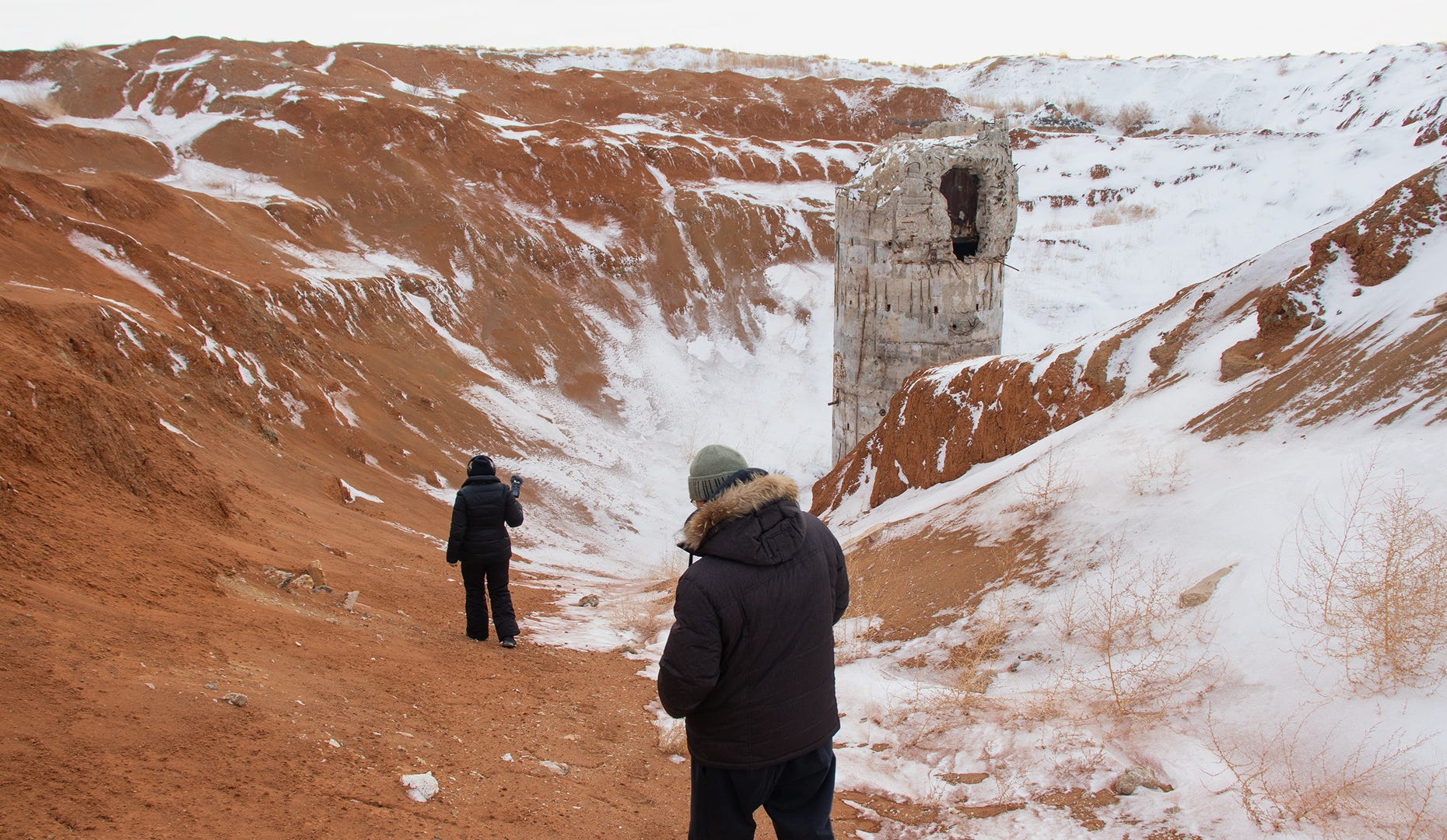
There is a phrase in the introduction of Cal Flyn’s book Islands of Abandonment that has stayed with me since I read it a few years ago: “Every environment bears a palimpsest of its past.” In Flyn’s case, visiting sites of historic pollution, ecological collapse or urban decay, it calls us to look a little more closely. Understood in sonic terms, it’s also a phrase that could be applied to the work of Vicky Clarke and Kamila Narysheva, whose 2025 project T1/2 listens between the layers of overwrite at Semipalatinsk, a Soviet-era nuclear test site in Narysheva’s native Kazakhstan.
Semipalatinsk, also known as the Polygon, was the primary nuclear test site for the Soviet Union. Roughly the size of Belgium, the site was subject to around 450 nuclear tests between 1949 and 1989. Some were atmospheric, others were underground - all exposed the rural Kazakh population to unsafe levels of radiation without prior warning. Shut down in 1991, the environmental and public health impacts remain - a dirty legacy of geopolitical misadventure and slow violence, whose history has yet to have been fully reckoned with.
Brought together by the British Council, the remote collaboration between Manchester-based sound artist Vicky Clarke and Almaty curator and researcher Kamila Narysheva focussed on teasing out the acoustic memories of the site, using sound as a medium through which to transmit the “invisible but tangible traces of catastrophic events.”
Based on Narysheva’s in-person field recordings and subsequently manipulated and composed with Clarke into a 37-minute piece, T1/2 was premiered in the basement gallery of a former Soviet building in Almaty earlier this year, referencing not only the psychological and architectural elements of the site, but also providing a contrast to the themes of ecological repair and renewal that they encountered in the sonic environment.
What initially interested you about working at the Semipalatinsk Test Site?
[Kamila Narysheva] It started as something both distant and strangely close. My dad’s side of the family is from northern Kazakhstan, and many of them spent years living in and around Semey. Growing up, I heard stories. They were never dramatic, often quiet, but the Test Site was always somewhere in the background. It would come up in passing, but rarely in detail. That kind of heavy silence stayed with me. What drew me in was a feeling that something important had been left unprocessed, not just historically, but emotionally and culturally. I was curious about how the Test Site exists in the national imagination, and at the same time how absent it can feel. Over time, I began to see it less as a historical location and more as an ongoing condition, something that still hums quietly beneath the surface.
I also kept returning to the idea of the "half-life." Not only as a scientific term, but as a metaphor: for interrupted lives, for suspended time, for stories that were never fully told. Working at the site became a way for me to listen more carefully. Not just with my ears, but with attention and care, and with a willingness to sit with things that resist easy explanation.
In many ways, working on T1/2 has been a way of trying to get closer to that unspoken legacy. It’s about listening for what hasn’t been said, or couldn’t be said, across generations.
What does the site feel like when you are there? And what does it sound like?
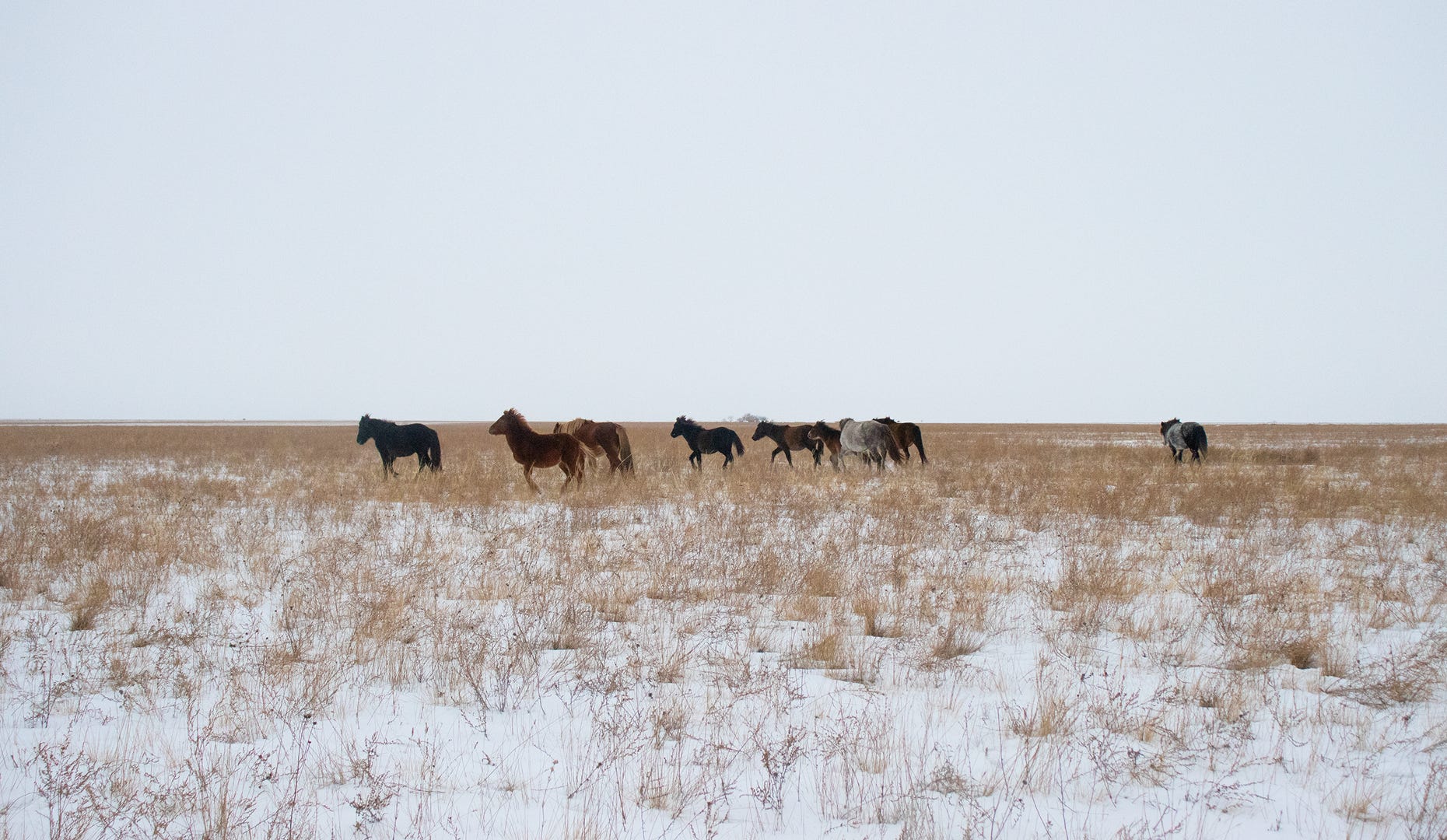
[KN] Being there is unsettling in a quiet way. Not dramatic like in the documentaries. No warning signs, no spectacle. Just steppe stretching endlessly, snow in winter, dry grasses, a few crumbling structures. The silence is thick, as if something has been pulled out of the air. The stillness feels off, charged by what you know happened there. The site sounds almost like nothing. Wind. Footsteps. But that absence becomes its own sound. I recorded through different mics, pipes, soil, concrete remains, all gently vibrating with air and time.
0:00
-3:04
Wind on the steppe
And within that stillness, there’s a kind of quiet resilience. Grasses push through. Birds nest in old impact sites, horses graze along the road. The land hasn’t forgotten, but it’s learning to hold both damage and recovery at once.
What kind of recordings did you make and what were you interested in discovering through making these recordings?
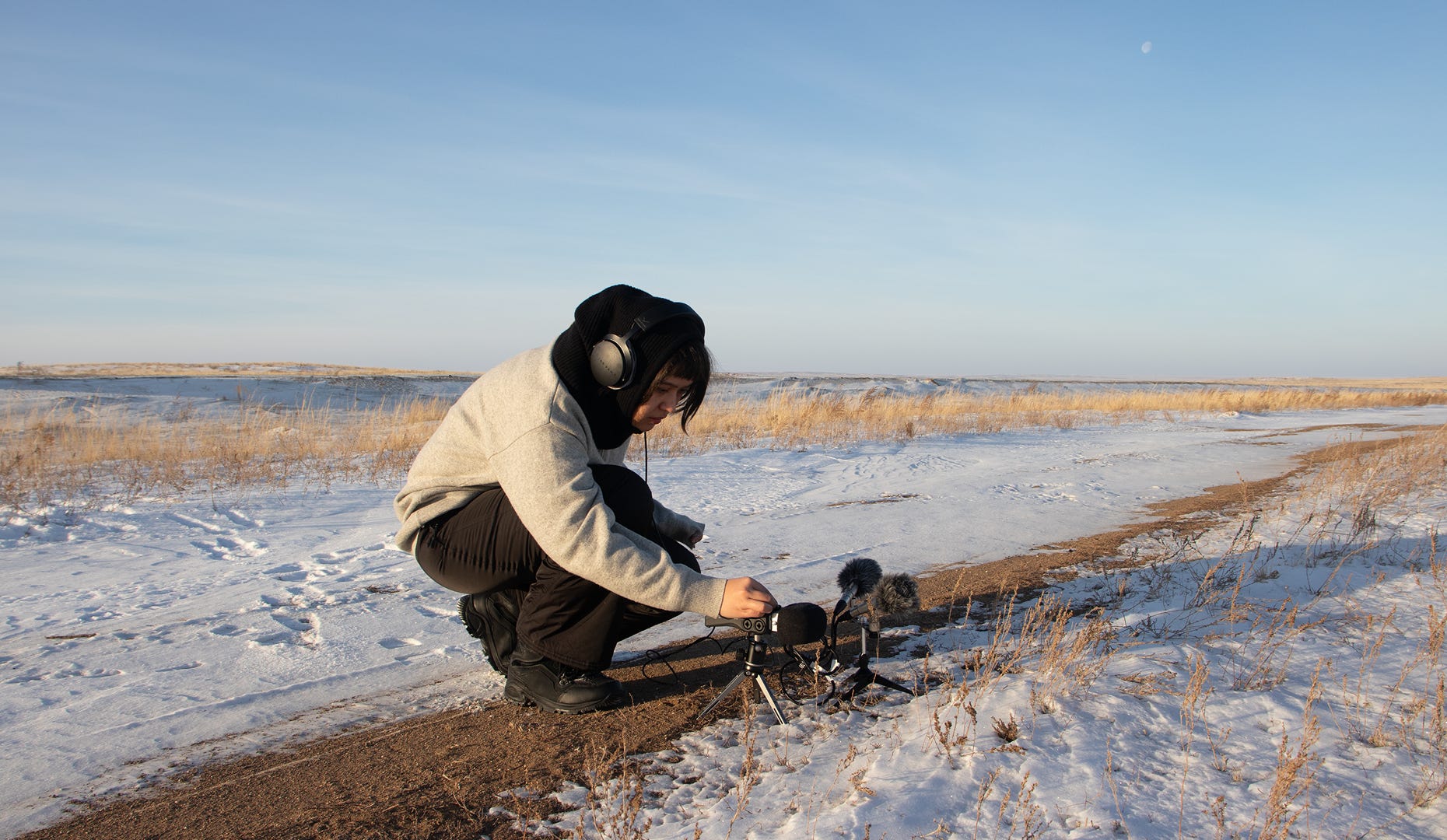
[KN] I was interested in how different materials and surfaces at the site might hold onto memory. I used contact microphones on rusted debris, geophones in the soil, hydrophones in bodies of water. One of the most striking moments was submerging a hydrophone into the Atomic Lake, a crater lake on the site, and into the Irtysh River, which had once supplied the Test Site’s industrial operations. These recordings felt deeply charged, not just acoustically but symbolically.
0:00
-3:37
Decay of materials, Atomic Lake
While some recordings were passive, letting the environment unfold, I also experimented with more direct interventions. At one point, I attached a contact mic to a slab of concrete and struck the exposed metal rods embedded in it, trying to trace how impact traveled through forgotten infrastructure. I paid close attention to elements that made the Polygon function: the railroads, the river, the built and broken systems of extraction and logistics. These were often overlooked in how the site is represented, but I saw them as central to its acoustic and political history.
What I hoped to discover was not a single truth but a layered acoustic image. The recordings are not illustrative or explanatory. They ask you to spend time, to attune yourself to the site’s more subtle expressions: what still vibrates, what barely moves.
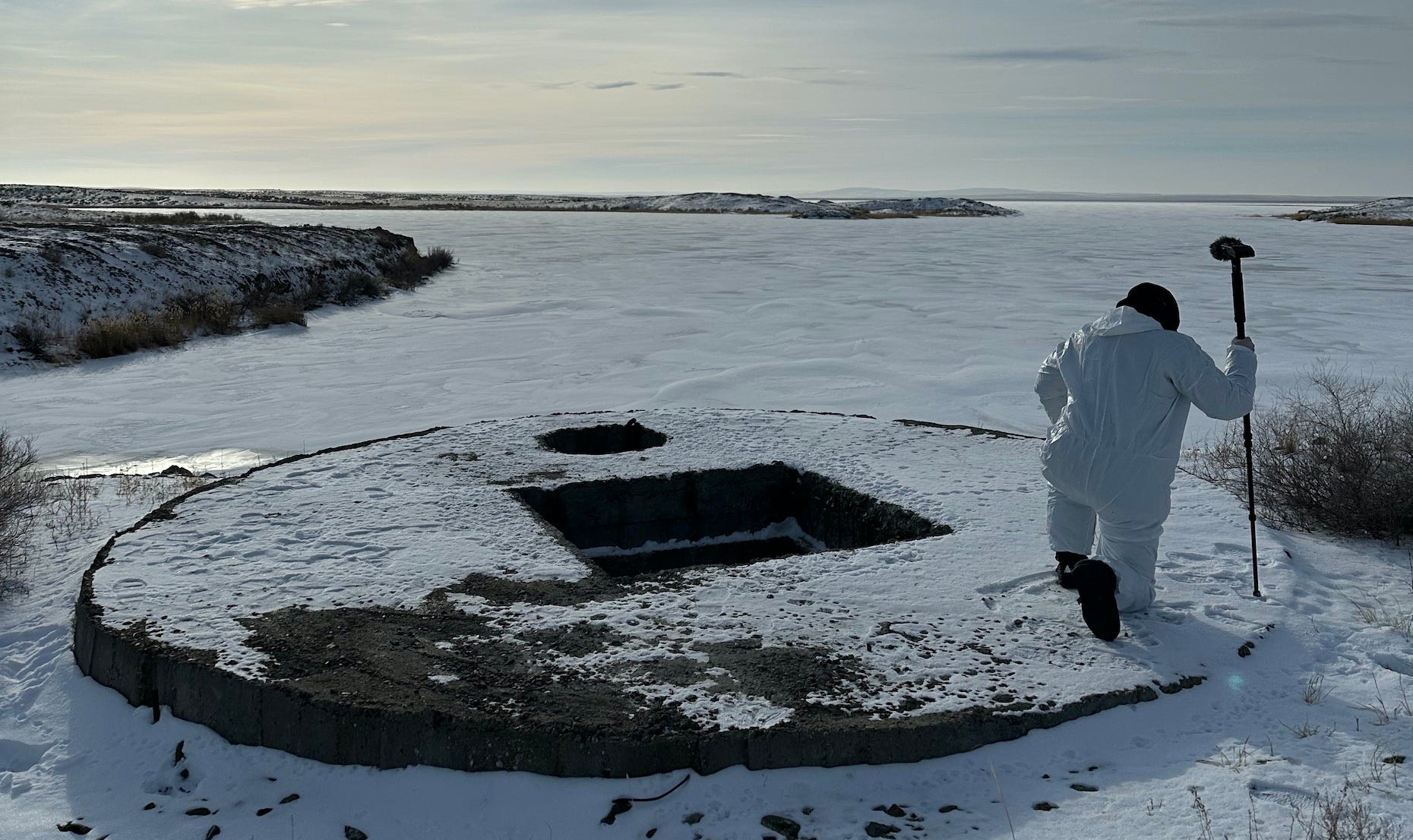
[Vicky Clarke] The range of recordings was fascinating to listen back to, from vast open expansive wind from the Steppe to subterranean bunker recordings to the inside of concrete and metal rods and debris. We undertook a listening and categorisation process that was initially anonymous, so Kamila sent me the recordings, and I listened without the knowledge of what they were. It was interesting to compare what I imagined the sounds to be and then Kamila revealed the recording details. I found this fascinating as my practice is inspired by concrete techniques and approaches, considering sound without context, so I saw these samples as sonic fragments or atoms that had innate qualities. I am very much in the camp of letting sounds speak for themselves, letting the material guide you through the composition process. For myself who wasn’t able to go physically to the site, I wanted to discover and relate to the location through the recordings themselves.
How did you process, manipulate and compose using the original recordings?
[VC] In general we wanted to stay true to the material recordings and not process them too much, enabling the listener to become as close to the source sounds as possible. Where we added some manipulations for dramatic effect, for example there is a drone sequence created out of layered planes and pitches, it was important that these were made from the field recorded material and not inserting a synthesiser line that might take it away from its source.
0:00
-3:37
Planes and industrial noise recording
There was so much depth in terms of frequency content to play will, lots of low and moody rumbles and claustrophobic feelings to glitch small micro sounds so it was important that each sound was heard and ordered, so where needed there was of course some small EQ here and there, and even with field recordings these are already edits, choices made at the time of recording, so there is already an imprint. Another dynamic of working with the micro to the expansive sounds was to enable them to inhibit space. As a durational piece (37 mins), sounds needed to breathe and allow the listener to inhabit them before transitioning into something new, so changes often happened subtly and slowly to evolve to new sound spheres.
There was a key section of the piece where we did manipulate sound recordings, in order to purposely and drastically degrade them over time, an artistic motif to convey the poetic ideas of decay and transformation.

Expanding on this, could you explain the relationship between radionuclides, decay and regeneration that is also central to this project?
[VC] At the start of our collaboration we brainstormed ideas, influences and what inspired us sonically around the theme of Half Life ((T½) is the time required for a quantity (of substance) to reduce to half of its initial value), we had many cross overs including deep time, technological materiality and transmutation. We thought it would be interesting to develop an algorithm that could decay sound material itself, so we developed a Half Life Max MSP patch that deconstructed recorded samples from the Polygon and used these within our piece. A key reference point was Togzhan Kassenova’s Atomic Steppe book, which lists the half lives of the radionuclides found on the Steppe, these include Carbon, Tritium, Strontium. From here we mapped and translated these (often very long) time intervals into more musical temporalities (i.e. number of seconds rather than years) that would take a sample at full fidelity and move to total degradation through an exponential curve.
We made this into a Max4live patch for use on [music production software] Ableton so we could both experiment, so the user adds the effect to a channel, draws a curve, presses go, and you can hear the sample degrading over time. This was an interesting creative process as depending on the time interval and steepness of the curve, you can get lost within a sample’s materiality.
For our composition we degraded lots of the materials and added these within a key section of the piece. Crucially although it is a degrading curve, the material never disappears to nothing, it has become transformed into something new, reflecting a recurring motif of our project, that material transmutes into something else, that life finds a way.
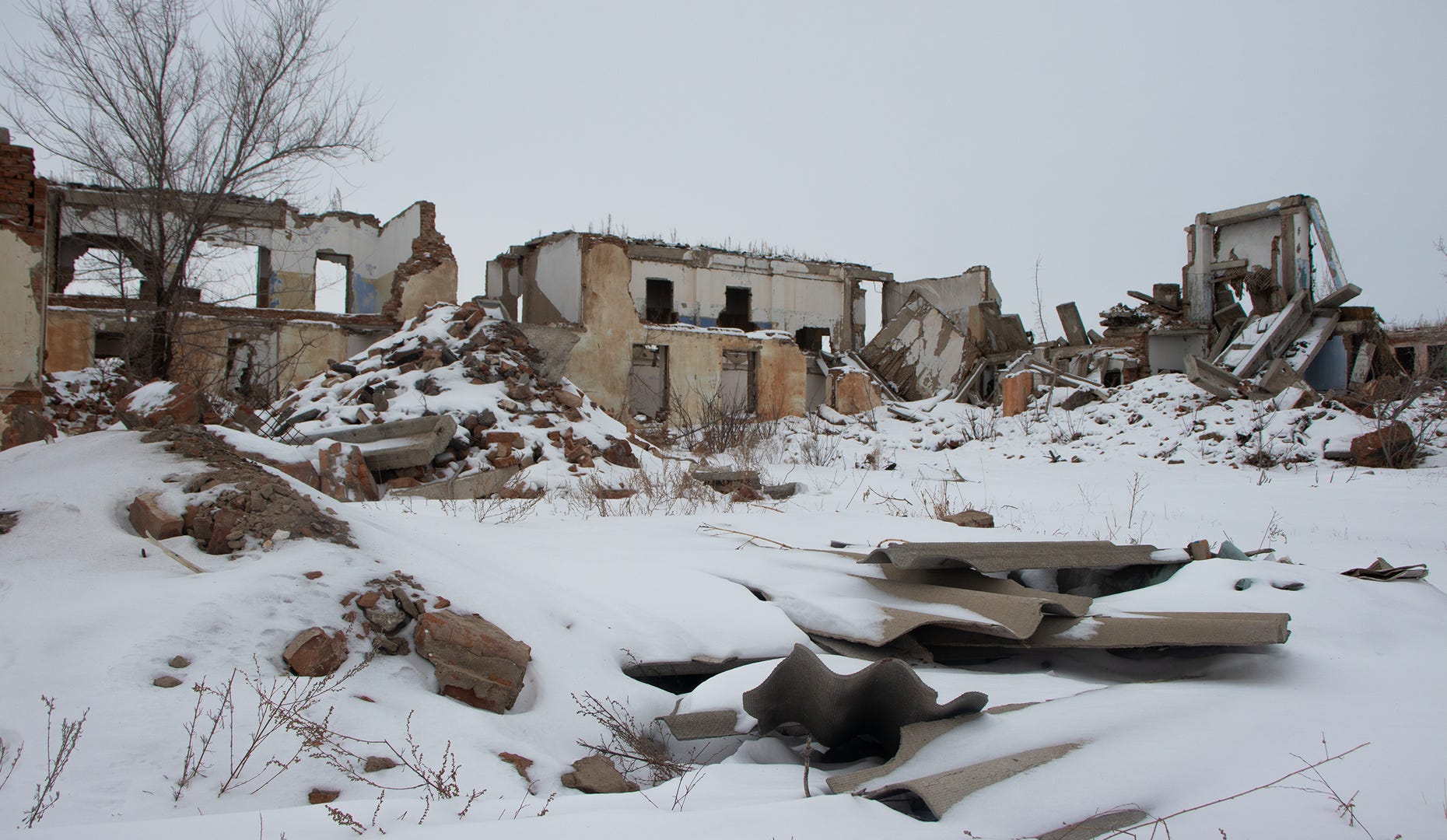
In her book Curated Decay, Caitlin DeSilvey talks of how artistic interventions can serve to both create new narratives and rehabilitate sites of historical violence. How did you navigate this tension between the site’s dark history and the aesthetic needs of an artistic project?
[KN] This was a central concern for us throughout the project. We were aware that any artistic approach would inevitably reframe the site in some way, and we wanted to be careful not to aestheticise or simplify its traumatic history. Rather than aiming to represent or explain the site, we focused on creating a space for deep listening and attention, something that invites reflection without offering closure.
The sound installation was intentionally minimal and immersive. We kept the space dark, slow, and physically quiet, so that the audience could engage with the material in a bodily, open-ended way. We didn’t want to dramatize or illustrate the history. Instead, we were interested in holding space for what continues to resonate: what is still felt, even when it’s not directly visible or audible.
Equally important to us was grounding the work beyond the gallery space. From the beginning, I planned a public programme alongside the installation, inviting artists, researchers, and community members, especially those from Semey and nearby regions, to contribute. I saw this as a way to shift the frame of the project away from isolated artistic authorship and toward something more collective, situated, and accountable. Creating space for those voices felt essential to the integrity of the work.
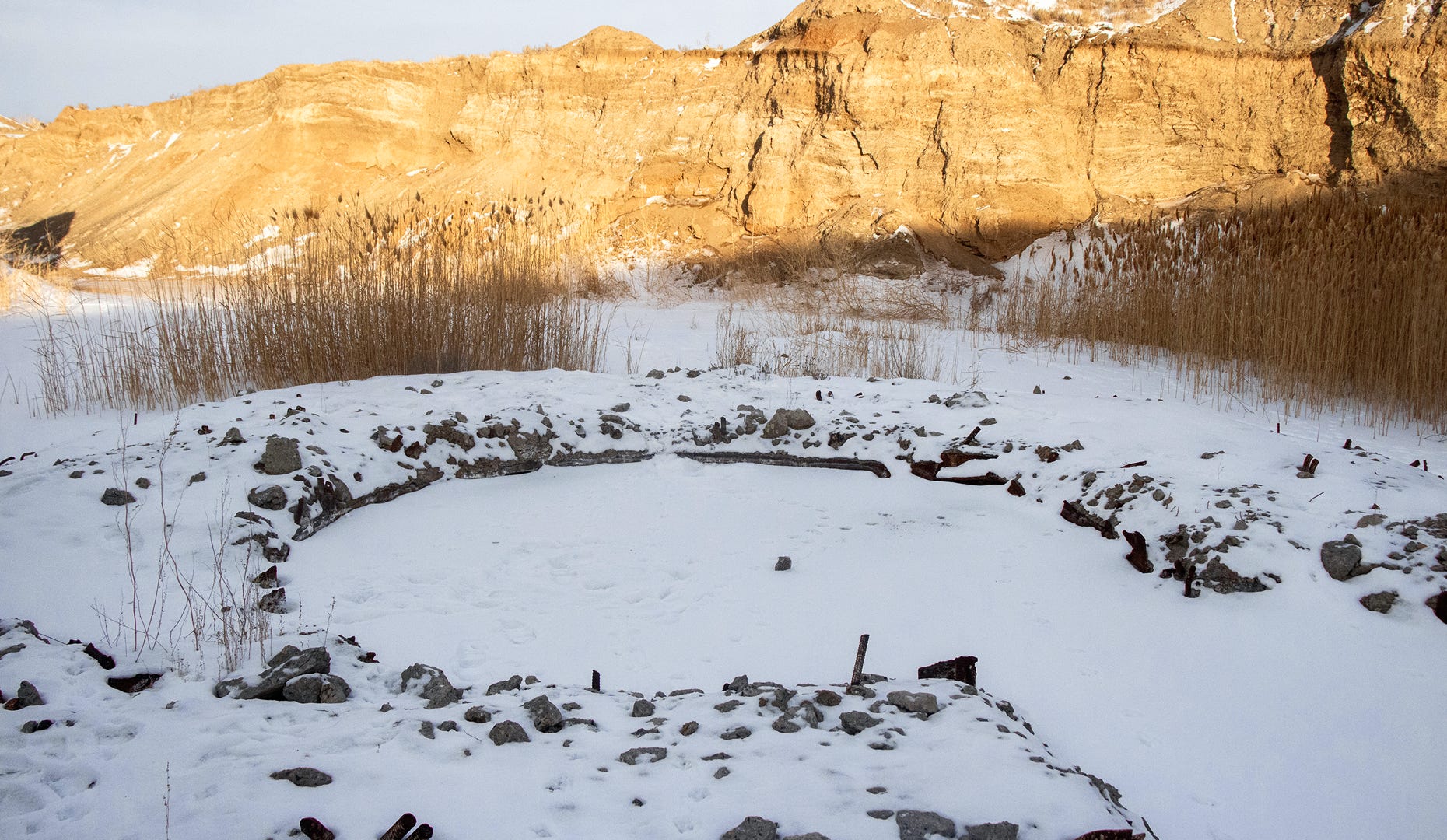
Has the project changed the way you think about the site?
[KN] Yes, profoundly. Before starting the project, most of what I had encountered about the Test Site came from media and documentary sources that focused almost entirely on suffering and catastrophe. While those narratives are real and important, they often stop at victimhood. They rarely highlight the strength, resistance, and ongoing efforts of the communities who live with the consequences. That shaped how I initially perceived the site, as a place defined by devastation.
But spending time there, listening closely, and meeting people whose lives are still entangled with that landscape changed everything. The site is marked by violence, but it’s also marked by persistence. Not in a symbolic or romantic way, but in the quiet, everyday forms of resilience. Grasses grow. Animals return. People remember, adapt, and continue to fight for recognition and justice.
This shifted how I listened and how I approached the work. I began to understand the site not just as a historical wound, but as a space where life keeps asserting itself. There is power in that, power in survival, in the ability to carry on without resolution. The project didn’t offer closure, but it gave me a deeper respect for what endures and what refuses to be erased.
No posts
Comments
Nothing yet. Say the first thing.
Sign in to join the conversation.