
This is an update of my Q4 2025 Spotify piece. To understand how the first leg of the thesis developed, you can read this article.
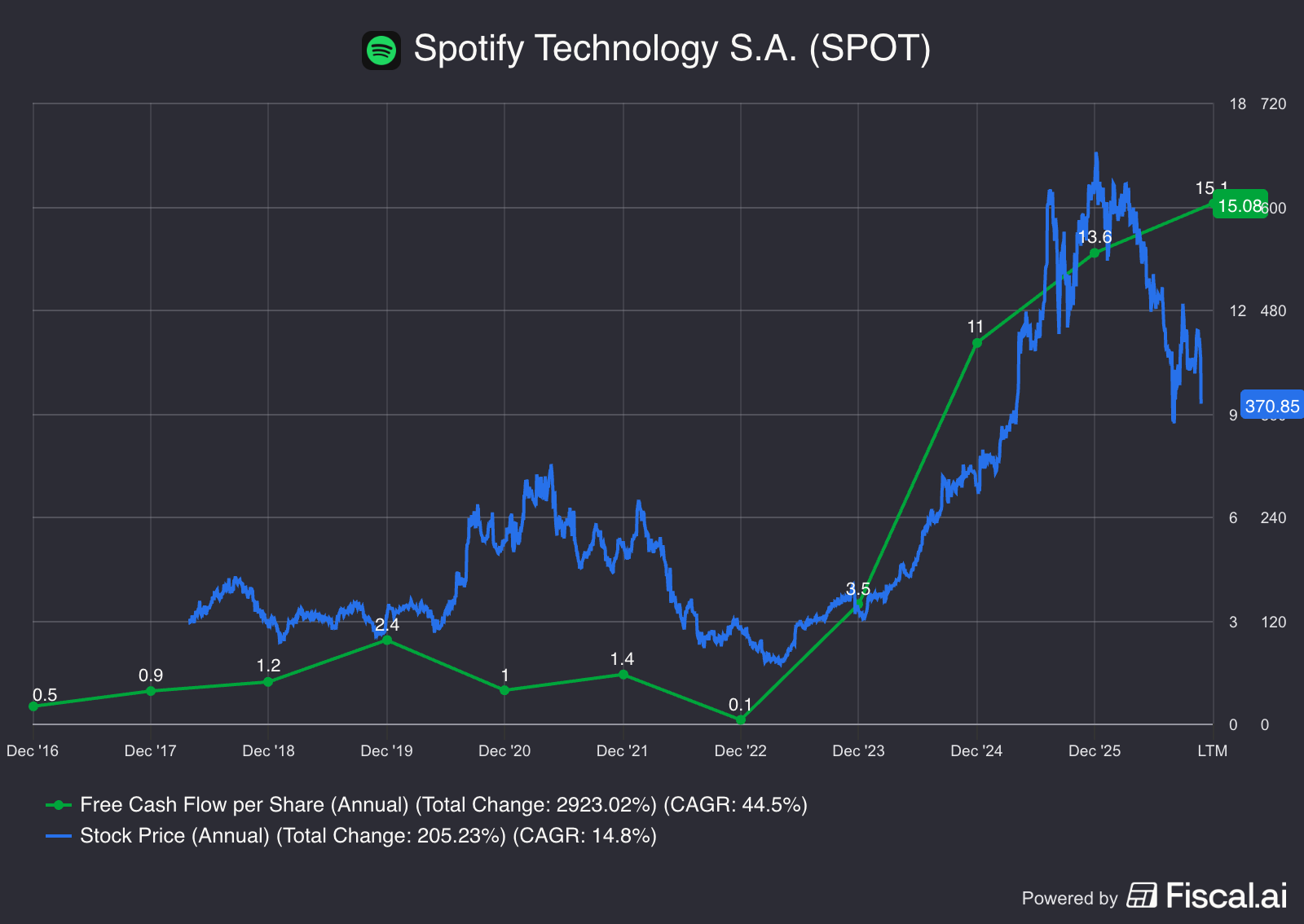
Spotify compounds free cash flow per share by personalising media at marginal cost. On a first principles basis, it’s a media engine that better predicts what you want to consume and does so more cheaply over time. The free cash flow per share explosion has been primarily the result of expanding this capability from one vertical (music) to a growing range of them, multiplying user lifetime value with marginal incremental investment, enabled by personalisation built on statistical signals.
Spotify is now entering a new era in which personalisation goes vertical, powered by AI and semantic feedback, and with it, free cash flow per share. Stock prices track free cash flow per share over the long term. Having entered at $97.50, I remain positioned for a historic return.
DJ has nearly 100M users and SongDNA has 52M users four weeks after launch. Apart from being engaging features, these are primarily sources of semantic proprietary data. Users tell Spotify what they want in natural language, which enables personalisation orders of magnitude more precise than anything seen to date. The leap is discontinuous, rendering statistical signals practically medieval overnight.
The financials we see, summarised by free cash flow per share above, are effectively obsolete. Not only has the stock price deviated from intrinsic value, but it is also completely oblivious to what is coming.
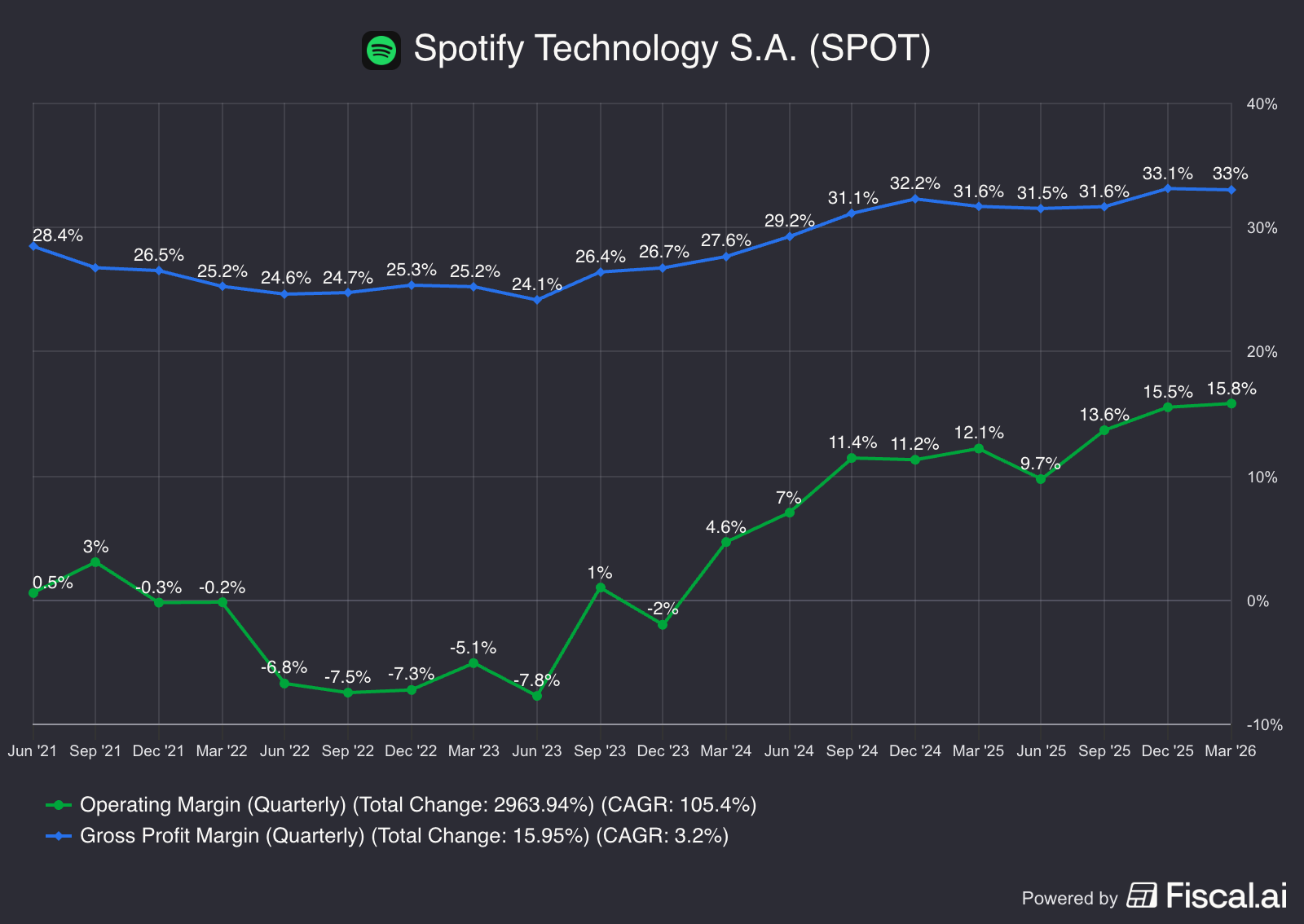
The stock went down 17% yesterday because OpEx is expected to trend up as Spotify continues to invest in building and marketing AI features such as the above. However, the graph below illustrate’s management’s ability to balance profitability and investments: Alex Norstrom, current co-CEO, is the guy who drafted Spotify’s plan to become a profitable business some years ago. Spotify continues to execute the Costco Algorithm, applied to media, as Alex explained during the Q1 2026 earnings call:
[…] we optimise for the long term, and we talk about optimising for lifetime value.
How do you bridge these two things with an ever-increasing catalog of content and lifetime value?
You know, it turns out that the number one reason for why people actually engage more with Spotify is personalisation.
You know, how we track that is if AI increases engagement for us, it generally means that it increases personalisation for us, right? Increased personalisation engagement, to Gustav’s points, are going to lead to.
They are gonna be the best proxies for the increase in retention that we’re gonna see over time with these investments.
If that happens, then we know that that will eventually translate to a longer lifetime value, which in turn translates to more enterprise value. That’s how we think about the investments.
The market does this often, but naturally long term investors shouldn’t be disappointed when a management team focuses on long term value creation.
The second driver of enterprise value is the rate of incremental personalisation: as Spotify ships faster, it creates value faster. I often get asked, why use the term Ontology? Because you have to label and understand concepts clearly.
The market has broadly believed for the past year that software is dead, which is largely true, but that doesn’t mean “software companies” are dead. Some will die, but others have already evolved into something much bigger: Ontologies. Proprietary data sets are the moat of the 21st century and if you can translate that into an AI that’s marginally better than the next one, you get more proprietary data which keeps you ahead.
If your AI is 0.0001% better and your Ontology spins just a tiny bit faster, you take the whole market because consumers don’t care about second best. Spotify is a Taste Ontology and no matter how good generic AI models get, they won’t capture taste as well so long as Spotify continues increasing engagement and it’s ability to extract semantic signals. Co-CEO Gustav Soderstrom shed light on this during the Q1 2026 earnings call:
In terms of type of traffic, it depends on the feature, but what Alex mentioned up front is we have, for the first time in Spotify history, this ability for users to actually tell us in plain English, or actually whatever language they want, what they want.
[…]
I talked last time about the large personalisation model, which is a model that we’re training from based on open source models, but it’s trained on our proprietary data. This is not something that we rent from someone. This is something we’re building in-house. You know, the casual name for the large personalization model is a taste model. Why is that important?
It is because it turns out that taste is actually not a fact. It is an opinion, it differs between people, between markets, between use cases and activities.
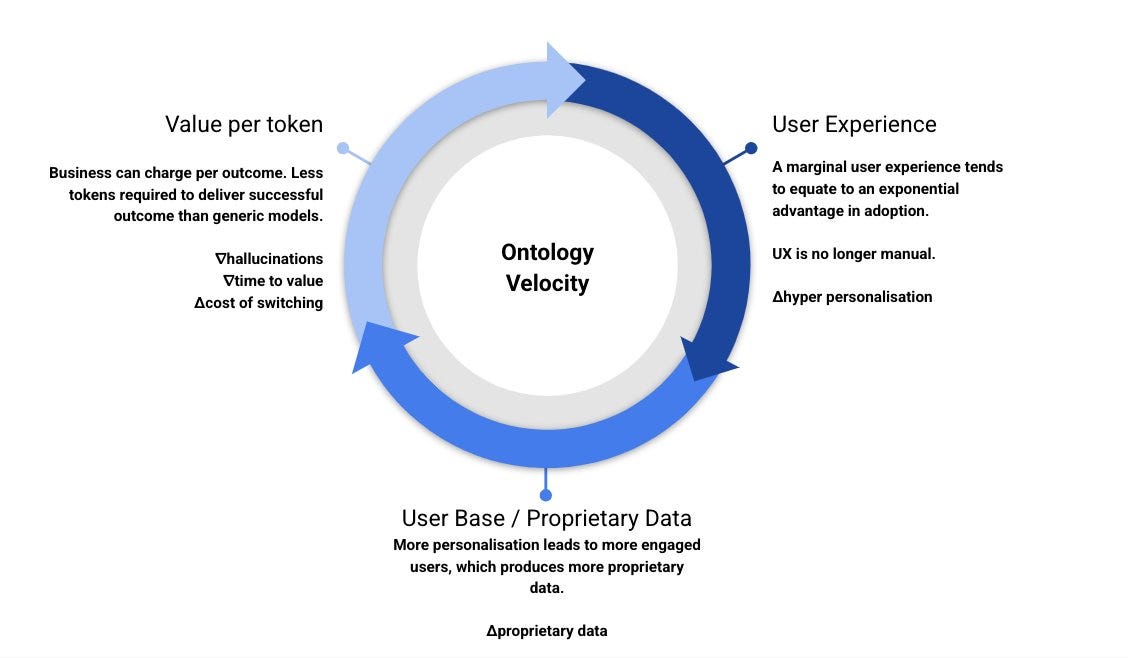
Spotify’s Ontology Velocity is going up, according to Gustav:
We are spending more compute per employee. That is because we’re seeing tremendous return in terms of productivity. We talked about accelerating our ability to ship products already during the late fall. That has only accelerated since then. We’re simply doing much more. We’re getting very good return on that investment.
[…]
We think this opportunity is as big or possibly bigger [than the iPhone]. We’re taking that opportunity. We are very diligent and very disciplined about those investments.
Until next time!
⚡ If you enjoyed the post, please feel free to share with friends, drop a like and leave me a comment.
You can also reach me at:
Twitter: @alc2022
LinkedIn: antoniolinaresc
These are opinions only of the individual author. The contents of this piece do not contain investment advice and the information provided is for educational purposes only and no discussions constitute an offer to sell or the solicitation of an offer to buy any securities of any company. All content is purely subjective and you should do your own due diligence.
Antonio Linares makes no representation, warranty or undertaking, express or implied, as to the accuracy, reliability, completeness or reasonableness of the information contained in the piece. Any assumptions, opinions and estimates expressed in the piece constitute judgments of the author as of the date thereof and are subject to change without notice. Any projections contained in the Information are based on a number of assumptions as to market conditions and there can be no guarantee that any projected outcomes will be achieved. Antonio Linares does not accept any liability for any direct, consequential or other loss arising from reliance on the contents of this presentation. Antonio Linares is not acting as your financial, legal, accounting, tax or other adviser or in any fiduciary capacity.
No posts
Comments
Nothing yet. Say the first thing.
Sign in to join the conversation.