
This is an update of my original Duolingo deep dive and Q4 2025 ER digest.
Duolingo has a 100% track record of improving any metric it decides to focus on. When high-level numbers dip, most investors extrapolate the decline indefinitely — but when a company's organisational properties remain intact, as is the case with Duolingo, the financials rarely stay down for long. And the stock follows rather quickly, as we saw with Meta and Amazon in 2022, or more recently AMD in 2025.
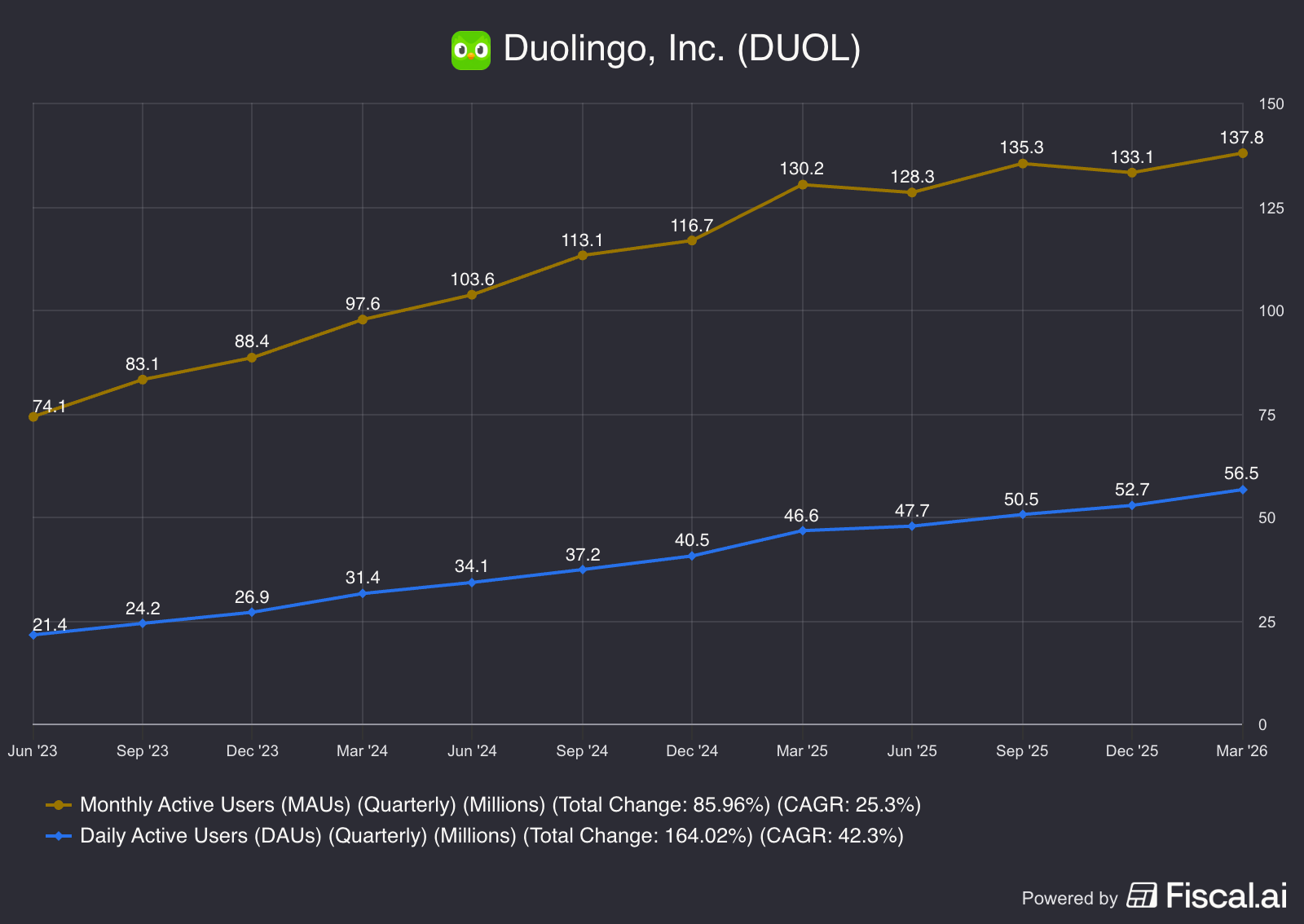
What's peculiar here is that metrics aren't actually pointing downwards, despite the broader sentiment suggesting otherwise. MAUs grew from 133.1M to 137.8M quarter over quarter, and DAUs from 52.7M to 56.5M. The year-over-year numbers aren't bombastic, but the narrative clearly doesn't reflect the fundamentals. Duolingo doesn't appear to be dying at all and if anything, seems to be picking up steam again.
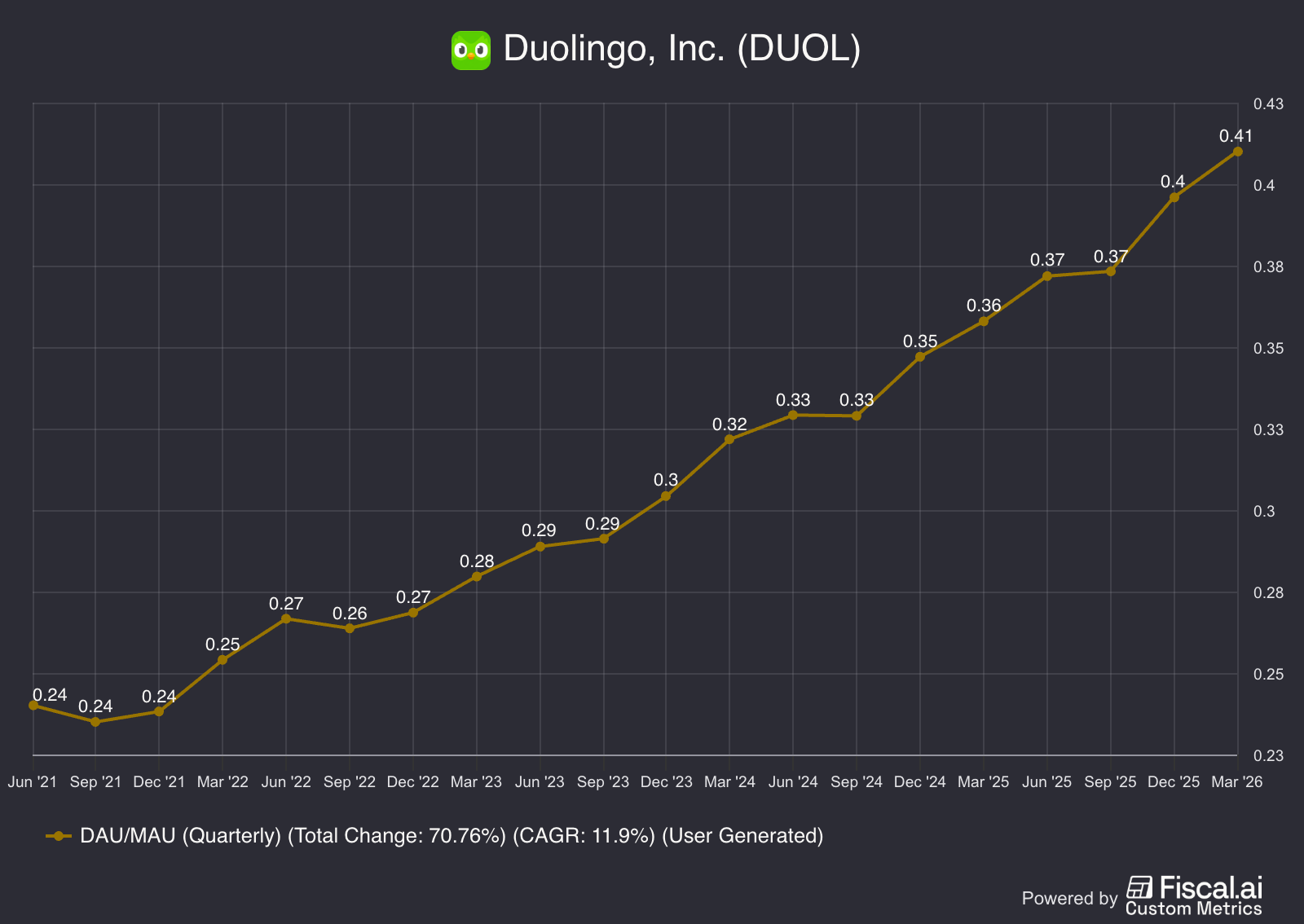
Further, engagement is going up in a straight line ever since LLMs entered the scene, as depicted by the DAU/MAU ratio. Q1 2026 saw a notable uptick too.
As DAU/MAU goes up, it means that more monthly users are deciding to engage daily with Duolingo. Engagement is a good proxy for teaching quality, because users spend more time on Duolingo as they get more value from it. In turn, the rate at which teaching quality improves is a direct function of the shipping rate, which seems to be going up quite a bit and perhaps explains the DAU and MAU upticks:
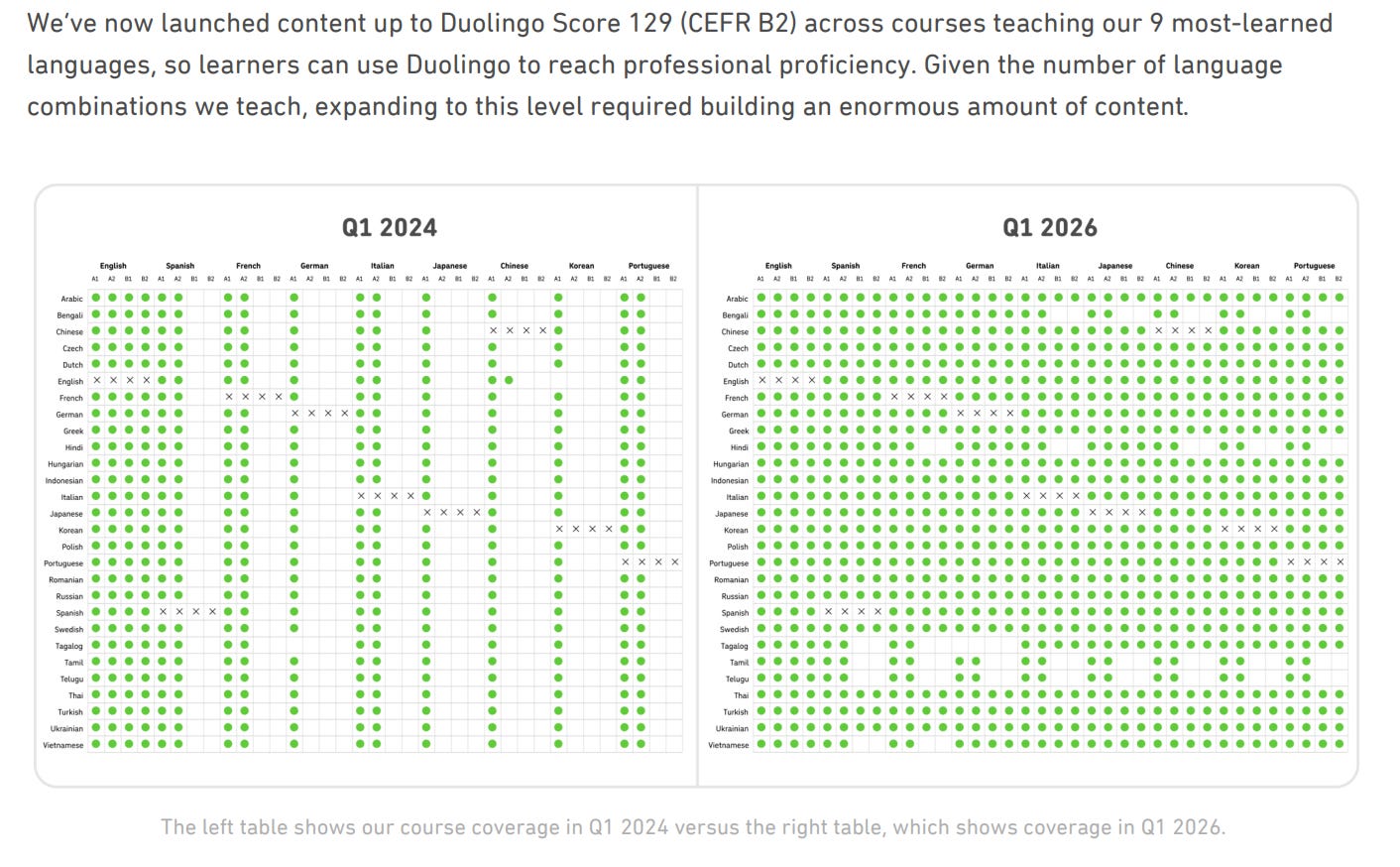
We now offer courses up to professional proficiency, which is B2 on the CEFR scale across all our 9 most learned languages and we got there fast.
In Q1 alone, we published 20,500 course units. To put that in context, that’s more than 10x what we were shipping per quarter just 2 years ago.
AI has fundamentally changed what’s possible for us, and I believe we’re just scratching the surface. The product is better than it has ever been, and I couldn’t be more excited about what’s ahead.
-Luis von Ahn, Duolingo CEO during the Q1 2026 earnings report.
Average words spoken per Video Call is a proxy for Duolingo's progress toward becoming a superhuman AI tutor. At the limit, this metric could theoretically reach pathological levels, not unlike what Meta has achieved with Reels, where the AI is not only an effective teacher but knows exactly what to say to keep you on the call. Words spoken per user are up over 2x year over year. That's a better indicator of where things are headed than any headline and in line with the above observations.
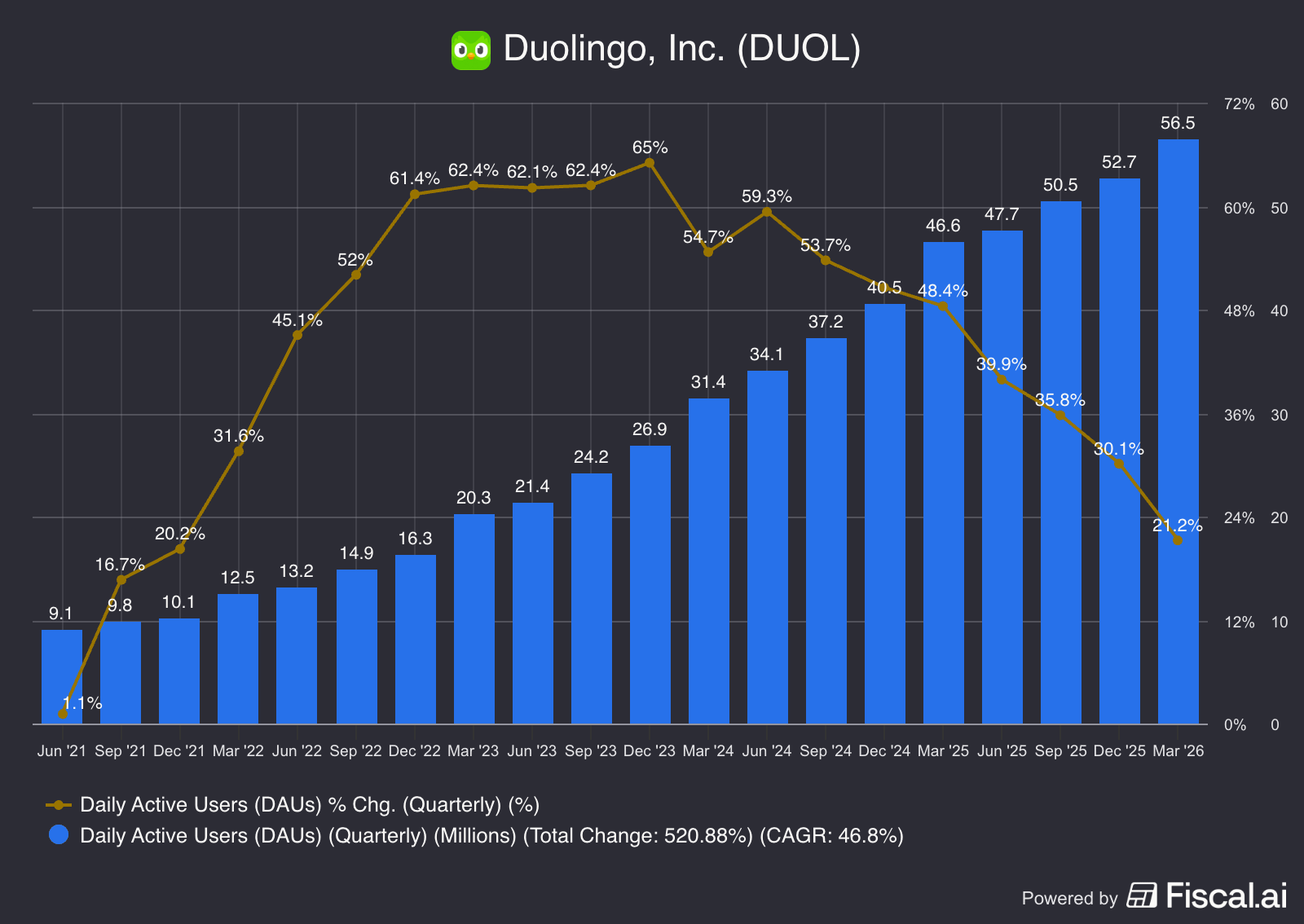
The above is why the DAU growth deceleration is cyclical rather than structural. It takes time for deeper metrics to show up in YoY DAU growth, but Duolingo's renewed focus on user growth is working, as evidenced by the QoQ uptick in DAUs and the DAU/MAU ratio. For the historians among us, Duolingo experienced something similar in 2021 and DAU growth came in at 60%+ a year later. Conditions then are not the same as now, but it illustrates Duolingo's ability to focus on user growth cyclically and, over the long term, grow the platform in absolute terms.
Fundamentally, AI continues to accelerate Duolingo’s value creation process. Generic AI models can teach, but Duolingo has a lot of behavioural data that allows it to understand how to motivate people through a learning experience. Using that data to fine tune a generic model produces better results than the generic model alone, which is why DAUs are not plummeting to zero and DAU/MAU continues going up in a straight line. The volume and quality of content on Duolingo is going up exponentially, to the point that hyper-personalised content is starting to make sense for them, according to Luis during the Q1 2026 earnings call:
And we’re also likely going to move to something where we have all this content, this is awesome, but we may even start generating content just for you.
Based on everything that we know about you, we may just be able to generate content just for you, maybe not the immediate next exercise, but like two exercises from now based on everything.
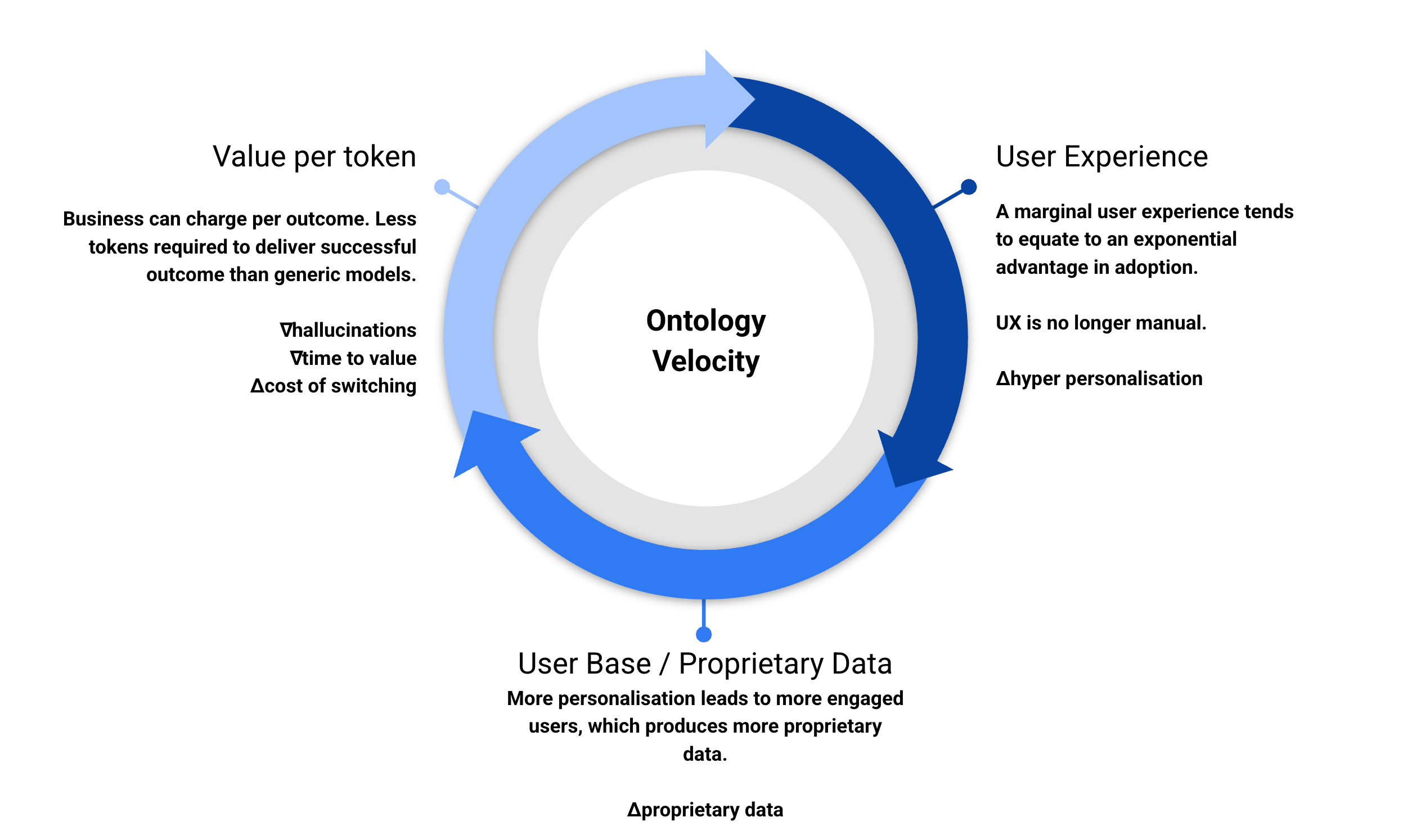
As you may have realised, this is a pristine example of the Personalised Token mental model. Using tokens is not an option, but a token is much more valuable to someone when it’s personalised and for that, you need a lot of data about that person. Duolingo is effectively an Education Ontology, which enables them to deliver more value per token than anyone else for their specific goal of improving learning outcomes. Duolingo’s shipping rate is an order of magnitude higher than two years ago and it won’t take long to increase several by orders.
In the AI space, competition happens at the infinitesimal edge. This is what the market has been trying to understand throughout 2026.
If your Ontology has a little more proprietary data, which enables you to train an AI that's marginally better than the next one, that marginal improvement compounds into an exponential advantage in user experience, which drives more users, which generates more proprietary data. The flywheel doesn't just spin faster. It becomes harder to stop.
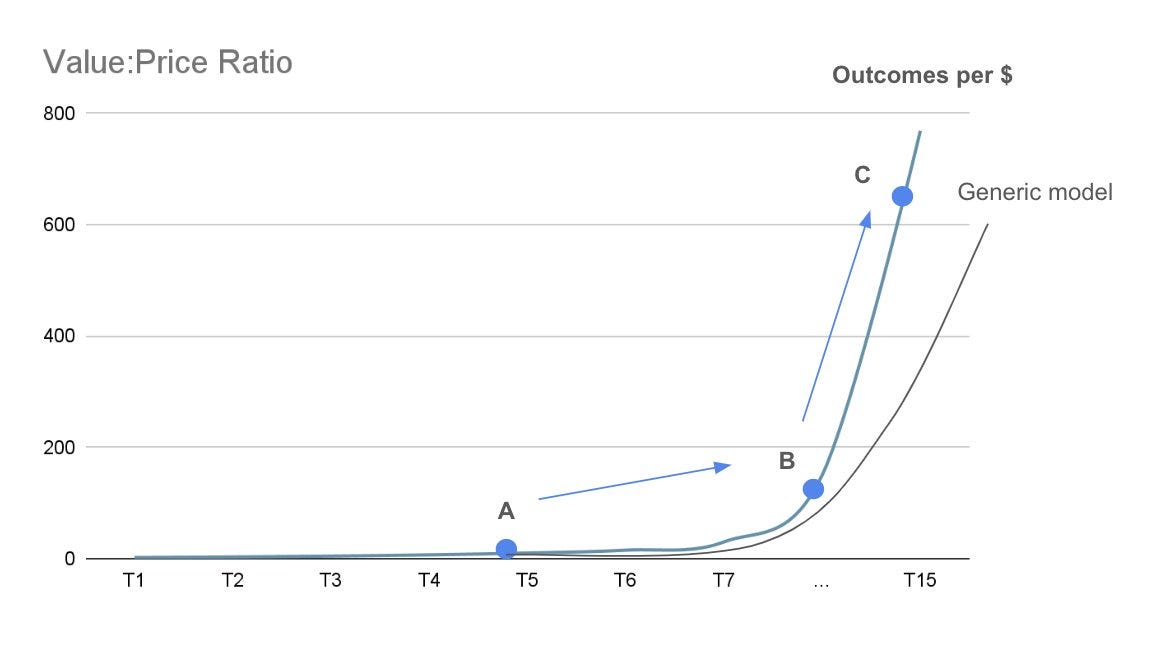
So long as the model fine tuned with proprietary data offers even marginally more value per dollar to end customers, the company will stay ahead of the curve. This is because second best is meaningless to consumers, as we saw with Spotify in 2022, when the market believed Amazon and Apple were going to kill it. In the digital space, a marginal advantage translates into an exponential outperformance over the long term. AI is only enhancing this dynamic.
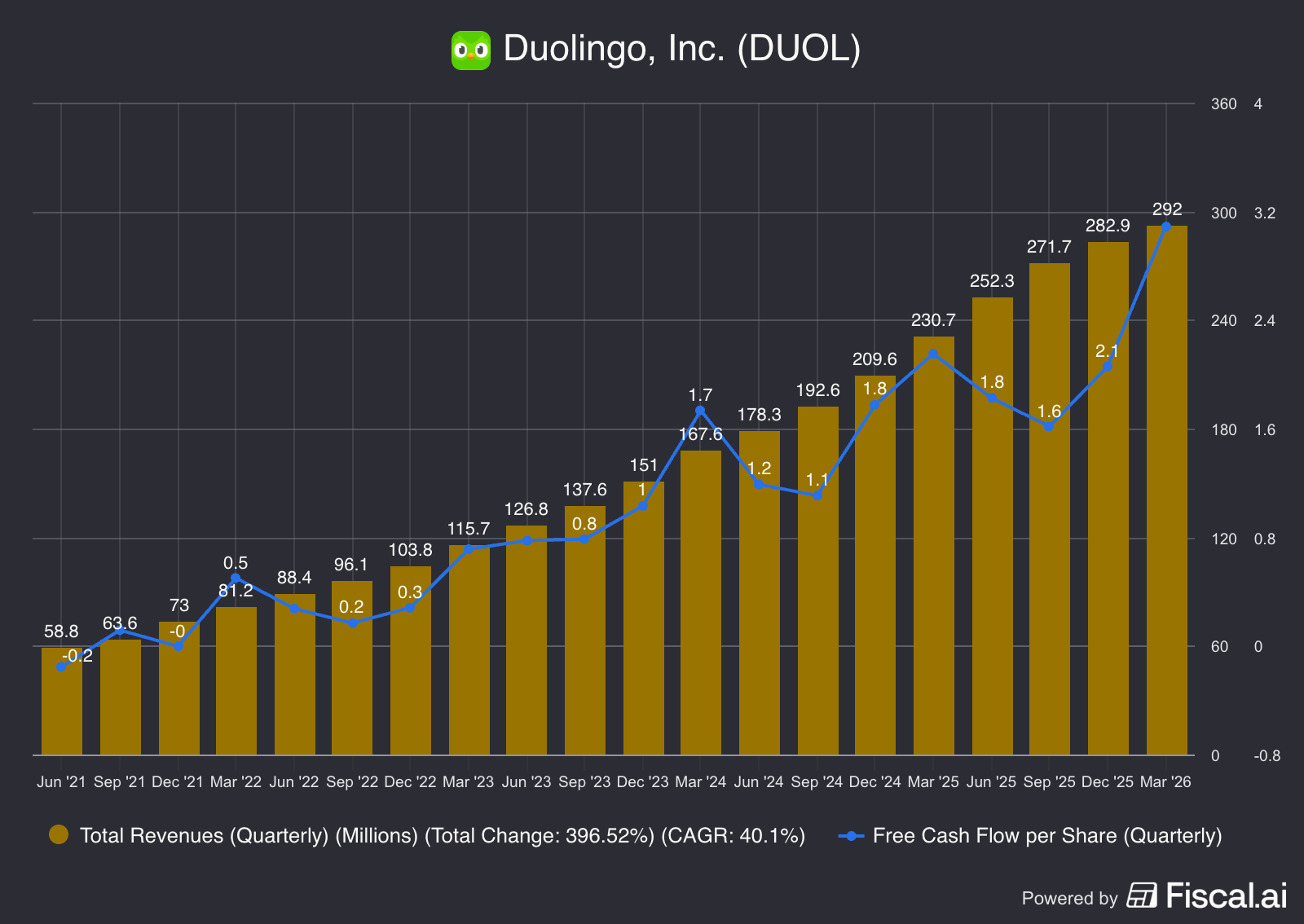
Free cash flow per share (blue line, below) is broadly tracking the recent DAU and DAU/MAU upticks. Duolingo is currently in investment mode, having deferred near-term financial guidance in favour of long-term value creation. What's interesting is that even in this context, Duolingo remains an extraordinary cash flow compounder. If we take free cash flow per share as the best proxy for intrinsic value, which it is, the latter is up 86% while the stock is down by roughly the same amount.
As a result, as Duolingo’s fresh round of enhanced experimentation translates into reaccelerated DAU growth, it seems that much of that will be highly accretive to the bottom line.
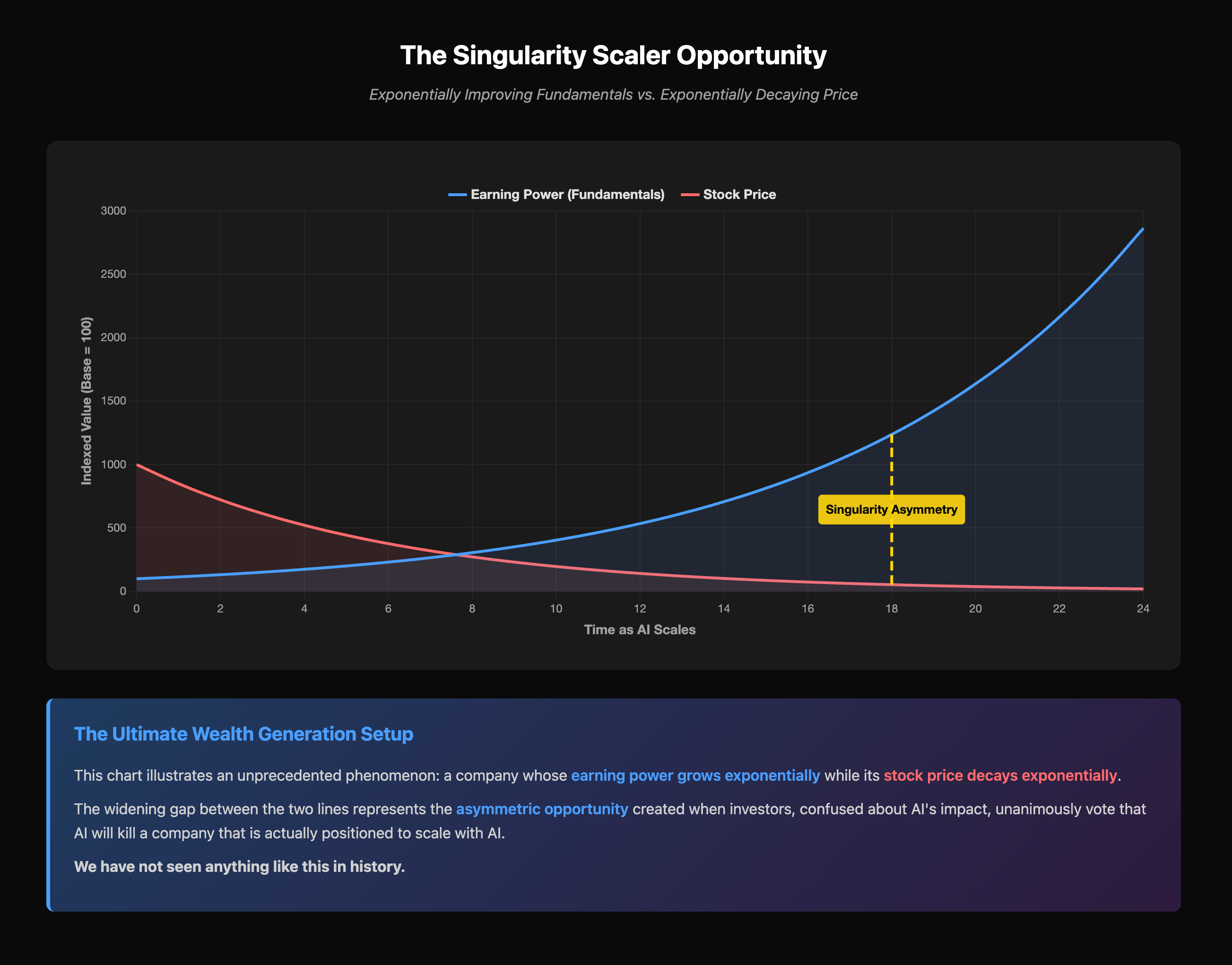
While Palantir is the first instance of a Singularity Scaler, Duolingo is the first instance of a Singularity Asymmetry. Duolingo’s intrinsic value is increasing in tandem with AI scaling laws, which are turbocharging its value creation processes. The market, however, has decided the opposite is true, with the stock decaying exponentially. The delta between these two realities is a Singularity Asymmetry: two exponential curves converging to yield a quadratic wealth creation event.
Until next time!
⚡ If you enjoyed the post, please feel free to share with friends, drop a like and leave me a comment.
You can also reach me at:
Twitter: @alc2022
LinkedIn: antoniolinaresc
These are opinions only of the individual author. The contents of this piece do not contain investment advice and the information provided is for educational purposes only and no discussions constitute an offer to sell or the solicitation of an offer to buy any securities of any company. All content is purely subjective and you should do your own due diligence.
Antonio Linares makes no representation, warranty or undertaking, express or implied, as to the accuracy, reliability, completeness or reasonableness of the information contained in the piece. Any assumptions, opinions and estimates expressed in the piece constitute judgments of the author as of the date thereof and are subject to change without notice. Any projections contained in the Information are based on a number of assumptions as to market conditions and there can be no guarantee that any projected outcomes will be achieved. Antonio Linares does not accept any liability for any direct, consequential or other loss arising from reliance on the contents of this presentation. Antonio Linares is not acting as your financial, legal, accounting, tax or other adviser or in any fiduciary capacity.
No posts
Comments
Nothing yet. Say the first thing.
Sign in to join the conversation.