
Iterative proteoform mapping is on course to become the epicenter of capitalism and human life, like (Palantir’s) digital twins were in 2022. The human body is just an electromagnetic LEGO puzzle, otherwise known as the proteome. Iterative mapping will soon allow us to decipher it and by simply airdropping our proteome's digital twin into AI, we will be able to cure anything. We are moving towards an inflection point in human history, as I explained last week:

Antonio Linares@alc2022
https://t.co/tv5bvXdubv
11:56 AM · Mar 20, 2026 · 488K Views
75 Replies · 188 Reposts · 2.03K Likes
And Nautilus Biotechnology, with a $380M market cap, is right at the center of it.
Nautilus is pre-revenue, but three things are true:
No one is even close to their iterative mapping platform.
They have a clear track record of scaling platform capabilities while keeping costs in check.
And while it’s too early to evaluate Nautilus based on financials, the recent milestones suggest the odds of them succeeding eventually are material.
Iterative mapping consists in cycling fluorescently tagged probes (amino acid chains) across immobilised proteins and registering which ones bind. Every time a probe binds, a fluorescent light emission gets registered by a computer vision model. The aggregate of all light emissions is used to create a computational model of a protein's shape, which is just the inverse of all the probes that bound.
Iterative mapping thus solves the epistemic ceiling of mass spectrometry. The latter cannot possibly capture the state of a protein because it fragments it in the process of reading it, destroying the very modifications it is trying to detect. Iterative mapping, by contrast, reads the protein intact and in place, cycling through probes repeatedly until a complete picture emerges, giving it, in principle, infinite resolution over the proteoform state.
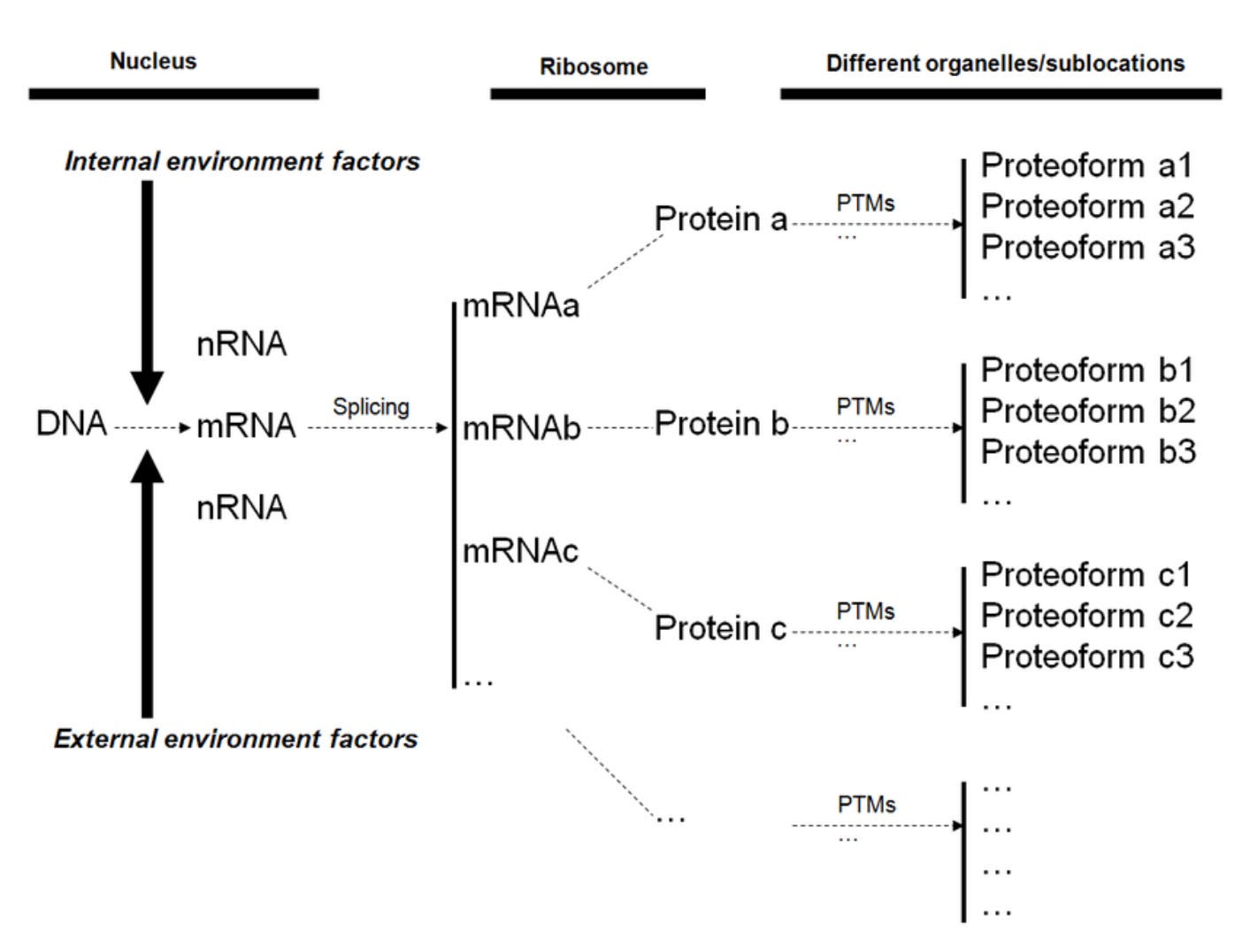
In practical terms, this means that iterative mapping is the path to digitising the proteome. Many proteoforms can emerge from a single protein: the former are merely slight variations of the latter, characterised by adding a glycan or a phosphate, for example. The diagram below shows how a single gene produces multiple base proteins, each of which can then be modified at specific sites via different methods.
For example, mass spectrometry cannot tell you if you are looking at a protein with two glycans at positions A and B or two proteins, one with glycan at A and another at B. However, being able to map out that difference is essential to truly understand the proteome and understand illness deeply enough to stop it at the root level. Every physiological process in the body emerges from a proteoform chain and by extension, so does all illness. Cells read genetic code and print a base protein, which then is converted into any number of proteoforms via post translational modification (PTM).
Illness is simply a coding bug at any stage in the diagram below, plus the fact that many proteoforms can emerge from a single protein and that proteins in general combine with other proteins to create entirely new functional structures.
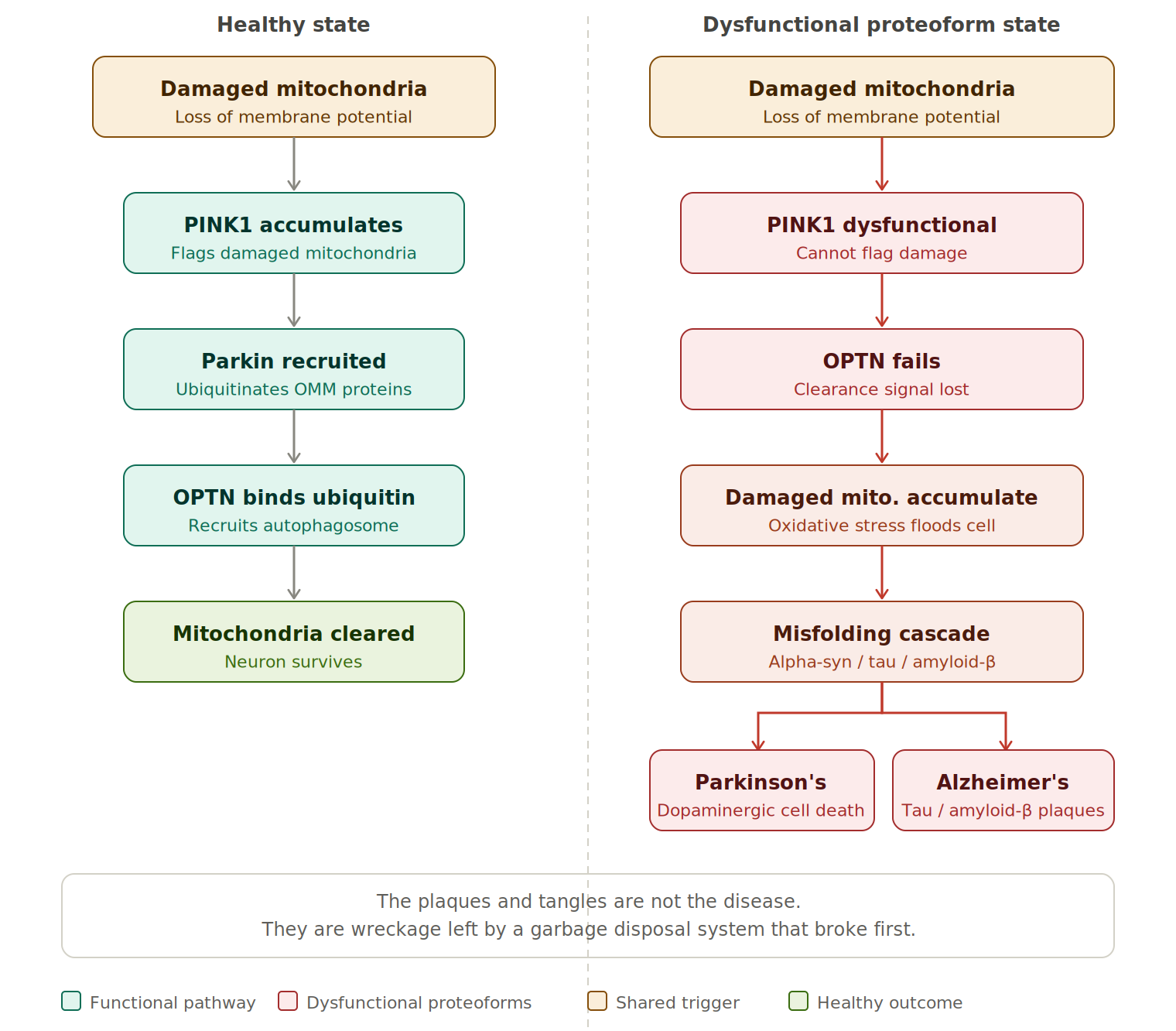
To understand the power of a body-wide digital twin of the above information, consider Alzheimer’s and Parkinson’s, which manifest as proteoform misfolding diseases. In Alzheimer’s, amyloid beta plaques and hyperphosphorylated tau tangles destroy synaptic architecture. In Parkinson’s, alpha synuclein misfolds into Lewy bodies and kills dopaminergic neurons. At a deeper level, both seem to emerge from dysfunction at the same proteomic level.
Both diseases share a common upstream failure: the mitophagy axis. PINK1, the kinase that flags damaged mitochondria for disposal, and OPTN, the receptor that executes the clearance, are themselves proteoform dependent. When either arrives in a dysfunctional proteoform state, damaged mitochondria accumulate, oxidative stress floods the cell, and the misfolding cascade begins.
The plaques and tangles are not the disease. They are the wreckage left behind by a garbage disposal system that broke first. This remains a hypothesis, but the broader point stands: we will soon be able to map any illness at the proteomic level, and then deploy algorithms like AlphaFold and LigandForge to design targeted molecular interventions that halt it before it ever manifests clinically.
In Q4 2025 Nautilus management announced the launch of the early access program for tau assays — ahead of schedule. Collaborators began submitting samples and receiving data, with initial response described as encouraging. The program is not designed to drive near term revenue but to support publications, grant applications, and workflow validation, which is exactly how transformative life sciences platforms have historically entered the market. The clinical signal is early, but the commercial motion has started.
This comes after announcing in Q4 2024 that they would shift resources towards reconfiguring their platform:
By making the decision to pursue modifications to our assay configuration, surface chemistry and related platform elements at this time, we believe that we are positioning Nautilus to ultimately make the maximum possible impact on the marketplace and on biological science.
This elongated development timeframe necessitated that we reevaluate our operating plan and organizational structure to ensure that we are in the best position to execute against both our broadscale and targeted proteoform goals.
Nautilus CEO and co-founder, Sujal Patel, during the Q4 2024 earnings call.
The tau assay is the beachhead, not the ceiling.
Nautilus is now moving into Parkinson’s, beginning with an 18-month collaboration funded by the Michael J. Fox Foundation to develop an alpha-synuclein proteoform quantification assay. This matters because alpha-synuclein is precisely the protein whose dysfunctional proteoforms drive the misfolding cascade described above, making this not just a commercial expansion but a direct scientific validation of the thesis.
We see a familiar pattern emerge: Nautilus is leveraging its core platform to deploy a growing volume of verticals at a marginal cost. As they launch and mature new verticals, the time to value will shrink, yielding an operational flywheel similar to Palantir’s: more productisation yielding incremental network effects. Nautilus Chief Scientific Officer, Parag Mallick, commented on this during the Q4 2025 earnings call:
While much of our current momentum is in neuro degeneration, it’s important to emphasise that Iterative Mapping is not limited to neuroscience.
We see meaningful long-term potential across oncology, immunology, cardiology and beyond.
We are currently evaluating multiple oncology-focused candidate proteins with the goal of having an oncology-focused proteoform assay enter early access in the second half of 2026.
The long term thesis rests on the innate superiority of the core platform, of which we have no exhaustive confirmation. However, dynamic range leaves a clue: the industry’s average is 1 order of magnitude, while Nautilus’ is over 3 orders of magnitude. That means the platform can detect proteins present at vanishingly low concentrations alongside those present at high abundance in the same sample.
This is the difference between seeing the full proteomic picture and seeing only the loudest signals. Most disease-relevant proteoforms, including the specific truncations and modifications that precede clinical symptoms, exist at low abundance. A platform that cannot see them cannot find the bug before it crashes the system: let alone intervene early, which is precisely the point if the long term business is prevention and optimisation rather than damage control.
What makes the platform hard to replicate (and increasingly so as new verticals are deployed, because every new protein class magnifies the error) is that binding kinetics change when fluorescent tags enter the picture. Tags are bulky molecules, and bulk interferes with precision binding. Attaching one to a probe risks altering the very interaction you are trying to measure, introducing noise that is hardest to separate from genuine signal at exactly the low abundance range where disease-relevant proteoforms live.
My read on the competitive environment is largely intuitive. It is too early to be certain, but this feels like one of those rare situations where there is simply no one else in the room.
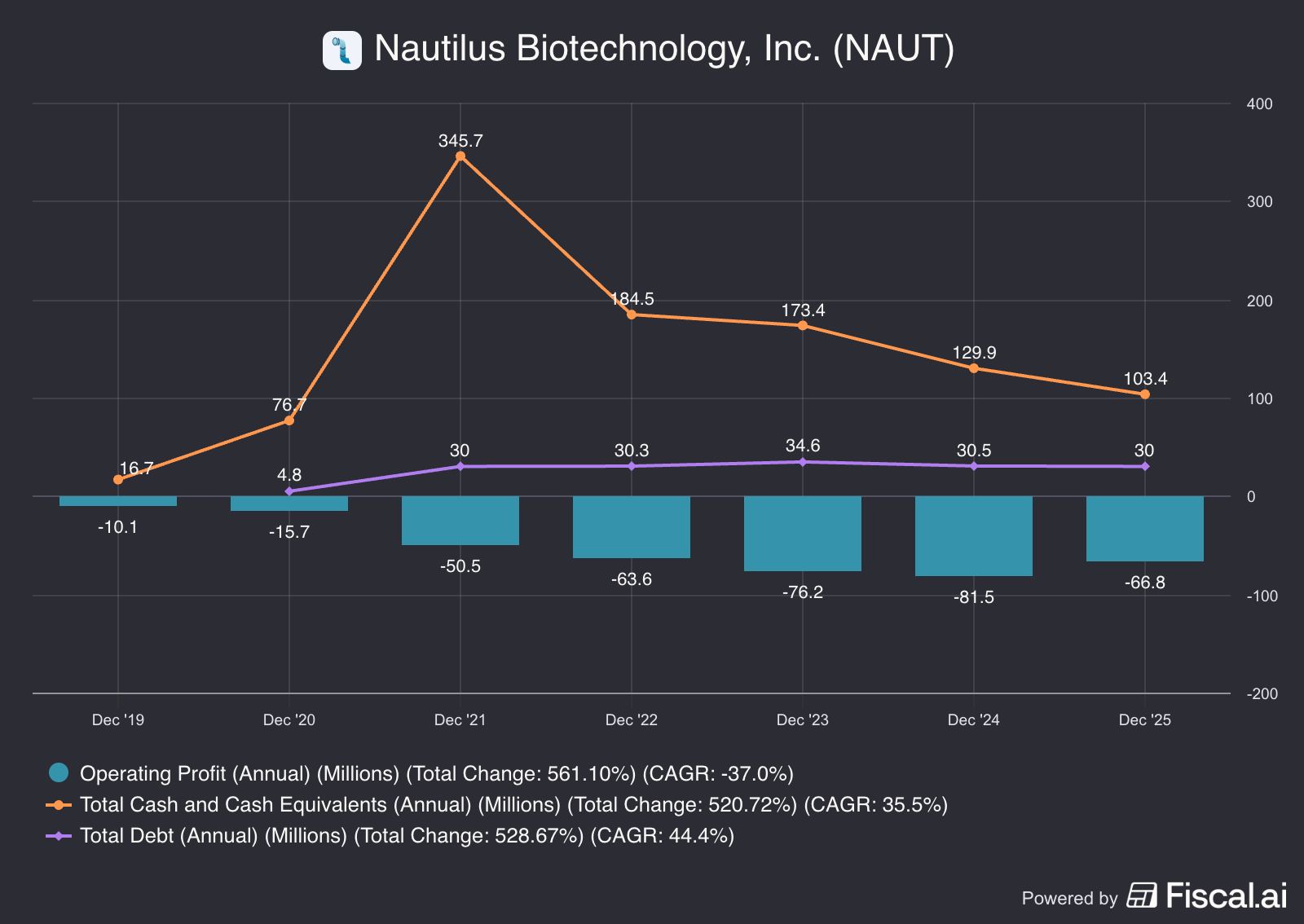
Despite being pre-revenue, Nautilus presents a reassuring financial profile. Cash has declined from its 2021 peak of $345.7M to $103.4M at the end of 2025, which is a natural drawdown for a company in heavy development mode. But the burn rate has improved meaningfully, with operating losses narrowing from $81.5M in 2024 to $66.8M in 2025. Debt has remained flat at $30M for three consecutive years. The company is not in a race against a collapsing runway. It has time to execute.
I believe iterative mapping is on course to scale population-wide. While it currently requires a lab setting, the near term vision is a monthly proteomic snapshot processed immediately by an AI model alongside all other longitudinal biomarkers. Over the longer term, as the technology miniaturises, the destination is a real time digital twin of your proteome with AI running permanently in the background, optimising your protocol to maximise health outcomes before any disease has a chance to declare itself.
We are curing everything.
Until next time!
⚡ If you enjoyed the post, please feel free to share with friends, drop a like and leave me a comment.
You can also reach me at:
Twitter: @alc2022
LinkedIn: antoniolinaresc
These are opinions only of the individual author. The contents of this piece do not contain investment advice and the information provided is for educational purposes only and no discussions constitute an offer to sell or the solicitation of an offer to buy any securities of any company. All content is purely subjective and you should do your own due diligence.
Antonio Linares makes no representation, warranty or undertaking, express or implied, as to the accuracy, reliability, completeness or reasonableness of the information contained in the piece. Any assumptions, opinions and estimates expressed in the piece constitute judgments of the author as of the date thereof and are subject to change without notice. Any projections contained in the Information are based on a number of assumptions as to market conditions and there can be no guarantee that any projected outcomes will be achieved. Antonio Linares does not accept any liability for any direct, consequential or other loss arising from reliance on the contents of this presentation. Antonio Linares is not acting as your financial, legal, accounting, tax or other adviser or in any fiduciary capacity.
No posts
Comments
Nothing yet. Say the first thing.
Sign in to join the conversation.