
On July 19, 1692, five innocent women - Sarah Good (38 yrs old), Elizabeth Howe (57), Susannah Martin (71), Rebecca Nurse (71) and Sarah Wildes (65) were slowly choked to death by hanging at the foot of Gallows Hill, Salem, Massachusetts, for the crime of witchcraft. More horrifyingly, their accusers were young girls immersed in an elaborate cover-up story. Two of girls had engaged in the occult and consequently experienced bouts of demonic possession, leaving them two options - hang until dead, or defer. They chose the latter which led to an eight-month reign of terror.
‘These…young women had been present at Indian ceremonies conducted by two Carib Indians, John and his wife Tituba.’ Witchcraft and the Gay Counterculture, 1978, Arthur Evans, page 130
Massachusetts lived in a culture of witch-vigilance. There had been prior hangings, but 1692 was very different. The hanging of Bridgit Bishop (60) seemed to be a testcase – Could the congregation be led into a terrifying holocaust by its leaders? Would they leave the Word of God for the word of man? And finally, could Protestant Massachusetts be crushed and conquered? The speed in which the five were accused, convicted and hanged answers the questions; it is testimony to the nefarious consequences of mind control and blind obedience to authority.
Salem (now Danvers) has become infamous for the witch-hunt and trials. The village is now a mecca for witches and dark tourism. But in the 17th century medieval mindsets coming out of the papal run Dark Ages made it a powder-keg. While the Reformers shed the pagan trappings of Rome, they still aligned themselves with papal witch-hysteria first formalised by Pope Innocent IV.
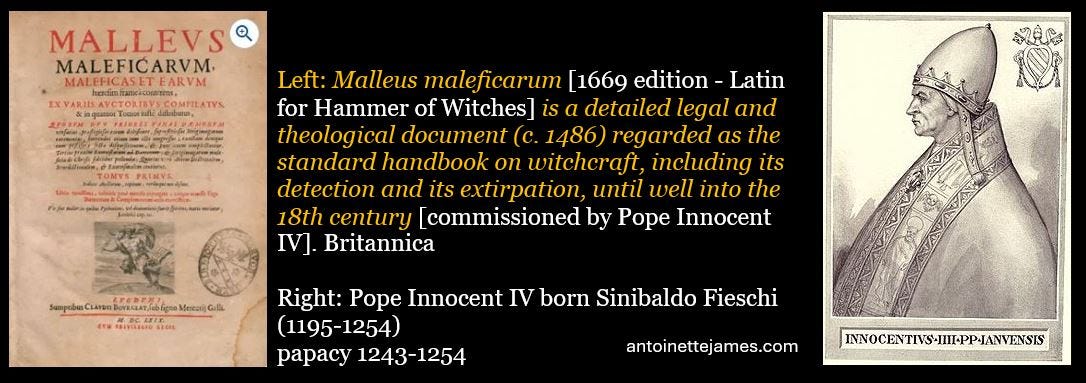
‘To mastermind the massacre, Innocent gave his own ‘supreme authority’ to two Dominicans. These inquisitors, Heinrich Kramer (or Institoris) and James Sprenger (known as the Apostle of the Rosary), operated in Germany…They jointly wrote Malleus Maleficarum, The Witches’ Hammer, in 1486 [and followed by other manuals]. It led, according to historians, to more misery and deaths than any other book.’ Vicars of Christ: The Dark Side of the Papacy, 1988, Peter De Rosa, page 183
Salem 1692 history reads like a grizzly social experiment conducted in a Christian sect. A social experiment very similar to the 1978 Jonestown massacre or the 1993 Waco Clinton bloodletting. With everything considered the whole Salem affair smacks of a top-down instigated false flag event conducted by a small group of closely connected elitist men.
New England had declared itself as Protestant. The immigrants having experienced firsthand the spite of the Jesuit Order in Europe, fled England. They were aware that papal Rome was hard on their heels looking for inroads to infiltrate but were not vigilant enough.
‘The war had an impact on the witch trials in 1692…In the course of the seventeenth century, French fur traders and Jesuit missionaries in northern New England…had cemented an alliance with the Wabanaki and converted many of them to Catholicism…Now the plot had come to America: the Pope and his minions, along with their heathen associates, had allied with Satan to destroy New England.”’ A storm of Witchcraft: the Salem trials and the American experience, 2015, Emerson W. Baker, page 63
To safeguard themselves, in May 1647, the Massachusetts General Court banned Jesuit and Catholic priests from the colony on the pain of death. It would be another 128 years before Pope Clement XIV, so fearing them, banned them worldwide. However, history tells that banishment only makes the Order go dark; it does not go away.
‘…Among the Reformers, to be a Reformer; among the Huguenots, to be a Huguenot; among the Calvinists, to be a Calvinist; among other Protestants, generally to be a Protestant; and obtaining their confidence, to seek even to preach from their pulpits, and to denounce with all the vehemence in your nature our Holy Religion and the Pope [i.e. lie]…that you might be enabled to gather together all information for the benefit of your Order as a faithful soldier of the Pope…’ Jesuit Superior General (Black Pope), address to postulants before his Extreme Oath to destroy Protestantism
Antoinette: The World We Live In is a reader-supported publication. To receive new posts and support my work, consider becoming a free or paid subscriber.
The Jesuit Order never forgets and unleashes their vengeance on any country or town that banishes them. They position their men for action and wait for a crisis. Their goal is to infiltrate and take control. And by the 19th century, the Order had gained the upper hand in Massachusetts headquartered in Boston, seventeen easy miles from Salem.
In 20th-century Boston, the Jesuits (Society of Jesus) heavily influenced local culture and the global Church through major academic and theological institutions. Their work [strategically] shifted from serving early immigrants to engaging with modern theology and social justice google.com
By the end of the 17th century the Puritan colony was in tatters, so the Vatican fomented trouble in Ireland and herded in mass, Irish Roman Catholic to Boston a mere fifty years after the trials finished. The Jesuit Bishop Benedict Joseph Fenwick (1825–1846) oversaw Boston in the 19th century, and in the 20th century the city became the epicentre for CIA (Catholic’s in Action), a Jesuit run and operated organisation, conducting LSD social experiments among misfits and outliers of society.
‘Then in 1949, a famous Viennese doctor named Otto Kauders traveled to the United States in search of research funds. He gave a conference at Boston Psychopathic Hospital, a pioneering mental-health institution affiliated with Harvard Medical School, and he spoke about a new experimental drug called d-lysergic acid diethylamide…Kauders’ description of how an infinitesimally small dose had rendered Dr. Hofmann temporarily “crazy.” “We were very interested in anything that could make someone schizophrenic,”…It would take many years of research to show that LSD did not, in fact, produce a “model psychosis,” but to the Boston doctors in 1949, the drug showed incredible promise. Max Rinkel, a neuropsychiatrist and refugee from Hitler’s Germany [Operation Paperclip], was so intrigued by Kauders’ presentation…’ The search for the Manchurian candidate, page 182
Salem Village was populated in 1638 by a group calling themselves Puritans. They wanted autonomy and wanted their own jurisdiction from the Church of England already infiltrated by Rome. They shunned England itself and nearby Salem Town. Although many parishioners were Bible believing Christians, the leadership were religious law unto themselves. They functioned as Rome in a top down religiopolitical body; leaving parishioners ripe for exploitation.
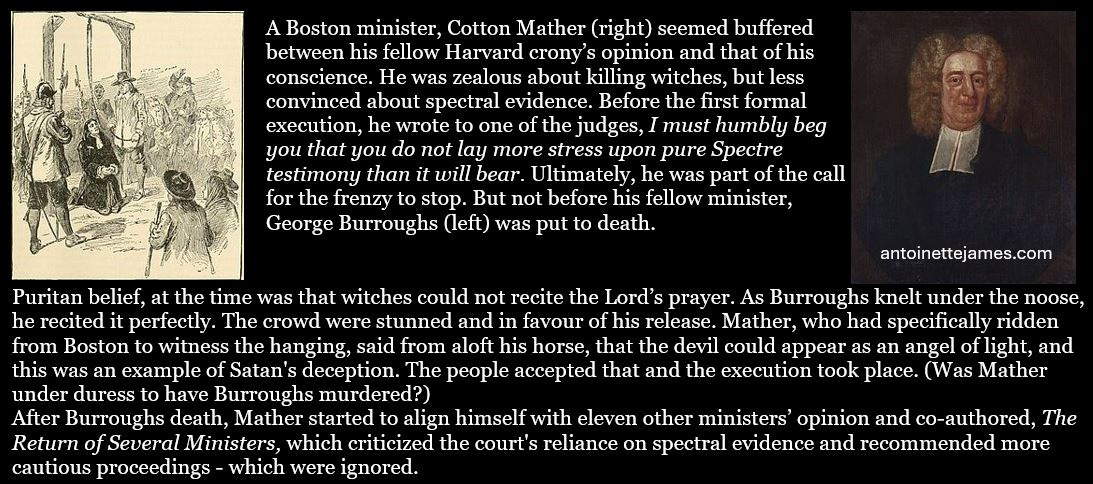
Before Rev Parris’ Ministership (1689-1696), Salem had welcomed and agitated three previous ministers. Among them was George Burroughs (1680–1683), who was accused of witchcraft by Thomas and John Putnum on the strength of Ann Putnum’s claims that his spectre harmed her. Burroughs had not fully paid back the loan that the Putnams demanded. Conveniently, the charge of witchcraft had no recourse, and he was hanged in 1692.
‘In the Salem madness every legal guarantee of personal and property rights was ruthlessly swept away; the estates of the arrested were seized before conviction and their families were beggared before the noose of the hangman had encircled their necks. Many, if not all, the seizures under the forms of law were pure and simple robbery and pillage, with waste and destruction, having no precedent in the established practice of Massachusetts…’ A Short History of the Inquisition, 1907, Eugene Montague MacDonald, page 404
There were three connected men of significance in Salem’s witch trials – The 1689 appointed Minister, Reverand Samuel Parris; the 1692 appointed Governor William Phips, and the 1692 appointed trial judge, William Stoughton. All three were Harvard men, with close social and family ties. Without them playing their part the sustained merciless nightmare could not have taken place.
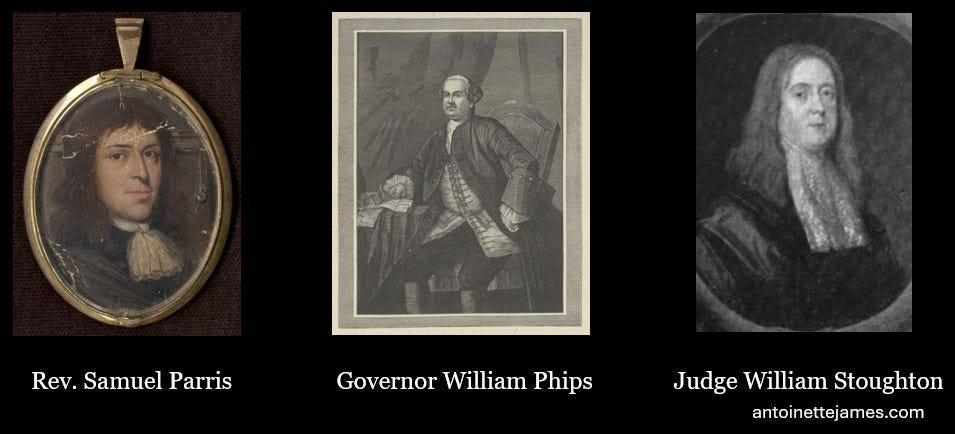
The witch trials and deaths originated within the house of Rev. Samuel Parris (1653-1720), a conveniently private, controlled and secured environment. Interestingly, the Parris family lived and worked within Jesuitical spheres. Samuel’s father, Thomas, was a merchant and owner of a sugar plantation worked by many slaves in the Caribbean.
‘Jesuit slaveholding…should not be seen as exceptional but as embedded in the diverse local, regional, and globally connected economies that the Jesuits operated in throughout the colonial world. Enslaved people worked on Jesuit sugar plantations, cattle ranches, tobacco farms…and as domestic servants [Mercy, Roman Catholic convert and domestic servant in the Putnum household] …Slavery supplied profits and labor that sustained Jesuit schools, churches, and missions. In their own practices, the Jesuits modeled a Catholic ideal of slavery…that model did not preclude ghastly violence.’ Journal of Jesuit Studies, Volume 8, Issue 1, 15 December 2020
When Thomas died in 1673, Samuel inherited his plantation. History tells he squandered his fortune and returned to Boston; but it could be argued he was a targeted individual for a “greater” work. Waiting in Boston was his Uncle John Oxenbridge, who had left Barbados in 1670 to be advantageously positioned as the minister in Boston’s first church.
‘It was common in the 1640s for absentee London merchants to purchase plantations on Barbados and dispatch family members or trusted business partners to the island and oversee their investments…The brothers John Parris and Thomas Parris had a similar arrangement. John Parris was a slave-trading New England merchant who developed an extensive commercial network in the 1640s that spanned the Atlantic. John Parris arrived in Massachusetts in 1642 but left for Barbados at the height of the sugar boom in 1647, and with the financial assistance of his brother Thomas in London, purchased land and storehouses on the island.’ Merchant Capital and the Origins of the Barbados Sugar Boom, 1627-1672, 2020, Michael D. Bennet, page 152
Whether Samuel’s uncle or other actors in Barbados helped give Samuel direction is unknown, but as fate would have it, the Boston warehouse he bought with a loan in 1682, happened to be next to one William Phips, who miraculously would become the governor of Boston in 1692 to facilitate the terror.
By 1689 the fire and Brimstone preacher, Parris, of known dubious character, was reluctantly but tactically positioned and ordained in 1689 as minister of Salem Village, with many of his demands for financial comfort met. With him was his wife Elizabeth, daughter Betty, niece Abigail and slaves Tituba and John. Thirty-seven new members networked around him including the Putnam family, a family whose name recurs through the trials and whose wealth increased over 1692.
With actors in place the wait was a short three years. History tells that his daughter Betty and niece Abigail were captivated by mystery folklore stories from Tituba, igniting a desire for things pagan. The girls started dabbling in witchcraft that opened the way for possession by evil forces. They displayed bouts of fitting, screaming and hiding as if hunted. Researchers today have no consensus concerning when the “possession” stopped and the play-acting started, but they agree that much of it was contrived.
Rev Parris called for a Physician. Although there is no written account that it was Dr. William Griggs, his name has gone down in history as then man who officially pronounced that the girls were “under an Evil hand.” The witch-hunt began.
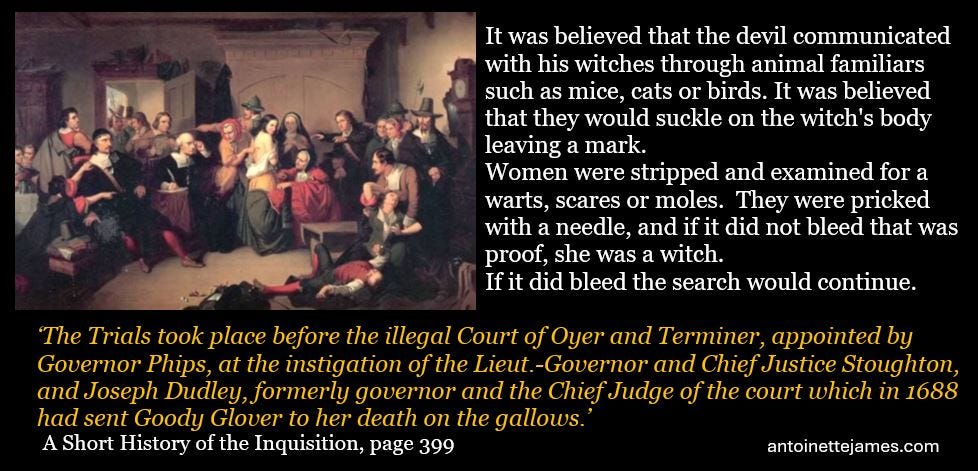
The girls, frightened of being sentenced to death as witches, started blaming others including Tituba for bewitching them. Betty and Abigail became celebrities not just in their village but further afield. And inevitably other girls joined the charade, including twelve-year-old Anne Putnam Jr. the main accuser, and Thomas Putnam’s maid, nineteen-year-old Mercy Lewis who had been forced to covert to Roman Catholicism. Mercy accused 29 people with several of them hanged. Together with Elizabeth Hubard and Mary Walcott they emulated the screaming, claimed they saw shapes, shadows and tormenting spirits.
‘Frenchman, Henri Boguet [Europe’s most zealous Roman Catholic witch hunter 17th c.] In his view, children should be made to witness against their parents. Even small children had to be tortured to get at the truth. If they were witches themselves, they, too, were to be killed, though with more compassion - say, by hanging.’ Vicars of Christ: the dark side of the papacy, 1988, Peter De Rosa, page 188
The girls were allowed to play-out their elaborate hoax during the court proceedings. The elite (most likely Jesuits and their adjutors) in Boston appointed their man Sir William Phips (1651-1695) also of dubious character, as governor, asking him to form an “emergency court” Court of Oyer and Terminer (an illegal Kangaroo-court). The judges were all wealthy Harvard educated, powerful, close friends. Six of the nine were related securing projected outcomes.
Phips was apt for corruption. He was unintelligent, near illiterate governor who flip flopped between obedience to his masters in the shadows and his conscience. His little wealth came from a discovery of Spanish treasure, interestingly enough, also in the Caribbean. Most of the booty went to the Crown, while he was a rewarded by being the first American to be knighted by the King of England, William III. William had been placed on the throne by the Jesuit Order. It was he who established the square mile City of London in 1694 gifting it to the papacy.
‘In December 1688 the armies of the Dutch, Prince William of Orange invaded England, interrupting the Hobbesian nightmare the country had experienced under the deranged King Charles I and his brother James II. A worse nightmare was to follow when William seized the throne of James II, for he embodied a more highly distilled form of poison which Venice [the Jesuit Order] had perfected during its sway over the remains of the Dutch Republic. This outright usurpation is blithely referred to in British-Venetian parlance as the “Glorious Revolution” which should give you some idea of how little regard for truth prevails in these circles.’ Graham Lowry, Historian, author
By the eight month the witch hunt hit too close to home for Phips. His wife, Lady Mary was accused – her spectre had visited one of the girls. The accusations that started with misfits, outliers were moving up the social order. Phips promptly wrapped up the Jesuitical Inquisition and just like that, the bloodletting was over. The means justified the end, and the end goal was the Jesuits vilified and fractured Protestant Christianity, opening the door for more overt papal rule in Massachusetts.
‘He befriends the French in Acadia…We now know when their merchants would come into Boston [Phips said] “you can’t arrest these fellows! I conquered Acadia and they’re as good an Englishman as you are. So, leave them alone.” Little did he realize they were spying and planning an invasion of Boston. We now know he was dogged by charges of misbehaviour throughout his whole career [typical leverage the Order looks for]. In late 1694 he was recalled to England to answer for high crimes…he dies in London of a fever before he can defend himself’ “Tad” Baker, State Professor of History, author “A Storm of Witchcraft: The Salem Witch Trials”, Museum of Old Newbury, 2019
The third bad actor in this tragedy was Harvard man Chief Justice William Stoughton, who not only presided over the trial hearings with malice and wrath but was chief judge and prosecutor. He and his subordinate judges defied English common law established on the King James Bible. Instead, he followed papal law according to the Roman Catholic Vulgate Bible, denying the accused legal counsel.
‘Historians trace the intricate web of these family connections to the elite merchant classes of the Massachusetts Bay Colony. Stoughton, alongside his eight fellow magistrates, formed a tight-knit political circle.’ google.com
Accused witch, Rebecca Nurse, was found innocent by the jury. So, Stoughton reconvened them until they came back with a guilty verdict, which they did. He ordered the hanging of suspects even if they were pregnant. But, to Phips credit, he denied the enforcement whereupon Stoughton stormed out in protest.
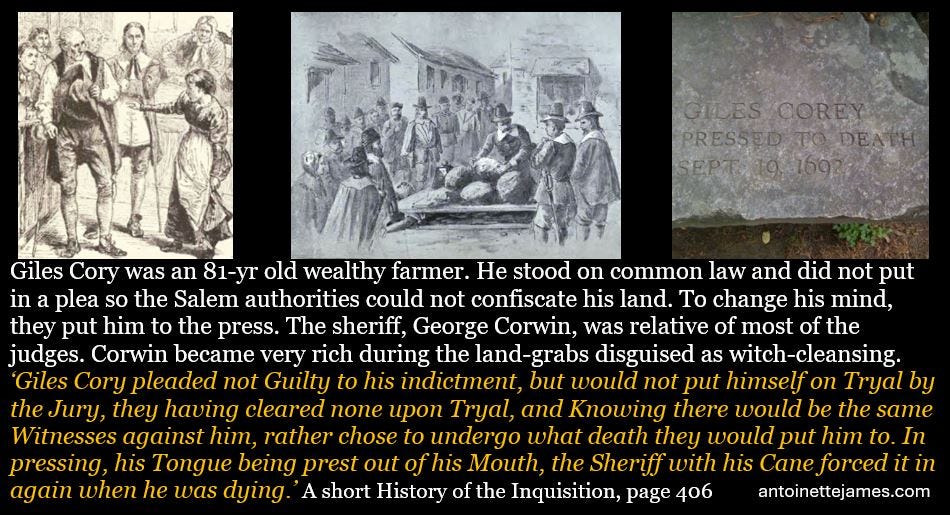
‘Armed with unassailable power from the pope, the two inquisitors ‘traversed the land’, writes Lea, ‘leaving behind them a trail of blood and fire, and awakening in all hearts the cruel dread inspired by the absolute belief thus inculcated in all the horrors of witchcraft’. The authors of The Witches’ Hammer laid down the basic principle that a witch must be convicted out of her own mouth. If not voluntarily, then by any other means.’ Vicars of Christ: The Dark Side of the Papacy, 1988, Peter De Rosa, page 187
Stoughton also departed from English common law by allowing papal “spectral evidence” to convict.
The word “specter” (or spectre) ultimately derives from the Latin word spectrum, meaning “appearance” or “vision”. Throughout history, the evolution of these ghostly entities has been shaped by Ancient Beliefs. Early civilizations, such as the Romans and Greeks, documented some of the first ghost stories. google.com
Spectral evidence was fabricated by the girls who testified that the accused spectre came to them in visions to hurt them. On the strength of increasing spectral accusations over 200 men, women and children were imprisoned. Their incarceration, trial and death were closely patterned on the European Papal Inquisition “witch-hunt” that culminated in annual public deaths of the Auto-da-Fé.
The pontiff [Pope Gregory IX] accepted without reservation that the devil was appearing at the witches’ sabbats, transformed into a toad, a pale spectre and a black tom-cat.’ Vicars of Christ: the dark side of the papacy, 1988, Peter De Rosa, page 183
A few of Salem’s imprisoned died in the squalor like their European counterparts. The Papal Inquisition removed people off the street on a whisper of a neighbour or enemy. The inquisitors took all property and belongings of the accused. The accused’s own money was used to keep them in the gaols. They were tortured, put on trial, and executed. In Salem an accused four-year-old girl spent months chained up inside the prison. When she was finally released, after her mother was hanged, she was without agency.
No one could defend themselves from spectral evidence, and that was the point. Nineteen women and a previous minister of the church were put to death by the gallows on the strength of it. Ministers like Increase and Cotton Mather did protest in an effort to install rule of law. After the trials were over, the judges expressed deep regret, except for Stoughton, he stuck to his papal views and belief in spectral evidence.
In the early part of June 1520, he [Martin Luther] added to this conclusion some words of exceptional vehemence which appear to mark a solemn and a final forging of his feelings towards Rome: ‘Farewell, unhappy, hopeless, blasphemous Rome! The wrath of God is come upon thee, as thou deservest . . . We have cared for Babylon, and she is not healed; let us leave her then, that she may be the habitation of dragons, spectres and witches and, true to her name of Babel, an everlasting confusion, a new pantheon of wickedness.’ Papal Power: its Origins and Development, 1989, Henry T Hudson, page 58
Stoughton’s cronies honoured his part in the crimes by naming the town of Stoughton, Massachusetts, after him. Also, Harvard College named dormitories after him in 1698, after they took his dirty money of £1,000.
Antoinette: The World We Live In is a reader-supported publication. To receive new posts and support my work, consider becoming a free or paid subscriber.
‘Possibly his [Pope Pius IX] natural tendencies may have inclined him to break the bonds which held him in the grasp of the monarchs and the Jesuits; but he was as unable to do this as a child is to tear away from the arms of a strong man…But in whatsoever direction he turned his eyes, he was haunted by the specter of Loyola, which flitted through the recesses of the Vatican at all times, ready...’ Footprints of the Jesuits,1894, Richard W. Thompson, page 308
The Salem conspiracy aimed to sully Protestant Christianity and America, while papal Europe’s torture and murder of over 500,000 accused witches - men, woman and children, is buried in Rockefeller history books. The Christians of Salem were called to a time of repentance, fasting and prayer, while the papacy continues its counter-reformation through wars, revolutions, pharmaceuticals and pandemics.
‘Remigius, criminal judge in Lorraine [Roman Catholic Nicolas Rémy], boasted that in fifteen years he had sent to death nine hundred persons for the crime of witchcraft.’ A short History of the Inquisition, 1907, Eugene Montague MacDonald, page 392-394
Please share this article with people you know who like this type of exposé
Comments
Nothing yet. Say the first thing.
Sign in to join the conversation.