
Chess is a game that kings have passed down through the millennia. But the reason why it is called the Game of Kings is that it is more than just a game, it holds culture, spiritual mysteries and psychological advantages. It could be said the game is the religious signature of presiding kings. Kings have morphed chess pieces to culture while retaining elite ancient esoteric beliefs. Chess is a game that goes beyond an earthly pastime, it totters at the pit of eternity. Chess is the game the gods gave to rulers to hone the art of war over their enemy.
‘The Gospel having spread itself into Persia, the pagan priests, who worshipped the sun, were greatly alarmed, and dreaded the loss of that influence they had hitherto maintained over the people’s minds and properties. Hence they thought it expedient to complain to the emperor that the Christians were enemies to the state…The emperor Sapores, being naturally averse to Christianity, easily believed what was said against the Christians, and gave orders to persecute them in all parts of his empire. On account of this mandate, many eminent persons in the church and state fell martyrs to the ignorance and ferocity of the pagans. Speaking of his victories over rival emperors of his own time, he [Constantine] said, “I subdued these solely by faith in Christ; for which God was my helper, who gave me victory in battle, and made me triumph over my enemies…I neither offered sacrifices to the ancient deities, nor made use of charm or divination; but only offered up prayers to the Almighty God, and followed the cross of Christ. Rejoiced should I be if the throne of Persia found glory also, by embracing the Christians…In consequence of this appeal, the persecution ended for the time, but it was renewed in later years when another king succeeded to the throne of Persia.’ Foxe’s Book of Martyrs, 1563, John Foxe, page 68
Elite devotees to the gods, that sit as chess pieces on the checkered board, celebrate and signal to each by using chess themes in books, art, plays and in modern times movies. No corporate media outlet releases, be it written or visual works, which has not been first checked by a Jesuit Order actor (CIA). Accepted works are puffed-up with the purpose of slotting the desired messaging into the psyche of man.
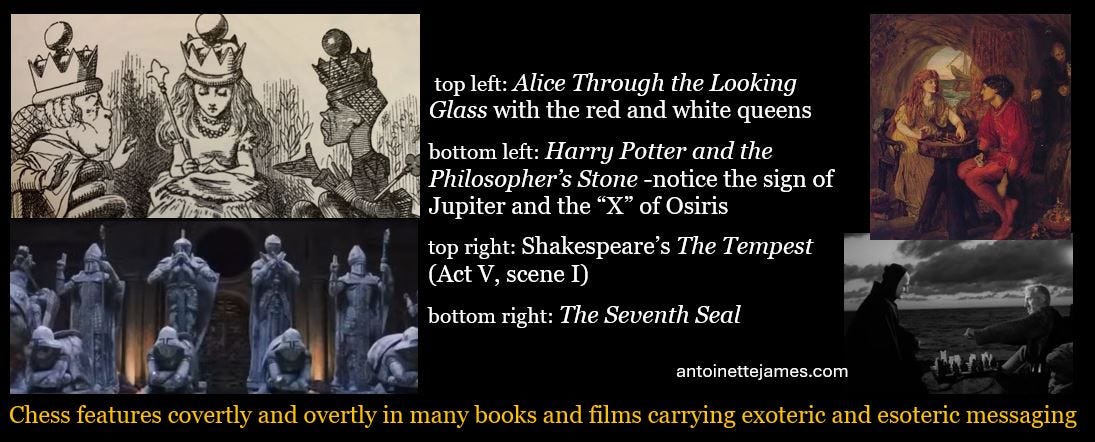
Chess examples are - Bergman’s 1957 film The Seventh Seal, where the game is used as a platform to stall the inevitability of death. JK Rowling’s Harry Potter and the Philosopher Stone chess sequence full of Ancient Mystery symbolism is another example of many where Hollywood imprints the humanistic notion that there is no higher power than the self-crowned king on earth – the pope. The mysterious pen behind the person William Shakespeare inserts what is almost an irrelevant scene (Act V, scene I) into The Tempest, where the audience finds the young lovers Miranda and Ferdinand playing chess. It is a metaphor for the hidden hand in politics.
Young children are subliminally introduced to their fixed place on the board of life by elite insiders like Louis Carol. His 1871 book Through the Looking Glass, uses a chess board landscape as the stage for Alice’s transformation from pawn to queen – she becomes Ishtar.
‘The simplest way to understand what is going on in the world today is to study the events of History as the moves being made in a continuing game of International Chess...The leaders of the Illuminati [Jesuit Order] have divided the people of the world into two main camps. They used Kings and Queens; Bishops and Knights; and the masses of the world’s population, as pieces in their games. The ruthless policy of the leaders is to consider all other human beings as EXPENDABLE, providing the sacrifice of a Major piece, or a million Pawns, places them a move nearer their ultimate totalitarian goal. The despotism of Satan. Pawns in the Game, 1955, William Guy Carr, page 61-62
So integral is the game to elite culture, chess analogy is used hidden in plain sight. Politicians use chess terms; Military theorists use chess principles and Philosophers use chess metaphors when illustrating the mind slavery of man’s self-image.
The early form of chess was created, more than likely by the occult practises, many centuries before the birth of Christ in the Ancient Mystery sun worshipping culture of India. By the time of the 7th century BC, the game was established and modified for pagan sun worshipping Persia. From there, with interaction between pre-Mohammedan Arabs and papal Rome the game was introduced into Roman Catholic Spain during the 7-8th centuries AD. As the papacy had a stranglehold monopoly across Europe, chess easily spread from country to country during the Dark Ages.
Throughout history, the game of chess itself became a chess move. – to coin two lines from the 2002 esoteric Jesuitical movie, Count of Monte Cristo, Italy was now King of the moment. And the Jesuit Order in the 16th century had more in store; it is by no accident that in the 2002 movie Napoleon Bonaparte looks out from the Island of Alba (where the Jesuits banished him), and announces, in life we are all either kings or pawns…Kings and Pawns, Marshal, Emperors and fools.
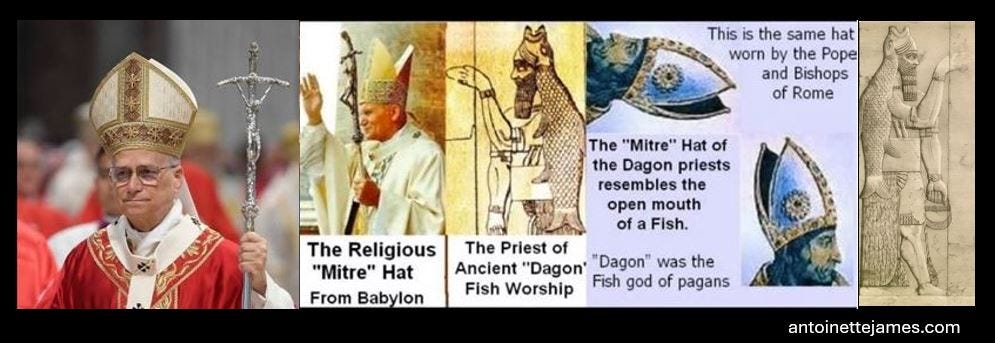
Papal Rome may appear to have a Christian face, but that face covers an ancient pagan Mithraic core. They did not change the pagan display of chess, they did what they always have done, they took their pagan beliefs underground by rebranding. Papal Rome transformed the Eastern figure of the elephant, to a Mithraic Dagon Bishop complete with mitre, making the highest levels of the game reflect the hierarchy of the Catholic Church itself.
‘…two Elephants (where the Bishops now sit), two Horses, two Ruhks (Persian for “chariot”), and eight Foot Soldiers. The object was to capture, trap, or isolate the opponent’s King.”’ The Immortal Games: A History of Chess, 2008, David Shenk, page 18
In India the elephant embodies divine power and are vital iconic participants in religious rituals of royalty; all the attributes papal Rome claim for herself. Embodied in the Bishop is the spirit of the elephant.
The elephant is synonymous with Ganesha, one of the most widely worshipped Hindu deities. As the “remover of obstacles,” he is invoked before starting any new venture. The elephant head represents perfect wisdom, while its large ears symbolize patience and the ability to listen. Google.com
Elephants in India are a symbol of military power. What elephants are to India, Mithraic pomp is to the papacy. Both are adorned in elaborate gold and brightly coloured textiles, complete with images of deities and idols during highly religious processions and festivals. In India to receive a trunk-touch a “blessing” from an elephant is believed to bring good fortune and prosperity; so too papal Bishops wield great power and historically were accompanied by their own army. The same core spirit makes easy the physical transformation on the chess board.
The core principle of chess is about the protection of the king, and the pope sees himself as a king – he sits on a throne, wears a crown and esoterically, as his pagan triple crown declares, he reigns over hell and over heaven and over every nation on earth. His triple crown also denotes he owns every man woman and child – Spirit, soul, and body. For extra security the papacy gave the chess king new defensive powers in the 15th century. The piece was given the ability to jump on its first move better positioning itself in a way no other piece on the board has. Later the king was given additional support by being able to move simultaneously with the rook, called castling.
Perhaps the most surprising physical chess piece transformation made to fit papal culture was when the king’s minister (the vizier or ferz) was replaced by the Queen around 1475. A century later she was further elevated receiving sweeping powers which caused a lot of opposition; which of course was ignored. Effectively the queen was unshackled from her limited actions, gaining much more freedom of movement.
Historians view the Queen’s immense power on the board as a reflection of the rise of royal woman at the time, such as Queen Isabella of Castile (1451-1504) and Queen Elisabeth I of England (1533-1603).
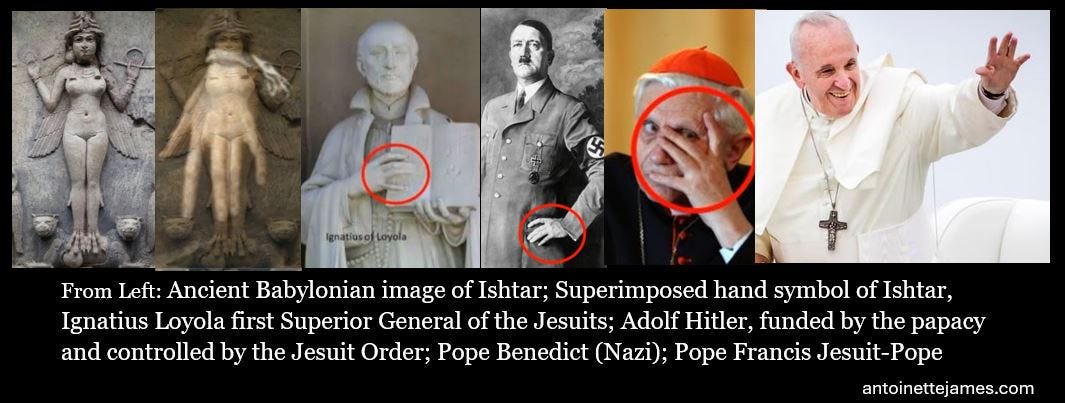
However, the chess queen is less about living women and more about the goddess worship. The queen is the goddess Ishtar, for whom the bishop facilitates. The bishop can only move diagonally in an “X” formation - the symbol of Osiris, Ishtar’s husband. The introduction of Ishtar made for a more aggressive faster game.
‘Her [Ishtar] temperament was, in many ways, more characterized by attributes commonly associated with masculinity. She was a fighter. She was assertive, aggressive, dominant, combative, competitive, courageous, fierce, strong, independent, violent, brave, and ferocious.’ Return of the Gods, Jonathan Cahn, page 158
On the board, papal Ishtar is the transformation of the Indian chess piece, the goddess Gajalakshmi. Gajalakshmi is a manifestation of principle goddess Lakshmi, born of the ocean. She is the goddess Venus (Ishtar/Roman Catholic Virgin Mary), an anagram for Satan.
‘She is, moreover, called the ‘horned’ Ishtar, being one of her names as the planet Venus. It has been suggested that the horned Ishtar was derived from the appearance of Venus, which astronomers describe as having two small horns, and as giving the appearance of a crescent.’ Tammuz and Ishtar: A Monograph Upon Babylonian Religion and Theology, 1914, S. Langdon, page 56
On asking google whether Ishtar fits well on the chess board, for all google’s weakness and deception, it sourced the truth with refreshing honesty - Representing Ishtar as the queen on a chessboard perfectly bridges her…traits with the mechanics of the game. In Mesopotamia…Ishtar is the powerful, multifaceted goddess of war, love, fertility, and political power. As the “Queen of Heaven” [title Catholicism gives the Virgin Mary] and the most versatile piece on the board, she embodies ultimate dominance, mobility, and fierce protection. The queen is both the most lethal attacker and the ultimate defender on the board. This duality reflects Ishtar’s…nature perfectly: The queen piece acts as a nurturing, protective force for the King [papacy]…Just as Ishtar was feared in battle, the queen can traverse the board instantly to strike down opposing pieces and devastate the enemy’s lines. Ishtar is a deity who transcends limits—she can travel between the heavens, the earth, and even descend to the Underworld. On the chessboard, the queen reflects this boundless freedom. She has the combined movement of both the Rook and the Bishop (moving diagonally). No other piece can match her reach, vision, or capacity to influence the entire board from a single square.’
Papal Rome renamed Ishtar to the Virgin Mary. As the ancients prayed to Ishtar, so Roman Catholics pray to Mary. According to Rome Mary is the Lady of Heaven, or Queen of Heaven, as Ishtar was to the ancients.
‘The following is taken from a prayer of Ashurnasirpal I to the Ishtar of Nineveh: ‘The matter which has befallen me, [even the sorrows] in words I will rehearse, Unto the creatress of peoples, [her to whom] praise belongs” Unto her who sits in Emasmas [divine Ishtar] who has extolled my name, Unto the queen of the gods in whose hand the laws of the gods are fulfil. Unto the lady of Nineveh, séster of the lofty ads, Unto the daughter of Sin, twin sister of Shamash,‘ who rules over all kings, Unto her who renders decision, goddess of all things, Unto the lady of heaven and earth who receives supplication, Unto her who hears petition, who entertains prayer, Unto the compassionate goddess who loves righteousness, Ishtar the queen, whom all that is confused oppresses, The woes as many as I see I will weep of before thee.’ Tammuz and Ishtar: A Monograph Upon Babylonian Religion and Theology, 1914, S. Langdon, Page 65
Through the Dark Ages Chess was introduced to Monasteries and Roman Catholic Seminaries as an important part of their education that included intensive spiritual, humanistic, intellectual, and pastoral teachings. The result was and is that most all, if not all, Popes in history were trained in the art of war on the chess board –
Pope Leo XIII (1810-1903) was described as a constant player for over 30 years whose skill at the game was by no means mediocre; Pope Gregory VI ( -1047) described as an avid chess player; Pope Innocent III (1161-1216) Chess.com run online tournaments named after him; Pope Leo X (1475-1521) was described as a keen chess player; Pope John Paul I (1912-1978), the Pope the Jesuits assassinated was a mediocre player; Pope John Paul II (1920-2005) who the Jesuits attempted to assassinate, was a composer of chess problems which shows a rare intelligent mind. The International Chess Federation (FIDE) awarded him the title Grand Commander of the Legion of Grandmasters in 1999.
‘I have attended an audience with Pope John Paul II, where he blessed the participants of the Banca di Roma International Chess Tournament.’ Raymond Kenne OBE, English chess grandmaster
Popes choose their papal names very carefully, taking on a previous name that fits their ideology. Pope Leo XIV like his predecessors is a champion of socialism and enhanced his strategy on the art of the war of attrition on the chess board. Vaticanfiles.org defaults to papal chess terminology signalling to the elite his purpose, In chess terms, the election of Leo XIV was a knight’s move: surprising, indirect, coming from the rear, and disrupting the board in ways that force everyone to rethink their position. The game has changed.’
Back in the 10th century the Vatican had a problem facing them. They demanded, on pain of death, complete obedience of thought and action. Today’s pope as of yester-year asserts that freedom of conscience (free thought) is an insult to God and man. The introduction of the game of chess did nothing to dampen freedom of thought, in fact it produced high levels of problem solving and critical thinking. So, the papacy and its agents banned chess.
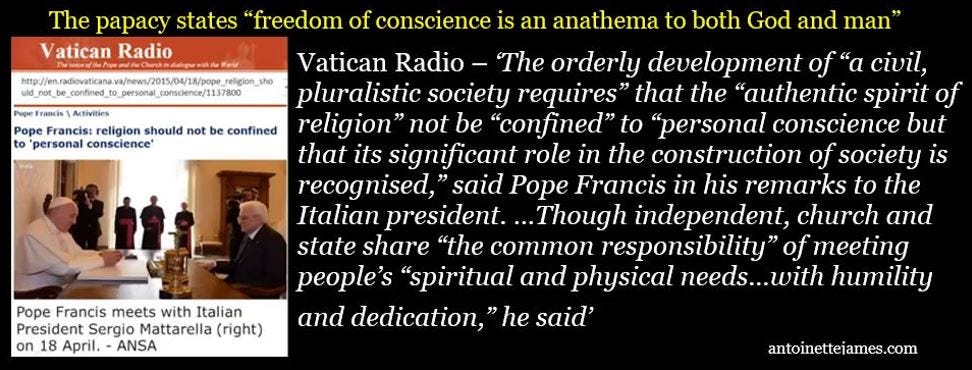
In 1128, St. Bernard of Clairvaux (1090-1153) prohibited the Knights Templars from playing chess. And later in 1197, Eudes de Sully, Bishop of Paris, forbade priests from playing chess or owning a chess set as he saw it as debased. Article 81 stated, And it is absolutely forbidden for them to have chess or dice or dice in their homes. He either was not in the inner circle or the papacy saw a threat among the priests. While the papacy continued, the priests took the game underground. For the common folk chess was formally prohibited in 1299.
The ruse was that playing chess was a form of idolatry. The Holy See uses Bible texts over Church Tradition when it suits; they cited Thou shalt not make any graven image is the 2nd commandment God gave to Moses. The only problem here is that the Papacy has removed that commandment from the ten, as it was too embarrassing for a church full of idols and graven images. Prohibition gave time to refigure the ancient Eastern chess pieces to suit papal Mithraism.
Nearly four centuries later in proverbial dialectic fashion chess was allowed back. Papal Rome shaped the game of chess in its own image a mere eleven years after Pope Paul III, by papal bull Regimini militantis Ecclesiae consecrated the Jesuit Order on the Luciferian date of 27th September 1540.
Chess was quickly used by the Jesuits as a teaching tool. Spanish Roman Catholic Priest, Rodrigo “Ruy” López de Segura (c. 1530-1580) stood out as a chess master. He wrote the first chess publication, the treatise Libro de la invención liberal y Arte del juego del Axedrez, in 1561 establishing chess vernacular that is used to this day.
Ruy later became a personified chess piece when he was promoted to Bishop and personal confessor and advisor to King Philip II of Spain. Holding such a powerful position, if he was not a Jesuit, he most certainly would have been a Jesuit adjutor.
‘Let diligent labourers, whose industry is equally bent on promoting the temporal, as the spiritual interest of the Society, be always held in the greatest esteem; of which sort are (generally speaking) confessors of princes…’ The Secret Instructions of the Jesuits, 1811, page 84
In 1574 by the invitation of King Philip II, two leading Italian chess masters Leonardo Dona and Paulo Boy travelled to Madrid to play against Ruy and his friend Alfonso Siron. The game took place at the royal court with Philip in attendance. The Italians won, moving the chess “control centre” closer to Rome.
Chess is an assessment tool the Jesuit Order uses for early targeting of young men the wish to stealthily press into service.
‘1566-72. [Pado] Boi [1528-1598] after having defeated all his [chess] opponents at home [Italy], resolved to travel in search of opponents. His intention was to go ultimately to Spain, ‘where he heard that there were very famous players who were honoured and rewarded, not only by certain nobles, but by the King (Philip II) himself, who took no small delight in the game.’ He travelled throughout Italy, playing the greater players, including [Giovanni] Leonardo [1542-1587], and was honoured by many princes, specially by the Duke of Urbino and Pope Pius V, who would have given him a rich benefice if he had been willing to take orders.’ The History of Chess, page 854
The game of chess can be used as a tool for We the people to track the Jesuit Order through History. Chess seems to be an ensign of Jesuitical triumph. What country holds the champion strangely tracks the countries that are being restructured by the Order. The Society of Jesus (the Jesuits) and chess have a deeply intertwined history, ranging from an early emphasis on intellectual training in Jesuit schools to modern elite programs.
Again, deferring to google - Historically, chess became a staple of Jesuit higher education in 1850 when the 13-year-old chess prodigy Paul Morphy attended Spring Hill College in Mobile, Alabama [a private Jesuit Institution], where he honed his classical education before becoming one of the world’s best players. Today, the tradition persists with competitive chess teams and clubs dominating at Jesuit high schools across the globe. For instance, the chess team at Jesuit High School Portland in Oregon has won multiple state championships, reflecting the Jesuit focus on patience, strategy, and analytical problem-solving. Beyond academics, Jesuits frequently use chess as a spiritual and pedagogical metaphor for Ignatian spirituality: The game’s 64 squares and battle between pieces reflect the Ignatian concept of spiritual discernment and the battle between good [Osiris] and evil [God of the Bible].
Chess and Sun Tzu’s (name used by the Jesuit author) The Art of War share deep philosophical links. Both are firmly designed around strategy, calculated sacrifice, and psychological warfare. The Jesuit Order have been behind all the wars and Revolutions of the 18-20th centuries.
‘The history of the Lenin and Stalin Dictatorships should convince any unbiased person that the masses of the world’s population, regardless of colour, or creed have been used as Pawns in the Game of international chess played by the “Red” international bankers and the “Black” Aryan Nazi War Lords as directed by the Illuminati.’ Pawns in the Game, page 269
The illuminati, the Jesuits hide in Masonic Masonry after their banishment by Pope Clement XIV in 1773. There they imbedded their Luciferian sun worshipping mysteries. The black and white tiles synonymous with masonry are also synonymous with the modern chess board. Black and white are the two natures of Ishtar. Hence Roman Catholicism has Black Madonnas (Ishtar) and white Madonnas. Masonry has degrees with 32-33rd being the highest. The chess board is made up of 32 white and 32 black squares, with 204 total squares. Chess is about degrees of strategy.
‘In 1923 at a big banquet attended by many men prominent in International Affairs, some of whom were connected with the League of Nations organization [forerunner to the U.N.], the President of the Grand Orient gave this toast. - “To the French Republic, daughter of French Freemasonry. To the universal republic of to-morrow, daughter of universal Masonry.”’ Pawns in the game, page 166
But it wasn’t until November 1958…I learned by accident…that Albert Pike [33degree Freemason] owned an extremely rare set of chessmen copied from the originals. Part of the chessmen belonging to his set were taken from his…in the summer of 1863…Pike’s chessmen fell into the hands of Captain E.S. Stover, of Company ‘B.’ After the war, he moved to New Mexico and became Grand Master of the Grand Lodge of Scottish Rite Masons. In 1915, when Stover was over 80 years of age, he had Pike’s chessmen placed with other relics of Pike, in the Library of the Supreme Council King, queen, Bishops, Knights and the plebs!’ Satan Prince of this world, 1966, William Guy Carr, page 71
St. Teresa of Avila (1515-1582) a Spanish Carmelite nun, and prominent mystic was formally recognised as patroness of chess players in Spain 2020. She wrote The Way of Perfection in 1566; She insisted the other nuns play chess with God, in attempt to “checkmate” Him. Check and Mate shortened to checkmate comes from ancient Persian Chess phrase, Shah māt, translated - the king is dead.
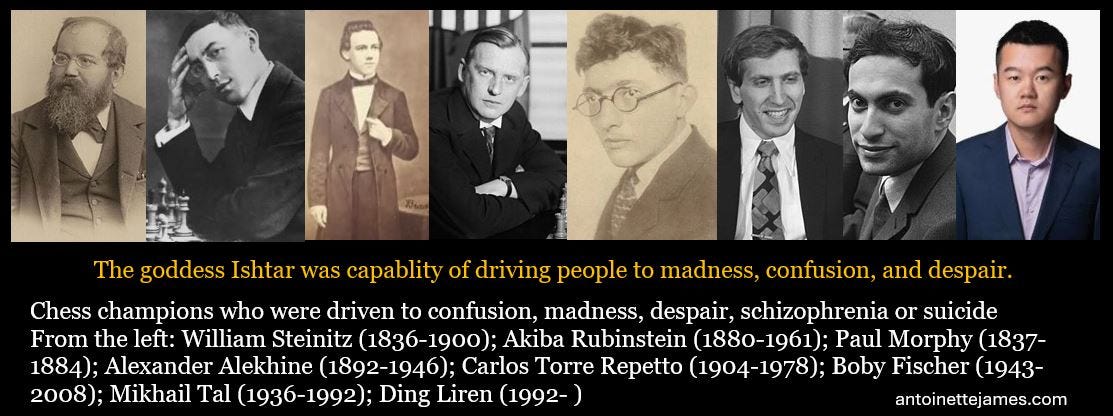
The death of God is the aim of Luciferian elite. Casual chess playing is harmless, but professional chess players have a high risk of insanity, selling their soul to Ishtar.
‘What of chess game? Needs such tension, supernatural tension [the spirit of Ishtar] that a normal human being cannot stand. This is to feel kind of aggression, hate or contention to your opponent to be able to stand such intensive play’ Latvian-Soviet Grandmaster and former chess World Champion, Mikhail Tal.

Please share this article with people you know who like this type of exposé
Comments
Nothing yet. Say the first thing.
Sign in to join the conversation.