
All countries around the world have iconic architectural statements that become synonymous with the city and nation. Each iconic statement holds history, culture and more, they hold hidden religious meaning.
Most of the culturally significant constructions across the West and Western Europe, when looked at through a lens of deep history, are nothing more than a renaissance of Pagan Rome imposed over the people’s will. Arches of triumph are clear examples of Rome’s stamp of presidency. Presidency over burgeoning Christianity.
‘Roman triumphal arches remained a source of fascination well after the fall of [pagan] Rome, serving as a reminder of past glories and a symbol of state power, that was especially appealing to Holy Roman Emperors. At Losch Abbey, the triple-arched Torhalle was built in deliberate imitation of a Roman triumphal arch to signify continuity between the Carolingian [papal] Empire [800-888AD] and its [pagan] Roman predecessor…It was not until the coming of the Renaissance, however, that rulers sought to associate themselves systematically with the Roman legacy by building their own triumphal arches… when Duke Charles Emmanuel I of Savoy married Infanta Catalina Micaela of Spain in 1585, he processed under temporary triumphal arches that asserted the antiquity of the House of Savoy and associated his dynasty, through the art and architecture of the arches, with the imperial Roman past.’ Wikipedia
The French ruling class under the Roman Catholic Bourbon Kings and later the Jesuit tool Napoleon Bonaparte, imposed permanent triumphal arches as statements of allegiance to the papacy and its esoteric Ancient Mystery Religion of goddess worship.
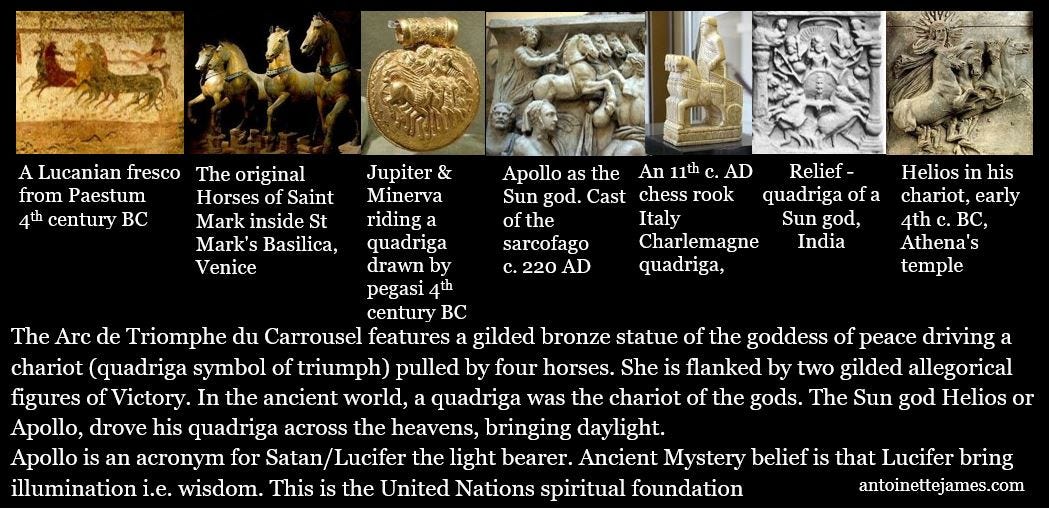
Although the Arc de Triomphe, Paris (built 1806 to 1836), stands as the most iconic, it is but one of many in the city and indeed across the world. It can be argued that this icon does not follow the usual ancient Roman blueprint particularly with its lack of columns, however it is adorned with Mithraic gods and goddesses with the nudity that is synonymous with it. A more perfect example of imperial Roman antiquity is better seen in the lesser-known Arc de Triomphe du Carrousel, constructed in Paris from 1806-1808. It is a copy of the Arch of Septimius Severus (202-203AD) in Rome.
As in antiquity, triumphal arches stand as statements of power and self-aggrandizement by dictators. The Roman Catholic Adolf Hitler, funded by the Vatican and mentored by the Jesuit Order, had planned what would have been the largest triumphal arch the world had seen to date. It was to be built in Berlin to celebrate his projected WWII victory. It was to be his reward for bringing Europe back to the papacy and ushering in esoteric Roman Catholicism - Mithraism, as a one world religion under the pope.
The Roman Triumphal Arch of Orange, built by The Holy Roman Emperor Augustus (27BC-14AD) around 21 AD and restored by Emperor Tiberius around 20-27 AD is the oldest triumphant arch to be found in France. It was built to honour the veterans of the Roman Gallic Wars. Other famous French arches are the Roman St-Martin and St-Denis gates (built 1670s), built as tributes to the champion of papal Rome, King Louis XIV. Exoterically arches are built to honour veterans of successful Roman campaigns. However, esoterically they are portals, or gates for the goddess Ishtar to enter through.
‘Worshipped as the Mistress of Heaven, Ishtar represented the power of sexual attraction and was thought to be savage and determined. Symbolized by the star and her sacred animal, the lion, she was also the goddess of war and the protector of ruling [Ancient Mystery Religious] dynasties and their armies.’ Wikipedia
Saint Martin arches, an apotheosis to deify Louis XIV is engraved with 12 labours of Hercules. On this arch Louis takes the god’s persona typically presented nude, but for a loin cloth and comically his 17th century wig due to his kingliness. The sculpture is to immortalise the rupture of the Triple Alliance during the war of devolution. That is, the collapse of the 1668 coalition between the Protestant nations of England, the Dutch Republic, and Sweden.
The iconic and grander Arc de Triomphe de L’Etoile was commissioned by Napoleon I in 1806. Its reference was the Arch of Titus in Rome (1 AD). Exoterically it was erected to hail the glories of the Jesuit run French Revolution, but esoterically it was to honour the goddess of war, destruction and sex - Ishtar.
Bonaparte, the wonder-boy of the Jesuits was allowed to commission Arc de Triomphe as a reward for conquering for Rome. So keen he was to be able to parade through it for his marriage to his second wife, Archduchess Marie-Louise of Austria in 1810 that he made a full-scale replica. The real monument was not completed until fifteen years after his death in 1836. However, in 1840 during his triumphant funeral parade his body passed under it mid-construction.
The Arc de Triomphe was designed by the Roman Catholic, Jean-Francois Chalgrin, a well noted designer and insider of papal France. Prior to the commission, he had been given leave to study ancient Roman architecture in Rome for four years. His sculptured ancient mystery friezes, engraved names of major papal French military victories and the French Revolution led by Jesuit Robespierre. He immortalized the Jesuit run Napoleonic wars and engraved the names of the French generals of the First French Empire - Imperium Francicum, when Napoleon was crowned and France was under Jesuit control. As the Arch of Titus, the Arc de Triomphe was adorned with winged goddesses of Victory/Liberty, Libertas (not freedom).
On the eastern façade of the Arc de Triomphe relief sculptor Jean-Pierre Cortot worked on The Triumph of 1810. It effectively is an apotheosis to Napoleon, depicted in classical Roman garb modestly wearing a toga. He is being crowned by Ishtar the winged goddess of Victory, also known as Queen of heaven. Above his head a exoterically an angel trumpets, but esoterically it is the goddess of Fame who flies in victory over a kneeling female who represents Paris, now a conquered city.
The Western pillar (spandrel) is also decorated with Roman mythological figures. For the war was for Ishtar, so the glory. On the northern pillar, Pheme (Fama to the Romans) the Greek goddess of rumour, fame and renown. In the Roman poet Virgil’s Aeneid, he depicts her as a monstrous, winged creature. Beneath every feather on her body lies a prying eye, a pricked ear, and a wagging tongue.
Rome often illustrated her as living in a house of a thousand windows and constantly buzzing doors. She is the goddess of surveillance, always listening in. In 21st century the internet is her house. And like the 21st century, where the ruling class have softly walked through the institutions becoming tyrants extinguishing freedom of free speech, her rumours begin as small, frightened whispers but grow into booming, monstrous shouts as she [and the ruling class] walks the earth with her head in the clouds.
Also on the northern spandrel, the goddess of victory, Ishtar reminds all of whose works are really being honoured. Wikipedia explains, Winged figures, very often in pairs, representing victory and referred to as winged victories, are common in Roman official iconography, typically hovering high in a composition, and often filling spaces in spandrels or other gaps in architecture.
The three famous arches form Paris’ Voie Triomphale (Triumphal Way) starting in the East with the Arc de Triomphe du Carrousel, in the middle, the Arc de Triomphe, and to the West the more modern 1989, Grande Arche de La Défense. Their sites were carefully planned to follow the path of the sun (Horus) as he is born each day in the East and dies each night in the West, called the Axe historique.
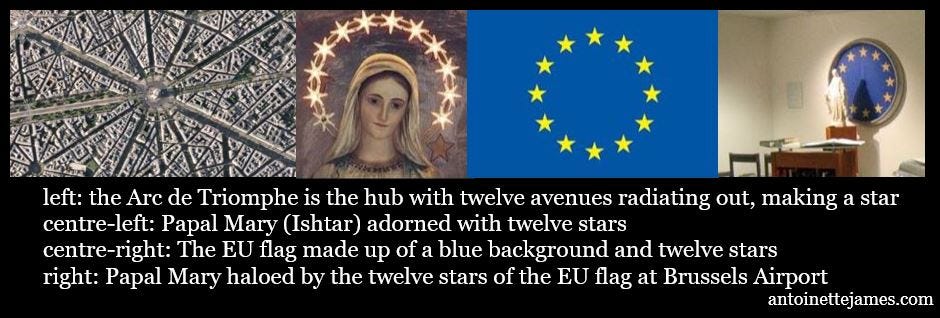
The elite honour the celestial, as the gods dwell there. The Arc de Triomphe in Paris sits at the centre of Place Charles de Gaulle or Place de l’Étoile. Étoile in French means star. There are twelve grand avenues that radiate out from the monument like beams of a star. Paving stones surround it in a stellar pattern pointing to the centre monument. A grand 5-mile processional route runs from it to the Louvre in the centre of Paris echoing ancient Babylon. And like the ancient occult rituals the Jesuit celebrations including Bastille Day military parades are held there.
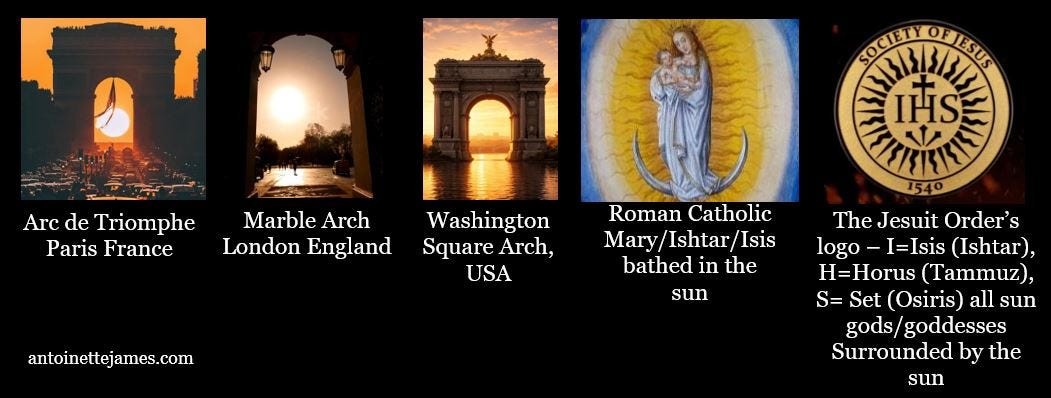
The planets are named after mythological gods; the sun and the moon are representations of their god Osiris and goddess Ishtar. So the Arc de Triomphe was positioned to honour them. The sun sets directly through the central arch and shines down the axis of the avenue twice a year, in early May and August. Anecdotally for that reason the Arch is known as the “Paris Henge” as in Stonehenge.
The elite Luciferians in London, England constructed two portals to the goddess Ishtar, though much smaller in scale. Both were commissioned by the short-lived Jesuit owned George IV, to celebrate British victories over the same Napoleonic Wars. The Jesuits “own” both sides of any conflicts whether national or civil war, Revolution or pandemic. These arches were designed initially to be the grand ceremonial gates, like in Babylon, at Buckingham Palace.
The Wellington Arch (known as Constitution Arch) (1826-1830) was designed after the Arch of Constantine in Rome by Decimus Burton. This arch was moved to its current site at Hyde Corner in the 1880s, which also have streets radiating from it.
Exoterically the Angel of Peace descending on the Chariot of War stands on the top, esoterically Ishtar stands above her gate. The elite deem it so important to their culture they have protected this arch with a Grade I-listing.
Burton was a collector of popery, owning an historical 18th-century print portrait of Pope Clement XIII and engravings of other popes. He collaborated on architectural alterations with the Roman Catholic Burton family of Borris House in Ireland. Due to their fealty to the Pope, they received papal permission to house a private Catholic chapel on their estate.
Marble Arch was designed firstly by John Nash. When it was resited, the architect Edward Blore was then brought in after financial concerns. It had its third and final resiting to the northeast corner of Hyde Park in 1851 in time for the Great Exhibition.
Nash took his reference from Rome, specifically from the Arch of Constantine and the Arch of Septimius Severus as a homage also to the Napoleonic Wars. Marble Arch heralds in the sun rays of the god Osiris along Bayswater Road mid-March and mid-September.
The younger nation of America received its Luciferian occult gateways -The Gateway Arch in St Louis, Missouri standing as the Gateway of the National Park. It was built to honour the Jesuit run Westward expansion. The Jesuit Order owned many of the ranches in the west and fomented the Indian wars against the protestant settlers.
New York City, the gateway for mass immigration from Catholic Europe, houses the Washington Square Arch. The sun rises through the centre of the arch late May and sets through the arch mid-July close to the summer solstice. The sun rises in the opposite direction in early December and early January.
In Huntington, West Virginia (named after the Virgin Mary), the Roman Catholic Ishtar arch was built to celebrate the death and destruction of world war I.
Wherever Rome’s Jesuits go to conquer, portals to Ishtar are erected. Other arches are - the Brandenburg Gate in Berlin, 1788-1791; the Narva Triumphal Arch in Saint Petersburg, 1814; the Arch of Victory in Ballarat, Victoria 1920; the triumphal arch of the India Gate, New Delhi, India1921-1931 ; the Arcul de Triumf in Bucharest, Romania, 1936; the Arch of Triumph in Pyongyang, North Korea, 1982; the Simpang Lima Gumul Monument in Kediri, Indonesia, 2008.
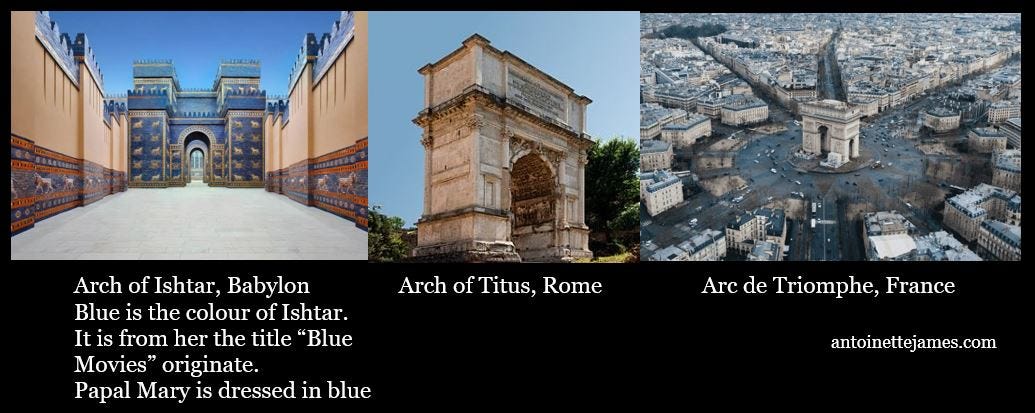
The original triumphant arch that all arches (gates) emulate was built in Babylon (present day Iraq) in c. 569 BC. King Nebuchadnezzar II (reigned 604–562 BC) ordered it to be built on the north side of the city. It was called the Ishtar Gate in honour of the war goddess of Babylon. Ishtar Gate was one of eight gates to enter the inner-city wall and procession way, finished in dazzling blue glazed bricks decorated with bulls and lions, symbols of their gods Marduk Adad, the storm god, and Ishtar respectively. Today Iraqi embassies in Amman, Jordan, Islamabad, Pakistan, and in Beijing, China, are modelled on the ancient Ishtar Gate.
‘Ishtar had always been drawn to gates. Among her most prominent symbols was a pair of standards referred to as gateposts. And one of the most famous of all archaeological remains is that of the Ishtar Gate that opened the way to the city of Babylon. So too gates played a central role in her descent to the underworld. She demanded their opening. She would open them one way or another. It was her nature; she was the trespasser of boundaries. What she was now about to force open was the long-closed door, the locked gateway of Western civilization. She would have to come to the gateway to do it. In the late twentieth century America was the leading power of Western civilization and of what could still be called Christian civilization. She would come to its gateway.’ Return of the gods, 2022, Jonathan Cahn, page 194
Babylon’s Ishtar’s Gate was a 800 metre Processional Way for parades culminating at the Temple of Marduk.
‘The creation of the gate out of wood and clay glazed to look like lapis lazuli could possibly be a reference to the goddess Inanna, who became syncretized with the goddess Ishtar during the reign of Sargon of Akkad. In the myth of Inanna’s descent to the underworld, Inanna is described as donning seven accoutrements of lapis lazuli symbolizing her divine power. Once captured by the queen of the underworld, Inanna is described as being lapis lazuli, silver, and wood, two of these materials being key components in the construction of the Ishtar Gate. The creation of the gate out of wood and “lapis lazuli” linking the gate to being part of the Goddess herself.’ wikipedia
Babylon, as Pagan Rome, as Papal Rome hate Israel. Nebuchadnezzar conquered Jerusalem taking the Southern Tribe of Judah captive putting them into slavery. Pagan Rome ruled over Judea with an iron grip. Many Jews took on Babylon’s spirituality and wrote the Talmud from its mysteries.
Pope Urban II in 1095, at the Council of Clermont in France, proclaimed the First Crusade to take Jerusalem from the Muslims, after a deal with them to capture Jerusalem and hand it over soured. He sent many Europeans peasants and knights to deaths of starvation and disease due to his obsession with the Holy Land. To motivate them he promising spiritual rewards and forgiveness of sins.
Three hundred years later, in 1555 Pope Paul IV issued a Papal Bull, Cum Nimis Absurdum. Italian Jews were forced to wear yellow badges on their clothing, and pay an annual fee to live in a walled off Ghetto of the city. He forced them to assemble under the Arch of Titus to recite an oath of submission to Roman Catholicism and the city of Rome. The same papal machinery and the same pattern they would use in 20th century Germany that in turn created the Trojan Horse of Zionism.
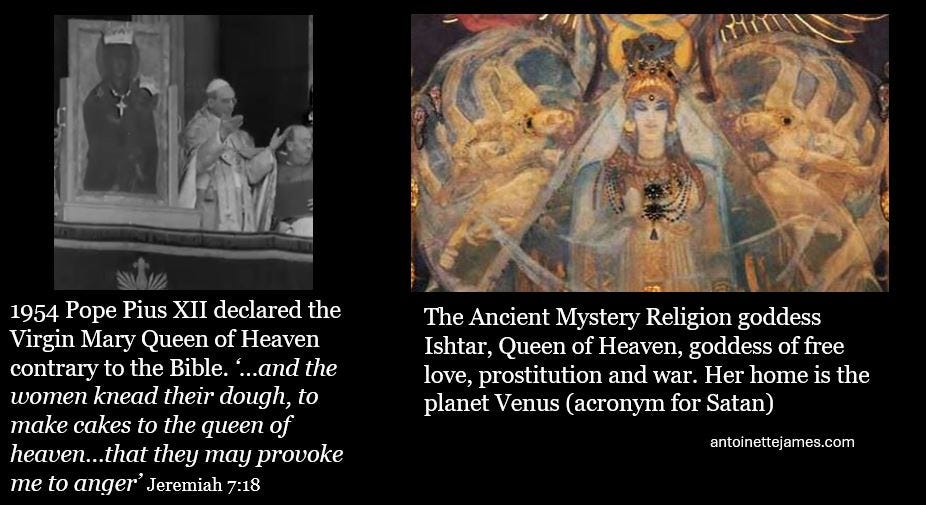
Papal Rome’s seat is Babylon, so it is of no surprise that Rome will spend a fortune to save, restore and resiting their Queen of Heaven’s gateways whether in London, Rome or Babylon. Pope Pius VII restored the ancient Arch of Titus in the Roman Forum at great expense in 1821. In 1930, the Ishtar Gate, and Processional Way of Babylon was painstakingly dismantled and reconstructed at the Pergamon Museum, Berlin, Germany, the ancient seat of the Holy Roman Emperors. It has been heralded as one of the most complex architectural reconstructions in the history of archaeology, giving insight to its spiritual significance to the Vatican.
‘The Arch of Titus was built in its present form under the sponsorship of Pope Pius VII. This reconstructed monument stands alone and unencumbered by buildings that had enveloped it for centuries—until they were cleared under Napoleon in 1810. This rebuilt arch quickly became a widely popular symbol of modern Rome, and the primary model for triumphal arches the world over. The image of the Arch of Titus became a commonplace [puffed-up] in both fine art and popular media, and has maintained this monumental power for nearly two centuries. The reconstruction of this structure in the aftermath of the Napoleonic occupation reflects the triumphal resurgence of the Pontifical State under Pius VII (r. 1800–1823). The papacy expressed its return to power through the reconstruction of monuments of imperial Roman greatness, which are now in the service of the imperial Church…This work was completed in 1823.’ Article, Arch of Titus, Marina Caffiero, researcher, author
Popes claim themselves God – Osiris on Earth. Historically, they too paraded through triumphal arches during their Possesso, an elaborate, ceremonial procession newly elected popes made from the Vatican to take possession of the Archbasilica of St. John Lateran.
The Medici pope Leo X’s (1513) Possesso was extremely opulent. He had constructed several elaborate, temporary wooden triumphal arches in Rome, adorned with paintings and sculptures of the Pagan Roman gods Apollo and Mercury whom esoteric Roman Catholicism worship. Pope Clement VII (1523) Pontif Maxim had the architect Baccio Bandinelli design temporary triumphal arches for his coronation procession, as a nod to his Pagan insider knowledge. Pope Sixtus V (1585) commissioned a permanent triumphal arch to celebrate his triumph at becoming the Holy See (Ishtar), naming it Arco di Sisto V (Arch of Sixtus V) Pope Pius VII (Early 1800s) had reconstruction work done on the Arch of Titus which was used for the all-important jubilee ceremonies the papacy indulges in.
The papacy keeps many of their pagan traditions alive. Arches are one on them. Through the lens of the Vatican, arches signify spiritual ascension, the passage to the sacred. Many newly elected popes used the occult mysteries of the arch in their processions.
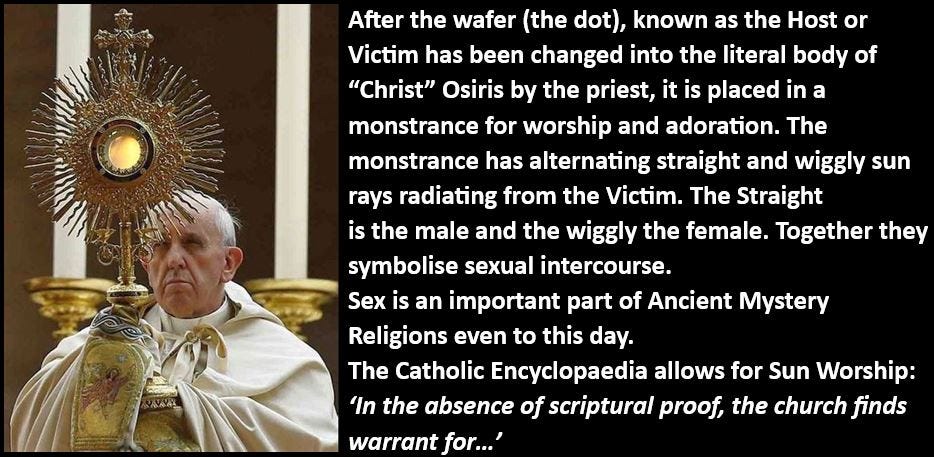
Roman Catholic churches were designed with a “triumphal arch” to separate the congregation in the nave, from the sanctuary and altar exclusive to the clergy. Popes have noted that this arch signifies the transition from the secular, earthly world into the sacred presence of God, a threshold crossed by the faithful during worship. Roman Catholicism recognises the arch as a bridge between divine and humanity, so popes and priests are arches; therefore, a gateway – a gateway for Ishtar. This makes sense of the Roman Catholic confession. A priest is needed as advocate between man and deity, in their case Osiris. In Protestant Christianity only Jesus is man’s advocate before God.
The NIV Jesuit-Bible repeats the papal Vulgate Bible - James 5:16 says, Therefore confess your sins to each other and pray for each other… advocates for confession to a man. Whereas the Protestant Bible the King James Bible the same verse says, Confess your faults one to another, and pray one for another… Faults are not sins, they are areas where help could be needed from a fellow.
‘What an arrogance for a Roman priest to call himself arch bishop of Baltimore; a presumption above all presumptions, when four-fifths of the inhabitants of Baltimore, do not belong to that precious spiritual jurisdiction of Mr. Samuel Eccleston, and the exceeding liberal religious society of Ignatius Loyola. If Mr. Sam would call himself Bishop of the Romans or Romanists, or Papists of Baltimore, I would have no objection ; but the ridiculous idea, to consider the city of Baltimore as a church, when it is in reality a city; it shows the secular and all-grasping tendency of Rome, and the ambition of that anti-Christian hierarchy.’ Intrigues of Jesuitism in the United States of America, 1846, Rev. l. Giustiniani, D.D., ex-Roman Priest, page 137
The mystery of the ancient arch was handed to the knights Templar. They used temporary wooden triumphal arches particularly when they fell out of favour with the papacy. The Templars built arches for their Hospitaller Grand Masters ceremonies in Medina, and Malta, the place of their last stand against Rome.
The Templar’s through Adam Weishaupt (1748-1830) hid the mystery of the arch in Freemasonry. The term “Royal Arch” is the name used at the completion of the Master Mason degree. It is thought to originate in antiquity of subterranean vaults beneath the ruins of the First Temple, accessed through a series of arches. The symbol of this degree is the Keystone. The keystone of the arch symbolises wisdom and knowledge.
‘The stone placed in the centre of an arch which preserves the others in their places, and secures firmness and stability to the arch. As it was formerly the custom of Operative Masons to place a peculiar mark on each stone of a building to designate the workman by whom it had been adjusted, so the Key- Stone was most likely to receive the most prominent mark, that of the superintendent of the structure. Such is related to have occurred to that Key-Stone which plays so important a part in the legend of the Royal Arch degree.’ An Encyclopaedia of Freemasonry, 1884, Albert G. Mackey, M.D., page 3

The world has not seen the end of gates built to Ishtar, Queen of Heaven!

Please share this article with people you know who like this type of exposé
Comments
Nothing yet. Say the first thing.
Sign in to join the conversation.