
Mother Teresa, born Anjezë (Agnes), Gonxhe Bojaxhiu, was groomed to be the gift that keeps on giving – way after her death.
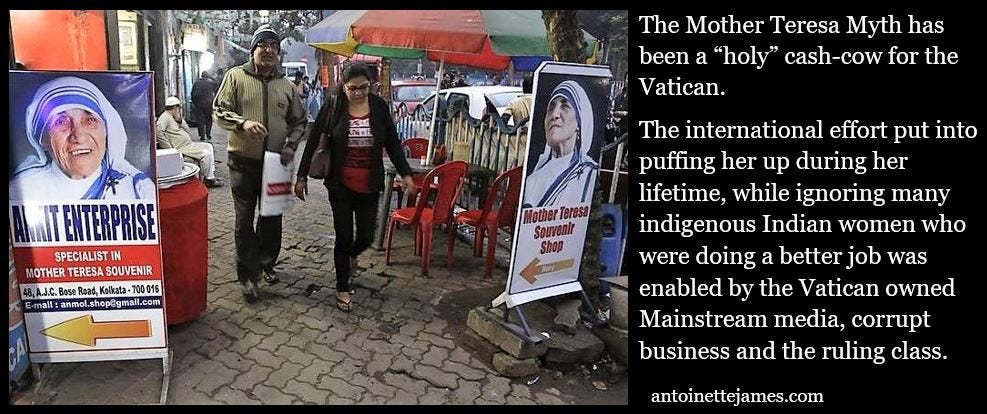
‘In December 1998, little more than a year after Teresa’s death, the Congregation for Causes, acting with the approval of Pope John Paul II, waived the five-year rule for her. After all, it was plain that within her lifetime she had already enjoyed a worldwide reputation for holiness. Very soon after her death many thousands of Catholics everywhere were praying for her intercession before God.’ Mother Teresa: the Life and Works of a Modern Saint, 2010, David Van Biema, page 89
Agnes’ life choices were shaped by a childhood steeped in staunch Roman Catholicism, the early loss of her father, being raised by a solo mother and living in remote Skopje, now the capital of Macedonia, far from Western influences. At the same time, India, where Agnes would spend most of her life was being reshaped by hidden forces. She was born nine years after the death of Queen Victoria, Empress of India (a reward from her Jesuit overlords). And by 37 years old, Agnes, (renamed Sister Teresa) witnessed India’s further reshaping as the nation was perceived to be regaining its independence from British rule.
‘The Indian Independence Act was passed in 1947. The act created two new independent dominions; India and Pakistan. Pakistan was split into Pakistan and East Pakistan which is now Bangladesh. The Bengal and Punjab provinces were partitioned between the two new countries. These dominions separated the Muslim, Hindu and Sikh population and caused the biggest forced migration which has ever happened that was not the result of war or famine. The Act repealed the use of ‘Emperor of India’ as a title for the British Crown and ended all existing treaties with the princely states…’ parliament.uk
As an adult she lived in an India manipulated by the activist Mahatma Gandhi, an elite insider, and devoted follower of Helena Petrovna Blavatsky. Blavatsky revamped Ancient Mystery Religion (Mithraism), to the New Age Movement, fronted by the Theosophical Society. This occult religion indulging in Jesuit Spiritual Exercises, was a tool used to water-down Protestant Christianity through the 20th century.
Teresa was the ideal candidate for Jesuit recruitment, as the Order look for vulnerable souls particularly those raised by solo mothers. At twelve year old, under a barrage of Catholic pressure, she predictably expressed a desire for a life of service.
‘In what manner is necessary to act in order that the sons and daughters of widows may embrace religion or a devoted life—As it is necessary in this matter for mothers to act firmly, so we must proceed gently; let the mothers be instructed to annoy their children, even from infancy, with reproofs, castigations, and especially when their daughters are grown up let them be refused ornaments and apparel suitable for them, often desiring and asking God that they may aspire to a religious life, and by promising ample portions on condition that they would become nuns;’ The Secret Instructions of the Jesuits, translated from Latin to English in 1680, page 20
However, Roman Catholic life of service is less a relationship with a loving God, and more a relationship with an overlord. The Jesuit-priest, Father Franjo Jambrekovic, was assigned to Agnes’ parish, where she became his interest. He introduced the parish girls to the Sodality of the Blessed Virgin Mary, one of whose aims was to involve young women in practical service to Christ [Tammuz] through charity to the poor. He programed the girls’ minds, repetitively recounting to them the efforts of Jesuit missionaries, especially a group…sent recently to Bengal, in India.
‘At that time the Yugoslav Jesuits had accepted to work in the Calcutta Archdiocese. The first group arrived in Calcutta on 30 December 1925…From there he sent enthusiastic letters about the Bengal Mission field. Those letters were read regularly to the Sodalists. Young Agnes was one of the Sodalists who volunteered for the Bengal Mission. She was put in touch with the Loreto nuns in Ireland, as they were working in the Calcutta Archdiocese.’ Something Beautiful for God: Mother Teresa of Calcutta, 1971, Malcolm Muggeridge, page 154
Against her mother Drana’s wishes, at 18 years old Agnes entered the Institute of the Blessed Virgin Mary [Ishtar], known as the Loreto Sisters, in Ireland in 1928; and here she learnt English. She would never see or gain counsel from a family member for the rest of her life. She was conveniently isolated from all those who loved her.
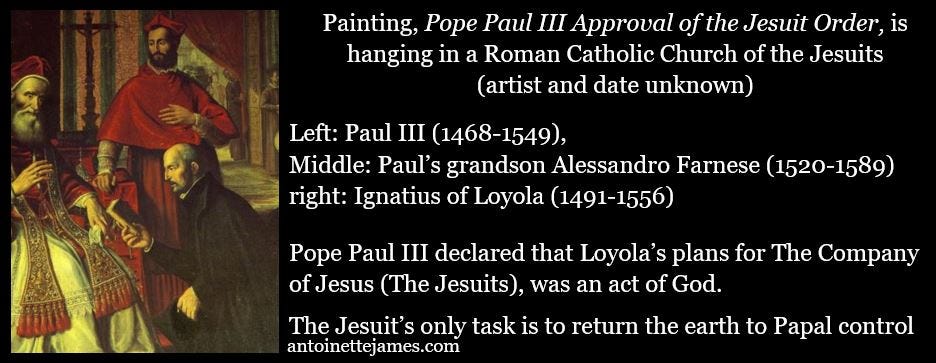
‘The Jesuits (who are men) put Gonxha [Agnes] in touch with the Sisters of the Institute of the Blessed Virgin Mary— the Loreto Sisters for short— who were active in Bengal and who accepted her. In October 1928 a weeping Drana, accompanied by Gonxha’s older sister, Aga, saw their “flower bud” onto a train leaving Macedonia.’ Mother Teresa: The Life and Works of a Modern Saint, 2010, David van Biema, page 15
Two years later she was renamed Sister Teresa, severing her from her heritage. She naively thought she was serving God, but she was serving the pope. She thought her calling and vision would be guided by God, but instead it was profoundly guided by the hidden hand of the Jesuit Order. Her autonomy was stripped, and every decision needed approval.
‘I had first to apply to the Archbishop of Calcutta. Then with his approval the Mother General of the Loreto nuns gave me permission to write to Rome. I had to do this because I was a nun who had taken final vows and nuns cannot be allowed to leave the convent. I wrote to the Holy Father, Pope Pius XII, and by return post I got the answer on the 12th of April [1948]. He said that I could go out and be an unenclosed nun. That means to live the life of a religious, but under obedience to the Archbishop of Calcutta.’ Mother Teresa, BBC interview, 1969
Every move required a papal rubber stamp. In early 1929 she moved to Calcutta (now known as Kolkata), where she taught in a school for many years. But the Jesuit Order saw she was controllable, so herded her towards a “life of service” to the poor. Teresa, claimed she had received a call within a call from God. However, from the tone of her published private letters, it could be said it was a call from her Jesuit handlers. They had a more lucrative career path in mind for her.
‘This must be firmly impressed upon them [nuns], that if they wish to enjoy perfect peace of conscience, they must without any murmuring, repugnance or inward reluctance, both in temporal and spiritual matters, follow the direction of their confessor, as of one specially allotted to them by God.’ The Secret Instructions of the Jesuits, translated from Latin to English in 1680, page 18
From that point on Teresa was hedged about by the elite, elite owned Media Industrial Complex, and Big Corp making her untouchable. The Jesuits spin doctors covered her atrocities, and they were many, by creating the Saintly Myth that still charms today.
So, in 1950 the Jesuits in Teresa’s name, founded the Missionaries of Charity, and started the biggest publicity scam of the 20th century. The world was introduced to the crafted, sanitised, Godly, girl-power known as Mother Teresa. The media smoke screen hid the truth of a depressed empty woman with no autonomy, no critical thinking and absolutely no empathy.
‘If people knew what she was actually like, they would find her repugnant.’ Stop the Missionaries of Charity, Hemley Gonzalez
Teresa’s enthusiasm for God, if it was ever there, had completely diminished. She had been molded to her handler’s heart’s desire in true Fabián fashion. She had become the Goose they needed to lay the golden eggs; she was their Cash-Cow. Worse still she was a honed tool of Vatican doctrine, leaving her in dreadful spiritual darkness and stagnation of soul, that her letters woefully lamented. She understood the cavernous gulf between the myth and the fact. She begged for many years for her letters to be destroyed lest the truth steal her fictional legacy, while staying her course with Jesuitical grit.
‘…That I may go to any part of the world withersoever I may be sent, to the frozen regions of the North, the burning sands of the desert of Africa, or the jungles of India…’ Jesuit oath
Her Jesuit minders were beside her, ever leading her to focus on the work rather than God. They cared not for her spiritual person, they cared only for the trade, the money and increasing influence that their propagandised Kolkata squalor provided them.
‘The pleasant surprise that awaits the visitor to Calcutta is this: it is poor and crowded and dirty, in ways which are hard to exaggerate, but it is anything but abject. Its people are neither inert nor cringing. They work and they struggle, and as a general rule (especially as compared with ostensibly richer cities such as Bombay) they do not beg.’ The Missionary Position, 1995, Christopher Hitchens, page 23
Teresa was invested so deeply in the myth, there was no way back, but she was clearly in need of spiritual and physical support; so, more Jesuits were sent to hedge her and advance the mission.
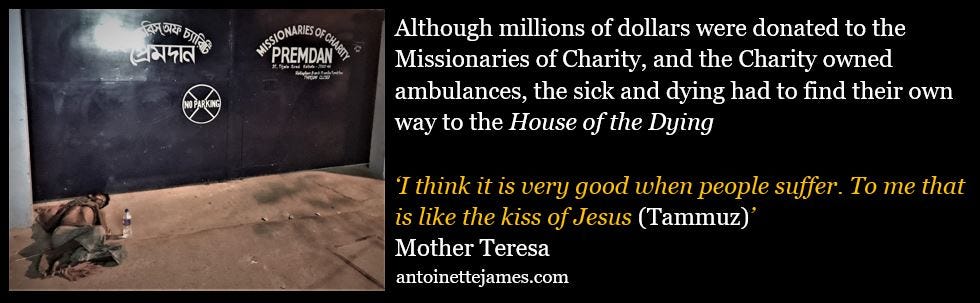
‘In 1963 the Archbishop gave me permission to start the Brothers. We [the Jesuits] felt a need for men who would take care of the boys in the school and the men in the Home for the Dying. And there are other things that we as women cannot do for the men in the docks and so on. His Grace gave the permission and now for the last two years their congregation is a diocesan congregation. Father Andrew, who was a Jesuit, got permission from the Holy Father to join the Brothers. And he’s their Superior now, he takes care of them.’ Mother Teresa, BBC interview, 1969
Jesuit-Father Andrew’s Project Mother Teresa could not be allowed to flounder. Too many years of groundwork in India would be for naught, jeopardizing their ongoing agenda in India.
‘The Society may also with advantage carry on business under the names of rich merchants attached to us, but having regard to a certain and abundant profit, even in India, which hitherto by the favour of God has supplied the Society not only with souls but also with much wealth.’ The Secret Instructions of the Jesuits, translated from Latin to English 1680, page 24-25
Teresa’s Jesuits had many historic role models to emulate in their mission to control India. Their focus was less the nun, and more the prize.
‘The Jesuit is the man of circumstances-despotic in Spain, constitutional in England, Republican in Paraguay, bigot in Rome, idolater in India...More unscrupulous was another Jesuit missionary, Nobili, who, in order to ingratiate himself with the natives, pretended to be a Brahmin, and for this purpose had his face stained, and gave himself as a descendant of the God of India.’ a The History of the Jesuits, 1914, Hector MacPherson, page 30, 34
Mother Teresa, Roman Catholic by birth, was unable to use critical thinking. She, as with all adherents knew little of the gnostic Vulgate Bible, as it is rarely opened. Her Jesuit mentors kept her busy, poor and counselled. Her spiritual practice was the Jesuit esoteric Spiritual Exercises Loyola (1491-1556) received from a snake.
‘A form in the air appeared to him [Ignatius Loyola founder of the Jesuit Order] and this form gave him consolation because it was exceedingly beautiful…It somehow seemed to have the shape of a serpent and had many things that shone like eyes but were not eyes. He received much delight and consolation from gazing upon this object…But when the object vanished, he became disconsolate.’ Jesuits: A Multi Biography, Jean Lacouture (translated from French)
Ignatius Loyola had deep bouts of darkness in his soul, and so did Teresa. She wrote many letters for help but received no comfort.
‘In a letter to one of her spiritual directors she wrote…pain deep down in my heart…Darkness is such that I really do not see…neither with my mind nor with my reason…The place of God in my soul is blank…There is no God in me…When the pain of longing is so great…I just long and long for God…and then it is that I feel…He does not want me…he is not there…God does not want me…sometimes…I just hear my own heart cry out…“My God” and nothing else comes…The torture and pain I can’t explain.’ Mother Teresa: Come Be My Light: The Private Writings of the “Saint of Calcutta”, 2008, Teresa, Mother, page 17-18
The Vulgate papal Bible exoterically is a social message but esoterically holds Mithraic paganism. Teresa’s own words about suffering reflects the esoteric doctrine.
‘Interior darkness is nothing new in the tradition of Catholic mysticism. In fact, it has been a common phenomenon among the numerous saints throughout Church history who have experienced what the Spanish Carmelite mystic St. John of the Cross termed the “dark night.” The spiritual master aptly employed this term to designate the painful purifications one undergoes before reaching union with God. They are accomplished in two phases: the “night of the senses” and the “night of the spirit.” In the first night one is freed from attachment to sensory satisfactions and drawn into the prayer of contemplation. While God communicates His light and love, the soul, imperfect as it is, is incapable of receiving them, and experiences them as darkness, pain, dryness, and emptiness. Although the emptiness and absence of God are only apparent, they are a great source of suffering. Yet, if this state is the “night of the senses” and not the result of mediocrity, laziness, or illness, one continues performing one’s duties faithfully and generously…’ Mother Teresa: come be my light: the private writings of the “Saint of Calcutta”, 2008, Teresa, Mother, Saint, page 50
In 1997, Teresa made the statement, the world is being much helped by the suffering of the poor people. She related Roman Catholic Doctrine when she went on to say it was, very beautiful for the poor to share [suffering] with the passion of Christ.
Mother Teresa viewed poverty and sickness as privileges that opened the door to God. There are very few journalists and medical personal who, on researching Teresa’s mission, would say there was any Christ-like compassion and empathy in attendance.
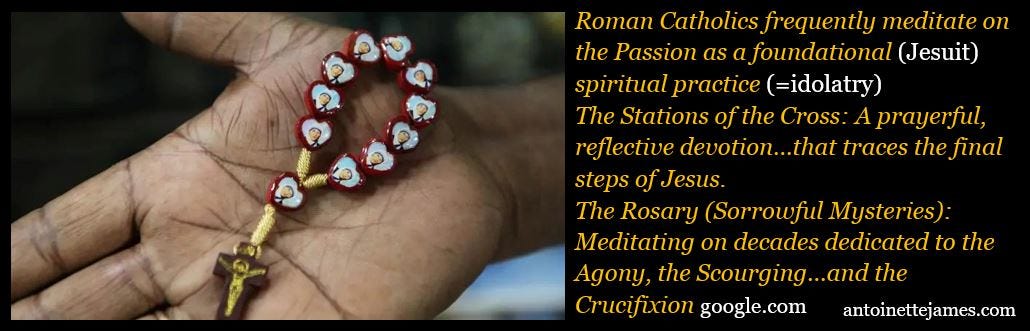
Teresa’s Jesuits wanted suffering, as suffering was the aim of Christ’s Passion Roman Catholic doctrine. Google enlarges, through Christ’s Passion, suffering takes on a profound redemptive meaning, allowing believers to unite their pain with Jesus to participate in the salvation of the world. Suffering in the Roman Catholic system gives mankind a hand in salvation. Mother Teresa bore her spiritual suffering well, but in vain. She was ignorant of the Protestant worldview from the King James Bible, that salvation is in Christ alone. His last words on the cross declared it - It is finished.
Although Teresa expected others to suffer, she did not manage physical suffering at all well. Unlike many of her poor who came to her to die with no other pain killer than paracetamol, Teresa was rushed to hospital to get the state of the arts medical care. Her most notable hospital stays occurred in 1983, 1989, 1991, 1992, 1993, and 1996.
‘There is always the danger that we may become only social workers…our works are only an expression of our love for Christ.’ Mother Teresa, BBC interview, 1969
And for her expression of our love for Christ, her overlords bestowed on her the Nobel Prize. The public were told she received it for work undertaken in the struggle to overcome poverty, to maintain the myth. Teresa, however told the truth, we are not nurses, we are not doctors, we are not teachers, we are not social workers. We are religious, we are religious, we are religious. Hidden in plain sight, her relinquishing of any care towards the poor. She was doing the work of the papacy. She was offered millions to build hospitals and medical staff, but she turned them down. Health was not the objective, suffering was.
The 1960s-70s were the decades that launched Teresa onto the international stage which helped in some way to fill her empty internal void. She was “puffed up” to fame and notoriety in a way that only happens to individuals who are actively advancing the global agenda; code for a return to a one world order and religion, on pain of death.
The Vatican hand was on every move Teresa made. From her first steps in Kolcutta the Jesuits guided and facilitated for her. Particularly protocols for standard rules, guidelines to run the infamous House of the Dying. They brokered with their Indian contacts getting the missions conditions rubber stamped and any legal requirements to accommodate for their plans. All official information regarding the hospices, accepting or rejecting volunteers, inspections and finances were in their hands alone.
The Jesuits were her directors, confessors, and retreat preachers. Jesuit Father James Martin involved himself in the administration of her hospices and homes internationally. They made the decision to expand the Jesuit presence.
Her international fame loosened money that was only to be found in the blessed Protestant West - so, to the West they took her. In 1960, she went to the United States to be an icon of able womanhood. Her first address to the National Council of Catholic Women, defined her purpose. The elite propaganda machine cogs pick up speed using the papal owned mainstream media. They puffed the illusion of the wee nun Teresa on a mission from God against the defiant Goliath size slums of Calcutta.
In Something Beautiful for God, a 1971 publication about Mother Teresa, the author, Malcolm Muggeridge repackaged his 1969 BBC documentary. For the most part the book is made up of a brave face and disinformation. But the Teresa-myth was being built, and the person herself did not matter anymore. Her robotic faithfulness kept her going, rather than any real enthusiasm or satisfaction, while publication after publication slowly built her up on foundations of lies, as a living saint.
‘Each day Mother Teresa meets Jesus; first at the Mass, whence she derives sustenance and strength; then in each needing, suffering soul she sees and tends.’ Something beautiful For God: Mother Teresa of Calcutta, 1971, Malcolm Muggeridge, page 130
The book’s propaganda released a flood gate of attention and with the attention more money started rolling in, in increasing amounts as the years went by. With little to no audits and bookkeeping there was no account of what money was used to help the poor. Donations ended up in the Vatican Bank, money laundering and fraud increased, while mainstream media kept a lid on.
Teresa’s minder, the prominent, Jesuit-Father James Martin was good friends with the so-called protestant Christian Pastor Rick Warren (1954-) of Saddleback Church. With his enthusiasm, the Mother Teresa myth gained Protestant endorsement loosening more Protestant pockets to keep the Cash-Cow in the field and closing the ecumenical loop the papacy had been working hard to achieve.
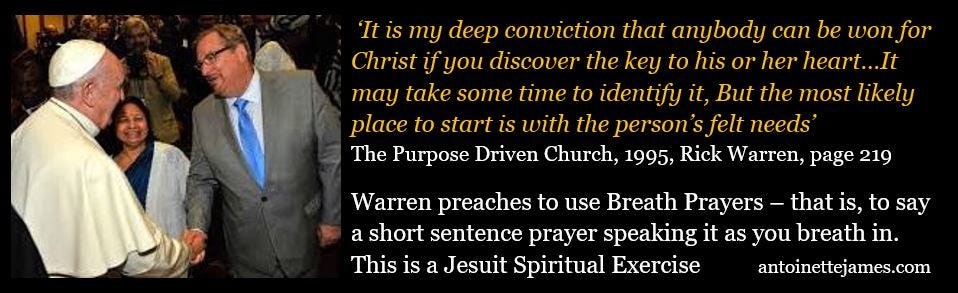
Warren wrote an introduction, and Martin an essay in a book published to celebrate the centennial of the birth of Mother Teresa, TIME Mother Teresa at 100: The Life and Works of a Modern Saint
The Jesuits control the so-called Christian media, the publishers and the booksellers. They control the churches and the seminaries. They control the prophecy conferences and the ecumenical councils. Swarms of Locusts: The Jesuit Attack on the Faith, 2002, Michael Bunker, page 273
Warren’s books of the Purpose Driven Church and life lean more towards man-centred Theosophy than Christianity. He often cites Teresa’s Catholic life and gnostic teachings as profound influences on his faith and writings. He has hung a handwritten note to him from Mother Teresa on his office wall, ‘Be holy because the God who created you is holy and he loves you.”
Warren worked closely with another closet Catholic, Robert Schuller, who in turn worked closely with the pope. Warren calls the humanistic worldview of Mother Teresa - the Mother Teresa Principle: The more you care about the powerless, the more power you have. The more you serve those with no influence, the more influence God gives you. The more you humble yourself, the more you’re honored by others.
Teresa lived her life on trust in the papal Jesuit machine. She showed the working end of Vatican II protocols to move to liturgy to meet man’s needs for self-esteem. Suffering people are needy people. It is the neediness that Teresa’s mission captures. There is no desire to alleviate it, rather indulge in it. Suffering is the endpoint.
‘Without our suffering, our work would just be social work, very good and helpful, but it would not be the work of Jesus Christ, not part of the Redemption. Jesus wanted to help by sharing our life, our loneliness, our agony, our death. Only by being one with us has he redeemed us. We are allowed to do the same; all the desolation of the poor people, not only their material poverty, but their spiritual destitution, must be redeemed, and we must share it, for only by being one with them can we redeem them, that is, by bringing God into their lives and bringing them to God’ Mother Teresa on Suffering
Teresa’s legacy is one of pagan torture, slavery and death, shamefully in the name of God.
‘If I ever become a Saint, I will surely be one of ‘darkness.’ Mother Teresa
(next week Mother Teresa part 2 of 2: a Cult of Suffering and Death)
Please share this article with people you know who like this type of exposé
Comments
Nothing yet. Say the first thing.
Sign in to join the conversation.