
Mother Teresa is a crafted image of compassion, yet without any. Her Greek name means “to reap” and she stands with the legendary Grim Reaper, as the personification of suffering and death. Behind her fictious front stands the woman who is, to this day, a goddess of a pagan death cult.
The papacy, who state that they own and control all media (Hollywood, TV, internet) as their birthright, propelled a crafted Teresa to the heights of international fame. The full weight of the Vatican and their lap-dog Mainstream Media (modern day Jesuit Drama) exalted her to sainthood after a life of perpetual cruelty.
‘India had already put that image on a postage stamp, but now the floodgates of international fame truly opened. In 1975 the New York Times headlined a page-one story about a meeting she attended with the words spiritual parley hears living saint. A few months later Time magazine put Teresa on the cover for a pre-Christmas story called living saints: messengers of love and happiness. Teresa was interviewed by Barbara Walters. The anthropologist Margaret Mead kissed her hand, and Elizabeth Kiibler-Ross, godmother to the modern hospice movement, sought her out. Perhaps her greatest admirer was Pope John Paul II. Towey recalls them as the “dynamic duo.” As he says, “They had the respect of people of all faiths, and of the irreligious.”’ Mother Teresa: the life and works of a modern saint, 2010, David van Biema, page 64
Teresa was sent to India to help flood-zone Catholicism in the nation. A well-honed historic strategy and one that they applied in Vietnam through the 50s and 60s and are doing today in Northern Ireland. The “Teresa Cult” usurped the focus from many indigenous women and Protestant Christian missionaries who had been truly relieving suffering way before her arrival. It could be said Teresa was given the spotlight to specifically distract from the Protestant-Irish missionary, Amy Carmichael (1867-1951). Her effective work ending suffering of many young girls and women in India was well into its stride 34 years before the nun’s arrival.
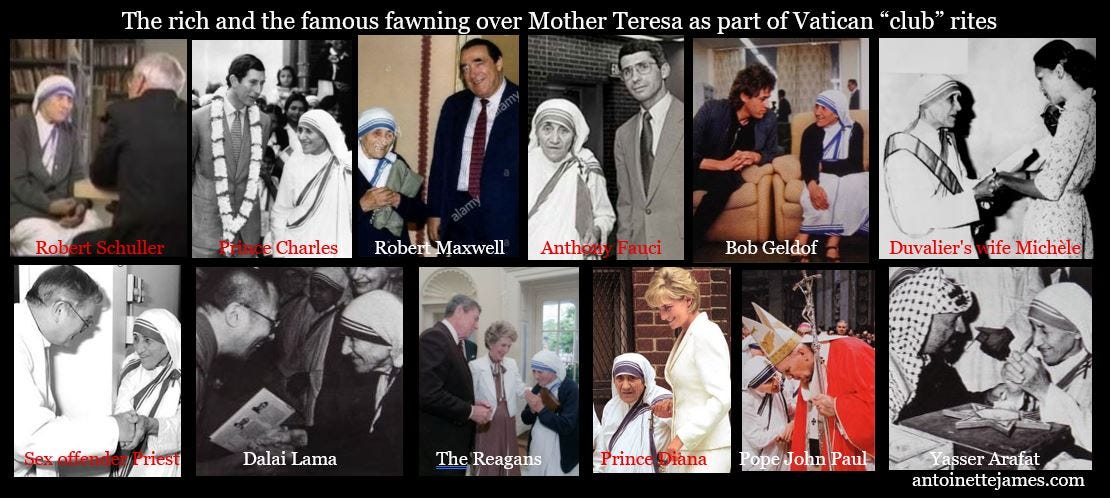
Amy spent 55 years in India without taking a furlough; while Teresa, who preached a life of poverty to other nuns, spent more time jet-setting in luxury around the globe, enjoying accolades – and millions of dollars - from the rich and famous.
‘In 1971 she was awarded the first Pope John XXIII Peace Prize. Eight months later came the Joseph P. Kennedy Jr. Foundation Prize. In 1973 the first Templeton Prize for progress in religion came her way. Year after year the awards and honors kept arriving.’ Mother Teresa: the life and works of a modern saint, 2010, David van Biema, page 48
Amy risked her life going into Hindu pagan temples, smuggling out very young girls who were forced to a life of Devadasi (temple girls married to god). These girls were subjected to pagan rituals as temple prostitutes. Amy went further, protected them in rescue shelters; whereas Teresa left those who came to her to suffer and die.
Dr Aroup Chatterjee wrote the Book, Mother Teresa: The Untold Story exposing the home run in the name of Mother Teresa was a cult of suffering; children were tied to their beds, and the nuns gave little to comfort dying patients but aspirin. In researching for material, Dr. Chatterjee interviewed over a hundred volunteers each of them describing gruelling conditions – workers with limited medical training administered 10 to 20-year-old medicines to patients, and blankets stained with feces were washed in the same sink used to clean dishes.
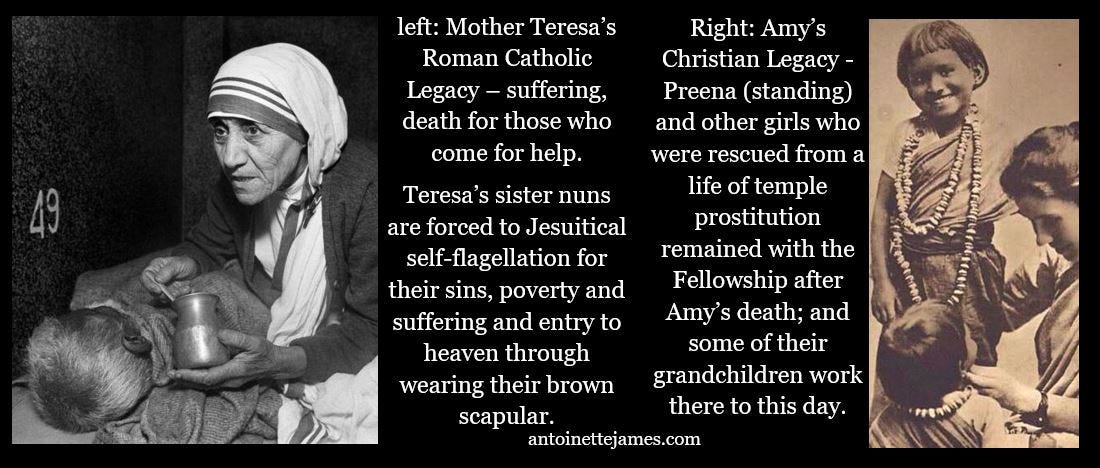
Amy, with no “backers” established the Dohnavur Fellowship in 1901 in Tamil Nadu, that still operates today. The sanctuary over time grew into a large village-style community providing education, healthcare, and a home for hundreds of children and women, lifting them out of poverty; while Mother Teresa, for all the millions of dollars donated - often dirty money she made “Holy” and stored in offshore Vatican banks, left the poor content with their lot.
‘Confessors and preachers must be very careful to avoid giving offence to nuns, or giving them any occasion of temptation contrary to their calling, but rather having won over to themselves affection of the principal superiors, let them manage to receive at least the extraordinary confessions, and to preach to them, if they may enjoy their gratitude in return; for the noble, and especially rich abbesses [Mothers] are able to render much assistance to the Society…the Society may by degrees be able to come to the knowledge and friendship with almost the whole city.’ The Secret Instructions of the Jesuits, 1680, page 34
The Missionaries of Charity (MOC) was offered medical supplies and skilled practitioners, but each offer was declined. After all, to fix the poverty-problem would mean an end of the money fraudulently lifted from the Protestant West.
“My initial impression was of all the photographs and footage I’ve ever seen of Belsen and places like that, because all the patients had shaved heads. there are no chairs anywhere. they’re just these stretcher beds and they’re like First World War stretcher beds…This is two rooms with 50 to 60 men in one; 50 to 60 women in another. They’re dying, they’re not being given a great deal of medical care and not being given painkillers really beyond aspirin…for the sort of pain that goes with terminal cancer and the things that they were dying of…They didn’t have enough drips. The needles they used and reused over and over and over and you would see some of the nuns rinsing needles in…cold water…why are you not using boiling water and sterilizing your needles? [The answer] There’s no point, there’s no time.’ Mary Loudon, former Missionaries of Charity volunteer
Kolkata born Mihir Bose medical researcher said of Teresa, she’s part of the western agenda, it makes the West feel better…’ Of course, he is correct but does not go far enough. Because the Protestant West has empathy, the Jesuit Order knows with the right propaganda they can tap into endless streams of money.
Amy’s unrelenting activism helped change laws making temple prostitution in India illegal; while Mother Teresa made no attempt to call out any government advocating for change. Suffering was a photo opportunity. She said she stayed out of politics, but she didn’t. Instead, she enabled political corruption for money.
Amy lived among the children who voluntarily called her Amma, the Tamil word for mother. Mother, was a bottom-up response of reciprocal love; whereas Mother Teresa received her title “Mother” by top-down election, for her administrative work, not her heart. The title “Mother” originates from pagan Rome where it was the name for Ishtar/Libertus the Mother of Exiles. The difference between the two women was Amy served Jesus, the Son of God, while Teresa served Osiris, the Sun god, who the papacy renamed Jesus, when they harboured themselves under a thin Christian veil.
‘The Jesuit is the man of circumstances-despotic in Spain, constitutional in England, Republican in Paraguay, bigot in Rome, idolater in India.’ The History of the Jesuits, 1914, Hector MacPherson, page 30
Amy, who had no handlers, sought to stop Ancient Mystery Religious practices in heathen temples; while Teresa and her Jesuit handlers bought a heathen Hindu temple to continue the Ancient Mystery sun worshipping pagan rites of death. They called this temple - the House of the Dying.
In 1952 the House of the Dying, a take on the ancient Egyptian House of the Dead, was opened. The temple was a perfect fit for the task, as it was a temple to Kali, the goddess of time and change, death and destruction. Roman Catholicism relies on supplying needs and India had them in abundance. It made an excellent humanitarian smoke-screen to instigate the energy rites of suffering.
‘Nay, more, they [the Jesuits] so dilute Christianity with heathen superstition, that in the process the distinctive doctrines of Christianity are entirely abolished. Take as evidence their doings in India.’ The History of the Jesuits, 1914, Hector Mac Pherson, page 33
Papal Rome always build their places of significance, like Westminster Abbey, Notre Dame Cathedral and the Vatican etc. etc., on the ruins of pagan sun worshipping temples. Esoteric Roman Catholicism need these sites to continue performing their pagan Sun worshipping Mithraic rituals, hiding in plain sight.
‘Kali, also called Kalika, is a major goddess in Hinduism, primarily associated with time, death, and destruction. Kali is also connected with transcendental knowledge [Jesuit Spiritual Exercises] and is the first of the ten Mahavidyas, a group of goddesses who provide liberating knowledge…Kali is chiefly worshipped as the Divine Mother, Mother of the Universe, and Divine feminine energy…Shakta and Tantric traditions additionally worship Kali as the ultimate reality or Brahman.’ Wikipedia
The House of the Dying was formally founded by the Jesuits to coincide with Teresa’s 42nd birthday celebrations in 1952. Mother Teresa is the modern-day personification of the death goddess Kali. Such attention to detail is a key signature for the Order.
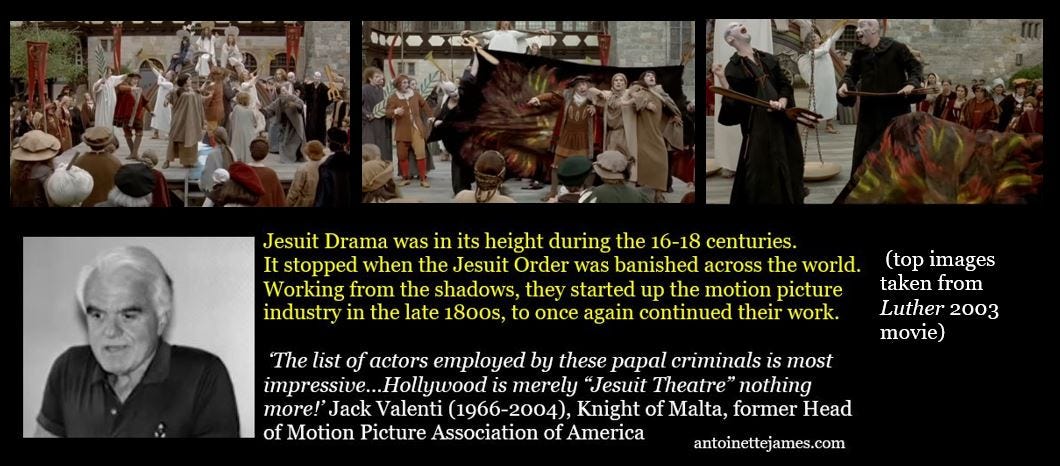
Modern day Jesuit Drama released Indiana Jones and the Temple of Doom (set in India), on 23rd May 1984; a date that matched the date that Mother Teresa frequently celebrated…May 23 was the eve of her own first religious vows (which she took on May 24, 1931). Furthermore, the Temple of Doom was set in 1935, the year that Teresa first requested permission from her superiors to leave the convent school to work in…the streets of Calcutta. These “coincidences” again, are key signatures of pagan/papal rituals. The movie’s professionally researched sacrifice scenes are historically realistic to the cult’s practices.
‘The Temple of Doom, also known as Temple of Kali, was a place of worship to the goddess Kali used by the Thuggee cult. The temple was hidden underground, beneath Pankot Palace in India, and had been rebuilt following the destruction of the original temple during the British suppression of the cult in the 19th century. While the structure was large in and of itself, evidence suggested that the site was dwarfed by the original temple complex used at the height of Pankot Province’s power as the center of Thuggee activity.’ indianajones.fandom.com/wiki/TempleofDoom
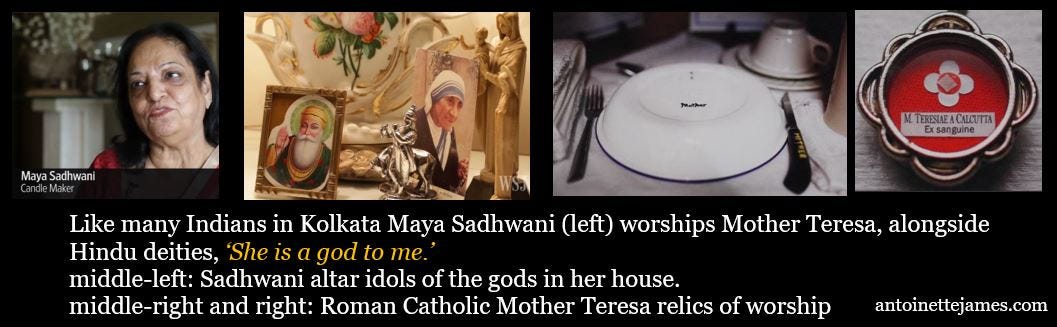
The Vatican and its machinery have assigned Teresa as an icon to be venerated and prayed to (necromancy). She has been given goddess status - she is Kali, akin to the goddess Ishtar (Isis); in contrast, a faction (more than likely agitated by the Jesuits), spread rumours that Amy was a child catcher, calling her the child-stealing missy in attempt to destroy her work.
Amy Carmichael wore a traditional Indian sari to blended in and dressed the children well in local garments; while Mother Teresa copied, her sari to set her apart - a pagan/papal Roman ensign.
Her handlers originally chose a white sari with one blue stripe for two reasons. Blue is the colour of Ishtar who the papacy renamed the Virgin Mary. The second reason, as a mark of poverty. Single striped border saris were worn by low caste street cleaners working for Calcutta corporation. But the second reason backfired as it was too lowly to attract new initiates to the Missionaries of Charity. The answer was found in Bishop Louis Morrow (1939-1969). He founded the Sisters of Mary Immaculate (Ishtar) in India and his Sisters wore consecrated (1952) white saris and three blue stripes. In 1960 Teresa got his permission to copy his design. Morrow said, more the merrier! Teresa grabbed it and patented it!
‘The blue-designed border on the sari worn by nuns of Missionaries of Charity was recognized as Intellectual Property for the organization on September four, 2016, the day the Mother was canonized.’ Press Trust of India, intellectual property attorney Biswajit Sarkar
The papacy clothes Mary in blue, because esoterically she is Ishtar the goddess of pornography and prostitution. Exoterically, the three blue stripes remind the wearer of their vows to poverty, to obedience, and to chastity in wholehearted service to the poorest of the poor; no mention of God.
‘…if we try to transliterate the English term [Ishtar] “Mother of Exiles” into the Greek…Mother as a word has similar phonetic sounds. Doing the same with “exiles” from English into Koine-Greek, the Koine-Greek listener would link it to a similar Greek word that connoted deep inhalation of air or “heavy breathing. This is tied into the Greek word “epithumia” which in English is normally translated as “lust” but the literal meaning in Koine-Greek meant literally “heavy breathing” and was connoted with desire. Now this terminology is then linked to the word “Porneoh” from which we get the word Pornography. Porneoh=lust fulfillment by sexual relations in exchange for money… which again was the main claim to fame for Ishtar… holy sexual prostitution.’ Transmissionmedia.com
Mother Teresa lived a life of deep emptiness of soul. Her life was the outworking of her worship and trust in Ishtar/Mary. And it was Mary/Ishtar in whom she trusted her salvation. The brown scapular she wore under her habit day and night as an act of daily devotional life to Mary, was her ticket to heaven.
‘…she [Mother Teresa] was a devout Catholic who faithfully wore the traditional devotional scapular. She was a strong advocate for these sacramentals, actively encouraging her sisters and the sick to use them to seek the protection of the Blessed Virgin Mary [Ishtar].’ ‘The promise of wearing the Catholic Brown Scapular is the assurance from the Virgin Mary that anyone who dies wearing it will be preserved from the fires of hell.’ google.com
Apparently, Mary Rome’s Blessed Mother, appeared to St. Simon Stock (1165-1265) in 1251 giving him a scapular, saying, whoever dies wearing this Scapular shall be preserved from eternal flames. It is a sign of salvation, a sure safeguard in danger, a pledge of peace and of my special protection until the end of the ages.
But Ishtar’s salvation comes with a caveat, that the scapular can only be given in a ritual of blessings and prayer by a Roman Priest; it must never be removed from one’s person; and finally, the wearer must strive to live a virtuous life, observe chastity…and practice daily prayer. Fear was Teresa’s driving force.
‘Let us ask our Lady [Mary/Ishtar] to make our hearts meek and humble as her Son’s [Tammuz] was. It is so very easy to be proud and harsh and selfish, so easy; but we have been created for greater things. How much we can learn from our Lady! She was so humble because she was all for God. She was full of grace. Tell our Lady to tell Jesus, ‘They have no wine,’ the wine of humility and meekness, of kindness and sweetness. She is sure to tell us, ‘Do whatever he tells you.’ Accept cheerfully all the chances he sends you. We learn humility through accepting humiliations cheerfully.’ Mother Teresa
Part of Teresa’s ensemble was her Jesuit Douay-Rheims Bible, where she learnt the protocols of her pious life to Ishtar. According to the Douay-Rheims Bible, Jesus only made the path straight for salvation, rather than completing it, Jesus, therefore, when he had taken the vinegar, said: It is consummated. And bowing his head, he gave up the ghost. Because to the papacy and their Jesuits, Jesus esoterically is the god Tammuz/Horus he continually remains in a state of severe suffering on a crucifix. Suffering is an important part of the Roman Catholic ethos, so, the House of the Dying is a continual ritual of suffering to the gods.
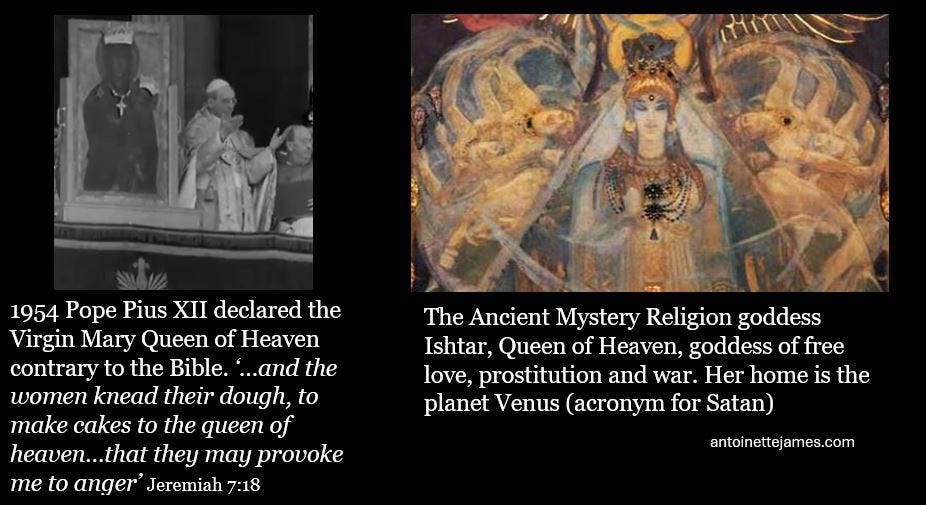
The papacy made Mary co-redemptrix with Christ as Ishtar was co redemptrix with Horus. Pope Leo XIII in his 1894 encyclical on the rosary, Iucunda Semper Expectatione, and again in 1895, stating that Mary participated in the work of our salvation. This is in line with ancient Mystery Mithraic beliefs of Ishtar as co-redemptrix with her son Tammuz. Pope Pius X, Pius XI and Pope John Paul II reiterated her as the source of salvation.
‘As early as the year 180, the Church Father Irenaeus of Lyons referred to Mary as the causa salutis (cause of our salvation) given her fiat, her “let it be” at the Annunciation. From that moment, the seeds of the notion that Mary plays a unique co-operative role with Christ were planted.’ Thecatholichearald.com, 2025
The Protestant King James Bible known as the majority text (sourced from over 90% of all known ancient manuscripts) states in John 19:30 ‘When Jesus therefore had received the vinegar, he said, It is finished: and he bowed his head, and gave up the ghost. Christ died and rose again, salvation was finished, He ended suffering.
The socialist style inscription over the entrance door of Teresa’s House of the Dying, is a quote from the Douay-Rheims Bible - ‘He that loveth correction loveth knowledge’. It holds no comfort or hope; suffering is the correction. The King James Bible says - Whoso loveth instruction loveth knowledge, meaning an openness to receive counsel. In contrast to Teresa’s motto, the inscription over the entrance of Amy’s fellowship and orphanage was Praise; God abides in the praises of His people.
‘…as you come from one of the outside compounds into the inner compounds, there’s a beautiful moon arch and it has “Praise” on one side and “Salvation” on the other…Also the children’s cottages etc. were named with the names of the stones in Revelation, the 12 precious stones.’ Margaret Holland, Dohnavur Fellowship Missionary to India and the UK
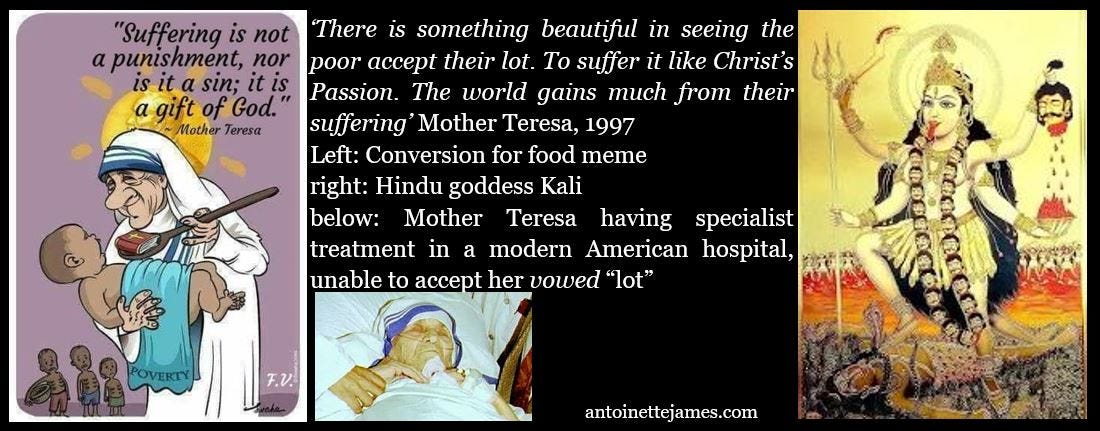
Amy allowed indigenous Tamil-led Christians to lead in her settlements, whereas Teresa and her nuns run a conversion for food policy, in some cases forcing Indians to become Roman Catholics or starve. This coercion through hardship was and still is a dialectic tool Rome uses to grow their numbers. They did it in the papal run Dark Ages and they do it now through the Vatican owned United Nations; in this case it is sex for food.
According to a former nun at the Missionaries of Charity, Susan Shield the nuns were told to deceitfully baptise the dying into the Roman Catholic Church. She said they would, pretend she was just cooling the person’s forehead with a wet cloth, while in fact she was baptizing him, saying quietly the necessary words.
‘…the late Mother Teresa, embodied Universalism…she helped a Hindu to become a better Hindu, a Muslim to become a better Muslim, a Catholic become a better Catholic. According to her theological grid, the god in one’s mind is the god one must accept; and Jesus inhabits us all. If you follow Buddhist practices, you ostensibly get to Buddhist heaven. In like fashion, if you follow Muslim practices, you’re guaranteed Muslim paradise, especially if you strap on a bomb for detonation in some public forum.’ Forcing Change, Volume 8, Issue 11, 2014, page 7
Amy’s legacy continues today under local leadership where new projects including nurseries, hospitals, and residential care meet present needs bring hope and a future; whereas Teresa’s legacy is one of corruption, money laundering and child trafficking.
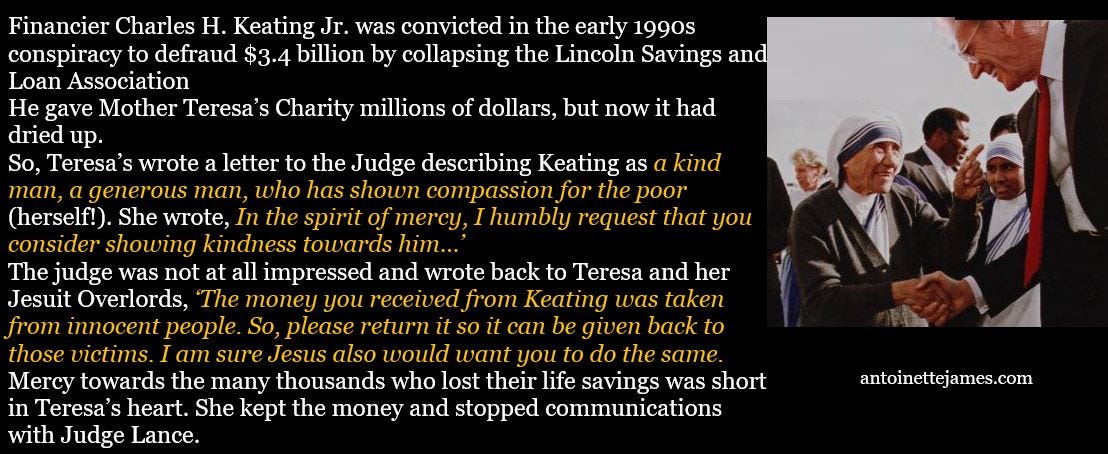
Lawyer and financier Charles Keating, a big money donator to the Vatican via Teresa, was convicted of fraud and racketeering. Teresa wrote to the judge asking favours for him. She also “courted” the Clintons who like Keating defrauded thousands of Americans of their lifesavings. Teresa had no qualms at taking money from her friend, Jean-Claude Duvalier, knowing he was a ruthless dictator, having supported torture and murder of thousands of his people in Haiti.
‘“Further, I must not forget to state that there were many secret Jesuits who went about the country with these idolatrous Indian merchants who bear the name of Banians [mercantile and business community comprising traders, merchants, bankers, and moneylenders], in order to search for diamonds and pearls. These individuals dress like the Banians, speak their language, eat and drink with them, and observe exactly their customs. Indeed, whoever did not know them would necessarily take them for true Banians as they offer up sacrifices to the heathen deities just as the natives do. It is true that all this happened under the deceitful pretext that they desired to convert them: but in truth they only went about with them in order to trade with them, and at the same time to conceal through their society their transactions.’ The History of the Jesuits, 1914, Hector Mac Pherson, page 37-38
Amy was a beacon of integrity. Jambulingam known as Raj the Brigand Chief (?-1923) stole and defrauded the rich in India. Amy challenged him, and he and some of his cabal repented, gave up stealing, and became Christians. He helped Amy as a caretaker for the poor and even asked her to raise his children after his wife’s death.
Mother Teresa died in 1997, and she had a state funeral with pomp and ceremony with many world dignitaries in attendance. Pope John Paul II fast tracked her beautification in 2003. In 2016, Pope Francis, in a canonization ceremony gave her Sainthood, so she could become a goddess and the perpetual sacred cash-cow to Rome. She said of her death, If I ever become a Saint, I will surely be one of ‘darkness.’
Amy died in 1951. Her funeral was held in the Dohnavur after lying in state in the Village church. She said of her death, when I go, ring the joy bells, the bells in the tower and sing all the most joyful songs that we sing in worship.

Please share this article with people you know who like this type of exposé
Comments
Nothing yet. Say the first thing.
Sign in to join the conversation.