
The ruling class of the 21st century is actively drawing in choices and preferences for We the 99%. Across the smorgasbord of life, from Religion, cultural expression, travel, food, education, truth and information, there is a top-down narrowing, a herding, a corralling away from inalienable rights and freedoms of the past.
‘A revolt of the plebs would become as unthinkable as an organised insurrection of sheep against the practice of eating mutton.’ Bertrand Russell
The elite have chosen a universal language for the plebian of the world. Not only are they aiming to have “useless eaters” visually distinguished, but also linguistically segregated from their exclusive world. Their goal is to establish an invisible fence between the ruled and the rulers.
Esperanto is the modern-day title for the One Language. It is not the elites’ first attempt of dumbing down “the great unwashed”, but it seems to be their best attempt.
When Esperanto is mentioned, the Jewish Hungarian billionaire George Soros (1930-), comes to mind. As a fourteen-year-old boy Soros (born György Schwartz) collaborated with the Third Reich serving papers to Jews sending them to extermination camps. Today, at 95 years of age, his son Alex is continuing to advance the Fourth Reich; or as Klaus Schwab rebranded it the Fourth Industrial Revolution.
George’s father, Tivador Schwartz, a lawyer, was an ardent follower of the Zionist Jew and occultist, Ludwik Leejzer Zamenhof (1859-1917). It was Zamenhof who constructed Esperanto in 1887. Tivador adhered to the socialist philosophy behind the language changing his family surname to Soros, an Esperanto word To Soar.
Zamenhof wanted a world without war, no national borders and an international auxiliary language to unite all peoples. He then published a religious manifesto called Homaranismo, in English meaning Humanism. Zamenhof said of Homaranismo - It is indeed the object of my whole life. I would give up everything for it.
Zamenhof was an ardent student of the teachings of the notable Pharisee, Hillel the Elder, who, according to tradition, was born in Babylon, 110BC when the Jews were taken captive. Before his death around 10AD, he was involved with the authorship of the Mishnah (rewriting of the oral Torah) and Talmud (Ancient Mystery pagan Kabbalah).
‘Everything begins in faith and ends in politics.’ Charles Péguy (1873-1914), philosopher in socialism and nationalism
Zamenhof, called his constructed language, the Universal Language, in an 1887 publication, Unua Libro (First Book). He had high hopes, it would be the catalyst for a world of peace, believing one universal language would eliminate conflicts and wars between cultures. His vision for one world order with no borders and one language resulting in unity is the blueprint for the United Nations. The UN recognises Esperanto Day, 26th July, and Zamenhof Day, on December 15, (his birthday) keeping the struggling global vision alive until they can mandate it.
‘During the so-called Counter-Reformation, the Society of Jesus had been quite active in Eastern Europe, especially Ukraine, in their push for Orthodox Christians, deemed schismatic, to return to union with Rome. They established a network of schools that attracted the best and brightest of society.’ How the Jesuits helped to bring Latin to Russia, 2020, Brian P. Bennett
The International Language quickly became known as Esperanto during a two-year marketing push. It had its grand reveal in the Russian Empire where the Jesuit Order was already well established, and from there France and Germany were encouraged to accept it. In 1889, Governments circulated periodicals and literature facilitating its global spread, reaching as far as the United States and Japan by the early 1900s. To ensure its success, efforts were supported the same year with the publication of the magazine La Esperantisto. There was over a thousand active enthusiastic socialist Esperantists in 1889 which has increased to over a million in the 21st century.
‘The relationship between the Jesuit order (Society of Jesus) and Esperanto is one of shared interest in universal communication, cultural bridging, and internationalism [one world order under the papacy], which led to a, largely positive, reception of the constructed language within Catholic circles.’ google.com
In English Esperanto means, one who hopes (esperi “to hope”). Who or what the “one” refers to is debatable, but it set a foundation, at the end of WWI, for U.S. president, Woodrow Wilson’s (1856-1924) diplomacy to establish the Jesuit run League of Nations (LON). The LON saw multiple languages as a big problem in their quest to bring the world back to a one world dictatorship of king Nimrod. So, in 1922 they unanimously voted Esperanto as the official League language, approving Esperanto as the “International Auxiliary Language”. The League installed their man, Lord Robert Cecil to promote the language; and for his services he received the Nobel Peace Prize in 1937.
The ancient noble bloodlines are dedicated to returning to the days of Nimrod. During his rule the Ancient Mystery Religion of Mithraism was the only religion in the world, underpinning a one world structure with one solitary language. It was Nimrod who commissioned the Tower of Babel to challenge God.
‘And the LORD came down to see the city and the tower, which the children of men builded. And the LORD said, Behold, the people is one, and they have all one language; and this they begin to do: and now nothing will be restrained from them, which they have imagined to do. Go to, let us go down, and there confound their language, that they may not understand one another’s speech. So the LORD scattered them abroad from thence upon the face of all the earth: and they left off to build the city. Therefore is the name of it called Babel; because the LORD did there confound the language of all the earth.’ Genesis 11:1-9
After the dispersion of the people from Babel variations of the mystery religion appeared in line with the many languages that existed. This decentralised Nimrod’s political power. The introduction of Christianity in Israel in the first years of AD further changed the order of spirituality. The freedoms of Christianity were contrary to the top-down control of the Mystery Religion. This was a problem for the powers that wanted to rule the known world; they now had competition.
‘It is well known that the Tower of Babel was one of the most ancient traditions of Masonry…’ John Yarker, the Arcane School
Papal Rome did gain a murderous monopolistic dominance for a thousand years called the Dark Ages, but after Martin Luther’s 16th century Protestant Reformation the Vatican’s power was broken. In reaction they conducted a Counter-Reformation creating the Jesuit Order as their private military, that continue their work to this day in and outside of the United Nations. When the Jesuit Order was banished in over 80 countries through the 17th-19th centuries the Order hid itself in Masonic Masonry.
Woodrow Wilson’s “handler” the Shriner Freemason Edward Mandell House (1858-1938) was the middleman between the Roman Catholic New York Archbishop and the Democrat party in Washington D.C. Mandell House authored Philip Dru: Administrator: A Story of Tomorrow, a Utopian humanistic Socialist State. He took his inspiration from the Jesuit shill, Karl Marx’s Communist Manifesto. Although the League failed, all the manifestos were archived waiting for another strike.
‘While Esperanto and Humanism are technically two different concepts (a language vs. a philosophy), they are historically and ideologically linked through the vision of Zamenhof, with many practitioners viewing the language as a practical application of humanist ideals.’ google.com
Esperanto is now spoken and actively encouraged by governments in at least 120 countries. It is branded the language of peace – peace on communistic tenants of “equality and consensus” among people; i.e. the United Nations Agenda 2030 model.
‘Under socialism, you would not be allowed to be poor, you would be forcibly feed and clothed, lodged, taught and employed whether you like it or not. If it were discovered that you had not character and industry enough to be worth all this trouble, you might possibly be executed in a kindly manner; but whilst you were permitted to live, you would have to live well.’ George Bernard Shaw, Fabian
Esperanto, like other elite agendas are steered from the top to inspire those at the bottom. The Jesuit Order and their elite enablers take 3 steps forward, check the social temperature of the masses, taking one or two steps backward if needed. They are patient in their spiritual conquest. As they run the United Nations, it is not surprising that the UN’s primary motivation and goal is to bring a one world order and religion of the Nimrod governing model back. And it is no coincidence that the UN has an Esperanto office at their New York Headquarters.
The promotion of this political universal language went global in the early 20th century. The first Esperanto conference was held in 1905, and in 1908 the Swiss journalist, Hector Hodler created Universala Esperanto Asocio, ‘The Universal Esperato Association’ (UEA) establishing a base as far south as New Zealand.
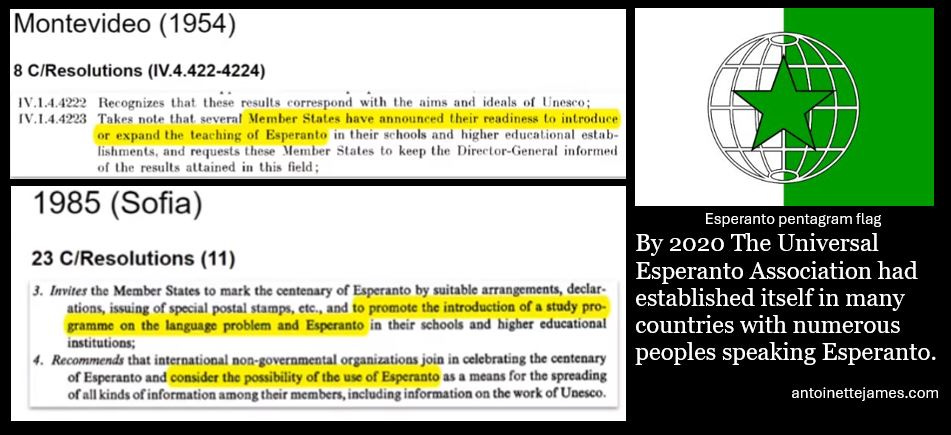
After WWII, in 1945, the elite successfully rebranding of League of Nations to the United Nations. The same year the UN created the Education, Scientific and Cultural Organization (UNESCO), as an action arm of their global agenda. They put their man Aristotelian/Darwinian Sir Julian Huxley (1887–1975) in charge. His job was to make inroads for the removal of Protestant Christianity and replace it with the religion of humanism (socialism-Mithraism). Esperanto re-entered the UN conversation at an international level. In 1954 and again in 1985 UNESCO adopted resolutions in favour of bringing Esperanto into wider global use. In 1994 UNESCO backed the language’s expansion financial underpinning it.
By 1954, the UN Montevideo, 8C/new Resolution stated, ‘Recognise that these results correspond with the aims and ideals of UNESCO; Take note that several Member States have announced their readiness to introduce or expand the teaching of Esperanto in their schools and higher educational establishments, and requests these Member States to keep the Director-General informed of the results attained in this field;’
In 1977 UNESCO Director General, Amadou-Mahtar M’Bow (1921–2024), visited the World Congress of Esperanto. His presence endorsed the language propelling it further. In 1980s, Gregoire Maertens became President of UEA and proposed using Esperanto for international travel and diplomacy.
In 1985 (100 years after the language was first created) the UN brought in a new resolution 23 C – 3 Invites Member States to mark the centenary of Esperanto by suitable arrangements, declarations, issuing of special postage stamps, etc., and to promote the introduction of a study programme on the language problem and Esperanto in their schools and higher educational institutions; 4. Recommend that international non-governmental Organisations join in celebrating [NGOs Big Corp] the centenary of Esperanto and consider the possibility of the use of Esperanto as a means for the spreading of all kinds of [dis and mis] information among their members, including information on the work of Unesco.’
In legal documents as this, when the word “include” “included” “including” is written in a sentence it legally means all words before “including” are invalid. This word trickery means no plebian NGO is to understand the UN intensions. It is considered above their pay grade. However, they can be informed by the UNESCO propaganda arm that distorts and destroys independent cultures.
Regimes such as Communism, fascist, NAZI, and UN dominance are all based on the Ancient Mystery Religion. Their ideology is the cause of soft and hard wars seen over the centuries and that still continue to this day.
‘Societies cannot create a political system from the top down (as opposed to one that grows organically) any more than they can create a truly living language from the top down, as shown with Esperanto and Volapük, languages that linguists constructed but that failed to take hold. Languages are plastic and evolutionary, but they are never random. Neither are the cultures to which they give rise. This is not a trivial issue. As bilingual speakers know, one thinks slightly differently, depending on the language one is using, not simply in matters of vocabulary, but in sentence structure, even conceptualization of both concrete and abstract ideas.’ The Devil’s Pleasure Palace: Cult of Critical Theory and the Subversion of the West, 2015, Michael Walsh, page 20
In 1993, Esperanto was recognized by the International PEN (Poets, Playwrights, Editors, Essayists, and Novelists) Club as the 114th language of literature in the world.
In 2020 the UEA is established as a “mole” in many countries including The People’s Republic of China with some people speaking Esperanto.
Because Esperanto’s culture of globalisation, it has to be artificially maintained. It has no country and no people, therefore is shallow and manipulable. Esperanto is a supranational language that goes beyond the confines of any given nation. The culture of this language is associated with a manufactured ideal. The elite want to destroy culture, so they use phrases like, communication without linguistic discrimination. Linguistic discrimination occurs when those whose native tongue is a dominant language. It is English they want to marginalise. Everyone in this communistic globalised world need to start off at the same place – everyone in the world must learn Esperanto – the great leveller!
The elite expect transnational education. As all countries in the world have been forced into the UN Common Core Curriculum, the job is half done. When the time is right, they will spring the trap. Then everyone should have the same access to knowledge, no matter their nationality or walk of life. It will be narrowed by Silicon Valley and Rockefeller publishing – Oh! That has already happened!
‘…international legislation of labour, and especially the participation of an organised working-class in international councils; the spread of a general pacifist education based notably on the extension of an international language (Esperanto!); the creation of a European spirit, of a League of Nations patriotism—in brief, the formation of the United States of Europe, or rather World Federation” (Convent of the Grand Lodge of France, 1922)’ Light-Bearers of Darkness and the Trail of the Serpent, 1930, Christina Stoddard, page 16
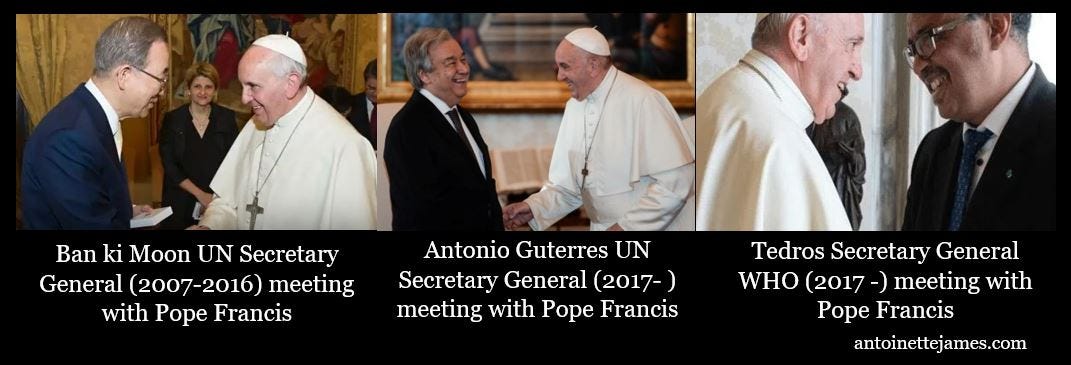
Language is imbedded into a culture, psychology, and politics of a nation. The UN movers and shakers agree with the papacy, that culture, tribalism and nationalism is a scourge that will be driven out through Common Core Education. Esperanto is now taught in quite a few schools around the world. This One World Language in the wings mission is to replace other languages and diverse cultures with a globalist culture of the State as God is being brought in.
‘The Universal Order is yet another pseudo-mystic group, professing to have nothing to do with occultism, but nevertheless equally deceptive and dangerous. It was known for many years as the “ Order of Ancient Wisdom,” with its headquarters in Manchester, and a branch in London and possibly elsewhere. Its teachings were Neo-Platonism…The ceremonies were simple, but occult, attracting forces, such as are found in all occult ceremonies, though they professed merely to teach a form of philosophy…later the name was changed to the” Universal Order,” no doubt as being more akin to international brotherhood, and was conducted on more or less Christian lines, including retreats, meditations, and having, I believe, modified grades to suit the apparent change of outlook. This induced a form of pseudo-religious excitement, creating highly nervous, emotional, and mediumistic conditions, leading to possible control, as is universally found in all such Orders and groups…their mission was also apparently to enlighten the Church or bore from within…From this leaflet the Universal Order appears to be a veritable Esperanto of philosophy, religion, and mystic science, for they aim at the realisation of Universal Wisdom…They use rituals, rites, and symbolism, rightly or wrongly interpreted and adapted from the teachings of the ancient mysteries…What do the “Protocols” say of “collectivism”? “We will let them ride in their dreams on the horse of idle hopes of destroying human individuality by symbolic ideas of collectivism…”…this great annihilating machine, whose mission, in the name of Unity and Universal Brotherhood, is a slow and deadly destruction of all individuality, creating a soulless automaton, whose driving and directing power is the will of this central group of Hidden Chiefs, the Great White Lodge?’ Light-Bearers of Darkness and the Trail of the Serpent, 1930, Christina Stoddard, page 186-188
The papacy has supported the use of Esperanto from its creation. But as there was no enthusiasm amongst Roman Catholics to support a Catholic Esperanto organization, the priest, Emile Peltier (1870-1909), of France, stood vigil. He published the first issue of Espero Katolika (Catholic Hope) in 1902. The publication did not gain the support the Vatican wanted, but one year after the priest’s death, in 1910, Pope Pius X welcomed the first Congress of Catholic Esperantists, giving his blessing, signalling that efforts to spread the language must continue.
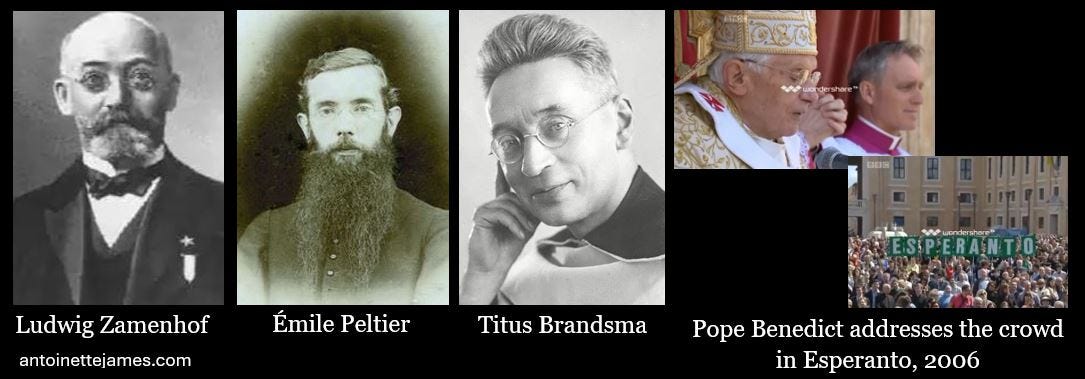
The baton was passed to the Dutch Carmelite priest, Titus Brandsma (1881–1942), a member of the Commission for the Ecclesiastical Dictionary of Esperanto. He made it his life’s mission to promote the language and regularly attended the Esperanto International Congress. For his efforts herding the world back to one language, the papacy made him patron saint of the Catholic Esperantists. In 1985 he was duly beatified by the papacy and finally canonized by Pope Francis in 2022.
Pope Paul VI recognized the importance of the Esperanto movement publicly in 1966. In 1977, Vatican Radio started promoting the language by speaking Esperanto on their regular broadcasts. Since 1998 Esperanto has been broadcasted by the Vatican three times a week. In 1994, Pope John Paul II incorporated Esperanto in his annual Urbi et Orbi greetings. The Nazi pope, Benedict XVI spoke Esperanto in his Urbi at Orbi Easter and Christmas greetings of 2006.
The socialist Pope Francis kept a consistent Esperanto presence. In his 2017 homily his words seemed contrary, saying, one’s mother tongue is a bastion against ideological and cultural colonialization. He seemed to be expressing the need to keep diversity of languages. However, the white Pope, speaks with a forked tongue. When he “allows” something publicly, it is code for the Jesuit Order to double down to accomplish the opposite. Since 2017 Esperanto has been experiencing a renaissance.
‘I’d say I dream in Esperanto’ Pope Francis
The Catholic Church desperately needs a common language, for communication between her children who come from every nation, culture, and language on earth. Since the establishment of the International Union of Catholic Esperantists (IKUE) in Paris in 1910 the Vatican machinery has backed all efforts. So keen to be hands on, the Paris headquarters was moved to Rome.
Esperanto is yet another Trojan Horse to bring the West’s culture and English language to its knees. The pope states that freedom of conscience is an insult to God and man. Esperanto’s basic expression will be an able tool to destroy enquiry and critical thinking. Being an artificial language it inherently comes with no history, literature or culture - a perfect eraser!
The UN documented reasoning for bringing the language into common use gives clues. Their victim mentality bleats English speakers have the advantage – just another smear of the blessed Protestant world.
Please share this article with people you know who like this type of exposé
Comments
Nothing yet. Say the first thing.
Sign in to join the conversation.