
Teaching history - to anyone - is incredibly fun. You’re telling a story! You get paid to go off on tangents! People are so weird and interesting and confusing! But there is one thing that is A) critical for someone to understand before they can truly appreciate all that History has to offer and B) incredibly difficult to teach. Here it is:
At any given moment, a lot of interesting things are happening around the globe. At the same time.
It is almost impossible to teach this in a traditional classroom setting. Any way I organize my history classes, I’m dividing up moments into “eras” or “regions” or some other arbitrary line that tells a student they should move to the next tab in their binder.
Anti-Social Studies is a reader-supported publication. To receive new posts and support my work, consider becoming a free or paid subscriber.
In AP World History, we first learn about the Song Dynasty (1.1) and the Abbasid Caliphate (1.2) Then we hop over to South and Southeast Asia (1.3) before swinging all the way around to see what the pre-Columbian people were doing in the Americas (1.4) Then we check out the great empires of West Africa and the trading city-states on the east coast (1.5) before looking in on medieval Europe (1.6) Great! That’s Unit 1! That’s just our starting point.
How do I get students (and just people in general) to understand that all of these civilizations were going on at the same time.
For example, let’s take the year 1215 CE. In that exact year:
King John begrudgingly signs the Magna Carta, theoretically granting rights to his noblemen.
Genghis Khan’s four-year campaign to conquer the Jin Dynasty ends with his capture of their capital at Zhongdu (a.k.a. Beijing.)
A small kingdom called the Inca has begun to extend its power into the Sacred Valley, while still contending with many other groups for control.
In West Africa, Sundiata Keita is born. He’ll go on to found the great Mali Empire.
The House of Wisdom in Baghdad is still a thriving center of knowledge, with scholars from around the world translating and preserving ancient texts. They have no idea they have just a few more decades before the Mongols destroy the library, throwing so many manuscripts into the Tigris River that supposedly the water ran black with ink.
THAT’S JUST ONE YEAR.
And I didn’t even mention the growing Islamic power in northern India that is a young Delhi Sultanate. Or that Kubilai Khan, the future Yuan Dynasty Emperor (and grandson of Genghis) is born. There’s so much more going on!
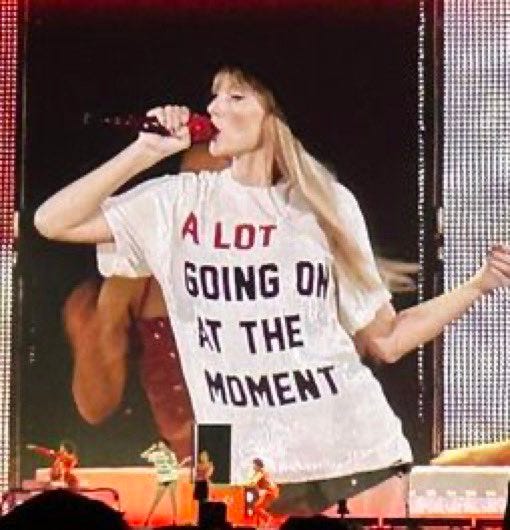
A lot happening at once? We can relate.
How do you teach this idea without totally overwhelming somebody? Well, fortunately (for me) and unfortunately (for the world) it’s gotten a lot easier to get this concept to “click” over the last few years. Because all we have to do is look at the world today, scroll through our FYP or check some headlines from a few news sources around the world and we get it. Oh right. As Taylor’s shirt put it, we have “A lot going on at the moment.”
So how do I address this in class?
That’s why one of my earliest activities in any history class is to get kids to think critically, and historically, about the time period we’re currently in. In U.S. History, that means we dive into the political debate over the U.S. History curriculum and evaluate it as a DBQ. For World History, that might mean that we create a thematic SPICE-T chart looking at the United States as a historic empire. (Psst… You can find both of these activities shared with my paying Patreon supporters.)
Having students, fill out a SPICE-T chart trying to sum up the United States (1776-present) into ONE PAGE really makes kids realize how much we’re going to have to generalize in our class as we do the same thing with, say, the Ottoman Empire. And that’s not bad; it’s necessary in an entry-level course. But you should make sure everyone knows that everything is a lot more nuanced than it might seem just in the textbook.
And the DBQ activity over history education, students are starting to think about what makes a historical “document.”
An opinion article from a political website? Yep.
An Executive Order from the President? Of course.
A Tweet? The Library of Congress thinks so.
And what about contextualization? Is there anything else someone should know about the United States in 2026 that might help them understand this one debate?
Um, hell yeah there is.
They might want to know about the divisive politics and disputed elections of the past few years. Or the campaigns by groups like Moms for Liberty to get “wokeness” out of our schools. It might be helpful for someone to know that the U.S. is declining in stature and losing much of its power and influence around the globe (people around the world see China more favorably than the U.S.) All of this would be important to understand before someone could really get into an analysis of the debate over history education as it relates to modern American society.
By starting with a modern example - something familiar to students and less intimidating than, say, a 13th-century Chinese poem - you can help make some connections that they will, ideally, carry over into their work.
When you are discussing the establishment of the Jamestown colony in Virginia, remind students that other things were happening at the same time.
Shakespeare had already written his most famous works.
The so-called Elizabethan Era was firmly establishing England as a powerhouse in Europe and around the world (militarily - thanks Spanish Armada; and culturally - thanks Will!)
Over in the Holy Roman Empire, Emperor Rudolph II imposes an imperial ban over a Protestant stronghold, sparking the creation of the Protestant Union of German states the following year. (It’s no wonder that Catholics are going to found Maryland across the Potomac just 25 years later. And it’s also no wonder that Protestants are going to overtake the young colony for themselves.)
The same year Jamestown was founded, Johannes Kepler observes Halley’s Comet amidst a crescendo of Scientific Revolution in Europe; a tradition that will easily travel to the New World (especially as the Catholic Church bans new thinking back home.)
And I’m sure the English voyagers were emboldened on their journey if they heard news of the Spanish defeat (by the Dutch) at the Battle of Gibraltar - let them fight it out back there while we discover gold and land routes to Asia! (Narrator: Neither of those would be accomplished by the Jamestown settlers.)
All of these events are A) interesting in their own right and B) might influence each other. And we didn’t even leave Europe! I mean, the Ottomans regained control of Baghdad in 1607 (remember that the entire reason the Europeans wanted to find an Atlantic route to Asia was so they could avoid those pesky Ottomans.)
I could go on tangents like this for days. In fact, one of my favorite internet activities is picking a year at random and skimming its Wikipedia page. (Did you know that there is a Wikipedia page for every year in human history?!?!) Most of the entries are things I’ve never heard of but it also gives me Aha! Moments that remind me that the way we learned history - segmented by era or region or topic - is not the way those events felt at the time.
While Captain John Smith was imprisoned for mutiny on the voyage to the New World, maybe he passed the time by remembering that new play he’d seen back home, what was it? Romeo and Julia, I believe? When Matoaka (Pocahontas) was taken by John Rolfe back to England, she might have overheard conversations amongst the nobles about Galileo’s house arrest.
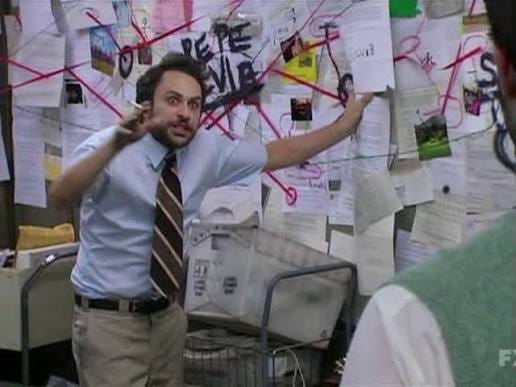
My students used to tell me that I “taught history like I was hunting a serial killer” and I think it’s so accurate that it needs to be a line in my obituary. What started as a clean world map, or a simple diagram to explain something like the Columbian Exchange, would end with color-coded dry erase markings and arrows and me exclaiming, “IT’S ALL CONNECTED!”
So, as you look out onto the world and see:
Political anxiety and debates related to the upcoming U.S. midterms
But also, the first pro women’s baseball league has reformed after 70 years!
Continued Israeli strikes in Gaza while the U.S. and Iran claim to be “close to a peace arrangement.”
But also, the UN Summit on HIV/AIDS is reporting incredible progress in its decades-long battle against the disease.
Colombia devastated by a 7.4 magnitude earthquake.
But also, Mayor Mamdani is taking on Amazon and fighting for workers’ rights!
Oh yeah! And the Russia-Ukraine War is still going on. A recent Russian attack, supposedly strengthened by North Korean missiles, killed 10 Ukrainians.
(FYI: almost all of these events have happened within 12 hours of each other.
What can we learn from this?
You are not crazy. You just have more access to information than at any other time in history (times, like, a million.)
Things were not calmer or less chaotic in other eras of history. Interesting and important things are happening all over the world all the time… always. And if the Jamestown settlers had access to TikTok, they would have also been stressed as hell.
Anti-Social Studies is a reader-supported publication. To receive new posts and support my work, consider becoming a free or paid subscriber.
Comments
Nothing yet. Say the first thing.
Sign in to join the conversation.