
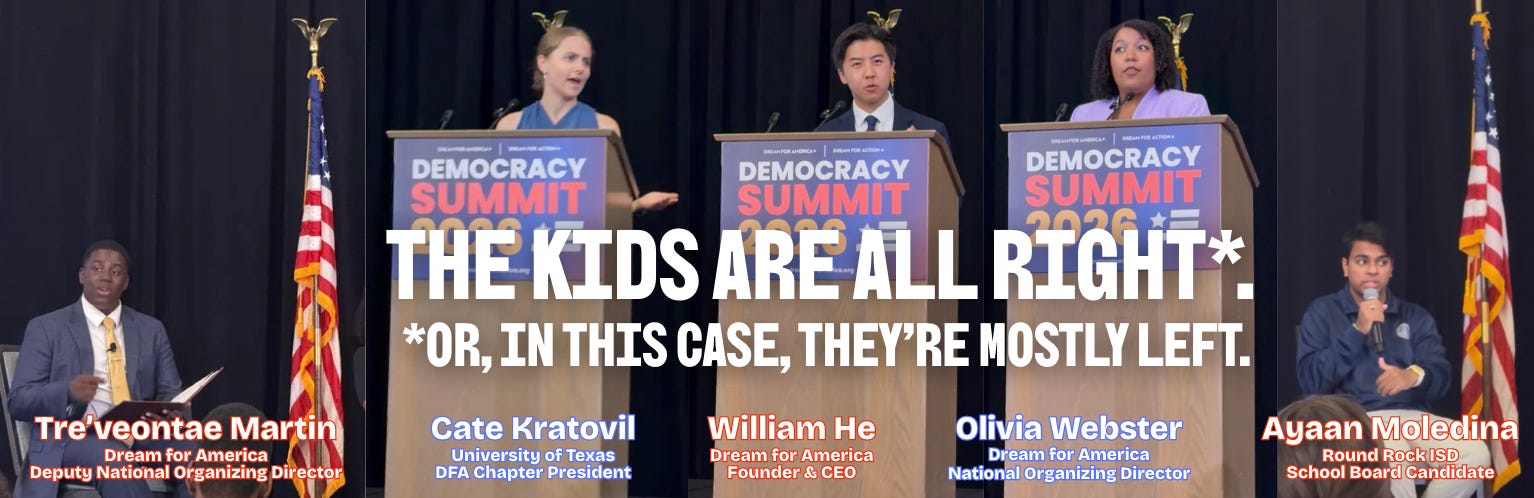
I was invited to attend Dream for America’s first in-person conference, the Democracy Summit, and I met a lot of really interesting and inspiring people.
Rep. Kenyatta was recounting conversations with older family members who were active in the Civil Rights Movement. One woman told him that they didn’t know what they were doing; they just tried a bunch of stuff to see what stuck.
This is a really important concept to remember any time you’re studying history. We are only studying what worked. The conquering leaders who actually conquered. The civilizations that made themselves known beyond their boundaries. The movements that gained traction and upended society. But for every bold word in the textbook, there are countless examples of failures, or at least examples that have been lost to history.
Yes, Dr. King made an enormous impact. But there were thousands of MLKs before Dr. King came along. Maybe they didn’t become as famous. Maybe their audience didn’t grow to, you know, the entire world. Maybe their marches weren’t as well attended and their speeches weren’t preserved in marble. But they were there. And they were doing the work. And it mattered.
Who knows how many people, invisible in the history books, made tiny moves that led to seismic shifts? It’s the “A butterfly flaps its wings in the Amazon and a hurricane hits Florida” analogy. We know that someone like Dr. King stood on the shoulders of other giants: Sojourner Truth, Frederick Douglass, Du Bois, Booker T. Washington, A. Philip Randolph, Bayard Rustin. But he also ended up where he did - in the right place at the exact right time - because of so many other crisscrossing factors that we’ll never know.
What can we learn from this?
You know what you need to do. So just do the thing expecting no results. High hopes, good preparation, zero expectation. You’re phone banking for a local candidate not because you’re positive they’re going to win, but because it’s the right thing to do. You speak up when a family member makes an unacceptable comment, not because you think you can change that person’s behavior, but because it aligns with your values.
You can’t only take action when you know the outcome will be successful. Then no one would ever do anything interesting or important.
This especially hits home as a lifelong Texan who is constantly treated like I’m hopelessly naive when I work for progress in a state that’s been red my entire life. Just because it hasn’t happened yet doesn’t mean it won’t happen. And that attitude - of believing the outcome is already decided is what They want. (“AI is the way of the future. Get on board.” or “Texas will never elect Democrats, just move somewhere that already has.”)
So, do the thing. Flap your butterfly wings and maybe a blue wave will hit the Gulf coast in 2026… or 2028… or 2032…
Hunt is running for Congress in a historically red district so he knows a thing or two about talking with people who disagree. And his advice was simple: this campaign isn’t about persuasion. It’s all about awareness.
What a relief to finally accept that your uncle isn’t going to be persuaded by your next Thanksgiving rant. Give it up. Save your energy and mental health.
Let’s say there are 25% of people who are on the left and will be on the left no matter what. And there are 25% of people who are on the right and will be on the right no matter what. Great. That leaves 50% in the middle who might be interested in talking with you. Talk with them.
Identifying 5 people in your life who have never mentioned politics with you, and checking in with them, is infinitely more valuable than arguing with your work nemesis who will never be convinced. It’s only slightly awkward.
Here’s what you can text them:
“Hey _____, we’ve never really talked before about politics so I’m sorry if this is not welcome. 🙂 I’m reaching out to friends to make sure that they’re registered and planning to vote in November. I’ve been following a lot of the races fairly closely, let me know if you ever have any questions or want to discuss more! [Insert link to voter registration info]”
That’s it. Apolitical. Friendly and helpful.
They might ignore you and give you a weird up next week at school pick up. They might respond with a Thumbs Up and that’s OK. But they might have been waiting to be “invited” into the world of politics, one they’ve never engaged in before. And no matter what, you will have identified yourself as a future resource if that person ever decides to get more involved, or change their party affiliation, or just has questions about how this all works.
Thanks for reading Anti-Social Studies! This post is public so feel free to share it.
Today I watched a 19-year-old CEO lead a conference featuring some of the most powerful political voices of the day (a job he created for himself three years ago… when he was 16.)
Today I talked with a high school senior running to serve on his district’s school board because he isn’t satisfied with how schools are responding (or not) to kids’ mental health needs and growing racism experienced by students of color.
Just a few days ago, at a teacher professional development, I was reminded that the young people of Selma challenged their own teachers for not being involved enough in the ongoing fight for voting rights (many had been arrested over the past few weeks because of their participation in demonstrations.) “We’ve been out there, marching, singing, engaging with our community the way you tell us to. Where are y’all?” In January 1965, over 100 Black teachers led a historic march from Selma to the Dallas County Courthouse, two months before the first march across the Edmund Pettus Bridge.
Is every young person smart, motivated, and politically aware? No, absolutely not. Many are illiterate (thanks to our crumbling education system) or have lost hope (or never had it to begin with. Remember that at this point most young people have lived most of their conscious lives in the Trump Era.)
But we don’t need every young person. We just need enough. And there are more than enough who are capable and ready to step into a more active role in our “battle for the soul of the nation.” So invite them in, ask them for help, listen to them. Again, just because historically young people have been disengaged voters doesn’t mean that they always will be. One day an election will come that will be known in textbooks as the “Young Wave” and I, for one, would love to be around when that happens.
The Civics Center (“on a mission to make voter registration party of every high school in America.”
Common Cause (Nonpartisan, pro-democracy organization since 1970)
Dream for America (“The largest pro-democracy youth movement in America.”)
Voter Guides from the League of Women Voters (Find your state or local voter guide by Googling “League of Women Voters Guide [State/City}”
Y’all Vote (organization focused on supporting flippable red seats in Southern States)
No posts
Comments
Nothing yet. Say the first thing.
Sign in to join the conversation.