
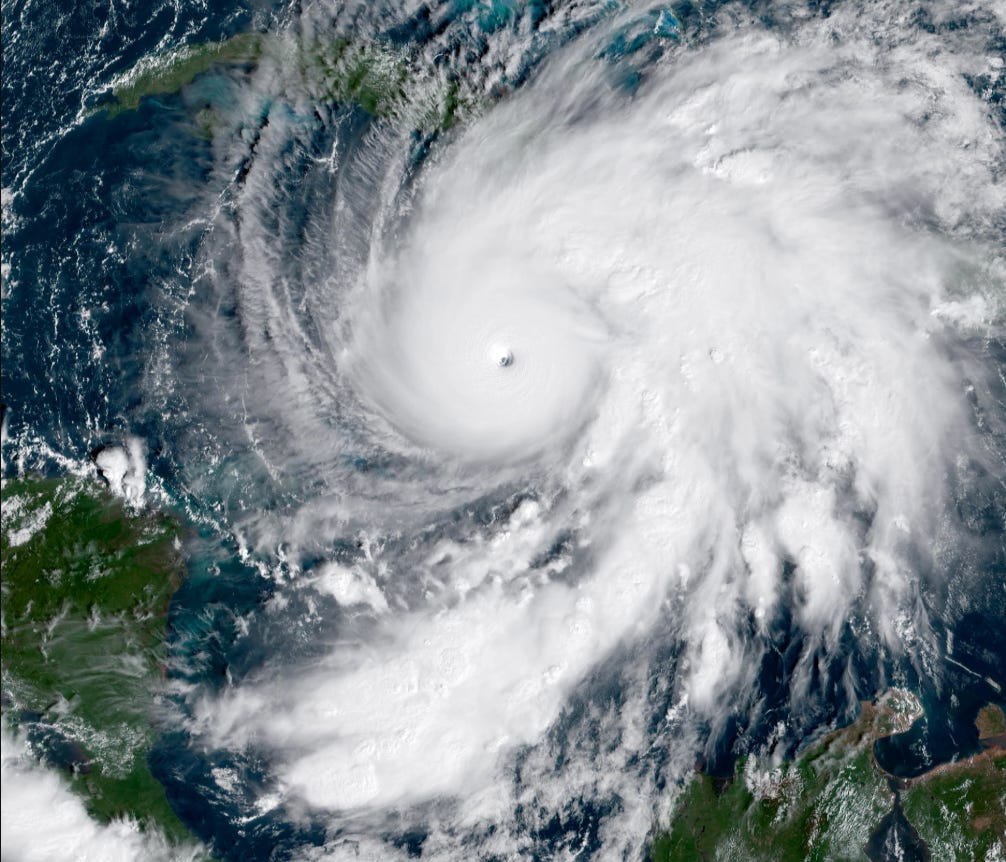
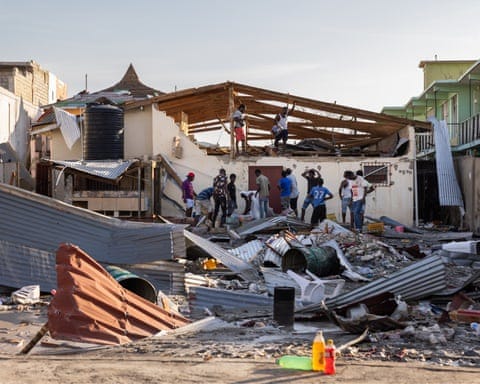
The barometer is in free fall, and the wind is howling. Sheets of rain blast the house. Forecasts predict gusts to near 50 knots. It is nothing like Hurricane Melissa, which barreled through Jamaica, Cuba, the southern Bahamas and Bermuda, leaving broken homes and lives. But while Melissa was an extraordinary storm system, among the most powerful ever recorded, the gale currently battering the south and west coast of Ireland is entirely ordinary—a single low-pressure system in the clockwork sequence of lows that form off North American and rumble across the Atlantic to blast Ireland and Northern Europe during the winter months. It is an impressive display of raw power and volatility. There will be plenty more to come in this cold season.
Conditions are brutal for anyone out on the ocean, but excellent for anyone in a warm sitting room with a book in hand. I have just finished a great novel (highly recommend), Great Circle, by Maggie Shipstead. In it, Marian Graves, the protagonist, disappears during an attempt to fly over both poles during a circumnavigation. “What I have done is foolish; I had no choice but to do it,” she writes in her logbook.
I resemble that remark, as we used to say. I left a very comfortable (too comfortable) life in the leafy Washington DC suburbs that was enviable by conventional standards, and exchanged it for an entirely unconventional life aboard a sailboat, and now in a small coastal village in rural Ireland. I assume to many who know me, not least my own family, the choices I have made seem foolish (occasionally, very occasionally, I wonder the same thing myself). But I am unwavering on the second part: “I had no choice but to do it.” When you feel you are living the wrong life, and that feeling short-circuits you, you have to go out and try to find the right life. You have no choice but to do it.
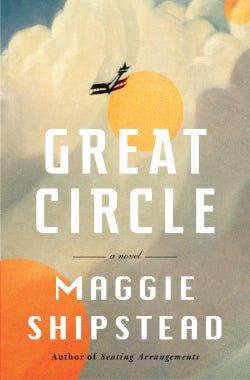
Of course, I haven’t figured it all out yet. Maybe I never will. One of the appeals of Great Circle is that the lives of the protagonists are a constant exploration. Maybe life (or at least late life) is—or should be—a constant journey toward re-invention. “I’m not retiring,” a friend once told me. “I’m RE-WIRING.” I sort of like not knowing where I might end up. Though perhaps that is foolish too.
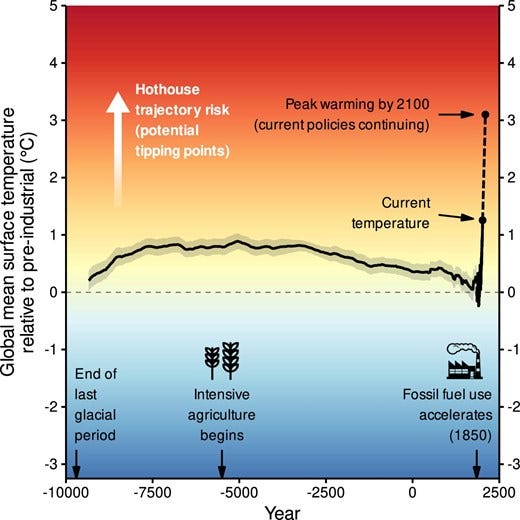
Still, there is little question that human lifestyles and human culture are in dire need of radical reinvention. Better we author that reinvention ourselves than have it imposed on us by planetary physics. Some other gale-inspired reading—less lyrical, more urgent—I did was “The 2025 state of the climate report: a planet on the brink.” It is as ringing a call for urgent course correction as a group of scientists—in this case a cadre of planetary experts—can make. Grist has a good summary, but so does the paper itself:
We are hurtling toward climate chaos. The planet’s vital signs are flashing red. The consequences of human-driven alterations of the climate are no longer future threats but are here now. This unfolding emergency stems from failed foresight, political inaction, unsustainable economic systems, and misinformation. Almost every corner of the biosphere is reeling from intensifying heat, storms, floods, droughts, or fires. The window to prevent the worst outcomes is rapidly closing.
There are lots of dire predictions flying through the ether these days. But it might be wise, given the existential stakes, to allow for the possibility that these sorts of predictions just might be on target. The authors of this paper are not chumps; they are sober leaders in their fields. They are closely evaluating hard data. The paper presents the evidence that this is where we stand. It makes the crucial point that it will be far more costly to NOT take radical action. It lays out the key strategies needed to mitigate the disasters for humanity and the planet that are in motion if we don’t act.
The strategies are familiar, and, crucially, all lie within the realm of the possible (if humanity as a global community simply chooses): much more rapid conversion to renewable energy; much greater protections and restoration of terrestrial and oceanic ecosystems; and much better strategies to reduce food waste, paired with dietary changes that take us away from livestock agriculture and toward plant-based diets. Many good things are happening in all these areas. Just need to push all the good things to warp speed.
Most important:
To ensure a livable and just future, we must confront the deeper challenge of aligning human civilization with the limits of the Earth’s natural systems. Transformative change is needed to address ecological overshoot and the worsening climate emergency. This includes reducing overconsumption, particularly among the affluent, stabilizing the human population through the empowerment of girls and women, shifting toward plant-based food systems, providing safe water and sanitation to all, and adopting economic models that prioritize well-being, equity, and sustainability over perpetual growth (Ripple et al. 2020, Gupta et al. 2024). These systemic shifts are necessary to safeguard the biosphere and promote long-term well-being.
In short, we need to start living differently than most of us (especially in the wealthier parts of the planet) do now. I had no choice but to do it. Everything Is Connected.
Change is hard, of course. Many view change as sacrifice. I think that is wrong. Change can be liberation, an opportunity to discover better ways of being. So far, my own personal conclusion is that a life that has less stuff, spends more time in Nature and in undistracted community with others, and is kinder to the planet and all the other species on it, is a richer life. It’s a hopeful insight that leads toward a tipping point. My only question is whether we will get there fast enough. The math of global system degradation is cold, hard math. Time isn’t on our side. Accelerate, accelerate, accelerate.
Deceleration Denied: Bill McKibben does a masterful job (“Any conversation about Bill Gates and climate should begin by acknowledging that he’s been wrong about it over and over again.”) dismantling Bill Gates recent argument in favor of de-emphasizing climate change in favor of anti-poverty and global health spending.
Meaty Methane: Would it surprise you to know that animal-ag companies are responsible for emitting more methane (a highly potent greenhouse gas) than the fossil fuel industry? Well, surprise:
The five biggest meat and dairy producers are generating more methane than the five largest oil and gas companies, according to a new report. While sheep and cattle are a prolific source of the highly potent heat-trapping gas, few countries have set targets to cut emissions from livestock.
For the report, the Dutch think tank Profundo gathered data on the number of animals handled by 45 leading producers of beef, pork, chicken, and milk. The group found that, together, these firms are unleashing more methane yearly than the whole of the E.U.
Vegetarian/vegan cuisine is really good, people. And a triple win. Better for the planet, better for the animals. Better for you.
Orca Altruism?: They may be sinking boats in the eastern Atlantic, but sometimes they just want to offer us food. A fascinating new study documents this cross-species connection:
The study spanned two decades and recorded dozens of instances in which wild orcas shared prey with humans. As criteria for inclusion, these interactions had to have been instigated by the whales, and not a result of humans approaching orcas. The interactions were either captured on video, in photos, or described to the researchers via interviews…
About two-thirds of the time the orcas approached alone, but occasionally they approached in pairs and less often in groups. In half of the 34 interactions, the orcas offered an entire food item, such as a whole seal. In all but one of the cases the whales waited, for a median time of five seconds, to see what would happen after making their offering.
Ostensibly to the orcas’ chagrin – but absolutely advised for ethics and cross-species safety – the humans ignored the offerings in 30 of the 34 recorded interactions. Still, some of the orcas made additional attempts to offer the food item. One can’t blame an orca for trying.
Apologies, orcas, if we seem rude.
If you liked this post from Sailing Into The Anthropocene, why not subscribe here (free!), and/or hit the share button below? You can also find me on Instagram and BlueSky. (You can find me, but I have discovered life is better without social media).
No posts
Comments
Nothing yet. Say the first thing.
Sign in to join the conversation.