
While doing research for this latest article in Filmmaker Magazine (“Putting the Art in Artificial”), I was struck by a story in a publication called The Logic from earlier this year about Canadian visual effects artists being recruited via Linkedin to work on short-term contracts for Meta. With Canada’s VFX workers suffering because of job cuts and studio closures, the work was sorely needed, and many were tempted by the opportunity—until they realized they were being hired to train AI models to essentially replace them. “That sucks for us,” said one visual effects artist. “They’re hitting up people at a pretty desperate time.”
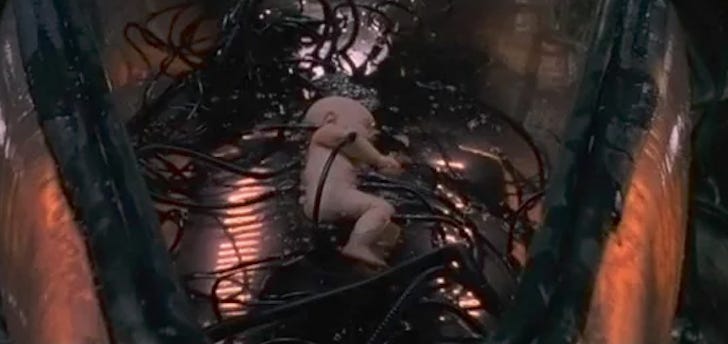
Similarly, last month, The Hollywood Reporter published a story about how out-of-work Hollywood creatives were taking gigs in the world of “Reinforcement Learning From Human Feedback,” i.e. to help AI systems being deployed to work in creative industries do their jobs better. (And it sounds like a downright Matrix-like work—according to authors Katie Kilkenny and Steven Zeitchik, one veteran writer “described an environment akin to a high-school standardized test, with a strict human proctor in the room telling people what they can and can’t do as one output after another flashed across their screens.”)
This kind of thing is happening everywhere: Corporations rushing to train AI models to make their companies more efficient, standardized, and robotized, at the expense of a human workforce that is being shown the door.
According to The Hollywood Reporter article, the share of job postings related to AI within the arts category doubled between May 2025 to April 2026. But as Tim Friedlander, head of the National Association of Voice Actors (NAVA), told the publication, “$1,200 for four hours’ worth of work” is “enticing, but that may be the only four hours you’re ever going to work in that job,” he said. “I think in the long term, it is more damaging to the entire creative sector to be training these systems.”
Aye, there’s the rub.
Short-term benefits; long-term jobpocalypse.
Independent filmmakers could look at these examples and say, there goes the Hollywood; too bad for them!
Sure, that’s one way of looking at it. If Hollywood may be dooming itself with its full embrace of AI, cutting its workers, and creating even more cookie-cutter content based on previous cookie-cutter content, independent filmmakers are benefiting from the technology by now being able to make work that looks just as good as what big-budgets used to produce for a small fraction of the cost.
Indeed, when I spoke to indie filmmakers using AI, there’s a lot of talk about being empowered by the technology.
“From a purely independent side, I think there’s a moment where people can be liberated,” filmmaker and Asteria co-founder Paul Trillo told me. “Ideas that might have been crazy to pitch, or things you didn’t have solutions for, they now exist.”
Trillo is especially bullish on AI being used to “truly benefit independent animation,” he said. “We have very few independent animated films—if that can revolutionized, the smaller team of independent films can do a lot more.”
For independent filmmakers, it is certainly tempting to compare AI’s arrival with past technological breakthroughs that have democratized the process of filmmaking, for example, the arrival of lightweight 16mm cameras, prosumer digital video, home editing software, YouTube, etc. There’s obviously some aspects of AI’s arrival that are helpful, as Trillo and others have touted.
But there’s also a couple differences this time. In a world of massive AI-enhanced workflows, production, and algorithmic distribution, do independent filmmakers really stand a chance in the long run? Again, indie filmmakers could very well have an edge in the short-term. We’re all waiting for some desktop AI filmmaker to make the next Lord of the Rings and break the entertainment industry like Obsession and Backrooms times 100, and yes, it could very well happen any minute. But like so many times across recent history, indie success will quickly get co-opted by and dominated by the larger corporate systems. With more consolidation and more companies looking to control more of the content, and importantly, how it gets seen (thank you, Paramount-WBD merger), do independent filmmakers really stand to benefit from being able to make some really cool visual effects for cheap?
The other big difference between AI and other moments of technological change is that no one was worried about digital video taking away human jobs and consuming our water supply on a massive scale. (According to one of the best and easiest reports I could find on the subject, AI data centers are set to consume by 2028 an estimated 469 billion-844 billion gallons of water—more than all of the country’s golf courses—and as much as 12% of all U.S. electricity needs.)
And even if you don’t believe in such doomsday scenarios, there’s more immediate concerns about our current AI bubble. In a recent episode from NPR’s On the Media titled “F@#$ the AI Overlords” (July 31), Cory Doctorow, author of Enshittification and the recently published The Reverse Centaur’s Guide to Life After AI, spoke about what happens when global corporations’s rush to adopt AI ultimately doesn’t pay off.
“This is what scares me,” he said. “I’m not worried about AI making me into paper clips; I’m worried about a bubble bursting and us doing more austerity, and giving rise to more powerful authoritarian and fascist movements.”
On the other side of the spectrum, there is a more optimistic way of looking at the rise of AI that could help indie film. What if people reject AI in sizable numbers? And what might that do for more authentic and realistic forms of storytelling, i.e. the kinds of films that indie cinema has always been historically associated with (from John Cassavetes’ “Shadows” to “The Blair Witch Project.”)
Could authentic depictions of reality — fiction or documentary — increase in value in an all-simulacra media environment? Some of the filmmakers already using AI have suggested such an outcome.
As Steven Soderbergh told The Associated Press (after his AI-enhanced John Lennon documentary premiered and was roundly criticized at Cannes), “As it becomes possible for anybody to create something that meets a certain standard of technical perfection, then imperfection becomes more valuable and more interesting.”
(According to Substack, this post is certified 100% human written)
Comments
Nothing yet. Say the first thing.
Sign in to join the conversation.