
I am not writing this because I care about the Oscars. In and of themselves, the Oscars are biased, fickle, susceptible to manipulation, money, influence, and insider campaigning, and they’ve disappointed me many, many, many times over the years. But there’s no doubt that the Oscars can give a movie prestige, a higher profile, and increased awareness—which is, of course, especially why so many people pay attention to them, especially the beleaguered documentary industry, which needs as much help as it can get these days.
And it’s also why it would be important (and quite possible) for “American Doctor” to be recognized this year. As the first documentary about the atrocities and injustices in Gaza to have received a substantial platform (a Sundance launch, a decent distribution campaign, launching this week), and widespread critical support for its gripping observational chronicle of physicians trying to save people’s lives in the most horrible circumstances, “American Doctor” is undoubtedly one of the year’s most significant and fearless documentaries.
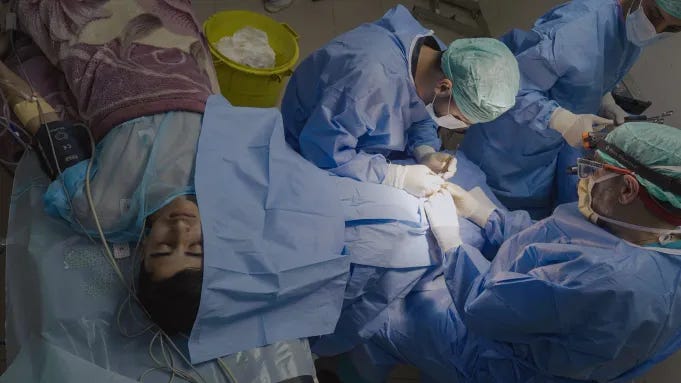
But for the same reasons, some might consider it too politically fraught, or too much of a hot-potato. But our culture has changed a lot, even since “American Doctor’s” Sundance premiere seven months ago, and definitely a lot more since “No Other Land” won the Oscar in 2025 (more on that in a second). In interviews around the time of its premiere, I remember director Poh Si-Teng telling me how the film was being warmly welcomed in red state Utah, how distributors were calling, and how she felt the country had turned a corner. But honestly, I was skeptical, and thought it was still too soon.
But now, New York City has a mayor who called for the arrest of Benjamin Netanyahu; Michigan’s Democratic Senate nominee opposes unconditional military aid to Israel (as do many House reps); and it is no longer as forbidden or politically toxic for American politicians or citizens to condemn the fact that Israel’s army has killed more than 20,000 Palestinian children, and continues to do so (with one child killed in Gaza every day since the so-called “cease fire” in October 2025, according to UNICEF).
When “No Other Land” was released and won the Oscar, it was a very different time. But “No Other Land” was also a very different kind of film. For one, it was about, and made by, a partnership between Palestinians and Israelis. It was also not about the war, at all, but about ongoing life in the Occupied Territories. Yes, it gave context to the conditions surrounding the Oct. 7 attack and its bloodier aftermath, but it didn’t show the corpses of dead Palestinian babies, shot in the head by Israeli soldiers.
If that sounds tough to bear, it is. But director Poh Si-Teng—encouraged by one of her subjects, Jewish orthopedic surgeon Mark Perlmutter—is smart to address such issues head-on and early in the film. While earlier this year, I felt that “American Doctor” might be too tough for audiences, I now believe that viewers are more willing to face the harsh realities of life on the ground in Gaza, not only because of shifting sympathies, but because it’s not in the news every day. This also makes the film all the more urgent, because these things are still going on and the news media has largely moved on to America’s other war in Iran.
However, America’s larger cultural and media institutions are still Islamophobic and haven’t changed much—see my 2025 post “The Genocide Won’t Be Televised” where I indicated skepticism around a big streaming deal for “No Other Land” or any docs about Gaza. (“It’s not just the risk-averse business environment; it’s also Big Media’s capitulation to the new right-wing regime taking over our country.”) To be fair to the corporations, in April of this year, it’s worth noting that Disney-owned Hulu acquired SVOD rights for “The Voice of Hind Rajab” (but only after it proved itself commercial with nearly $1 million in sales at the box office.) “American Doctor” is being released by the Palestinian-American-run Watermelon Pictures.
But if most companies remain in bed with Israel, a lot of people’s minds have changed. According to a July 2026 AP-NORC poll, there are major shifts in public opinion, with 58% of Democrats saying the U.S. is “too supportive” of the Israelis, and a third of Americans acknowledging Israeli has committed genocide against Palestinians.
Now to more of the Oscar prognostication stuff, this year’s documentary race is also more open than usual. While the last couple years have been dominated by Sundance heavy-hitters, I’m not sure there are any clear frontrunners in this year’s crop. “Once Upon a Time in Harlem” is clearly this year’s critic’s darling, and will garner momentum from the support of national and metropolitan film critics’ groups, but I’m not sure how it will play with voters. Similarly for “Closure” and “Nuisance Bear.”

I would love to see “Everybody to Kenmure Street” get more recognition, but it will need a major campaign to get on people’s radar—if it does, it could be a surprise contender. Sundance international favorites such as FRONTLINE’s “One in a Million” and World Competition winner “To Hold a Mountain” may also have a good shot, but none of these seem to have a particular edge. There are also corporate-backed crowdpleasers (like Liz Garbus and Elizabeth Wolf’s “Give Me the Ball!”), and major entries this fall from the likes of veterans Ava DuVernay (Netflix’s “14th”) and Alex Gibney (“Musk”), but recent years have proven that Oscar voters prefer newcomers.
And while I’m sure there will be more great documentaries hitting festivals this fall, I’m not sure which of them will pop, especially the kind of nonfiction cinema that gets serious awards attention these days—something that balances those markers of recent Oscar winners: a relevant and timely social issue; a global perspective or topic that will connect with international voters; memorable character(s); and skillful filmmaking with a narrative arc. But, of course, there are always surprises, especially when it comes to the documentary branch.
As I noted recently, I am eagerly anticipating the new round of nonfiction that will tell the true stories of ICE’s brutal invasion of American cities, and the Department of Homeland Security forces that have been murdering both American and non-American citizens. But for now, most of this content will be arriving in short form at fall festivals and streaming platforms this year. Feature documentaries take a lot of time to make, so we can wait for those to hit, hopefully, at Sundance 2027—and the 2028 Oscars.
Comments
Nothing yet. Say the first thing.
Sign in to join the conversation.