
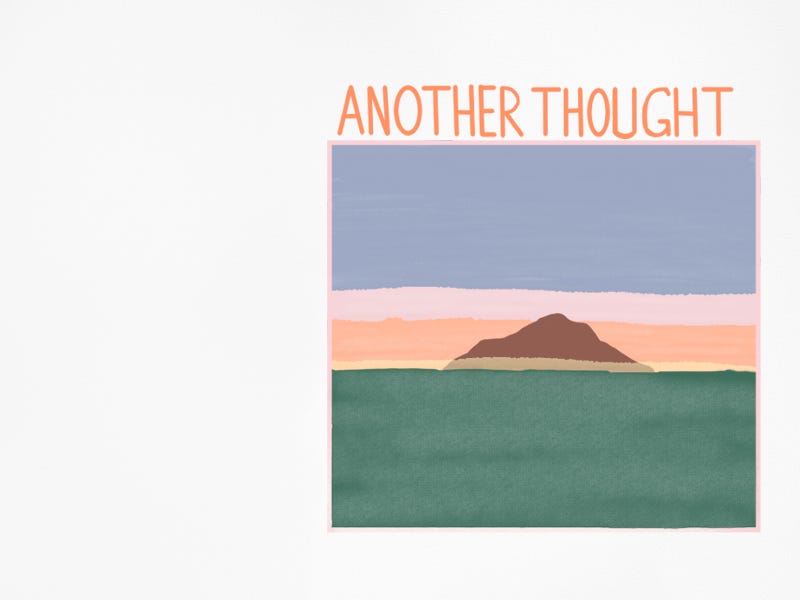
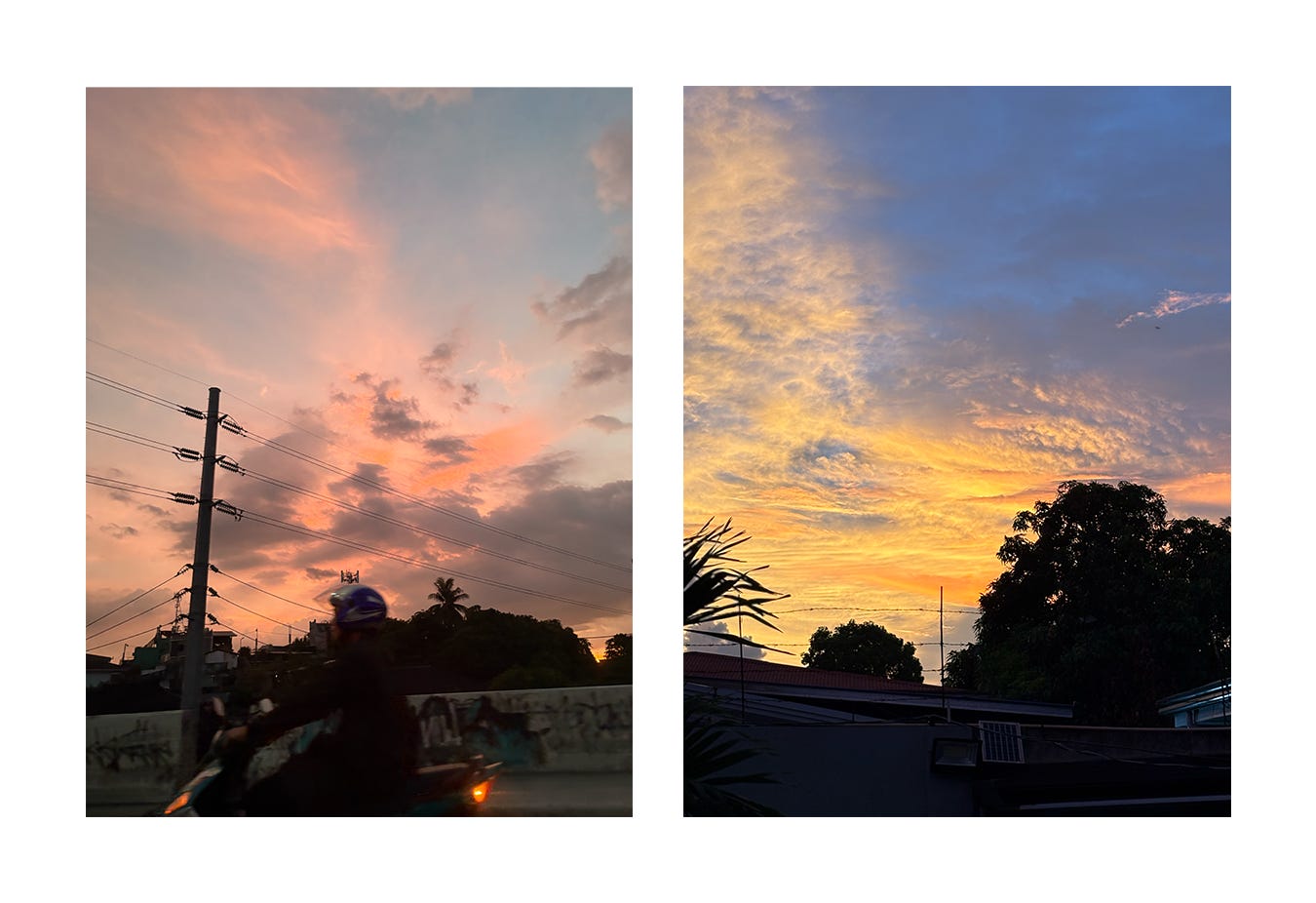
Sunsets never get played out. I laugh a little at myself every time I take a picture of a sunset on my phone. As if it’s a rare occurrence when, in fact, it happens every day. The sun rises and it sets. One of the few dependable things we have in this temperamental world. And yet, it feels like a gift every time. Each one unique. Sometimes you barely notice it happening. Other times, you’re captivated by hues of orange, yellow, blue, and purple. It’s a miracle of light moving through our atmosphere. A painting out of thin air.
Right now I’m traveling through the Philippines with my family, staying in the provinces up north. Even being spoiled by the gorgeous sunsets of the Pacific Northwest, there’s really nothing like the skies here as daylight fades away. The excruciatingly humid heat starts to dissipate. It feels like you can finally breathe again and you’re rewarded with magnificent, brightly saturated skies. I snap countless photos as usual. But even they pale to the feeling it evokes when you stand beneath it in awe.
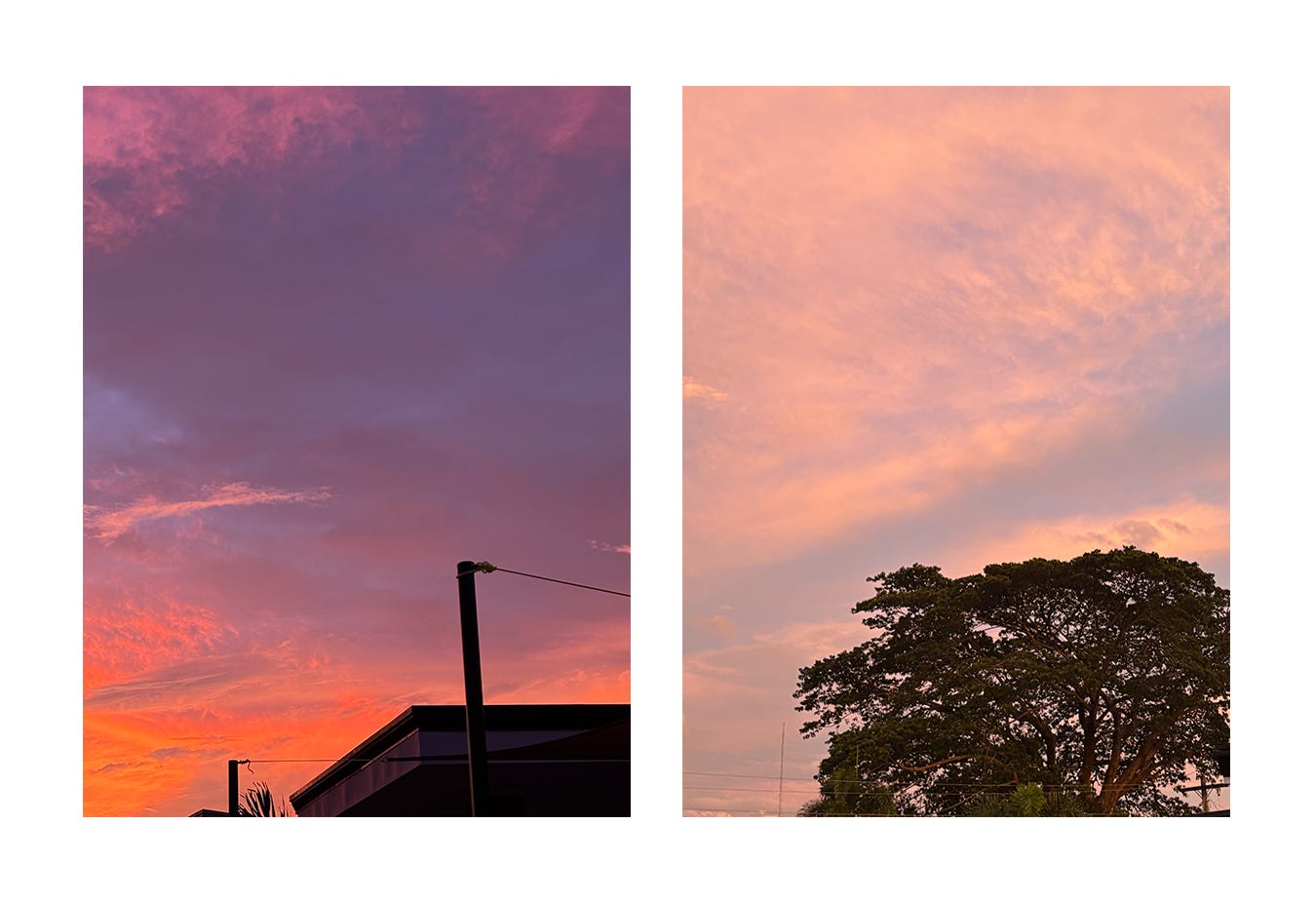
I’m used to being a night owl. Sunsets are usually just the beginning of my evenings. Typically, when I’m wrapping up these newsletters, I’m getting dangerously close to seeing the sun come up. But time moves differently here and my body follows suit. As the sky changes color and fades into dark, I feel myself already making my way to bed at the ungodly late hour of… 7:30 PM. It makes me feel more connected with the natural speed of the earth. The earth has spun and it beckons you to end the cycle with it.
As I’ve stared out at these skies, I’ve felt compelled to revisit one of my favorite ambient albums, Robert Fripp and Brian Eno’s monumental second collaborative album, Evening Star. Or I suppose you could call it “proto-ambient,” given that it came three years before Eno’s Ambient 1: Music for Airports, which is when we truly started to hear the widespread use of ambient as a term.
I’ve spilled a lot of ink explaining why ambient started way before Eno. When I was working on my book 20th Century Ambient, I continually reminded myself that this was not a Brian Eno book. I think a part of me even wanted to resist his undeniable influence just because I wanted to make sure I was properly acknowledging all the other players and musical movements involved in the genre’s evolution.
But really, there’s no denying Eno played a crucial role. I think that initial resistance actually made me appreciate him even more because the more I read into his work, the more it seemed he agreed with me.
“I think although great new ideas are usually articulated by individuals, they’re nearly always generated by communities,” Eno said in an interview with Basic Income UK in December 2015. “Being an artist you hear a lot of talk about genius, which is the process of singling out certain people in art history and saying those were the important ones, you know, Picasso, Rembrandt, Shostakovich, whatever. Whenever you look at any of those artists you find that they lived and drew from a very, very active flourishing cultural scene and they were only one of the elements in that scene.”
Eno’s humility is very endearing. I mean, this guy’s credited with the popularization of an entire genre. That’s on top of working with everyone from David Bowie to U2 to Coldplay. But it’s his knack for experimenting and collaborating that I think has been his key to success.
I find listening to the albums Eno worked on in the early 1970s before Music for Airports to be especially enlightening. Particularly the albums where he’s circling around these ideas that would lead him down this road of expansive sound.
In 1975 alone, he released Discreet Music, Another Green World, and Evening Star. A proverbial holy trinity of sounds that would guide him into his next era. All of these albums can be (and have been) dissected and expounded upon time and time again, and I’m sure will be for years to come. Another Green World is certainly not an ambient record. But it has some key moments. It’s the moment we hear Eno at an intersection of his glam rock past merging with his languid, dreamy future. You feel the latter prominently throughout, like on the elegant title track and peaceful, hypnotic songs like “Becalmed.”
Discreet Music has a strong case for being his true “first ambient album,” with the opening title track swooning across 30 minutes of minimalist sound followed by three tracks of Pachelbel interpretations. In the album’s liner notes, we see him circling around the term, describing the music as “part of the ambience of the environment.”
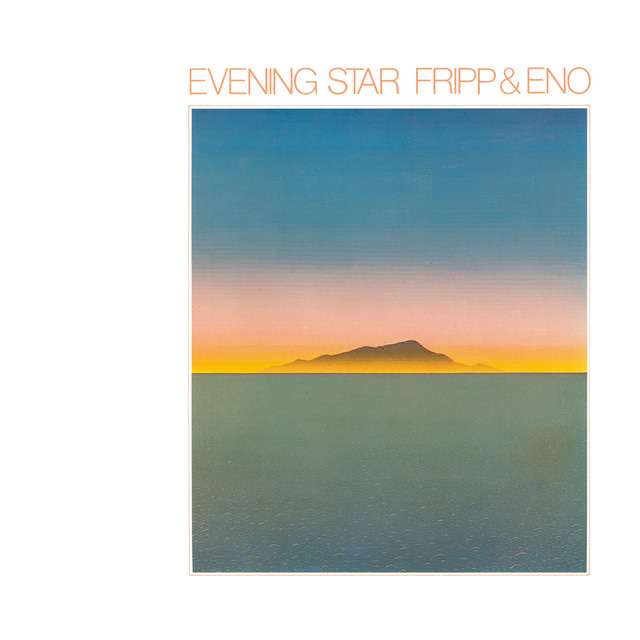
And yet, it’s Evening Star that I’ve found myself coming back to most. It was the last of these records to come out in 1975, something of a sunset itself for this monumental year.
What’s fascinating to me is that Evening Star isn’t necessarily new ideas for Eno. But it’s when things start to crystallize. And the implications it had for where music would go and how artists would create are still echoing through to today.
Of course, this was his second time working with Fripp. Fripp cemented himself as a guitar god as the founder and guitarist for the legendary prog-rock group King Crimson. The group’s 1969 debut album, In the Court of the Crimson King, is often held in the same discussions as Pink Floyd’s Dark Side of the Moon in terms of prog and psych masterpieces. (I’d also venture to guess, two records you’re most likely to find seeds and stems lodged in their vinyl slip covers if you come across a used copy.)
Fripp & Eno’s first collaborations often found the two at crossroads in their respective careers. When they first got together, Eno had just recently left the band Roxy Music. It was a big leap. Not only was Eno a key player, but it was a case of leaving a “sure thing” in order to pursue a passion. He’d become obsessed with the “delay and decay” sound effect methods of artists like Pauline Oliveros and Terry Riley from the San Francisco Tape Music Center and started to experiment with them on his own and see how far he could push them.
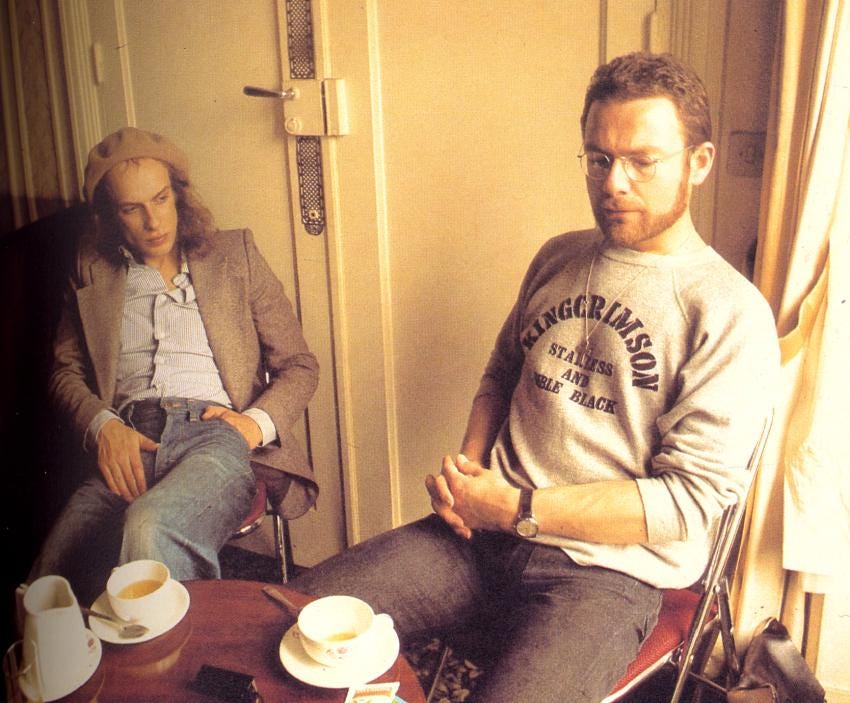
Eno brought Fripp to his home studio and showed him what he was working on. Fripp was riding high on the success of King Crimson, a type of success Eno could’ve been enjoying had he stayed with Roxy Music. But the two shared a yearning for expanding sound and dreaming up a future for music. Eno would play him tape loops and have Fripp improvise his guitar wizardry over them, Eno hitting record when he felt the moment was right. This method of looping sound and playing over it is pretty typical today. But in 1972, it was monumental. The method of recording would later be dubbed “Frippertronics.”
The sessions resulted in their first collaborative album, No Pussyfooting. The album is icy and mesmerizing. Fripp’s guitars rip over the woozy loops – the loops themselves also being Fripp’s guitar played back to him. You can still hear bits of that King Crimson mayhem sweeping in and out over the frantic licks. The first movement, “The Heavenly Music Corporation,” feels like a guitar solo being warped through a black hole. It’s an album that forever changed the recording process and practically invented the loop pedal that’s commonplace today.
Where their first album together, No Pussyfooting, felt experimental and thrilling, Evening Star is warm and self-assured. This time, Fripp was looking out into the unknown. King Crimson had just broken up for the first time. Fripp was discouraged by the music industry and convinced that music as an art form would undergo a radical change by 1981 (a very specific estimate and not entirely wrong).
No Pussyfooting created a new method, but Evening Star feels like a new day. So much of Eno’s music around this period is indebted to serving its environment. Evening Star does that, but also feels like it’s channeling environment in a very literal sense. The album brings the duo down to Earth. With instrumental music like this, I’m always fascinated by how a title can completely shift the idea and tone of a song.
Just reading the opening track’s title, “Wind on Water,” suddenly primes me with a visual. I can picture myself looking out at the sea, the rush of air blowing across my skin and hair. I can almost smell the sea salt as Fripp’s guitars twist and turn in beautiful spirals. The music is less harsh than No Pussyfooting. It’s less like a guitar solo and more of a transference of mood and feeling. Later on “Wind on Wind,” the tone is changed; there’s less resistance than the water. It feels purely like drifting, cool and effortless. The closing seven-part suite, “An Index of Metals,” is appropriately harsher and denser, like it’s crunching right out of the earth.
What I come back to the most is the title track, “Evening Star.” For me, it’s the finest moment of Fripp and Eno’s collaborative efforts. The twinkling harmonics of Fripp’s guitar at the beginning capture not just the look of the changing sky, but the sense of wonder it evokes. Even when he loops over it again with a surging, distorted riff, it doesn’t feel any less dreamy. At times, it sounds like a motorcycle revving off in the distance – not too dissimilar to staring out at the Philippine skies in this small town I currently inhabit.
A new element also appears in the music – the soft sounds of a piano. Sparsely played, it’s the foil to Fripp’s guitars. A reminder of the gentleness of the ending day. As someone who often resists sleep to “get more done,” it feels like the two instruments are pulling at one another. Eventually the guitar relents to the piano after a few more sleepy distorted riffs. It gives one last squall at the end, reverberating like a howl at the moon before it rings out and dissipates.
I imagine I’ll keep playing Evening Star again and again as I watch the skies change here. I know when I get home I’ll resist sleep again and the sunsets will signal the second part of my day instead of the end. Yet I don’t really think about any of this at all while I’m watching it happen. The music and the sunset feel miraculous in and of themselves. Sometimes all you have to do is sit back and appreciate that you get to be there for it.
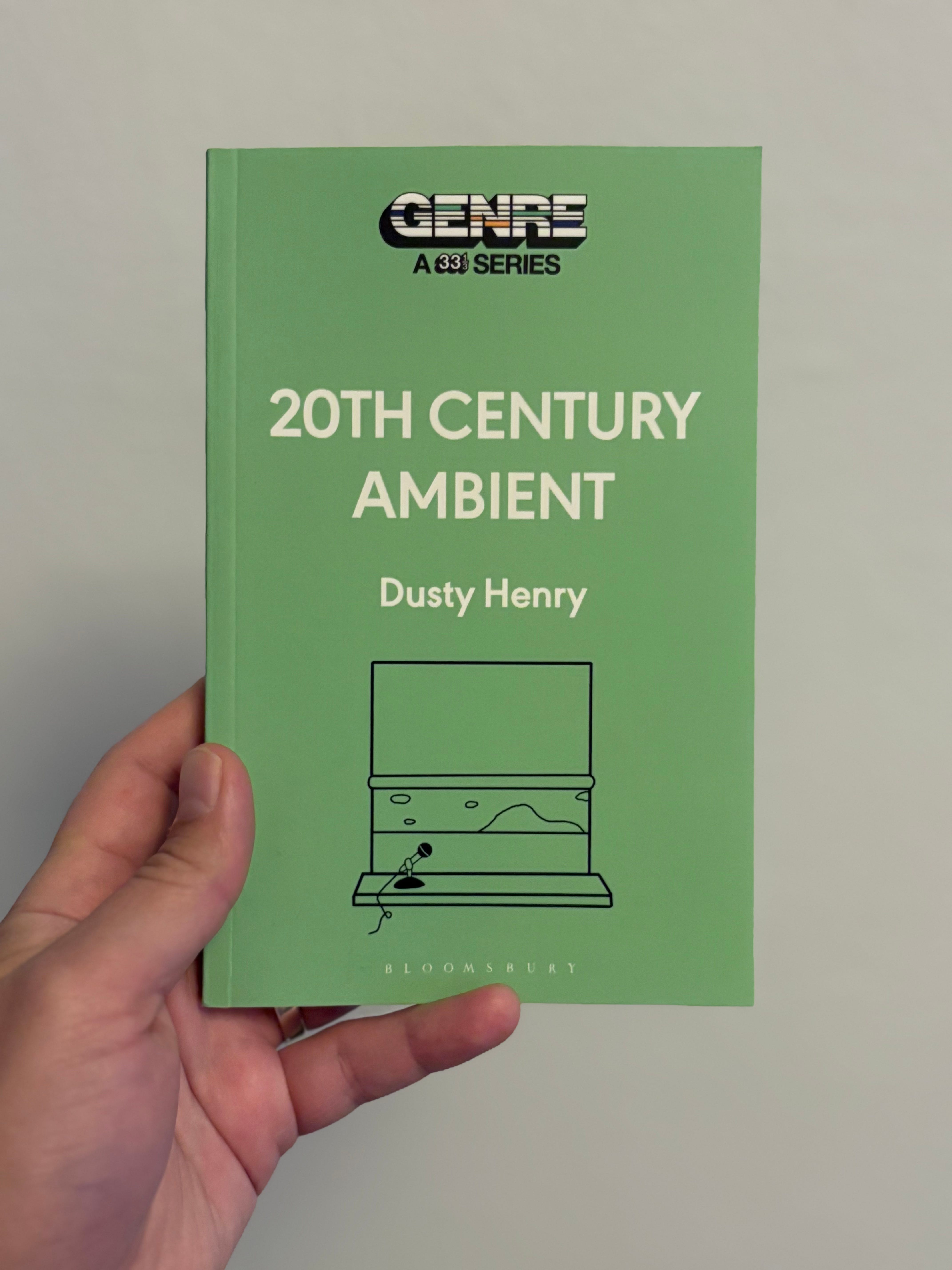
Through text and comics, 20th Century Ambient traces the recent history of ambient music to uncover how the genre has evolved and the role it plays in our daily lives. If you dig the combination of art and essays on Another Thought, I think you’ll love this book.
“Enriched by vivid profiles of the genre’s practitioners and capped by a list of essential tracks, it’s a quirky love letter to an enigmatic sound.” - Publishers Weekly
“Dad! Your book isn’t boring! It has pictures in it! It’s hilarious. Kids can read it too!” - my child
20th Century Ambient is out now from Bloomsbury Books.
I appreciate you reading Another Thought, whether this is your first post or you’re a long-time reader. Another Thought is a labor of love fueled by very long deadline nights, lots of art supplies, and espresso at ungodly hours.
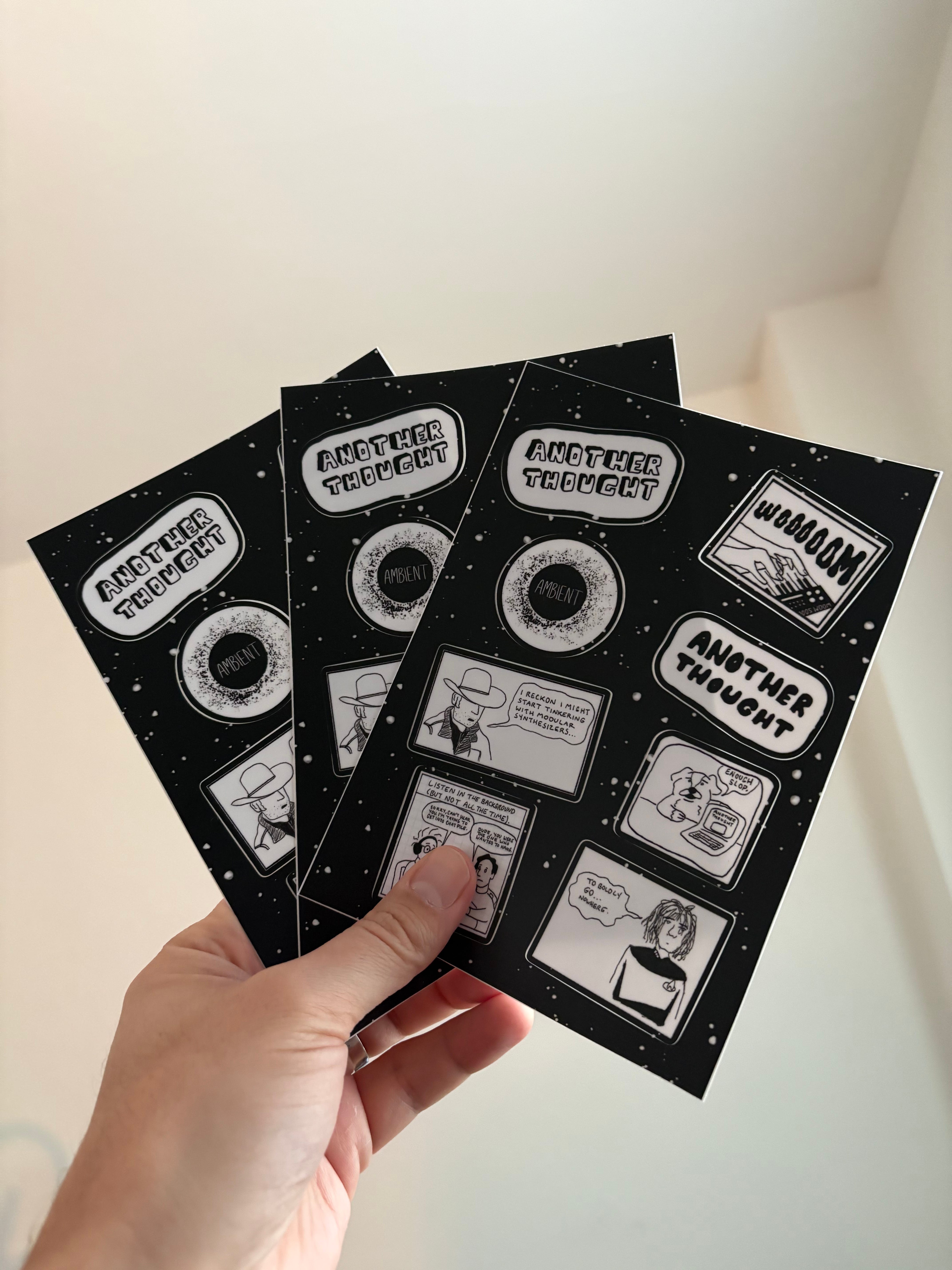
If you want to support the newsletter, please consider becoming a paid subscriber at $5/mo. You’ll get exclusive newsletters, early access to upcoming physical media, and a sheet of stickers featuring drawings from the newsletter and my book mailed to you!
No posts
Comments
Nothing yet. Say the first thing.
Sign in to join the conversation.