
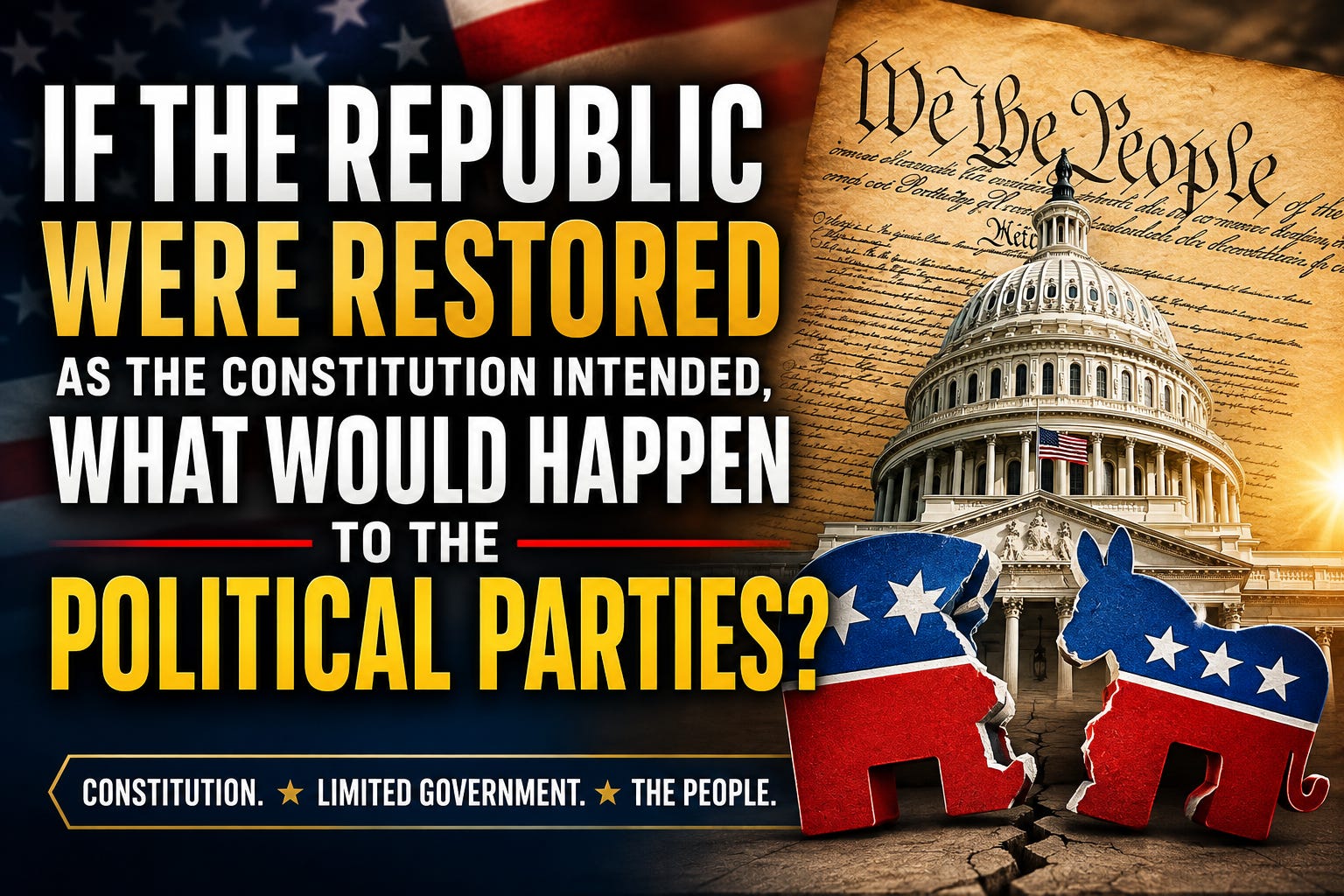
The United States Constitution never created political parties.
It established three branches of government, separated powers, checks and balances, federalism, and a representative republic. It carefully defined how laws would be made, how officials would be elected, and how power would be limited. Nowhere, however, does the Constitution establish Republicans, Democrats, or any other political party.
In fact, many of America’s Founding Fathers warned against the dangers of political factions.
George Washington, in his Farewell Address, cautioned that organized political parties could place loyalty to a party above loyalty to the nation. James Madison wrote extensively about the dangers of factions seeking power for their own interests rather than for the common good. Their concern was not that Americans would disagree. Healthy debate was expected. Their concern was that permanent political organizations could eventually become more interested in preserving themselves than preserving liberty.
If the American republic were restored to operate exactly as the Constitution envisioned, political parties would not necessarily disappear overnight. The Constitution does not prohibit citizens from voluntarily associating with one another. Americans would still be free to organize around shared beliefs under the protections of the First Amendment.
However, their role would likely be dramatically reduced.
Today’s political parties have become large political institutions. They recruit candidates, raise billions of dollars, influence legislation, shape media narratives, and often determine committee assignments and leadership positions. Party affiliation has become one of the strongest influences on how elected officials vote.
A constitutional restoration that emphasized the original balance of powers and limits on federal authority could significantly reduce that influence.
Representatives would be expected to represent their states or districts first rather than a national party platform. Senators would be expected to exercise independent judgment. Debate would focus more heavily on whether proposed laws fit within the Constitution’s enumerated powers instead of whether they advanced a party’s agenda.
Federal authority itself could become substantially smaller if government returned to exercising only those powers specifically delegated by the Constitution. Many issues currently debated at the federal level might instead return to the states, where the Tenth Amendment reserves powers not delegated to the federal government nor prohibited to the states.
Such a shift would naturally reduce the importance of national party politics because many decisions would once again be made closer to home.
Political campaigns might also look very different.
Instead of asking whether a candidate has an “R” or a “D” beside their name, voters might place greater emphasis on a candidate’s understanding of constitutional principles, personal character, integrity, and record of public service. Campaigns could become more localized, with greater attention given to the needs of individual communities rather than national party messaging.
None of this would eliminate disagreement.
Americans have always held different opinions about taxation, commerce, foreign policy, immigration, education, and countless other issues. Differences of opinion are a natural part of a free society. The Constitution was designed to provide a framework for resolving those disagreements peacefully while preventing any single group from accumulating unchecked power.
Whether political parties would ultimately fade or simply become less influential is impossible to know. History suggests that people naturally organize around shared beliefs. New coalitions would almost certainly form. The important distinction would be that those organizations would exist to persuade rather than to dominate the machinery of government.
Some commentators have suggested that, if the nation truly returned to the constitutional framework envisioned by the Founders, efforts by breakaway factions within existing parties to establish new national political parties would face significant obstacles. In that view, any attempt to build a new party primarily around fundraising or political influence rather than constitutional governance would likely struggle to gain lasting traction. Supporters of this perspective argue that such movements would “never make it past Go,” believing voters would quickly recognize and reject organizations perceived as serving the financial or political interests of their founders rather than the public interest.
Supporters of constitutional restoration generally argue that the ultimate allegiance of every elected official should be to the Constitution and the people they represent, not to party leadership or political strategy.
Critics, on the other hand, contend that political parties help organize government, clarify policy differences, and allow voters to better understand competing visions for the country. They argue that parties are a practical response to governing a large and diverse republic.
The debate, therefore, is not simply about whether political parties should exist. It is about the role they should play.
If the republic operated precisely as the Constitution intended, the Constitution itself would once again become the highest political standard. Parties could continue to exist as voluntary associations of citizens, but they would ideally become secondary to constitutional fidelity, limited government, and the independent judgment of those entrusted with public office.
Perhaps that was the vision the Founders hoped future generations would preserve: a nation where allegiance to liberty outweighed allegiance to any political banner and where the Constitution remained the common ground upon which all Americans stood.
Personal note:
We are going to go on record as saying that most Americans now know, the republic of the United States is and has been restored, including those who have served in Congress and or have been in the close circle of this administration.
That being said, why try to start a new party?
Parties will not exist, in the same manner as they do now, under the Restored Republic.
I’ll tell you why?
They know just as many of you know that the big reveal is very close to happening. They are trying to use their influence, to encourage you to open up your checkbooks.
“Take one last run on the wealth of the people.”
When it’s said and done, they will simply play dumb like they didn’t know and you will be snookered out of your contributions.
They have decided that if the fraud and corruption that has occurred in our nation without citizens ripping the doors off of Congress…then you are likely to be just as passive when they screw you a little bit more..ONE LAST TIME!
Comments
Nothing yet. Say the first thing.
Sign in to join the conversation.