
Image Source: thetruehonestcana
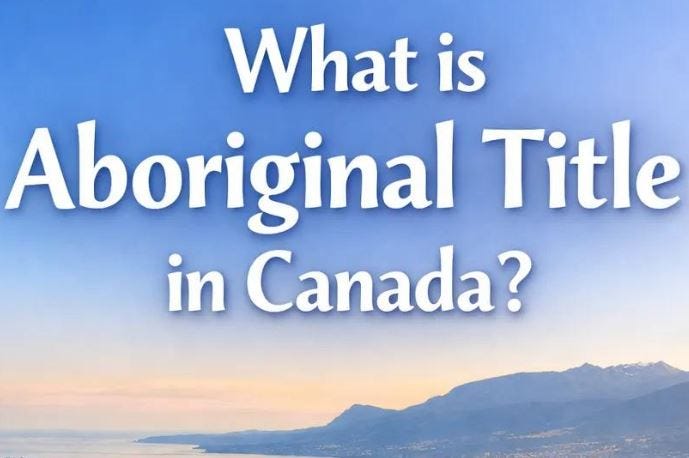
“Aboriginal Title” is a key concept that needs to be fully understood as part of reconciliation. Recent controversies in B.C. with respect to a decision regarding Cowichan land claims in the lower mainland have demonstrated that there may be some confusion as to the basis on which the courts have defined Aboriginal Title. This controversy has led the B.C. government under Premier Eby to reconsider their position on UNDRIP (United Nations Declaration of the Rights of Indigenous Peoples)1 despite the fact that the Cowichan decision is sound and based on principles established by case law in Canada and not by UNDRIP.
In 1997, in a case called Delgamuukw v. British Columbia the Supreme Court of Canada dealt with a claim for Aboriginal Title by the Gitxsan and the Wet’suwet’en, who sought recognition of their respective nation’s ownership and jurisdiction over approximately 58,000 square kilometres in north-western British Columbia.
In Delgamuukw (also known as Delgamuukw-Gisday’wa) the Court decided the rules of evidence had to be adapted to allow for the consideration of Indigenous Peoples’ oral histories. In this case, the Court also decided Aboriginal Title is not simply a bundle of rights: it is a right to the land itself. It includes the right to benefit from the land and the right to decide how the land is used or not used.
To prove Aboriginal Title, an Indigenous Nation must prove its exclusive occupation of the land before the assertion of Crown sovereignty. Occupation might be proven through physical occupation or the existence of Indigenous laws over the land. This is where oral histories were vital to demonstrating the traditional links with the land in question. Furthermore, the Court held that Aboriginal Title could not have been extinguished by provincial laws.
Because the Nations had argued at trial for ownership and jurisdiction instead of Aboriginal title, the Court decided a new trial was necessary. The new trial has never been held. Instead, building on the Delgamuukw decision, in a 2014 case called Tsilhqot’in Nation v British Columbia the courts made the first declaration of Aboriginal Title in Canadian history. On June 26, 2014, the Tsilhqot’in Nation v British Columbia decision was released by the Supreme Court of Canada. It was popularly seen as a victory not only for the Tsilhqot’in Nation, but for Aboriginal groups across Canada. This case established Aboriginal title and the conditions that are placed on Aboriginal title once it is granted (or in the process of being granted).
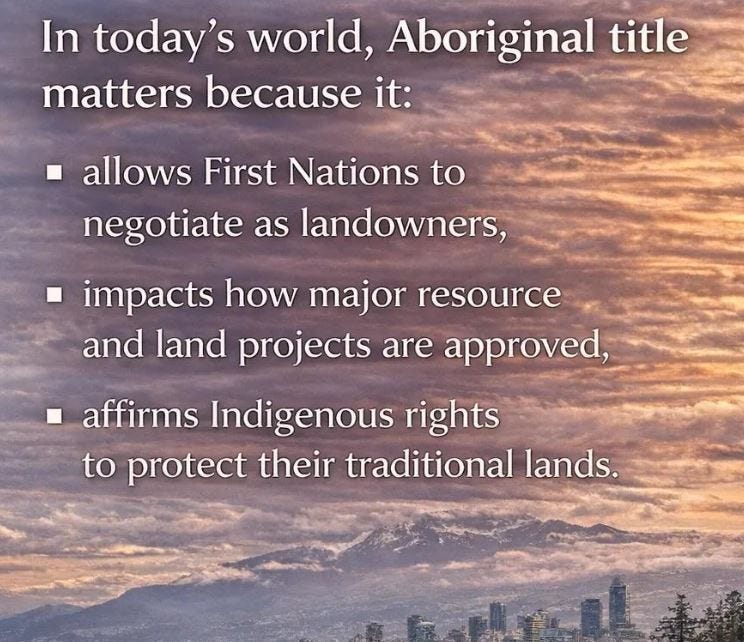
Image Source: thetruehonestcana
The dispute that launched this case began in 1983. That year, the government of British Columbia issued a forestry licence for an area on the traditional territory of the Tsilhqot’in Nation. The Nation challenged the grant of this licence on the grounds that that area was Aboriginal land where it properly held title. The Tsilhqot’in Nation is composed of six bands with a common culture. They have lived in a remote valley in central British Columbia for centuries. They lived, foraged, hunted and trapped on the land. They also repelled invaders. There are no treaties or other claims to the land. The Tsilhqot’in Nation claimed title for about five percent of its traditional territory.
In the Tsilhoqot’in case the Supreme Court affirmed its definition of Aboriginal title from the Delgamuukw case. In summary, Aboriginal Title is a form of ownership that is similar to regular ownership of land. Aboriginal Title allows for:
The right to decide how the land is used;
Exclusive use and occupation;
The economic benefits of the land; and
The right to manage the land.
However, Aboriginal title differs from regular ownership in some important ways. The source of the title comes from the prior occupation of the land by Aboriginal peoples, it is held communally, and it can only be transferred to the Crown (i.e. not to private owners). Aboriginal Title is held not only for the current generation, but also for all future generations of the Aboriginal group. Because of this, land with Aboriginal Title cannot be used in a way that prevents future generations of Aboriginal people from using the land for traditional purposes.
Governments can infringe on Aboriginal Title under some circumstances as follows:
The government has consulted (the duty to consult); with the Indigenous group impacted, and if appropriate, accommodated Aboriginal concerns
The Government’s actions are backed by a compelling and substantial goal; and
The Government’s actions are consistent with the Crown’s obligations to Aboriginal groups.
The decision in the Tsilhqot’in case clearly establishes the conditions that must be met to establish Aboriginal Title and delineate how provincial laws impact on that title. Provincial laws cannot be passed that infringe on Aboriginal Title unless the government has discharged its duty to consult, and its duty to accommodate. Provincial laws that infringe on Aboriginal title have to be enacted for an important compelling reason – often thought of as a reason of national or provincial importance. And the provincial laws must be consistent with the Crown’s obligation to Indigenous people, meaning in part being consistent with the goal of reconciliation.
In later cases the courts further determined how Aboriginal Title impacts on private (fee simple) ownership of land. In 2021, the Wolastoqey Nations filed a claim for a declaration of Aboriginal Title to lands covering more than half of New Brunswick, including lands held privately by commercial forestry companies. The Province of New Brunswick and the forestry companies asked the Court to strike out the portions of the claim for Aboriginal Title over privately held lands.
The New Brunswick Court of the King’s Bench (2024) held that a claim for Aboriginal Title can only be brought against the federal and Provincial Crown, not third parties. The Court struck out the portions of the claim which sought the return of privately held lands from the companies and removed the companies from the claim. However, the Court decided that in the future the Crown might be directed to use its expropriation powers to return Aboriginal title lands to the Wolastoqey.
The New Brunswick Court’s decision provided much-needed clarity by expressly confirming that Aboriginal Title continues to exist on lands which were historically used and occupied by Indigenous peoples, regardless of whether those lands are now subject to fee simple interests (i.e. private ownership). Incidentally that case is still under appeal and awaiting a final decision.
The decision also confirms that Aboriginal Title is, and has always been, a right to the land itself. Where the Crown fails to recognize and respect that right, remedies exist under Canadian law, including the possibility of the return of lands to the title-holding Nation.
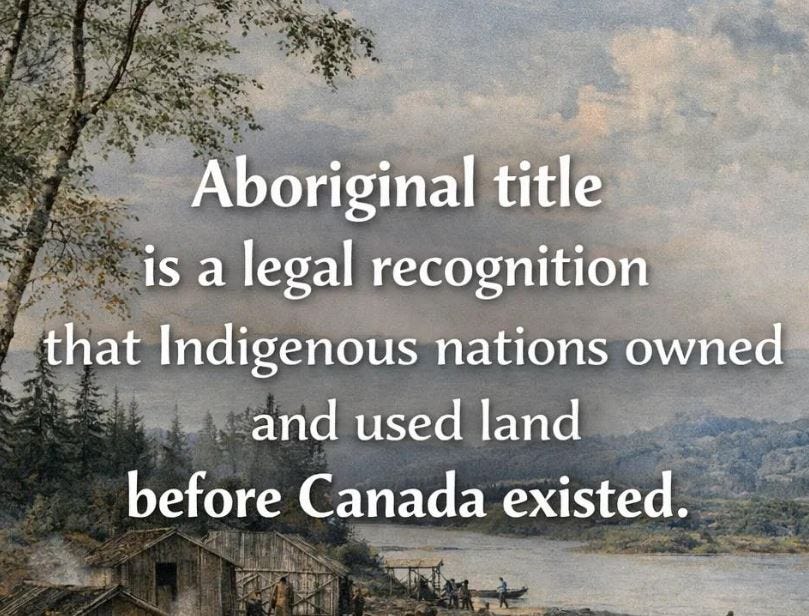
Image Source: thetruehonestcana
So, the current controversies in B.C. resulting from the Cowichan decision would exist with or without B.C.’s commitment to UNDRIP. Therefore, the issue is that many people simply do not like the fact that Aboriginal Title over-rides private property claims. This fact has been used by fear mongers to stir up the controversy. However, in every instance we are aware of, the First Nations in question have been consistent in asserting no interest in attacking or claiming private property from current owners. Secondly, in decisions like Cowichan and in Treaty arrangements First Nations have consistently sought remedies from the Federal and Provincial governments and have avoided infringing on the fee simple rights of property owners. These settlements have either been the result of a court order or are the result of the position First Nations have generally adopted.
A little research and a good faith approach to reconciliation by Provincial governments and the Federal government would uphold the honour of the Crown, help educate Canadians regarding Aboriginal Title and move us all another step closer to reconciliation. Surely Premier Eby can take a bit of time to reflect on the legal realities and stop taking back steps in the reconciliation and future building of relations with the First Nations.
Thanks for reading Canadian Indigenous Facts, Stories and Learnings! This post is public so feel free to share it.
Comments
Nothing yet. Say the first thing.
Sign in to join the conversation.