
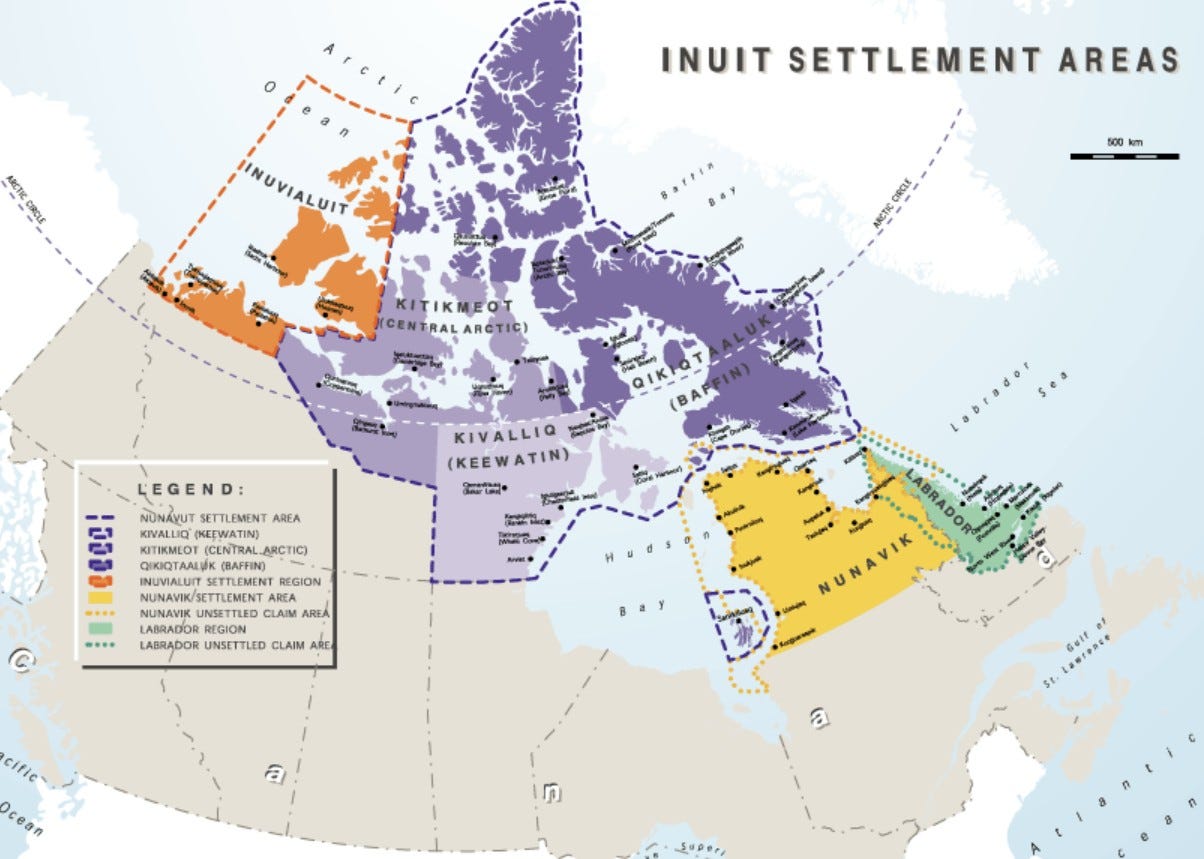
Image Source: https://www.makivvik.ca/wp-content/uploads/2013/02/canadian_inuit_map.gif
It is generally assumed and asserted that one of the distinctions between the Inuit and First Nations people is that prior to modern times there were no treaties with any Inuit groups. However, this generalization is false. In 1765-1766 “Peace and Friendship” treaties were struck between the British and the NunatuKavut Inuit, who occupied lands now referred to as Southern and Central Labrador.
Also, prior to these treaties with British, during the 1700s, the NunatuKavut Inuit had negotiated a couple of treaties with the French (1713 and 1719) but the French did not respect the terms and conditions, and the result was sustained conflict between the Inuit and the French Europeans. Finally, the differences were resolved in a treaty entered into with the French Captain Jean Baptiste Galliot at Chateau Bay in 1756, which led to more peaceful and lasting Inuit/French trade relations for a decade or so into the 1760’s. By 1763, there was still no sustained French presence north of Cape Charles, on what the French described as the “Cote des Esquimeaux”, Inuit territory.
Subsequently, this treaty was nullified with the defeat of the French by the British that ended the European Seven Years’ War and the signing of the Treaty of Paris (1763). Of course, the Inuit at the time were largely unaware of these international events. Notwithstanding, in order to assert their claim over the parts of North America that had been previously claimed by the French the British decided to negotiate treaty understandings with various groups that included the NunatuKavut Inuit.
In August 1765, a Peace and Friendship Treaty was entered into between British officials and the NunatuKavut Inuit of southern Labrador at Chateau Bay. This historic agreement formally acknowledged that Inuit were the rightful and established inhabitants of the lands and waters of what is now referred to as NunatuKavut.
Present for the negotiations were: three British navy vessels, with a total of some 600 British navy personnel; two merchant vessels with an additional 170 Europeans, and 300-500 Inuit. It was a big deal at the time. The diplomatic conference ran from August 18th until September 21st, a total of 34 days.
Far from a surrender, the treaty reaffirmed Inuit ownership and governance over the territory. It was part of a broader British strategy to promote peace and trade. It respected Inuit autonomy, identity, and longstanding relationship with the land. The Inuit signatories were not passive participants; but came to the table as leaders, negotiating in the interest of their people and their future.
The 1765 Treaty was formally entered into the colonial record in 1769 by the British Lords of Trade. It stands today as a foundational document and as an early affirmation of the rights that the Inuit continue to assert.
Over the next two hundred years the respect for the Inuit culture and way of life waned and ultimately devolved into a relationship marred by racism and that created too much dependency on the Canadian federal government. While the original British treaty such as it was did not create land reserves, other government policies were enacted that had a devastating impact on the NunatuKavut Inuit including the imposition of colonization that brought with it diseases that caused disaster in the Inuit communities. As well, Christian missionaries made every effort to “civilize” the Inuit and were sanctioned by the government to develop and run residential schools.
Despite these efforts to eradicate Inuit culture the NunatuKavut Inuit persisted and in the 1970s, like Indigenous people in other parts of Canada, the Inuit in Labrador started to organize and stand up for their rights and recognition, forming their own representative organizations. This lead ultimately to the formation of the NunatuKavut Community Council (NCC).
In 1996 the NunatuKavut Inuit united at Natsitok (on Eagle River) to fight the construction of a fishing camp, strongly protesting against outsiders who were encroaching on their lands and waters, without consent. In the final report from the Royal Commission on Aboriginal Peoples (RCAP), the NunatuKavut Inuit were recognized as Indigenous. The report asserted that the Inuit community “exhibits the historical rootedness, social cohesiveness and cultural self-consciousness that are essential to nationhood, and they are developing a political organization that will allow them to engage in effective nation-to-nation negotiation and to exercise self-government.” These important events were the prelude to the development of the NunatuKavut Community Council (NCC) as a self-governing body empowered to interact with other governments (federal and provincial) and with international agencies (e.g. the United Nations).
Following a successful court case in 2005, the Newfoundland and Labrador Court of Appeal held that NunatuKavut Inuit have Indigenous rights and have a credible claim.
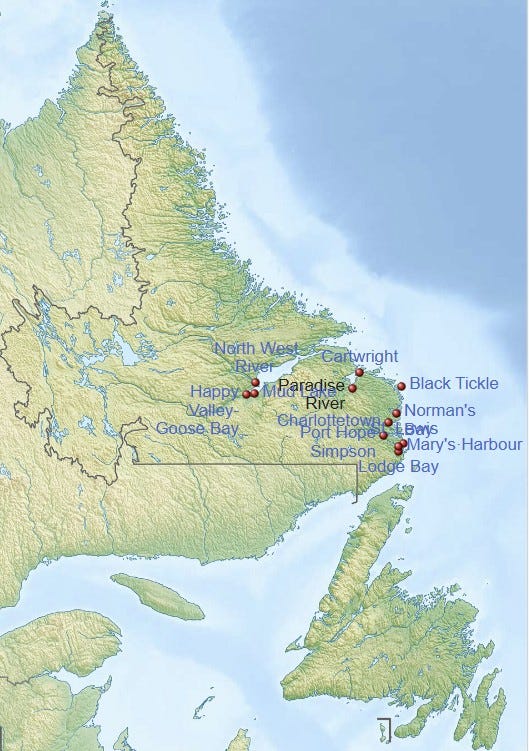
Map of Main NunatuKavut Communities
Image source: https://en.wikipedia.org/wiki/NunatuKavut
This coincided with the negotiation of the Labrador Inuit Land Claims Agreement (2005) which resulted in the creation of Nunatsiavut, represented by the NunatuKavut Community Council and Nunaatsiavut Government. This is one of five modern treaties between Canada and the Inuit people.
The other four modern treaties include:
James Bay and Northern Québec Agreement (1975): The first modern treaty in Canada, represented in the region by the Makivik Corporation;
Inuvialuit Final Agreement (1984): The first modern treaty north of the 60th parallel, represented by the Inuvialuit Regional Corporation;
Nunavut Agreement (1993): Created the territory of Nunavut, represented by Nunavut Tunngavik Incorporated; and
Nunavik Inuit Land Claims Agreement (2008): Covered offshore islands and marine regions, also represented by the Makivik Corporation.
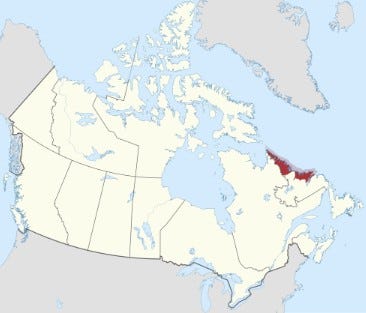
Map of Nunatsiavut area. Image Source : https://en.wikipedia.org/wiki/Nunatsiavut
For the NunatuKavut Community Council (NCC) the recognition of the right to self-government has lead to several agreements with the federal government including:
A Shared Understanding Agreement (SUA) was signed in 2015 with Parks Canada around the Akami-UapishkU-KakKasuak-Mealy Mountains National Park Reserve which provides a framework for consultation, cooperative management and planning for the Park.
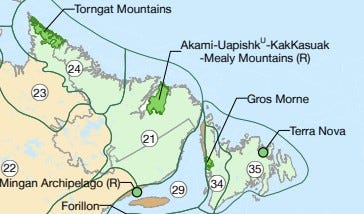
Map of the National Parks in NL and Labrador. Image Source: https://parks.canada.ca/pn-np/plan
In 2017 a Residential School Apology was issued and the NCC was granted MMIWG Participation. The federal government issued an apology to Labrador survivors, including the NunatuKavut children who attended residential schools. NCC received official legal standing and funding to participate in the institutional, knowledge-keeper and expert hearings around the National Inquiry into Missing and Murdered Indigenous Women and Girls (MMIWG).
After many years of not being consulted or respected regarding major resource projects in our territory, also in 2017 NCC signed a significant agreement with Nalcor Energy called a Community Development Agreement.
In 2019, a Memorandum of Understanding (MOU), guiding the relationship between the Government of Canada and the NCC, was formalized. Mutual areas of interest were outlined with respect to the recognition and implementation of agreements regarding section 35 rights, jurisdiction, and service delivery that reflect the priorities of our people.
NCC and the Province of Newfoundland and Labrador signed a Memorandum of Understanding (MOU) in 2022 on education. This MOU reflects the mutual interests of both parties to ensure that the culture and history of NunatuKavut Inuit are reflected in the provincial school system.
Also in 2022, NCC was granted standing as an Inuit Group to appear before the Supreme Court of Canada in Quebec’s challenge to Bill C-92, An Act Respecting First Nations, Inuit and Metis Children Youth and Families.
This article is intended merely to highlight the fact that there were treaties with one Inuit group and that the “Peace and Friendship Treaties” were similar to those negotiated with First Nations in the Maritimes and did not result in the ceding of any territory. As a result, it is a footnote in history that ultimately led to the negotiation of the modern treaty that is now in place.
In future articles we will cover other modern treaties in more depth.
Thanks for reading Canadian Indigenous Facts, Stories and Learnings! This post is public so feel free to share it.
Comments
Nothing yet. Say the first thing.
Sign in to join the conversation.