
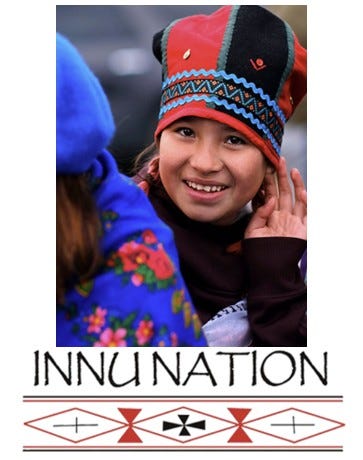
Images source: https://www.innu.ca/
Land claim negotiations have been underway with the Innu Nation of Labrador for a long time. The Innu submitted their statement of claim in 1977, and the federal government officially accepted the claim for negotiation in 1978. Substantive tripartite negotiations formally began in mid-19951, leading to a signed Framework Agreement in 1996. There are approximately 1,700 Innu in Sheshatshiu and 900 Mushuau Innu in Natuashish. Prior to the 1960s, they lived a nomadic existence following caribou in the interior of the Québec-Labrador Peninsula. The two (2) communities are distinct from each other, their residents were formerly known as Montagnais and Naskapi, respectively, but they share a political organization, the Innu Nation, which represents them in land claims and other negotiations.
The Innu Nation land claim, as accepted by the federal government for negotiation, covers approximately 70% of Labrador. A framework agreement, signed by Canada, Newfoundland and Labrador and the Innu Nation in 1996, sets out the ground rules for negotiations. Other agreements have been reached to further the process but the overall land claim has yet to be finalized.
For example, one such interim agreement reached is called the Tshash Petapen Agreement (jash pey-taah-ben), which translates as the New Dawn Agreement. This is a bilateral agreement between the Innu Nation and the Government of Newfoundland and Labrador. Signed in 2008 it resolved key issues relating to matters between the province and the Innu Nation surrounding: the Innu Land Claims Agreement; the Lower Churchill Impacts and Benefits Agreement (IBA); and, the Upper Churchill Hydroelectric Development Agreement. The New Dawn Agreement formed the basis for ongoing negotiations of all other outstanding issues.
The New Dawn Agreement represented a significant step forward in the broader tripartite land claim negotiation process because it essentially became an Agreement-in-Principle as it brought closure to several significant issues between the Province and the Innu Nation.
The Land Claims Agreement-In-Principle (AIP), the Lower Churchill Impact Benefit Agreement (IBA) and the Upper Churchill Redress Agreement were all signed at Natuashish2 on November 18, 2011. Negotiations among the three parties, Canada, Newfoundland and Labrador and Innu Nation, towards a final land claims and self-government agreement are currently ongoing. In discussion is ownership by the Innu of approximately 5,000 square miles of land and Innu shared management over an additional 9,000 square miles. Meanwhile, “Incremental Agreements” have been reached between the Innu Nation and Parks Canada that have enabled the Innu to play a central role in managing lands that are part of the local National Park Reserve.
Despite some of these successes the comprehensive land claim remains unresolved and has recently suffered a significant set-back.
A conflict erupted when the NL provincial government instructed organizers of the Innu Pakassiun3 exhibit, which was scheduled to open on June 21, 2026 at the Labrador Interpretation Center in North West River, to censor the cultural exhibit by capping the history of the Innu in the region to the past 300 years. This fictious timeline suggests that the Innu did not arrive in the area until after the Europeans and if accepted would have a dramatic impact on the land claims. The province’s position contradicts both Innu oral history and accepted archaeological consensus.
Innu oral history and long-standing archaeological evidence indicate that the Innu and their ancestors have inhabited the Quebec-Labrador peninsula (Nitassinan) for thousands of years, dating back to the retreat of the glaciers (Between 6.500 and 8,000 years ago). Peter Whitridge, an archaeology professor at Memorial University, is one of the eight social scientists who penned a letter to the provincial government in support of the Innu Nation, who maintain their history spans thousands of years4.
The Newfoundland and Labrador government censorship attempt has provoked significant anger within the Innu community. Innu leaders and cultural guardians protested, which led to the shutdown of Expo Labrador5. The Innu expressed concerns that the province’s denial of indigenous oral history and knowledge could be used to challenge ongoing land claims and self-governance negotiations, though Indigenous Relations Minister Lela Evans has maintained that the exhibition timeline dispute is not officially tied to land claim negotiations.
Minister Lela Evans has said the provincial government is dedicated to “true reconciliation” with Innu people, but has stopped short of any endorsement of Innu history in the region extending beyond 300 years. The controversy might be explained by the fact that many of the known artifacts only date to the post-contact period after the Innu began trading with Europeans. Objects made of metal and/or glass for example only existed after trading. However, the prior occupation of Labrador by the nomadic Innu who migrated throughout the region following the seasonal hunts, has been well documented.
For example, it is likely that the Innu were the group identified by the Vikings (aka Norsemen) as Skraelings. That would put them in Labrador in the early part of the last millennium (approximately 1021 CE) or about 1,000 years ago (and obviously the Innu were already here when the Norse arrived). Even accounts of other contact with European fishers, whalers, and missionaries (principally from France) began in the 1500s (which is also more than 300 years ago).
Accepted archaeological thought is that the Innu and their ancestors have inhabited the Quebec-Labrador peninsula (Nitassinan) for approximately 8,000 years. Traditionally nomadic hunters, they traveled the interior during winter and migrated to the coast in summer. Archaeological evidence shows their ancestral groups, such as the Point Revenge Indians, also lived in Labrador for hundreds to thousands of years.
The current situation with the Innu of Labrador seems all too typical. The comprehensive land claims process seems to have made progress but is also painstakingly slow. The governments’ stances seem at times to be contradictory; appearing to be intent on reconciliation at one point and seeming to obfuscate the truth and intent on throwing up barriers at others. The history of the Innu presence in Labrador however is a matter of fact, not opinion. It is ludicrous to arbitrarily place a cap on historic statements and exhibits to only those post contact with French and English settlers and traders. This does not accurately reflect Innu reality. It is easy to empathise with the Innu whose historical existence is being denied arbitrarily to potentially support a political position at the negotiating table.
Tripartite negotiations include the Innu Nation, the Federal government and the Provincial government of Newfoundland and Labrador.
Natuashish is a fly-in Mushuau Innu First Nation reserve on the northern coast of Labrador, Newfoundland and Labrador, Canada. Established in 2002 to replace Davis Inlet, the remote community of roughly 850 residents is only accessible by air or seasonal boat/snowmobile. It features modern amenities, including a health center and school.
The Innu Pakassiun was an Innu-led cultural exhibition developed by the Innu Nation. The exhibit was curated to celebrate history and repatriate artifacts.
Expo Labrador is a project of the Labrador North Chamber of Commerce. It is the region’s premiere economic development conference and trade show which takes place annually in Happy Valley-Goose Bay.
Thanks for reading Canadian Indigenous Facts, Stories and Learnings! This post is public so feel free to share it.
Comments
Nothing yet. Say the first thing.
Sign in to join the conversation.