
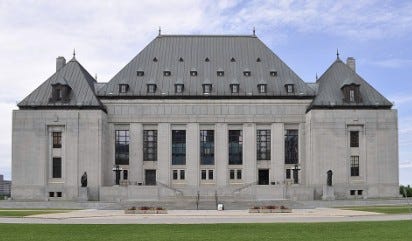
Image: Supreme Court of Canada (SCC) Building in Ottawa. Image source: Wikipedia
One of the more controversial land claims is the Wolastoqey Nation’s Aboriginal title claim that covers approximately half of New Brunswick. The Wolastoqey Nation is seeking legal recognition of unceded traditional lands and waters along the Wolastoq (SaintJohn River). The Nation argues they never surrendered these territories via their 18th-century Peace and Friendship Treaties. In December 2025 the New Brunswick Court of Appeal ruled that Aboriginal title cannot be declared over private, fee simple lands (including property owned by major forestry companies like J.D. Irving). This seems to run counter to the August 2025, B.C. Supreme Court landmark ruling that recognized that the Cowichan Nation holds “Aboriginal title” to approximately 800 acres of land in Richmond, B.C., including the site of their historic summer village.
The status of the law, with respect to whether or not Aboriginal title supercedes any claims held by private property owners, at this point seems to be at the very least unresolved. In more recent news the Supreme Court of Canada decided not to hear the Wolastoqey Nation’s appeal of the New Brunswick Court of Appeal’s decision. It has been reported that some have considered this an affirmation of the lower court’s ruling. However, all that has actually happened is the Supreme Court of Canada has declined to weigh in on the issue at least with respect to the specific claim being made in New Brunswick. In deciding to not hear the Wolastoqey appeal the Supreme Court of Canada did not uphold or endorse the New Brunswick Court of Appeal decision. It simply decided not to hear the appeal.
Due to these two opposing rulings, at a minimum we are left with some degree of ambiguity with respect to how Aboriginal title is to be interpreted. The New Brunswick Court’s ruling suggested there is “an important difference between a finding of Aboriginal title and a judicial declaration of Aboriginal title.” A declaration would award present-day ownership, while a finding would acknowledge that the Wolastoqey Nation never gave up ownership and deserve compensation. Former chief justice Ernest Drapeau said in last year’s New Brunswick ruling he was seeking “to open a clearer path to peaceful and respectful reconciliation between Aboriginal and non-Aboriginal Canadians in this province.”
In contrast, while the B.C. court recognized Aboriginal title, it found that this title and private (”fee simple”) ownership can coexist, and stated the decision does not invalidate individual private homeowners’ titles. That ruling has sparked major debates about the reliability of “fee simple” property titles in B.C. and how governments will negotiate to reconcile these overlapping property rights.
It is evident that there is general dissatisfaction amongst many parties as to the state of the law as it pertains to Aboriginal title and the potential impact rulings might have on “fee simple” ownership.
The issue arises from several important facts. In the case of indigenous land claims in both New Brunswick and B.C. it seems clear enough that, with limited exceptions, most of the land was never ceded to the Crown through any treaties. However, it is also clear that despite this historic reality title was presumed extinguished and the Crown proceeded to sell off land to private interests without consultation with the First Nations impacted by these decisions, or with any form of compensation to them.
The resulting problem is that given the passage of time the private interests have become an important issue. As seen by the responses in B.C., those private interests have a vested interest in ensuring their property claims take precedence over claims of Aboriginal title. It is a thorny problem because of these competing interests.
If you are interested, we have written two other articles regarding the Cowichan Nation case:
August 13, 2025 https://anokiigamig.substack.com/p/recent-land-claim-award-in-bc-lets?r=37xozd
September 24, 2025 https://anokiigamig.substack.com/p/response-to-bruce-pardys-august-26th?r=37xozd ]
Private ownership comes in the form of land titles, or documents of ownership, known as fee simple titles. They’re the most common form of land ownership in Canada and are supposed to be indefeasible which means basically guaranteed. In BC, the Cowichin ruling contains many references to this fact and ultimately only ruled that the Cowichin were entitled to Aboriginal title for half the land in dispute. The balance, held by private interests was not supposedly affected by the ruling and only the titles held by the federal government and the City of Richmond were directly impacted. This has not stopped critics of the decision from raising fears that fee simple rights are under attack.
Now, with the Supreme Court of Canada’s refusal to hear the Wolastoqey Nation’s appeal some observers are continuing to muddy the waters by asserting the refusal is tantamount to upholding the New Brunswick court’s decision. It is not.
However, what remains clear from these rulings is that land claims cannot be settled by the courts. In fact, these rulings all seem consistent in asserting that in order to further reconciliation and settle these matters the Federal Government, in the right of the Crown, has a duty to consult and negotiate with First Nations. Furthermore, in doing so the government must uphold the honour of the Crown; meaning it has to act in an objective way that recognizes everyone’s interests and in particular the interests of the impacted First Nations.
In the past we have cited the Kitselas Treaty which grants the Kitselas Nation fee simple title to approximately 36,000 hectares of Treaty Settlement Lands (known as Kitselas Lands) in northwestern B.C. Under this negotiated modern treaty structure, fee simple ownership functions as the highest form of recognized legal title, granting the Nation full management and law-making authority over the land base. The Treaty specifically deals with private fee simple land held by non-members that is surrounded by or adjacent to the Treaty Settlement Lands and clearly states they will not be affected. However, the Treaty provides that if any of these private property owners choose to sell, the Kitselas Nation may have a “right of first refusal” to purchase the land, integrating it into the Kitselas Lands.
So, through a negotiated settlement the parties were able to find a solution that met everyone’s needs. Other negotiated solutions are also possible including compensation to the First Nations. In the Cowichin case, the First Nation representatives have been clear that they do not intend on infringing on private property rights. They are however seeking through a negotiated settlement a full and final resolution to the matters that remain unresolved. It is unfortunate that rather than engaging in a negotiating process the government and the City of Richmond have chosen to appeal and therefore continue with litigation. It is equally unfortunate that the recent Supreme Court’s decision not to hear the New Brunswick case has emboldened the litigants rather than convincing the City and BC Government that a negotiated settlement is the better path.
The Wolastoqey Nation seeks recognition of land rights, though the Nation only intends to reclaim undeveloped Crown lands and specific industrial properties, not individual private homes or municipalities. As it sits right now the NB Supreme Court ruling stands which has ruled that the government has a duty to consult with the First Nation in order to resolve this matter. However, because the law remains unclear as to the relationship between Aboriginal title and fee simple rights the parties may find it difficult to find common ground for resolution.
In the end the courts will still be asked to weigh in on these matters as the Federal Government has not itself established a coherent and consistent policy with respect to how to move the process of reconciliation along. For what it’s worth, we suggest that the Federal Government continue with the development of modern treaties and require in an Modern Treaty a consistent approach to fee simple land rights to bring finality to disputes between the Crown and the First Nations.
We all share this land we call Canada and to create a foundation for peaceful coexistence we must reconcile the grievances with finality and move forward on a better more equal footing. This is a reality that cannot come too soon.
Thanks for reading Canadian Indigenous Facts, Stories and Learnings! This post is public so feel free to share it.
Comments
Nothing yet. Say the first thing.
Sign in to join the conversation.